
You want the features of the WhatsApp Business app on your personal phone. Greeting messages, catalog, quick replies — without lugging around a second device. Fair enough. But let's talk for a minute about what you're signing up for.
Short answer: Yes, using WhatsApp Business privately is possible. Long answer: It depends on what you mean by "private". Between "Meta allows it" and "legally clean", there are three stumbling blocks that most guides leave out.
Are You Even Allowed to Use WhatsApp Business Privately? The Honest Answer
First things first: WhatsApp is not just WhatsApp. There are three versions, each with its own rules. Mix them up and you end up either getting a warning letter (Abmahnung) or stepping into a GDPR trap.
| Version | Built for | Cost | Private use allowed | GDPR-clean without extra work |
|---|---|---|---|---|
| WhatsApp Messenger | Family, friends | free | yes, and only that | no (contact sync) |
| WhatsApp Business App | Solo, small business, freelancers | free | yes, grey area | no (see below) |
| WhatsApp Business Platform (API) | Scaling brands from ~100 conversations/day | per message | not intended for private | yes, via certified BSP |
The interesting column is the third one. Meta doesn't explicitly forbid private use of the Business app. If you set it up as a private person because you like having quick replies, or because your mum wants to browse your cake-delivery catalog — nobody is stopping you. For more background on the three variants, see our post on the WhatsApp business account.
The catch is the GDPR. As long as you use the app purely privately — no customers, no marketing, no business correspondence — Article 2 GDPR's so-called "household exemption" applies. Translation: As a data controller, the full weight of the GDPR doesn't land on you.
Completely clean it still isn't. The app uploads your address book to Meta by default — including contacts who never consented to that. For purely private use, this rarely ends up in court. But it's also not "no GDPR issue at all".
The moment you send your first customer an invoice, sell a consultation, or blast out a newsletter, the game changes. Now you're on the hook for imprint obligations, a data processing agreement (DPA) and opt-in rules — no matter how privately you label it.
My take: "Private use" of the Business app is, in 80 % of cases, a story we tell ourselves. Look at the feature list — catalog, automated replies, business profile with opening hours — and it's pretty clear you're using it commercially. Period. And when you do, commercial rules apply.
How to Set Up Two WhatsApp Accounts on One Device (Properly)
To clear up something that's stated incorrectly in many guides: The multi-account feature now lives in both the regular WhatsApp app and the WhatsApp Business app. It's been stable on Android since October 2023. On iOS, Meta has been rolling it out gradually since mid-2025 — if you don't see it yet, you're outside the rollout.
Here's how it works on Android (and on iOS, once unlocked):
- Open WhatsApp or WhatsApp Business → Settings
- Tap the small arrow next to your name
- Choose "Add account" → enter the second phone number → confirm via SMS or voice code
Requirement: You need a second, separate phone number. An eSIM, a second SIM, or a landline number all work. One phone number can only belong to one WhatsApp account at a time — regardless of which variant.
The older method still works too: Install both apps in parallel (WhatsApp + WhatsApp Business), each with its own number. Upside: clean visual separation into two app icons. Downside: two apps instead of one. The detailed walkthrough lives in our guide on running two WhatsApp accounts on one device.
What you should not do: "Dual Apps", "App Clone", or similar hacks that some Android manufacturers ship. They work part of the time but break after updates. Third-party clones like "GB WhatsApp" are a hard no — Meta bans them, and they're a security risk.
What the Business App Actually Gives You Privately
If you set it up properly, there are a few features the regular app doesn't have — and they make sense for freelancers, coaches, and solo entrepreneurs.
- Greeting message: First automated reply when someone messages you for the first time. Good for: "Hi, on holiday until 30 May, back to you after that."
- Away message: Time-controlled. You can switch it on and off or trigger it only outside business hours.
- Quick replies: Save shortcuts like
/prices,/terms,/booking. Type them and the full text block comes out. Saves minutes of typing every day. - Labels: Tag chats with "Lead", "Customer", "Paid", "Open". It's not a CRM, but better than nothing.
- Catalog: Up to 500 products or services with image, description, and price. For photographers, coaches, consultants — a clean way to do it.
- Statistics: You see aggregated delivery and read rates — no individual-level data.
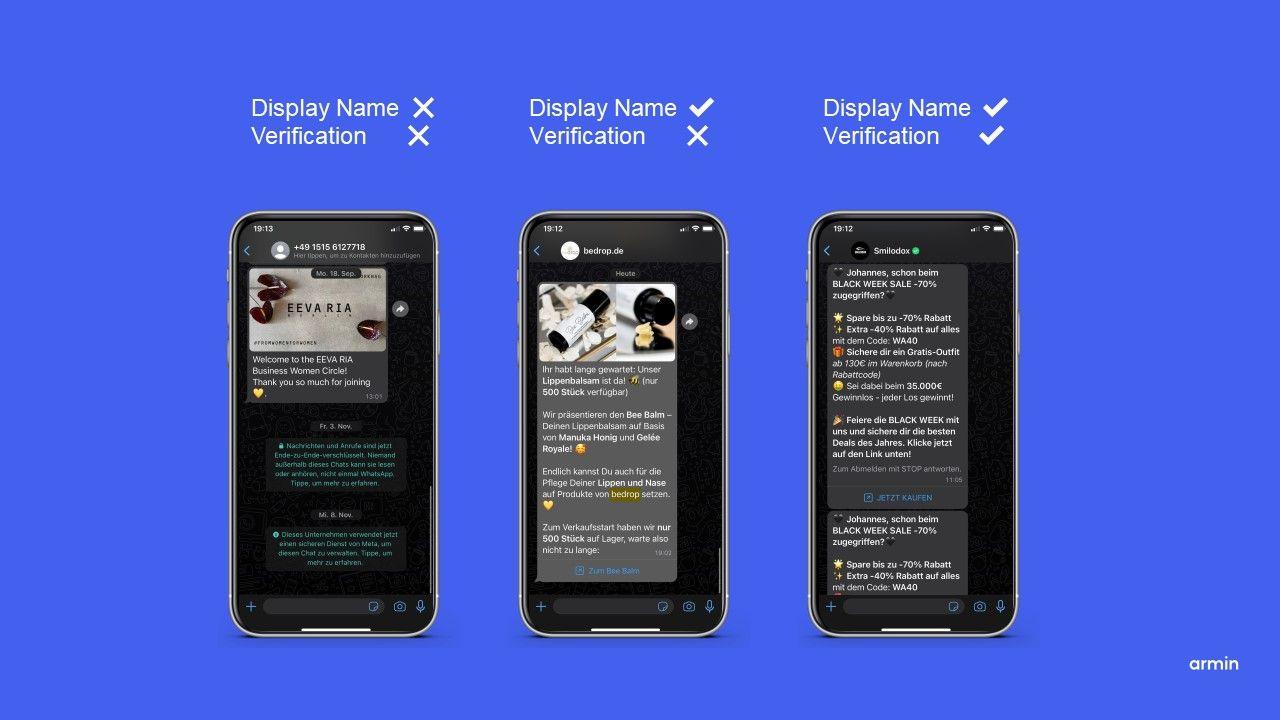
You can technically apply for the green verification badge. In practice almost nobody gets it via the app — it runs through the Business Platform ("Meta Verified for Business"). For solo users, the badge is wishful thinking.
A real-world example: You're a freelance photographer. You link your Business number on Instagram. An enquiry comes in. The greeting message replies automatically ("Thanks, I'll get back to you today"). You type /prices, the catalog link goes out. Three minutes later you've got a qualified lead in your chat. No second phone, no CRM setup.
The Three GDPR Traps Nobody Mentions
Here's where things get uncomfortable. Most articles on this topic claim the app is GDPR-compliant. That's not quite right. It can be — if you handle three things.
Trap 1: Contact sync with US servers
By default, WhatsApp reads your entire address book and syncs it with Meta's servers in the US. Same in the Business app. This happens without consent from the people in your address book — and that's the GDPR problem right there. Fix: Disable address book sync, or use a separate device with a minimal address book. For more on this, see our post on whether WhatsApp is GDPR-compliant.
Trap 2: Unencrypted cloud backups
Your chats are end-to-end encrypted — in transit. The moment you back them up to Google Drive or iCloud, they sit there unencrypted, unless you turn on the optional backup encryption in WhatsApp settings. For business communication, that's a problem. Fix: Enable backup encryption with your own password, or switch cloud backups off entirely.
Trap 3: Imprint obligation as soon as you go commercial
The moment you offer goods or services — even as a side-hustle Kleinunternehmer — you must include an imprint (Impressum) in your business profile, or link to one. In Germany, missing this is grounds for a warning letter (Abmahnung). One line like "Imprint: yourdomain.com/imprint" is enough. Forgetting it gets expensive.
My take: The Business app is the same GDPR compromise as Google Workspace or Slack. Usable with care. Risky without. Five enquiries per month from friends? Fine. Online shop with 200 customers in your address book? Time for a different solution.
Special Case: E-Commerce Brands
If you're reading this because you run a Shopify, Shopware, or JTL shop and you're thinking about WhatsApp — skip the app. You don't need quick replies and you don't need a catalog of 500 handmade items. What you need is:
- Shipping updates pulled automatically from your shop system
- Abandoned cart flows
- Newsletters to thousands of opt-ins
- Multiple team members answering simultaneously in one inbox
- A clean DPA with the BSP, not just with Meta directly
The Business app wasn't built for any of that. Go straight to the Business Platform. Anything else is wasted time — you're building a workflow you'll tear down in three months.
When It's Time to Leave the App Behind
The Business app is a decent entry point for solo entrepreneurs. But it has hard limits. You should move to the WhatsApp Business Platform (API) as soon as one of these is true:
- More than one person is replying. The app is limited to one main device plus four linked devices. The moment you have team members answering in parallel, you need a proper shared inbox.
- You want to send newsletters to more than 256 people. The app's broadcast feature is capped at 256 contacts per list — and only delivers to people who have your number saved. That's not a newsletter, that's a group order in your family chat.
- You want to plug in your shop. Shopify order confirmations, shipping updates, abandoned cart flows — all run via the API.
- You need legal documentation. Via the API you get a proper data processing agreement (DPA) with a Business Solution Provider — the legal basis you need as a company anyway. Our WhatsApp newsletter GDPR guide explains how this works in practice.
- You want AI to handle replies. Chatbots that resolve tickets or answer product questions only run on the API.
With Chatarmin, you sign the DPA, integrate Shopify, JTL, Klaviyo or your existing CRM, and run WhatsApp GDPR-compliant with EU hosting. Over 450 e-commerce brands across DACH do it that way.
FAQ: Using WhatsApp Business Privately
Is it allowed to use WhatsApp Business privately?
Yes. Meta does not prohibit private use of the Business app. As soon as you communicate commercially, however, imprint and DPA obligations apply.
What does the WhatsApp Business app cost?
Nothing. The app is free in the Google Play Store and Apple App Store. Costs only arise when you move to the Business Platform (API), where Meta has been billing per message since 1 July 2025 instead of per conversation.
Can I run WhatsApp and WhatsApp Business on one phone?
Yes. You need two different phone numbers. Either via two separate apps (WhatsApp + WhatsApp Business) or via the multi-account feature, which has been available since 2023 in both the regular app and the Business app.
Is the WhatsApp Business app GDPR-compliant?
No, not without extra work. You have to restrict contact sync, encrypt cloud backups, and add an imprint. For serious customer communication, the WhatsApp Business Platform is the legally safe choice.
Does the WhatsApp Business app have a message limit?
No, not for individual chats. Broadcasts, however, are capped at 256 recipients per list — and only reach people who have your number saved. The API has run on per-message pricing since July 2025, with free service replies within 24 hours of a customer enquiry.
Do I need an imprint if I use WhatsApp Business privately?
Depends. For purely private use (family, friends) no. The moment you offer services or products via WhatsApp Business — even as a side-hustle — yes. In Germany, warning letters (Abmahnungen) are real, not a theoretical risk.
Does WhatsApp Business work with a landline number?
Yes. You can complete verification via a voice call instead of SMS. It's the clean way for freelancers who don't want their private mobile number sitting on a business profile.
Conclusion: Works — but Not for Everyone, and Not Forever
Using WhatsApp Business privately is legal, technically straightforward, and a decent entry point for freelancers and solo entrepreneurs. You get features the regular app doesn't have — greeting messages, quick replies, catalog — and since 2023 you can run a second account on the same phone without carrying a second device around.
The trap sits in the word "private". The moment you message customers, sell services, or send marketing messages, the same GDPR rules apply as for any other business. Imprint, DPA, opt-in. And the moment you scale — multiple team members, newsletters above 256 recipients, integration with your shop or CRM — the app hits hard limits.
If you're an e-commerce brand looking to run WhatsApp as a real marketing and service channel, we'll handle setup, DPA, and integration. Book a demo and we'll show you in 15 minutes what it looks like for your shop.