
WhatsApp has an 85% open rate. Email sits at 20%. Put differently: eight out of ten emails to your customers never get opened — while a WhatsApp message lands directly on the lock screen and actually gets read. In the DACH region alone, around 75 million people use WhatsApp daily. Practically every one of your customers has it on their phone.
The question isn't whether your business needs WhatsApp. The question is which of the three available variants you should pick. You can go with the WhatsApp Business App, Meta Verified (formerly known as WhatsApp Business Premium), or the WhatsApp Business Platform. From the outside they look similar. Feature scope, GDPR status, and cost structure are wildly different. And from our sales calls every single day: most brands pick the wrong one on their first try.
The three variants at a glance
So you don't have to read 2,000 words to make a decision, here's the 2026 state in one table:
| Feature | WhatsApp Business App | Meta Verified | WhatsApp Business Platform |
|---|---|---|---|
| Monthly cost | Free | ~$15–$350 (~€13–€300) | BSP fee + Meta charges per message |
| Billing model | – | Fixed subscription | Per template + 24h service window |
| GDPR-compliant | ❌ | ❌ | ✅ (with EU hosting) |
| Verification badge | ❌ | ✅ | ✅ |
| Marketing automation & newsletters | ❌ | ❌ | ✅ |
| Multi-agent & ticketing | ❌ | Limited | ✅ |
| Connected devices | 5 (1 phone + 4 desktop) | 11 (1 phone + 10 desktop) | Unlimited |
| Integrations (Shopify, Klaviyo, Shopware) | ❌ | ❌ | ✅ |
| Voice & video calls | In-app | In-app | Calling API (2026, BSP-dependent) |
| Best for | Solo & teams up to 5 | Teams of 3–10 | Scaled marketing & service |
The biggest shift compared to 2024: The old "1,000 free conversations per month" model is gone. Since July 2025, Meta bills per delivered template — split into four categories: Marketing, Utility, Authentication, and Service. The full pricing breakdown lives in our WhatsApp Business Costs guide.
Which variant fits you?
Three questions get you there:
- Are you solo or a team of fewer than five people? → WhatsApp Business App.
- Do you need verified branding and multi-device access, but no automation? → Meta Verified.
- Are you sending newsletters, running automations, integrating with shop systems, or chasing GDPR compliance? → WhatsApp Business Platform.
Sounds simple. It is. And yet, every single month, dozens of e-commerce brands try to scale their WhatsApp marketing through the Business App — and crash into device limits, GDPR gaps, and zero automation capability.
My take: If you want to send a newsletter to more than a few hundred people, you need the Business Platform. End of story.
WhatsApp Business App: The entry point for small operations
The WhatsApp Business App is free and runs on Android and iOS. It works just like personal WhatsApp — with a handful of business features on top: business profile, product catalog, quick replies, automated greeting and away messages.
Setup takes ten minutes:
- Download the app and open it
- Add your phone number and confirm it with the 6-digit SMS code
- Enable two-factor authentication
- Set your business name, category, and profile picture
- Fill out the profile: hours, address, website, email, social links
What it's good for: hairdressers, law offices, local farm shops, yoga studios, small manufacturers. Anything where you mostly run 1:1 chats and don't blast campaigns to thousands of contacts.
What it's not good for: scaled WhatsApp marketing, multi-agent support, newsletters to bigger lists. The app stores chats locally on the device and is not GDPR-compliant for any kind of scaled business messaging.
Here's what's new in 2026: You don't have to give up the Business App when you later move to the Business Platform. Thanks to Coexistence Mode (rolled out across the EU, UK, and Australia in Q1 2026 — globally available since April 2026, including Nigeria and South Africa), both can run on the same number in parallel. Chats stick around, contacts come along. In 2024 this migration was a real barrier that kept many brands stuck. In 2026, it's not.
Meta Verified: Is the subscription worth it?
WhatsApp Business Premium has been called Meta Verified for Business since 2024. The subscription expands the Business App across four tiers — Standard, Plus, Premium, and Max. Pricing per Meta runs from roughly $15 to $350 per month (around €13 to €300), depending on the tier and the market. Meta is rolling the tiers out gradually — availability in Germany and Austria is still patchy as of mid-2026.
What you get:
- Verification badge (blue since 2024, replacing the old green checkmark and aligned with Instagram and Facebook)
- Up to 10 connected desktop devices (instead of 4 in the App)
- Ability to assign chats to team members
- Custom wa.me URL with your business name instead of just a phone number
- Priority Meta support
What you don't get: automations, flows, newsletter templates, integrations with Shopify, Klaviyo, or Shopware, multi-agent routing, analytics, AI chatbots.
My take: Meta Verified makes sense for teams of 3 to 10 people using WhatsApp mainly for 1:1 customer conversations. No marketing broadcasts, no support routing, no reporting. The moment you start thinking about any of those three, you need the Business Platform. Detailed breakdown of the Premium variant in our post Is WhatsApp Business Premium Worth It?.
WhatsApp Business Platform: The only variant that scales for e-commerce
The WhatsApp Business Platform — formerly known as the "WhatsApp Business API" — has been Meta's official solution for serious businesses since early 2022. GDPR-compliant, no device or user caps, and it slots into your MarTech and customer service stack.
Five things you need to know in 2026:
1. Cloud API only. Meta deprecated the on-premise variant in October 2025. The Meta Cloud API is the only active option now. Any tool still selling you on-premise setup is selling you a dead horse.
2. You need a BSP. The Business Platform isn't ready-made software — it's an API. You access it through a Business Solution Provider like Chatarmin — or you build your own. Building your own runs into the six figures in setup costs. A BSP starts around €100–200 per month plus variable Meta fees.
3. Per-template billing. Since July 2025, Meta bills per delivered message instead of per 24-hour conversation. In Germany a marketing message costs 11 cents; in Austria and Switzerland around 5 cents (Q1 2026 rates). Service messages within the 24-hour customer response window remain free. Pricing details in the WhatsApp Business API guide.
Sample calculation for Germany: Send 10,000 marketing templates to German customers = €1,100 in Meta fees. Typical conversion of 2 to 3% on an average order value of €60 = €1,200 to €1,800 in revenue. Positive ROI from the first campaign — assuming your opt-in list is clean.
4. Calling API is live (with caveats). The WhatsApp Business Calling API — voice calls directly through WhatsApp — is officially available across most EU markets in 2026, including Germany, Austria, and Switzerland. But: not every BSP has the feature integrated yet, especially in the SMB segment the rollout is still in progress. Ask your provider before you plan around it. Business-initiated calls are also still blocked in a handful of markets (US, Canada, Turkey, Egypt, Vietnam, Nigeria). If AI-powered telephony is on your radar, take a look at our AI Voice Assistant.
5. Coexistence Mode. Since Q1 2026, the Business Platform runs in parallel to the Business App on the same number. No lost chats, no lost contacts, no lost history. Migration doesn't hurt anymore.
What the Business Platform actually unlocks: automated abandoned cart flows (3 to 10x higher conversion than email abandoned cart), bidirectional Klaviyo sync, multi-agent inboxes with ticketing, AI product advisors in chat, native integrations with Shopify and Shopware.
Typical setup from our customer base: a D2C brand on Shopify, with Klaviyo as the email CRM, and Chatarmin as the WhatsApp layer on top. Marketing campaigns and service replies run through the same number. Over 450 brands in the DACH region operate this exact stack — from waterdrop® to Smilodox.
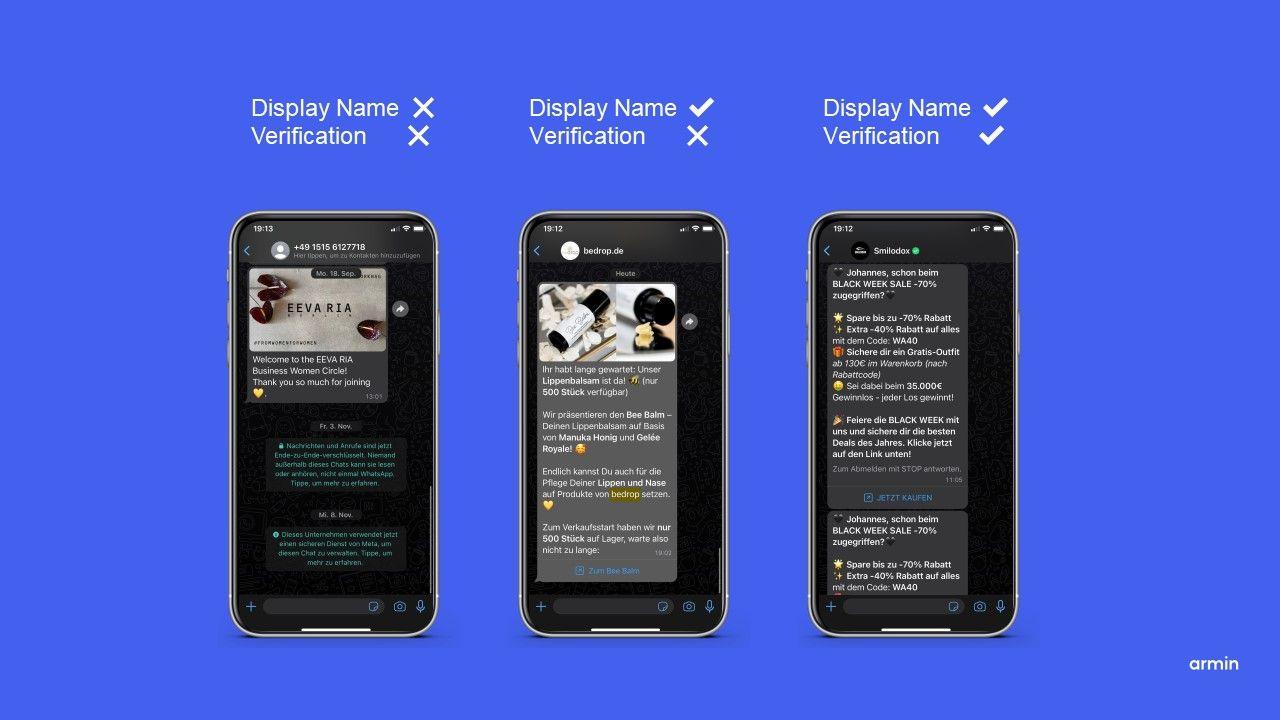
How do customers recognize a WhatsApp Business Account?
Customers see directly in the chat whether they're messaging a business or a private number. WhatsApp surfaces two indicators:
- For businesses connected through a BSP, the chat header shows: "This business works with other companies to manage this chat."
- For verified accounts, a blue checkmark appears next to the name. Green until 2024, blue since Meta unified the verification badge across Instagram and Facebook.
The verified checkmark isn't automatic. You request it through your BSP or directly in the Meta Business Manager. For established brands it usually comes through in a few days — for younger brands it can take weeks or a rejection round before approval. Step-by-step instructions in our WhatsApp Green Tick guide.
When you don't need the WhatsApp Business Platform
I'm the CEO of a tool that sells the WhatsApp Business Platform. Honest take anyway: for at least half of all "I'm thinking about using WhatsApp for business" cases, the free Business App is the right choice.
It's enough when:
- You're a solopreneur or your team is under five people
- Your contact list sits in the low thousands at most
- You're not running marketing campaigns, just real 1:1 chats
- GDPR compliance isn't a hard cut for you (local service business, no data collection, no tracking, no exports)
The moment newsletters, automations, shop integration, CRM integration, or serious GDPR setup enter the picture — you need the Business Platform. And then you need a good tool. Which one, that's covered in our WhatsApp Marketing Software comparison.
FAQ on WhatsApp Business Accounts
What does a WhatsApp Business Account cost?
Depends on the variant. The WhatsApp Business App is free. Meta Verified runs as a subscription between $15 and $350 per month. The Business Platform has software costs (BSP plans start around €100–200 per month) plus variable Meta fees per sent message.
Do I need a new phone number for a WhatsApp Business Account?
Depends. For the Business App, your existing number works — provided it's not registered to another WhatsApp account. For the Business Platform we recommend a separate number — or you use the Coexistence Mode (since 2026) with your existing Business App number.
Is the WhatsApp Business App GDPR-compliant?
No. The Business App stores chats locally and passes metadata to Meta. For scaled, commercial messaging it's not GDPR-compliant. The Business Platform with EU hosting (e.g. Chatarmin with servers in Frankfurt) is.
Can I use the WhatsApp Business App and Business Platform on the same number?
Yes, since Q1 2026. Coexistence Mode allows both variants on the same number in parallel. Chats and contacts stay intact. Available in EU, UK, Australia — globally including Nigeria and South Africa since April 2026.
Which WhatsApp Business variant works best for Shopify shops?
The Business Platform. It's the only variant with a native Shopify integration covering abandoned cart recovery, order tracking, and revenue attribution per campaign. Business App and Meta Verified have no shop system integration.
What's the difference between WhatsApp Business and WhatsApp Business Platform?
WhatsApp Business is the umbrella term covering three variants: the Business App (free, for small operations), Meta Verified (subscription for SMBs), and the Business Platform (Cloud API for scaled, GDPR-compliant communication).
How many devices can I link to a WhatsApp Business Account?
Business App: up to 5 devices (1 smartphone + 4 desktop). Meta Verified: up to 11 devices (1 smartphone + 10 desktop). Business Platform: unlimited — access goes through tool logins, not individual devices.
Conclusion: Your WhatsApp Business Account in 3 questions
Three questions, three clear answers:
- Solo or team of up to 5 people? → WhatsApp Business App. Free. 10-minute setup.
- Team that needs verified branding and multi-device access? → Meta Verified. Subscription. 1-hour setup.
- Scaled marketing, service, or sales? → WhatsApp Business Platform. Pick a BSP. 1-day setup.
If you fall into the third category and you're looking for a provider that's GDPR-compliant, deeply integrated with Shopify, Klaviyo, and Shopware, and comes with a German-speaking Customer Success Manager — then Chatarmin is the natural first call. Over 450 e-commerce brands in DACH run with us for exactly that.
15-minute demo. No bullshit, no pitch deck — we'll show you what a WhatsApp Business Account looks like inside your actual stack.