
40% of all AI agent projects will be cancelled by the end of 2027. Not my number — that's Gartner. At the same time, Gartner estimates only about 130 out of thousands of vendors are truly agentic. The rest is "agent washing": old chatbots with a shiny new sticker. For you as an e-commerce brand, this means the next wave in marketing is coming. But it will burn just as many budgets as it generates revenue. This article shows you what AI agents in marketing actually deliver — and where you're better off not spending your money in 2026.
What Is AI Agent Marketing?
AI agent marketing refers to the use of autonomous AI systems that independently plan, execute, and optimize marketing tasks. Unlike rule-based marketing automation, AI agents pursue defined goals, analyze context in real time, and make independent decisions — without a human directing every step.
In practice: Your old workflow "cart abandonment → email after 2 hours" is automation. An AI agent checks what products are in the cart, what segment the user belongs to, which channel they last responded on — and decides whether a WhatsApp message, a discount, or no reaction at all is the best option. Next time, it decides better because it learns from the outcome.
If you want to dive deeper into the technical architecture behind AI agents — the perception-reasoning-action loop, tool use, and memory — read our explainer: How Do AI Agents Work?.
Marketing Automation vs. AI Agents — the Difference That Determines Your Budget
These two technologies are constantly lumped together. They are not the same thing.
| Dimension | Marketing Automation | AI Agents |
|---|---|---|
| Logic | If-then rules (static) | Goal-oriented + context-aware |
| Control | You build every step | You define the goal |
| Data | Pre-defined triggers | Real-time context + memory |
| Learning | No learning — you optimize | Learns from outcomes |
| Risk | Boring, but stable | Powerful, but needs oversight |
One more distinction that's often missed: A chatbot reacts to a prompt. An AI agent plans multiple steps ahead and executes them — even while you're grabbing coffee. The chatbot answers "Where's my order?" The agent queries the API, checks tracking status, writes the response, sends it, and flags the case for the team if something looks off. More on the distinction between autonomous AI agents and traditional systems in our deep dive.
Why AI Agents in Marketing Are No Longer Optional in 2026
The AI agent market is growing from $7.76 billion (2025) to nearly $317 billion by 2035 — a compound annual growth rate of 45%. Gartner predicts that by 2028, roughly 33% of all enterprise software applications will include agentic AI. In 2024, it was less than 1%.
Even more relevant for your marketing: McKinsey estimates that agentic AI will power over 60% of all AI-generated value in marketing and sales. Some Fortune 250 brands already report 15x faster campaign execution according to McKinsey.
Sounds like a gold rush. Feels more like the wild west. Because at the same time, Gartner says: Over 40% of projects will be cancelled by the end of 2027 — due to escalating costs, unclear use cases, and inadequate risk controls. On top of that, only about 130 vendors are truly agentic according to Gartner. The rest is agent washing.
What this means for you: If you start now, you get a 12–24 month head start. If you buy the wrong thing, you pay a year's worth of tuition fees.
4 Use Cases That Actually Work in E-Commerce Marketing
Not every process needs an agent. But these four areas are clearly agent territory in 2026. And major brands are already using them in production:
| Brand | Use Case | What the Agent Does |
|---|---|---|
| Netflix | Hyper-personalization | Thumbnails adapt dynamically to each user's psychological preferences |
| Duolingo | Content engine | AI agents analyze TikTok trends and feed viral content ideas into the creative team |
| Coca-Cola | User-generated content | "Create Real Magic" campaign: fans create their own artwork from official brand assets via AI |
1. Hyper-Personalization — Segments of One
Classic segmentation: five segments, five newsletters, decent open rates. Hyper-personalization: every customer gets content based on live behavior, purchase history, and intent signals. Sephora shows what's possible: According to DigitalDefynd, their AI recommendation system led to 25% higher average order value and 17% more repeat customers. Users who engaged with personalized recommendations were 3.2x more likely to purchase.
2. Lead Scoring & Sales Handoff
Old world: Lead clicks three emails, gets score 80, goes to sales. New world: An agent reads signals from website, CRM, and social — and evaluates intent rather than activity. Then it triggers outreach autonomously: via WhatsApp, email, or a direct handoff into CRM.
3. Dynamic Ad Optimization
An agent monitors your campaigns 24/7 and shifts budget between channels and creatives on its own. Not "check ROAS every Monday." Instead: re-decide every 15 minutes where the next dollar goes. No media buyer can match that speed. What humans do better: set the strategy and the guardrails.
4. Autonomous Content Engines
Agent analyzes search trends → creates SEO briefing → writes draft → publishes in CMS → measures traffic. The human steps in for approval. Already works for product descriptions, glossaries, and long-tail SEO — and for trend analysis, as Duolingo demonstrates.
WhatsApp + AI Agents: The Concrete Case for D2C Brands
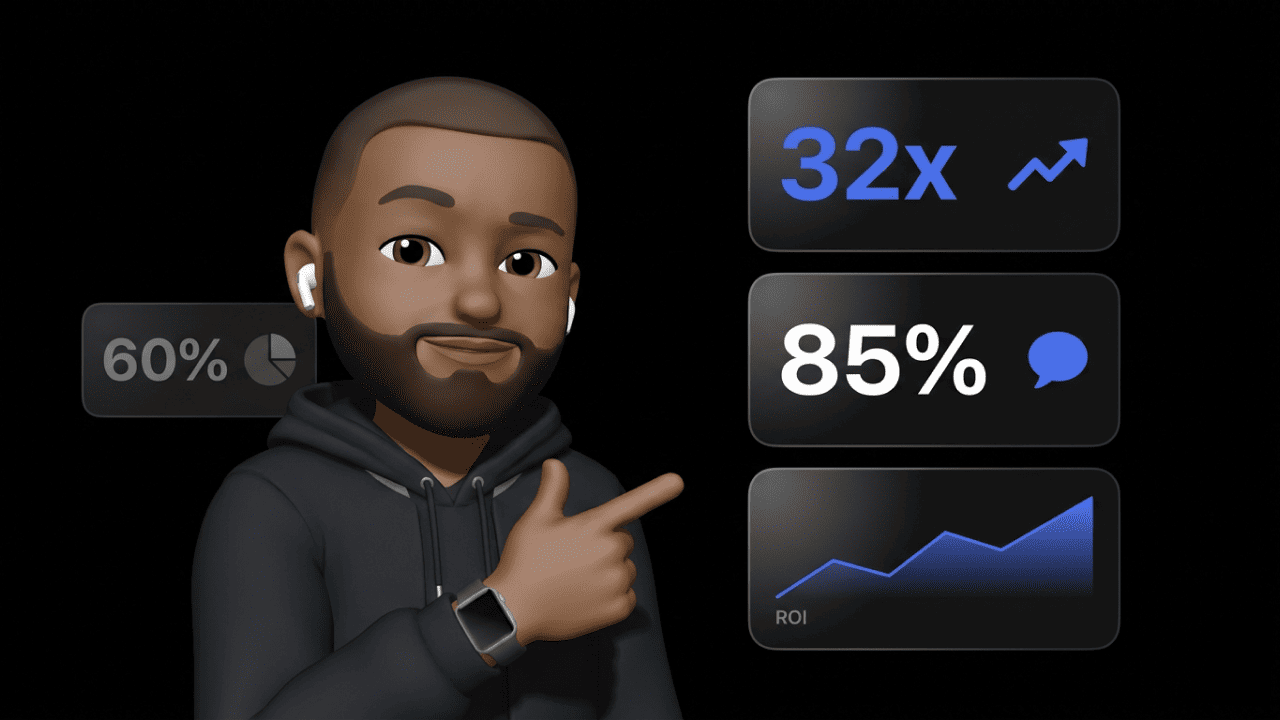
Let's get specific. WhatsApp newsletters achieve 85% open rates. Email sits at 20%. That's not subtle. And this is exactly where AI agents become the decisive lever.
How big the gap between batch-and-blast and targeted messaging can be is demonstrated by an Omnisend case study: Replacing classic batch campaigns with personalized, automated workflows led to 32x higher conversions. 32 times. Not 32 percent.
A standard WhatsApp flow asks: "Cart abandonment? → Message after 2 hours." An agent-powered flow asks: Which customer. What's in the cart. What timing works. What tone resonates. What incentive triggers. Then it sends the message — and learns from the response.
Concrete applications in WhatsApp marketing:
- Segment-of-one campaigns — individual messages for 50,000 contacts instead of five segments
- Autonomous product advice — customer asks "Which perfume suits me?" → agent pulls purchase history, preferences, stock levels → recommends specifically
- Post-purchase with context — review prompt after actual delivery, not after a set number of calendar days
- Winback with intent trigger — the agent detects declining engagement and acts before churn happens
The honest sweet spot: Shops with roughly 2,000+ orders per month. Below that, the data foundation isn't strong enough for agents to outperform a well-built rule. If you're at 300 orders per month, get your basic setup running first.
Multi-Agent Systems: When Agents Work as a Team
The next step isn't one agent. It's multiple specialized agents working in coordination. At the top sits an orchestrator agent — essentially a project manager that understands the goal ("launch campaign for new product"), breaks it into subtasks, and delegates to sub-agents:
- Research agent — analyzes target audience and competitive landscape
- SEO agent — identifies keywords and content gaps
- Copywriter agent — drafts landing page, emails, and ads
- Analytics agent — measures performance and suggests optimizations
The sub-agents work in parallel. Industry reports indicate this reduces processing time for complex workflows by 30 to 70%. A campaign setup that takes three days today runs in hours.
Honest assessment: Multi-agent systems are early-adopter territory in 2026. D2C shop with ten people? Not your topic yet. Scale-up with 50+? It will be soon.
Guardian Agents — the Control Layer Nobody Installs (Until It's Too Late)
The more autonomy you give AI agents, the bigger the damage when one hallucinates. Guardian agents are specialized monitoring AIs that oversee other agents:
- Budget control — stop other agents when ad spend or API costs spiral out of control
- Content quality — check outputs for hallucinations, brand violations, and factual errors before anything goes live
- Compliance check — verify decisions against GDPR, the EU AI Act, and internal policies
Concrete example: Your content agent writes a WhatsApp newsletter. Before it gets sent, a guardian agent checks: Does the tone match brand guidelines? Are the product claims accurate? Is the discount code valid? Only then does it send.
Without a guardian structure, a single agent can burn €5,000 in ad spend overnight or send a false claim to 50,000 customers. Guardian agents aren't a nice-to-have. They're the prerequisite for running agents in production at all.
Why AI Agent Projects in Marketing Actually Fail
Back to Gartner's 40%. Three patterns keep showing up:
- Wrong starting point — companies launch complex end-to-end scenarios before a simple use case runs cleanly
- No guardian structure — agents get access to budget, tools, and customer data without a control layer
- Missing human-in-the-loop — especially for tone and customer communication, you need human approvals. Otherwise, garbage lands on your best customers' lock screens
On top of that: the EU AI Act. Marketing AI usually falls into the "low-risk" category — but transparency, documentation, and data minimization are mandatory.
What works instead: Start small. One use case, tightly scoped, with clear KPIs. One agent for cart abandonment on WhatsApp. One agent for the first 80% of standard support questions. Once that's running, you expand. Only then.
Conclusion: Not Everything Labeled "AI" Is an Agent
AI agents in marketing are not hype. The technology works, the use cases are real, the data from McKinsey to Gartner backs it up. But in 2026, the market is flooded with agent-washing vendors selling you old automation as agents.
If you want to get started as a D2C or e-commerce brand: pick one concrete, measurable use case. Start small. And choose a vendor that can show you what the agent actually does — not just what the pitch deck promises.
At Chatarmin, we build AI agents for WhatsApp marketing and customer service — for brands like waterdrop and hundreds of other D2C shops. If you want to find out where AI agents can drive real revenue in your shop, book a demo with our team. We'll show you the use case that delivers the fastest impact — or tell you honestly if it's too early.
FAQ: Frequently Asked Questions About AI Agent Marketing
What is AI agent marketing?
AI agent marketing is the use of autonomous artificial intelligence that independently plans, executes, and optimizes marketing tasks. Instead of just reacting to predefined rules, AI agents autonomously pursue goals and adapt their strategies in real time.
What is the difference between marketing automation and AI agents?
Traditional marketing automation relies on rigid if-then rules and human inputs. AI agents, by contrast, work goal-oriented, understand contexts, and make independent decisions to solve complex workflows autonomously.
Can AI agents replace chatbots?
Yes and no. Chatbots primarily react to direct user inputs. AI agents go further: they act proactively, plan multi-step tasks in the background, and can control systems to resolve customer issues holistically.
What are multi-agent systems in marketing?
In a multi-agent system, multiple specialized AI agents work together. An orchestrator agent plans the strategy and distributes tasks to expert agents (e.g., for SEO or analytics) to handle complex marketing workflows in parallel and efficiently.
What are guardian agents?
Guardian agents are specialized monitoring AIs. They serve as a control layer for other AI agents, ensuring that budgets are maintained, no erroneous content is published, and brand guidelines are consistently upheld.
What tasks do AI agents handle in marketing?
AI agents handle tasks like real-time hyper-personalization, dynamic budget allocation for ads, autonomous lead scoring, and independent content creation and optimization.
Are AI agents in marketing GDPR-compliant?
Yes, provided they are set up according to data minimization and privacy-by-design principles. Under GDPR and the EU AI Act, AI agents require transparency and thorough documentation of their decision-making processes.
What is the ROI of AI agents in marketing?
The ROI can be significant. By automating complex analyses and personalized outreach, conversion rates can be substantially increased and operational costs reduced. McKinsey estimates that agents will account for over 60% of future AI value creation in marketing.
Which companies benefit from AI agent marketing?
AI agents are particularly valuable for e-commerce brands, D2C companies, and B2B organizations with high data volumes. Once standard automations no longer scale, AI agents provide the decisive lever for further growth.
Why do many AI agent projects fail?
Many projects fail due to missing use cases, poor data quality, or insufficient human oversight (human-in-the-loop). Often, conventional automation is also falsely marketed as an AI agent (agent washing).