
Everyone's talking about AI agents in 2026. Half the vendors mean chatbots with lipstick. The other half sell predefined scripts as "autonomous agents". Decision-makers book demos, understand nothing for twenty minutes, and cancel the pilot contract three months later. The problem is the term itself. It's watered down. This article clarifies what AI agents technically are, how they differ from chatbots and assistants, where they deliver real value in e-commerce in 2026, and where they still fall short today.
Definition: What Are AI Agents?
AI agents are autonomous software systems that use a Large Language Model as their control center to achieve a given goal independently. They take in information from their environment, plan intermediate steps, select the right tools, and execute actions. The human sets the goal; the agent plans and acts.
AI Agents, Bots, and Assistants: The Critical Difference
These three terms get confused constantly. But they're cleanly distinguishable. Anyone who understands the difference makes better buying and building decisions.
| Property | Chatbot | AI Assistant | AI Agent |
|---|---|---|---|
| Control | If-then rules or NLP models | LLM on user request | LLM with goal assignment |
| Decision authority | None | Human decides, assistant suggests | Agent decides within defined scope |
| Actions | Display text, show forms | Generate text, code, content | Independently use tools and APIs |
| Typical use | FAQ, routing, lead forms | ChatGPT, GitHub Copilot | Support automation, research, order management |
A chatbot says: "I've forwarded your question to a ticket." An AI assistant says: "Here's a draft of your response, you can send it." An AI agent says: "I've created the return in Shopify, generated the label, emailed the customer, and closed the ticket."
For a deeper look at the autonomy levels of fully independent agents, check our article on Autonomous AI Agents.
How Do AI Agents Work?
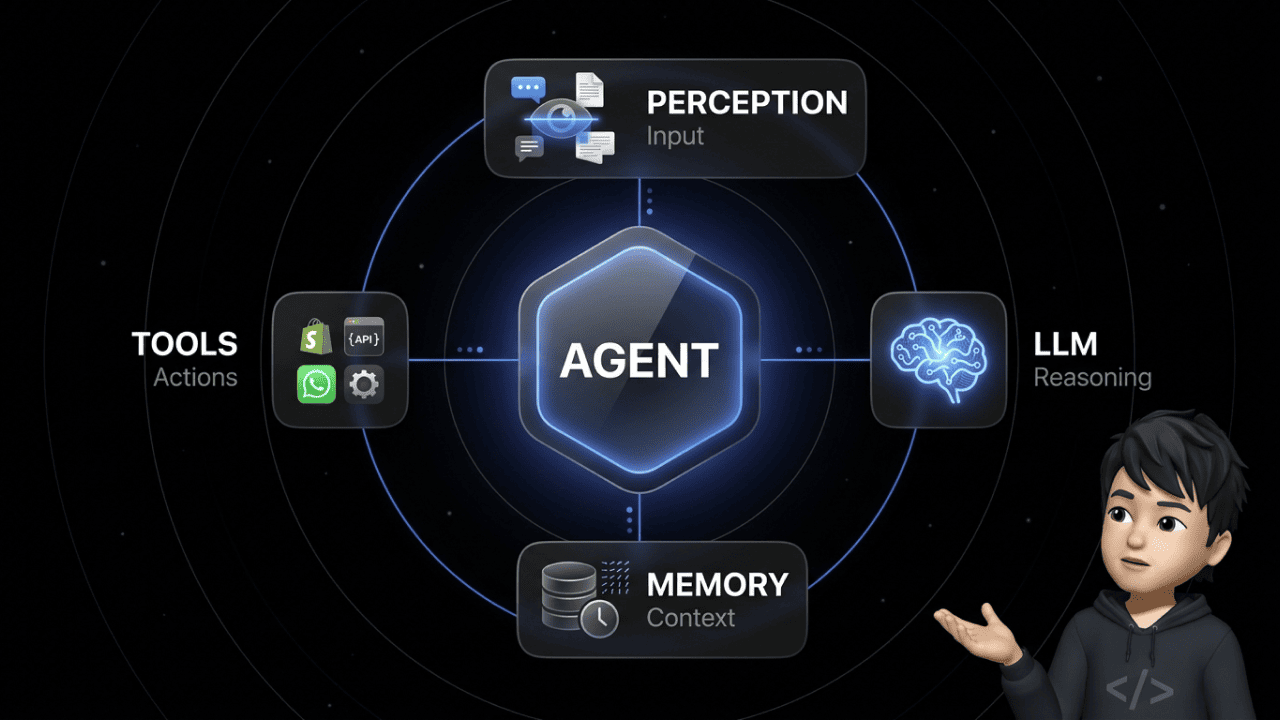
Every AI agent follows the same basic cycle: Perception, Reasoning, Action. Perceive, think, act. The agent takes in input, plans the next steps, and executes them. For the technical deep dive, check our article on how AI agents work. Here's the short version of the four components every productive agent needs.
- Perception: The agent reads emails, chat messages, database records, or API responses. Anything that describes its environment.
- Control center (LLM): The Large Language Model processes input, breaks the goal into subtasks, and decides which tool makes sense next.
- Memory: Short-term memory for the current task. Long-term memory often via vector databases or RAG architectures, so the agent can draw on past interactions and knowledge.
- Tools: The agent's hands. Through APIs, it queries data, cancels orders, generates labels, sends emails.
The tool layer is what matters most. An agent without real tools is a chatbot with better grammar. Only when the model can trigger actions in production systems does it become an agent.
AI Agents vs. Agentic AI
The terms get used synonymously. But they describe different levels. An AI agent is the concrete system that autonomously solves a task. Agentic AI describes the larger paradigm: architectures, governance, planning layers, multi-agent coordination. People who talk about Agentic AI think in systems. People who talk about AI agents build and operate. The detailed comparison lives in our Agentic AI vs. AI Agents article.
3 Use Cases That Actually Work in E-Commerce in 2026
Of all the use cases making the rounds, these three deliver measurable results in e-commerce right now.
1. Customer Service Automation
The biggest volume problem for every e-commerce team: 30 to 80 percent of all incoming tickets are "Where's my package?", return questions, and invoice requests. An AI agent reads the ticket, finds the order in your shop system, checks the status in the shipping provider's backend, and replies with concrete tracking data. No human touch required. Realistic automation rate after three to six months of tuning: 70 to 80 percent. With Chatarmin's AI customer service product armincx, these flows run directly across Shopify, WooCommerce, BigCommerce, and JTL.
2. Returns and Order Management
This is where the text-agent becomes a doer. A customer wants to cancel an order because they picked the wrong size. The agent checks: has the order shipped? If not, it cancels directly in the shop system, refunds the payment, sends the confirmation email. If yes, it generates a return label, attaches it to the email, logs every step in the ticket, and closes the case. That's the difference: real agents execute the process and close it out in the shop system. This is exactly where many 2026 solutions still break down, because the API connection to the ERP is missing.
3. Sales and Lead Qualification
Inbound leads from landing pages, ads, or LinkedIn have short attention spans. Whoever answers within minutes wins. An AI agent chats with the lead directly on the website, asks qualification questions against ICP criteria (company size, use case, timeline), writes the result to the CRM, and books a meeting with the Account Executive for qualified leads. Practical upside for B2B SaaS: response time from hours to seconds, better meeting quality, less manual follow-up for SDRs. Tools like Clay and the major outreach platforms move in this direction. In-house solutions can be built with the OpenAI Agents SDK or LangGraph.
Limits and Risks: Where AI Agents Still Fall Short in 2026
The honest picture: AI agents deliver solid results in clearly scoped scenarios and fail on open-ended goals. Gartner predicts that by the end of 2027, roughly 40 percent of all agentic AI projects will be canceled. Three main reasons show up in practice.
- Consistency problem on long task chains: In current benchmarks, agents often hit solid success rates on the first attempt. Across multiple runs, consistency drops off noticeably. What this means for you: repeated identical execution of the same complex task still isn't a done deal in 2026.
- Ambiguous goals without clear success metrics: Give an agent "make our returns better" and you get creative interpretations. Give it "for return reason 'wrong size': create label, offer exchange, close ticket" and it delivers reliably.
- Security risks: Prompt injection, data leaks, uncontrolled feedback loops. Autonomous systems with write permissions in production systems need least-privilege access, audit trails, and human-in-the-loop controls. The more critical the process, the more control belongs in the architecture.
Frequently Asked Questions About AI Agents
What's the difference between an AI agent and a chatbot?
A chatbot follows rigid if-then rules and responds within defined dialog paths. An AI agent uses a Large Language Model as its control center, plans intermediate steps independently, and executes actions through tools and APIs. Chatbot means: output text. Agent means: trigger actions in the target system.
Are AI agents and ChatGPT the same thing?
No. ChatGPT is an AI assistant that generates text, code, or analysis on request. The human steers the conversation. An AI agent uses a Large Language Model (often GPT, Claude, or Gemini) as its control center, plans steps independently, and executes actions across tools. ChatGPT can be part of an agent system. The two aren't interchangeable.
What tasks do AI agents handle in e-commerce?
The three most common deployments: first-line customer service with real shop system integration, returns and order management with automatic label creation and cancellation, and sales lead qualification. The prerequisite in all three cases: clear process definition and solid API connections to your backend systems.
Can AI agents make decisions without human involvement?
Yes, within a clearly defined scope. For well-scoped tasks like cancellations or standard returns, the agent operates autonomously. For critical actions (high-value refunds, sensitive customer data, legally tricky cases), human-in-the-loop is the right call. The agent prepares the decision, a human approves it.
Do AI agents replace customer service employees?
No. In practice, they take over 70 to 80 percent of repetitive ticket volume ("Where's my package?", standard returns, invoice requests). Humans focus on complex cases, escalations, and relationship work with VIP customers. The result is usually growth without proportional headcount, not layoffs.
Do AI agents hallucinate?
Yes. In 2026, hallucinations are still a real risk. Well-built agents reduce them through RAG architectures, structured tool outputs, and clear constraints. Eliminating them completely isn't possible today. In sensitive industries like medical, finance, or legal, human-in-the-loop is mandatory.
Do AI agents need access to my shop system?
Yes, as soon as they should trigger real actions. An agent without API connections to Shopify, WooCommerce, BigCommerce, or JTL can generate text, nothing more. For order cancellations, return labels, address changes, or refunds, it needs write permissions in your shop and ERP systems. Integration depth is the difference between real value and AI-washing.
What are the biggest risks with AI agents?
Prompt injection attacks, data leaks from sensitive systems, inconsistent results on long task chains, and a lack of traceability (black-box decisions). A clean implementation needs strict permission management (least privilege), audit trails, human-in-the-loop controls for critical actions, and ongoing evaluation of agent performance.
Do AI agents work for small e-commerce shops?
Yes, depending on the use case. For shops with fewer than 500 support tickets per month, the ROI of a fully automated support agent is often weaker than for volume-heavy businesses. For simple order inquiries, lead qualification, or FAQ automation, smaller shops see a clear payoff. The key is the ratio between ticket volume and implementation effort.
How do I tell a real AI agent from an AI-washing solution?
Ask the vendor three questions: Which tools and APIs can the agent call independently? Which actions does it actually execute in the target system, up to the final status change? And how is its consistency measured across multiple runs? If the vendor can't answer all three concretely, they're selling a chatbot with a better frontend.
Conclusion
AI agents aren't theory in 2026. In scoped use cases, they take over real ticket volume, process returns, and qualify leads. The difference between a successful project and one of the 40 percent that get canceled comes down to clearly defined goals, solid data foundations, and honest selection of the right processes.
Now that the definition, the distinctions, and the limits are in place, the logical next question is: which AI agent tools deliver the best results for which use case in 2026? The full vendor comparison sits in our overview of the best AI agent tools 2026. For a deeper look at how they work technically, check the deep dive on how AI agents work.