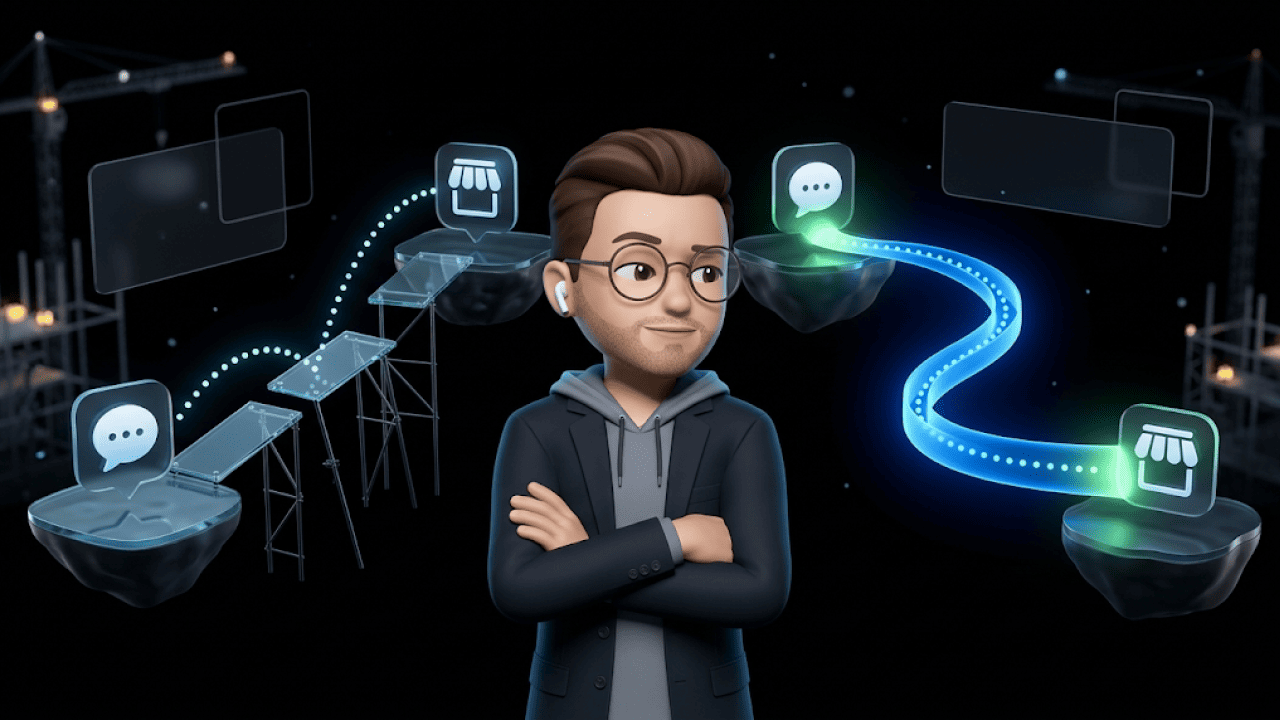

Only 130. That's how many agentic AI vendors Gartner considers real — out of thousands. The rest is agent washing: old chatbots, RPA workflows, and macros relabeled because "workflow" stopped sounding sexy in 2025.
The problem isn't that AI agents don't make sense. The problem is that over 40% of agentic AI projects will be canceled by the end of 2027 — because companies think they have an agent when they actually have a script.
If you're looking for AI agent examples that move real revenue or real cost in an e-commerce shop, you need two things: a clear line between what a real agent does and what it doesn't. And ten concrete use cases already running today. Both are below.
What an AI Agent Is — and What Isn't One
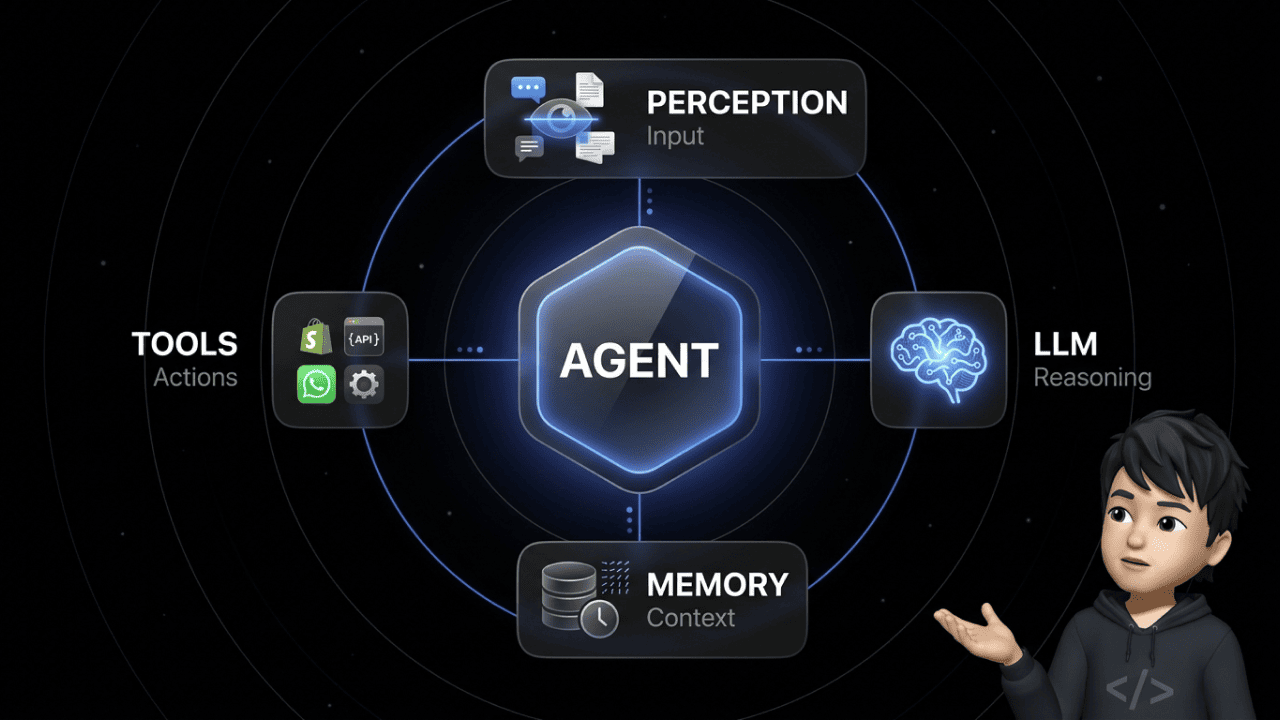
The short version. For the depth: How AI Agents work.
An LLM is a text model. A reasoning engine. You ask, it answers. That's it.
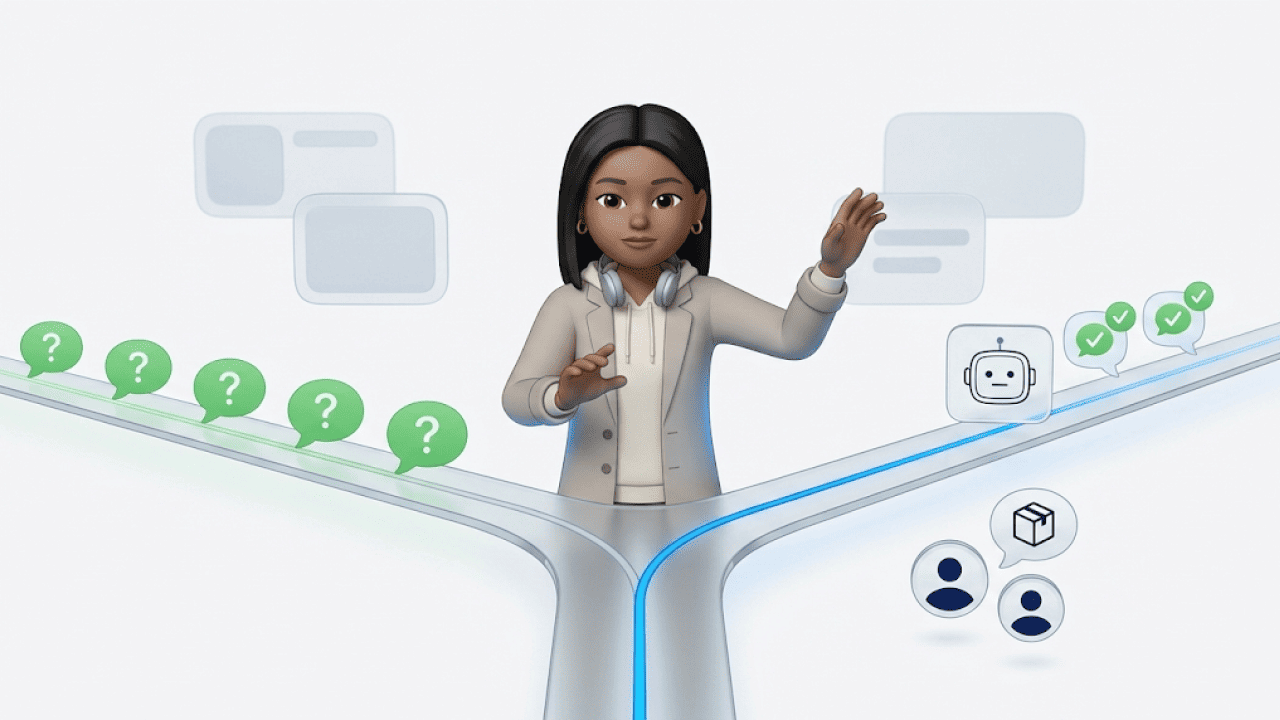
A chatbot is an LLM with a UI and sometimes a handful of rules. Reactive. No goals.
An AI agent has goals. It perceives data, breaks tasks into subtasks, and acts through tools, APIs, and backends. It works through a multi-step job instead of answering one question.
| Feature | LLM | Chatbot | AI Agent |
|---|---|---|---|
| Responds to input | ✓ | ✓ | ✓ |
| Plans multi-step tasks | – | partially | ✓ |
| Executes actions in backends | – | – | ✓ |
| Uses tools (APIs, databases) | – | rarely | ✓ |
| Works context across multiple steps | – | – | ✓ |
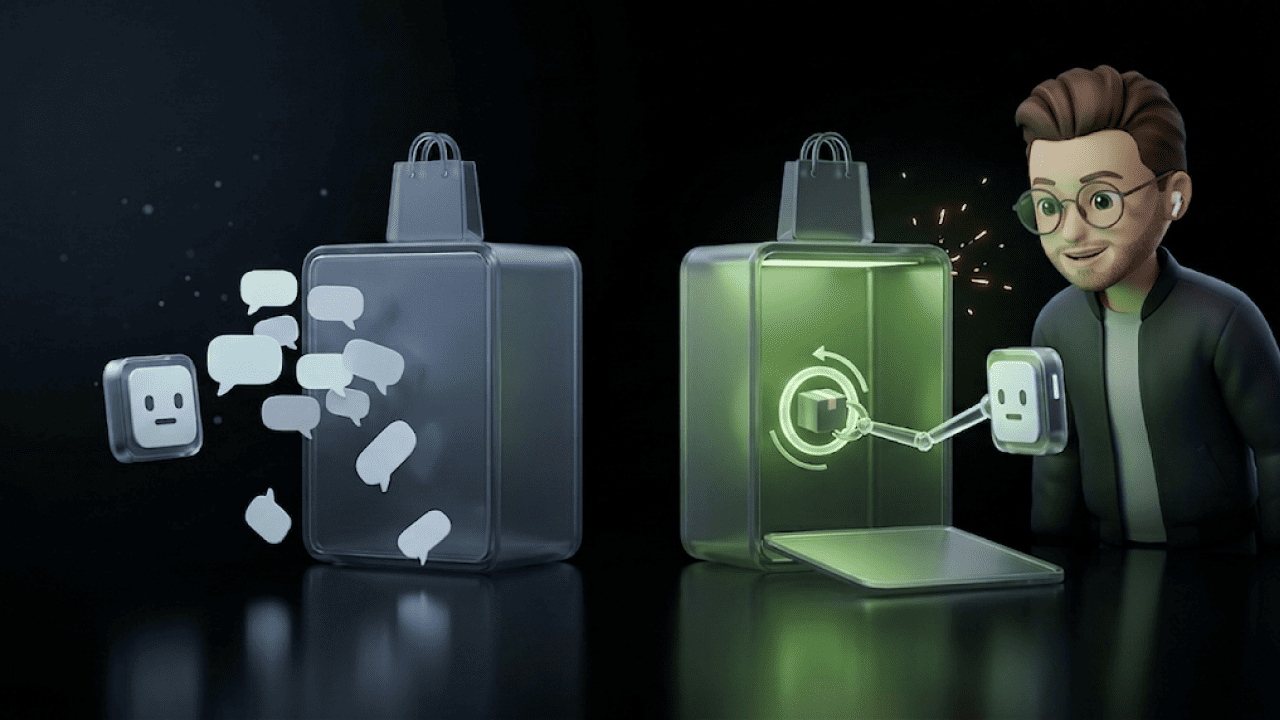
The hard test: A chatbot tells you how to change a shipping address. An agent changes it — in Shopify and your ERP at the same time. If your "AI agent" can't write into your shop backend, it's not an agent. It's a chatbot with a nicer font.
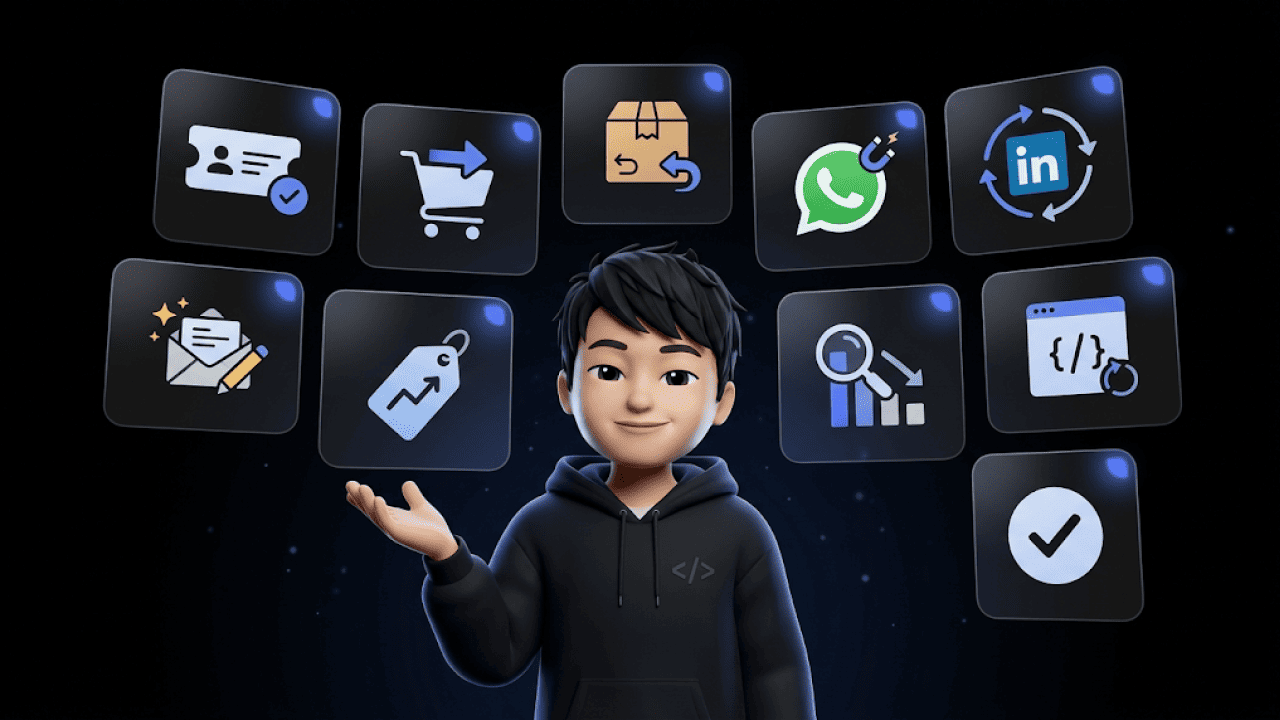
10 AI Agent Examples for E-Commerce at a Glance
| # | Use Case | Area | What the Agent Does |
|---|---|---|---|
| 1 | Ticket automation | Customer Service | Answers "Where's my package?" on its own |
| 2 | Address changes & cancellations | Customer Service | Executes workflow in shop and ERP |
| 3 | Returns handling | Customer Service | Checks rules, creates label, updates status |
| 4 | Lead qualification via WhatsApp | Sales | Asks, scores fit, logs lead in CRM |
| 5 | Lead enrichment from public data | Sales | Crawls LinkedIn and website, fills CRM |
| 6 | Personalized first outreach | Sales | Researches and drafts context-aware outreach |
| 7 | Competitor pricing monitor | Strategy | Tracks competitor prices in real time |
| 8 | SEO & content performance watcher | Strategy | Monitors rankings, alerts on anomalies |
| 9 | Code refactoring & shop migrations | Ops/Dev | Breaks down monoliths, migrates modules |
| 10 | Test automation | Ops/Dev | Writes and maintains tests for shop features |
Now in detail — sorted by speed of ROI.
Customer Service: The Fastest ROI Lever
Monday, 9:15 AM. 230 tickets in the inbox. 180 of them ask some version of "Where's my package?". Your team is copy-pasting between the DHL tracking tab and a Gmail thread for the 47th time. That's how the day starts in most e-commerce shops — and it's why support is the area where AI agents are furthest along today.
Example 1: Ticket automation. The agent receives the request, pulls the shipment status via API from DHL or UPS, identifies the order in your ERP, and writes the response. On AI-first platforms like armincx, the target is 70–80% full automation after onboarding — 40–60% is realistic post-launch. High-volume brands with sharp peak seasons — waterdrop® is an example from our own customer base — show how routine can run automatically while the team focuses on the cases that actually move retention.
Example 2: Address changes and cancellations. This is where the agent separates from the bot. A chatbot says "please change it in your customer account." An agent changes the address — in Shopify, in your ERP, in your warehouse software — sends confirmation, and logs the ticket. No more tab-hopping, no more "we're drowning in day-to-day."
Example 3: Returns handling. Customer reports a return. The agent checks the deadline, product category, and payment method, generates the label, sends it via WhatsApp, creates the case, and notifies the warehouse. Three manual steps become one. For a D2C shop with a 15% return rate, that's the difference between scaling and suffocating.
Sales & Lead Generation: Agents That Qualify 24/7
Sales teams spend a large share of their time on research, not on selling. That's been true for years — and it's exactly the part of the sales process AI agents attack most directly.
Example 4: Lead qualification via WhatsApp. A lead comes in through shop chat, Instagram DM, or WhatsApp. The agent runs the qualification conversation, checks fit against your ICP, writes structured data to HubSpot or Pipedrive, and triggers the right follow-up flow. Around the clock, no SDR on the line. Premium brands like Marc O'Polo use the WhatsApp channel exactly this way — as a CRM extension, not a contact form with a different color. The lead uses the channel they're already on, instead of disappearing into an email funnel no one opens.
Example 5: Lead enrichment from public data. The agent gets a company name and a contact. It crawls the website, identifies the tech stack, finds the person on LinkedIn, and detects company size and vertical. What you get is a filled-out CRM profile. What an SDR takes 30–45 minutes to do, the agent finishes in under a minute. Your SDR can now sell instead of research — which is the actual point.
Example 6: Personalized first outreach. Enrichment without action is data garbage. After the research, the agent drafts first outreach that fits the vertical, recent LinkedIn posts, and obvious product focus. A human reviews and sends. Automated outbound without review smells like spam by week two — and your domain reputation score won't thank you.
Strategy & Competition: Agents That Watch 24/7
These agents never message you first. They run in the background and ping only when something happens. For e-com teams pricing dynamically or doing SEO seriously, these are the ROI levers nobody sees — until they're gone.
Example 7: Competitor pricing monitor. The agent crawls your top competitors' product pages daily, detects price changes, promos, new variants, and out-of-stock situations. Output: a heatmap or a Slack alert. Three competitors, one dashboard. Fifteen competitors, you need an agent — because no human manually checks fifteen price lists a day without missing something.
Example 8: SEO and content performance watcher. The agent monitors Google Search Console, rankings, and Core Web Vitals. A revenue page drops three positions — you get a Slack ping. No more daily dashboard rounds. The agents are only as good as their tool integrations: an agent without API access to Search Console is a bot with an opinion.
Ops & Dev: When AI Makes Shop Migrations Possible in the First Place
This area is less relevant for pure Shopify shops without in-house dev. But it shows what agents can do at enterprise scale — and it matters to everyone with a shop migration or ERP replacement on the horizon.
Example 9: Code refactoring and shop migrations. At enterprise scale, the Nubank case from Cognition Labs shows what's possible: 6 million lines of code, an 18-month project, delivered with the agent Devin acting as a delegation tool for engineers — not a replacement for them — at 12× faster throughput. Translated to DACH e-commerce: if you're planning a Shopware-to-Shopify migration, retiring an old ERP, or consolidating multiple shops onto one platform, code agents can stretch your dev budget by a factor of three to five. No agent replaces a senior developer. But one on the team can now delegate work that used to sit in the backlog forever.
Example 10: Test automation. An agent writes unit tests and E2E tests for your shop frontend, maintains them when you ship features, and flags regressions. What a senior developer normally does on the side — and then neglects — runs continuously. For anyone trying to keep their checkout conversion clean, an underrated lever.
Where AI Agents (Still) Fail — The Honest Take
Now the part most vendors leave out. Without this section, any agent article is half a sales deck.
Agent washing. Gartner coined the term themselves: vendors relabel existing chatbots, RPA workflows, and static assistants as "agents" without the software actually acting autonomously across tools. Out of thousands of vendors, Gartner considers about 130 to be real. The rest is marketing.
Prompt injection. Security researchers have shown attackers can hijack agents through manipulated emails or web pages. Especially risky in e-commerce when the agent has access to customer data, addresses, or payment info. Running agents on sensitive actions without human approval is Russian roulette with your privacy policy.
Consistency problem. Current benchmarks show the first-attempt success rate is okay. Reliability across repeated identical runs drops hard. An agent that solves a task perfectly once often fails on attempts five and six. Testing and monitoring aren't optional.
Human-in-the-loop. Studies show hybrid teams of humans and agents beat both fully human and fully autonomous setups. For B2B sales closes, high-value complaints, or sensitive returns, a human belongs in the loop. For "Where's my package?", the agent handles it alone — and should.
5 Questions to Ask Your AI Agent Vendor
When you're in a vendor call, ask these five questions before you even look at a proposal. Rhetorically smooth answers with no substance are a red flag.
- Can your software execute actions in the shop backend — or only generate text? If only text: not an agent.
- How deep is your integration with JTL, Xentral, Shopware, Shopify? An agent without read/write access is useless.
- What does the agent do with a request outside its training set? Clean answer: escalates to a human. Red flag: hallucinates.
- How do you monitor consistency across repeated runs? See the consistency problem above. No monitoring = no production readiness.
- Who is liable when the agent approves the wrong return? The answer exposes mature vendors.
Frequently Asked Questions
What's the difference between an AI agent and a chatbot?
A chatbot responds reactively. An AI agent plans multi-step tasks and acts through APIs and backends. The chatbot describes, the agent does.
Which AI agents are available for e-commerce?
For the DACH market: customer service agents (armincx), WhatsApp sales agents (Chatarmin), code agents (Devin, Claude Code), pricing and SEO monitors. The pick depends on where your strongest pain point sits.
How much time does an AI agent save in customer service?
Realistically 40–60% ticket automation after launch, 70–80% after onboarding on AI-first platforms. Standard chatbots land below that — they generate text instead of executing actions.
Is an AI agent the same thing as agentic AI?
No. Agentic AI is the principle of autonomously acting AI; an AI agent is the software implementation. Details: Agentic AI vs. AI Agents.
Do I need my own developers to use AI agents?
No. Off-the-shelf SaaS for support, WhatsApp sales, or pricing monitoring only needs an IT-literate generalist. You only need developers for custom agents trained on your own processes.
Can an AI agent replace my customer service team?
No — and shouldn't. Agents handle routine (package status, address changes, returns); your team handles complaints, premium customers, escalations. The goal is relief, not headcount cuts.
Are AI agents GDPR-compliant?
Yes, if the vendor can show EU hosting, a data processing agreement, and clean data flows. US vendors routing unmanaged customer data to OpenAI are often a problem in the DACH market. Dig in before you sign.
Do AI agents hallucinate?
Yes — LLM-based systems can hallucinate. Well-built agents have safeguards: answers drawn from verified sources (product PDFs, shop data), escalation to a human on uncertainty. Ask explicitly how the agent handles unfamiliar requests.
Do AI agents work with Shopify and JTL?
Yes, but depth of integration decides the outcome. Shallow API access is fine for reads. For real actions — changing addresses, canceling orders, processing returns — you need read/write access to both systems. DACH-specific ERP integrations like JTL or Xentral are often missing from US tools.
How long does it take to roll out an AI agent?
Between two weeks and three months, depending on scope and data quality. 70–80% automation is rarely hit at launch — realistic after two to three months of tuning, once the agent has been trained on historical tickets and real conversations.
Bottom Line: Which AI Agent First?
Most AI agent examples from 2025 were demo theater. 2026 is the year the split shows — which use cases actually move revenue or cost. For e-commerce: customer service first, then WhatsApp sales agents, then the rest. Not everything at once. One use case, one KPI, three months of measurement, then roll out.
If you're genuinely weighing what a real AI agent would look like in your support — one that closes tickets instead of just generating text — book 20 minutes with our team. We'll walk you through ticket automation on Shopify + JTL live, and you'll see immediately whether the numbers work for your shop.
Still in evaluation mode? Agentic AI vs. AI Agents clears up the worst terminology mix-ups, and How AI Agents work goes deep on the perception-reasoning-action loop.