
74% of all call center agents are at risk of burnout. Annual turnover sits at 30–45%. And one of the main drivers? The blind obsession with handling time.
Your support team processes 100 tickets per day — per agent. At an average net handling time of 5 minutes per ticket (industry benchmark per Leafworks/Zendesk webinar, Feb 18, 2026). Yet the queue keeps growing. People keep burning out.
Meanwhile, the market is exploding: According to MarketsandMarkets, the global market for AI in customer service will reach $47.8 billion by 2030 — at an annual growth rate of 25.8%. The question is no longer whether AI can reduce handling time in customer service. The question is: Does it reduce the right metric — or does it just push a number that ends up alienating customers and driving agents away?
What Does AI Handling Time in Customer Service Mean?
AI handling time in customer service refers to the reduction of Average Handle Time (AHT) through the targeted use of artificial intelligence — via automated responses, agent assist, intelligent routing, or automatic after-call work.
The AHT formula:
(Total Talk Time + Total Hold Time + After-Call Work) ÷ Number of Interactions
What "good" looks like depends on context:
| Industry | Typical AHT |
|---|---|
| Retail / E-Commerce | 3–4 minutes |
| Financial Services | 4–6 minutes |
| Technical Support | 8–10 minutes |
These numbers describe net handling time per agent. Customer wait time — the time your customer actually spends waiting for an answer — isn't included.
At Chatarmin, we measure Average Resolution Time (ART): business hours from ticket creation to resolution, minus customer wait time. Methodologically similar to AHT, but not identical — because ART captures the entire ticket lifecycle. Important distinction: "On hold" times are currently still included in ART, but typically excluded from classic AHT. We're always transparent about that.
With armincx customers, we see ART improvements of 24–91% compared to the previous period (Chatarmin customer dashboards, week of Mar 4–11, 2026).
False Efficiency: Why "Faster" Doesn't Mean "Better"
Every Head of CX knows the pressure: AHT down, costs down, efficiency up. Sounds logical. But it's dangerous.
AHT isn't a thermostat you just turn down. It's an aggregate result of dozens of variables — system landscape, agent skill, ticket complexity, tool quality. AHT behaves like blood pressure: Too high is unhealthy. But too low is just as much of a problem — and usually a symptom of broken processes.
Anyone who treats AHT as a pure productivity target creates "False Efficiency": Calls get shorter, but repeat contacts spike and CSAT scores crash. Here's what actually happens:
Agents rush through tickets without actually solving the problem. First Contact Resolution (FCR) drops — customers have to write again. Reopen rates climb — more tickets, not fewer. CSAT crashes. Total costs go up because every unresolved ticket creates a new one.
That's the control illusion in customer service: Forced AHT reduction leads to escalations, repeat calls, and higher turnover. The number on the dashboard looks better — reality doesn't.
Vodafone solved it differently: Instead of optimizing purely for speed, they boosted first-time resolution from 15% to 60%. CSAT improved by 50%. Not by handling cases faster — but by fixing the processes behind them.
Friction Removal: How AI Actually Reduces Handling Time
AI doesn't reduce handling time by making agents type faster. It reduces it by removing system friction.
According to McKinsey, knowledge workers spend roughly 20% of their working hours just searching for and gathering information. In customer service, that means: Your agent has the customer on the line, but two out of every five minutes isn't spent addressing the problem — it's spent jumping between Shopify, the ERP, and the knowledge base. Tab-switching, copy-pasting, data silos.
AI eliminates exactly that friction. Not the human. Not the empathy. The search.
And the results are backed by evidence: A study by the National Bureau of Economic Research (NBER) with over 5,000 customer service agents shows that generative AI assistants boost productivity by an average of 14% — measured in resolved cases per hour. For inexperienced agents, the effect is even higher at +34%. Customer satisfaction doesn't drop. It actually increases slightly.
According to IBM, AI can reduce operational customer service costs by 30% and automate up to 80% of routine inquiries. AI-powered solutions reduce handling time overall by 30–50% (Leafworks/Zendesk webinar, Feb 18, 2026). But not across the board — at three specific leverage points.
The Three Real Levers: ACW, Agent Assist, and Routing
Automating After-Call Work (ACW)
After-call work accounts for 20–30% of total AHT. Ticket summaries, CRM updates, tagging, categorization — all manual. AI-powered automation cuts this block by 50–90%.
In practice: Your agent closes a conversation. Instead of 3 minutes of wrap-up, AI handles the summary, tagging, and CRM entry in seconds. At 100 tickets per day and 2 minutes saved per ticket, that's over 3 hours per agent — every single day. That's half a workday.
Agent Assist: Context Instead of Search Time
AI Agent Assist delivers real-time context to the agent: customer history, relevant orders, knowledge base suggestions. This reduces search time — the AHT component that's most underestimated.
Klarna used an AI assistant to cut resolution time from 11 minutes to under 2 minutes. Avetta reduced handling time by 16 seconds per interaction — sounds minor, but at 10,000 tickets per month, that adds up to over 44 hours.
The NBER study shows: The productivity gain doesn't come from AI writing the answer. It comes from AI systematically transferring the implicit knowledge of top agents to everyone else. New hires reach the level of experienced colleagues in 2 months instead of 10. Speed isn't the lever — skill transfer is.
Intelligent Routing Instead of Inbox Chaos
Classic routing: Tickets land chronologically in the inbox. Whoever clicks first, handles it. Regardless of whether it's a priority-1 damage claim or a "Thanks!" from a customer. Helpdesk systems without AI routing hit a wall here.
AI-powered routing analyzes intent and sentiment in real time:
| Request Type | Routing | Result |
|---|---|---|
| Accident / Damage Claim | → Claims Team (Priority 1) | No backlog |
| Standard FAQ (e.g., PIN reset) | → Auto-Response | Zero agent effort |
| Just "Thanks" | → Auto-Close | No reopen rate distortion |
This eliminates unnecessary transfers, prevents complex cases from landing with inexperienced agents — and reduces AHT without sacrificing quality.
Human-in-the-Loop: Why AI Frees Agents Instead of Replacing Them
Here's the point many AI vendors won't tell you: Not every ticket should be automated.
The reality in e-commerce support: 80% of inquiries are standard — WISMO ("Where is my order?"), returns, invoice copies, PIN resets. The same questions, day after day. AI can handle these 80% completely. No agent. No wait time.
But the other 20% are the tickets that matter: A complaint with a lawyer threat. A damaged product worth $2,000. A customer who needs to be heard. These cases require empathy, judgment, and someone who isn't watching the clock.
AI handles the volume so your team finally has the time to solve complex cases properly. Not fast. Properly. A customer service chatbot takes over the routine — your team gets room to breathe.
That's also the employee experience argument: In the NBER study, agent attrition dropped by 8.6% with AI access. At 30–45% annual turnover as the industry average and costs of $10,000–$22,000 per departure (McKinsey), that pays for itself immediately.
From Reactive to Proactive: Agentic AI and the Next Phase
Customer service has always been reactive: The customer reaches out, the agent reacts. Agentic AI flips the model.
Instead of just responding to inquiries, agentic AI detects problems before the customer even notices. A package is delayed? AI proactively informs the customer — via WhatsApp, via email, automatically. No ticket needed. No agent involved. The problem exists and gets resolved before it becomes a support case.
Gartner predicts that agentic AI will autonomously resolve approximately 80% of routine customer service inquiries by 2029 — at 30% lower operating costs. That's not sci-fi. That's the direction AI in customer service is heading right now.
The difference from classic chatbots: Agentic AI doesn't just have conversations. It acts — cancels orders, creates return labels, changes addresses. Autonomously, across multiple systems. At armincx, that's exactly the architecture: AI agents don't work with text templates — they execute real backend workflows via Shopify, JTL, and Xentral.
No Hallucinations: Why RAG at armincx Makes the Difference
The biggest fear around AI in customer service: What if the AI makes things up? Fair question. False promises to customers, invented warranty terms, wrong pricing — a single hallucination can get expensive. It's the number one concern we hear in sales conversations.
armincx uses RAG — Retrieval-Augmented Generation. In plain terms: The AI doesn't invent anything. It pulls its knowledge in real time from your verified data sources — product data, order history, knowledge base, internal policies. Every answer is tied to a real source.
This minimizes hallucinations and keeps support GDPR-compliant: Data stays on EU servers, the AI only accesses approved content, and you can see in the dashboard which source led to which answer.
Trade-off we'll be honest about: RAG is only as good as your data. If your knowledge base is outdated or incomplete, the AI will give incomplete answers too. That's why every armincx onboarding includes a data quality audit.
Where Standard Tools Hit Their Limits
The problem in e-commerce support is rarely the lack of AI. It's the tool sprawl.
Zendesk for tickets. Shopify for orders. Klaviyo for campaigns. An ERP for inventory. WhatsApp separately. And in between: copy-paste, tab-switching, data silos.
200,000 companies use Zendesk at the enterprise level (Source: David Grimm, Leafworks webinar, Feb 18, 2026). But Zendesk's AI can't natively read PDFs and attachments. Every workaround requires custom engineering through external agencies. Not scalable, not transferable.
For a fashion brand that receives damage photos via email every day, that means: The agent opens the image, manually describes the damage, searches for the order, checks warranty status — and only then responds.
armincx solves this with AI image analysis: Product recognized, damage classified, order and warranty status checked — the agent gets a structured summary before they even open the ticket.
The armincx Approach: How We Actually Solve This
armincx is an AI-first platform — built for e-commerce customer service, not retrofitted with AI as an afterthought. All channels — WhatsApp, email, live chat, social media, phone — converge in a single inbox. Anyone who has compared AI customer support tools knows the difference: With most vendors, AI is an add-on. With us, it's the foundation.
Less context-switching. Order data from Shopify, campaigns from Klaviyo, customer history — all in the ticket. The system friction that McKinsey says eats 20% of work time? Gone.
Automated standard inquiries. WISMO, returns, PIN requests — armincx resolves them via workflows. Via real backend actions, not text templates. The AI cancels orders, changes addresses, creates return labels — automatically across Shopify and JTL simultaneously. That's the core difference to tools that only generate text but can't actually act.
RAG-based responses. Every AI answer is grounded in your verified data. No hallucinations, full traceability in the dashboard.
Intelligent routing by intent and sentiment. Urgent damage claims go to specialists. FAQs are handled automatically. "Thanks" emails close the ticket. For a deeper dive into AI ticketing, check our full comparison.
Real Numbers From the Field
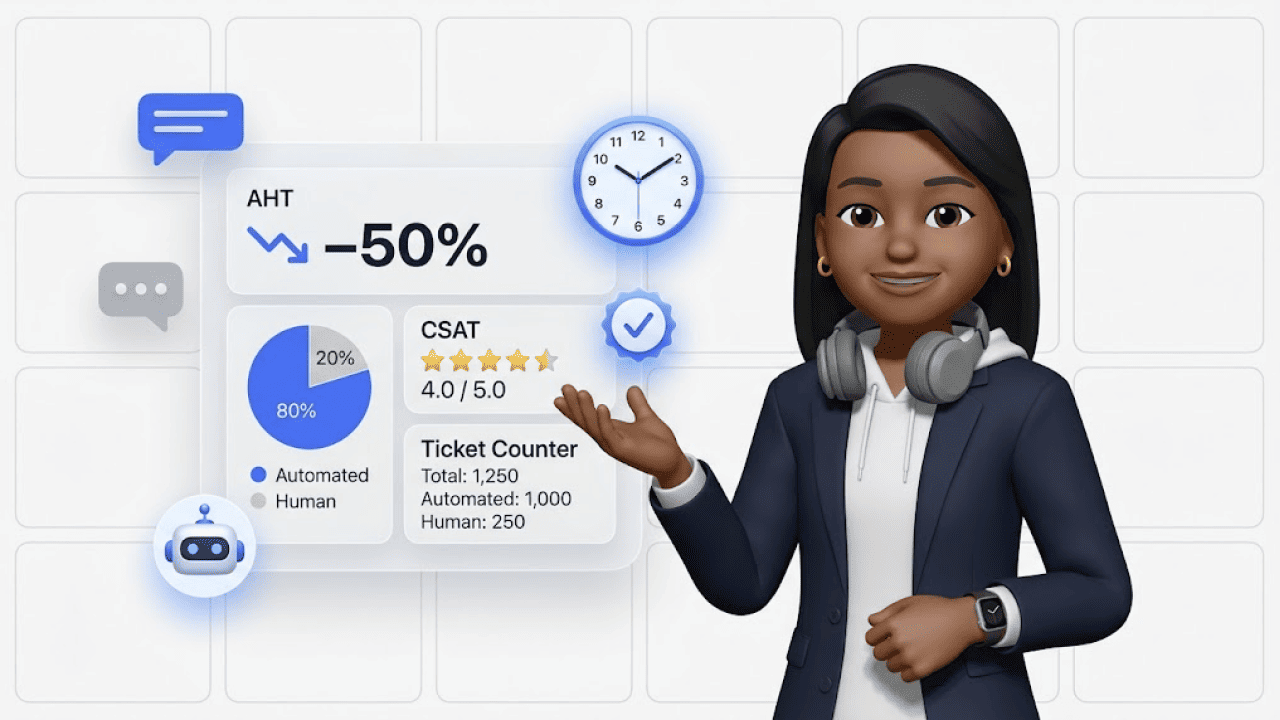
ART data from armincx customer dashboards (week of Mar 4–11, 2026):
| Metric | Result |
|---|---|
| ART Improvement (Range) | 24–91% vs. previous period |
| Top Agent Performance | 450 resolved tickets, ART 2h 57m |
| First Response Time (best value) | −54% |
| CSAT (Customer Satisfaction) | 4.0 / 5.0 |
These are Average Resolution Times, not AHTs. Methodologically similar — but not identical. These numbers confirm the +30–80% productivity gains from the Leafworks webinar in terms of magnitude.
What We Don't Promise
No 100% automation. armincx targets 70–80% for standard inquiries — after ramp-up with workflow tuning. The remaining 20–30% need a human. And that's exactly what your team should have the time for.
Bottom Line: Reduce Handling Time Without Wrecking Customer Service
AI handling time in customer service is not an end in itself. Anyone who just pushes the number down without addressing the root causes of inefficiency creates False Efficiency — shorter calls, but more repeat contacts and crashing CSAT scores.
The three real levers:
- Automate after-call work — 50–90% less wrap-up time
- Deliver context instead of making agents search — Agent Assist as co-pilot (+14% productivity per NBER)
- Route intelligently — the right ticket to the right agent, automatically
And the direction is clear: Gartner predicts that by 2029, approximately 80% of routine inquiries will be resolved autonomously by AI. The market grows to $47.8 billion by 2030. The question isn't if you'll make the switch — it's when.
armincx bundles all these levers in one platform. EU hosting, GDPR-compliant, RAG-based, native Shopify integration, no per-seat pricing.
Want to see what that means for your team? Book a demo — we'll show you, based on your actual ticket data, where the biggest levers are.
FAQ: AI Handling Time Customer Service
What is Average Handle Time (AHT)?
AHT is the average time spent per customer interaction — calculated from talk time, hold time, and after-call work, divided by the total number of interactions.
What's a good benchmark for handling time in e-commerce?
In e-commerce, typical AHT is 3–4 minutes, with a net handling time of 5 minutes per ticket including after-call work.
How does AI reduce handling time in customer service?
Through automated after-call work (ACW), real-time context delivery via Agent Assist, and intelligent routing. Together, these levers cut handling time by 30–50%.
Why does CSAT drop when you artificially push AHT down?
Because agents close tickets without solving the actual problem. That creates repeat contacts, rising reopen rates, and frustrated customers — the so-called "False Efficiency."
Does AI replace human agents in customer service?
No. AI handles the 80% of standard inquiries like WISMO, returns, and invoice copies. Your team gains the time to solve the complex 20% with empathy and judgment.
What's the difference between AHT and Average Resolution Time (ART)?
AHT measures net agent working time per interaction. ART captures the full ticket lifecycle in business hours — minus customer wait time. ART shows how long the customer actually waits for a resolution.
What does "Agentic AI" mean in customer service?
Agentic AI resolves customer issues autonomously — it cancels orders, changes addresses, creates return labels. The difference from classic chatbots: Agentic AI doesn't just generate text, it executes real backend actions.
How does RAG (Retrieval-Augmented Generation) prevent AI errors in support?
RAG forces the AI to generate answers exclusively from verified data sources — product data, order history, knowledge base. This minimizes hallucinations and makes every answer traceable.
How does AI shift customer service from reactive to proactive?
AI detects issues like delivery delays before the customer even reaches out and proactively informs them via WhatsApp or email. This prevents tickets instead of just resolving them faster.