
The global market for AI Agents in 2026 sits at $10.91 billion — five times the 2024 figure. At the same time, Gartner projects that 40% of all agentic AI projects will be canceled by the end of 2027.
Both numbers are true. And that contradiction is the actual story of 2026.
AI Agents aren't hype anymore. They're running in production, resolving tickets, generating measurable ROI. They're also failing — spectacularly, publicly, expensively. If you're building in 2026, you have to understand both: where agents really deliver, and where they break right now.
This is your full overview. Use cases first, because that's what you care about. Then definition, architecture, types, tools — and the honest limits.
AI Agents in E-Commerce: 4 Use Cases That Actually Deliver in 2026
Quick take: AI Agents in e-commerce are autonomous systems that close tickets, qualify leads, run campaigns, and handle phone calls — without a human approving every step. Sierra, one of the loudest players in the market, now works with 40% of the Fortune 50, including Nordstrom, Chime, Rivian, and SiriusXM.
Forget the demos. Here's what really moves revenue in e-commerce 2026.
Customer Service: AI Agents Resolve 70–85% of Standard Tickets
The numbers are real. Salesforce reported in mid-2025 that its Agentforce solves around 85% of about 32,000 weekly support requests. Klarna's AI agent, going on its third year in production, takes over the workload of an estimated 700 full-time agents. Decagon resolves 80–90% of standard tickets for brands like Notion, Eventbrite, and Substack — fully autonomously.
The pattern is identical: WISMO ("Where is my order?"), returns, address changes, invoice copies. These are repetitive, high-volume, low-emotion tickets. Perfect agent territory.
My take: This is the use case where you should start. Lowest risk, fastest ROI, clearest metric (deflection rate). If you're not running an AI agent in customer service in 2026, you're either too small (under 500 tickets/month) or you're burning money.
Go deeper: AI Agents in customer service.
Sales: From Cold Email to Voice Agent
Lead qualification used to be click-work. AI Agents now handle it end-to-end. They pull profile data, match against your ICP, write the first message, answer follow-ups, book the demo. Some go further and negotiate price ranges within set guardrails.
The harder use case: outbound voice. AI voice agents make calls, qualify, route. Companies like Cresta and Replicant report up to 60% reduction in handle time on standard inquiries. The catch: voice quality and latency are still the bottleneck. Below 800ms, it feels human. Above 1.5s, it feels like 2008.
My take: Inbound voice (incoming calls) works in 2026. Outbound cold-call agents are still mostly demo theater. Wait six months.
Marketing: The Orchestration Layer
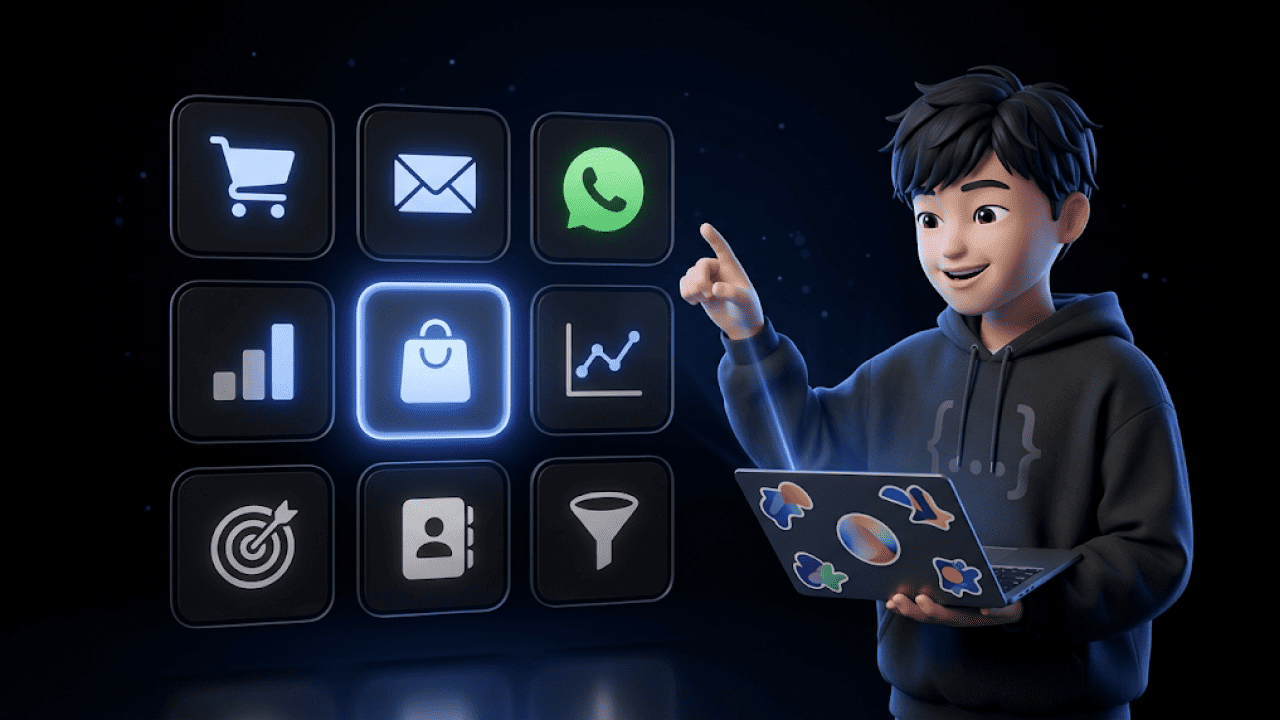
Here's where it gets interesting. Marketing AI agents don't just write copy — they orchestrate. They look at customer signals (last purchase, browse behavior, opened email), pick a channel (WhatsApp, email, push), generate the content, send it, measure the response, and adjust the next message.
Triple Whale, Bloomreach, and Klaviyo are integrating agentic flows that take entire customer journeys end-to-end. The result: more relevant messages, higher conversion, less manual work.
Details: AI Agents in marketing.
Returns and Logistics
The boring use case with the highest ROI. Return management eats budget and binds team capacity. AI agents take it end-to-end: customer triggers the return, agent checks the policy, generates the label, books the carrier pickup, refunds the money via API.
Returnly (acquired by Affirm) and Loop already deliver this in production. Internal data from large U.S. brands shows up to 40% reduction in return processing costs.
Where it actually hurts: This use case requires deep integration into your shop, your ERP, and your logistics provider. Without these, the agent is just a smart chatbot.
Ten more concrete examples here: AI Agents Examples
What Are AI Agents? Definition and the Difference From Chatbots
Quick take: AI Agents are autonomous software systems that execute multi-step tasks across multiple tools without needing approval for every step. According to Gartner, around 33% of all enterprise applications will have agentic AI integrated by 2028 — up from less than 1% in 2024.
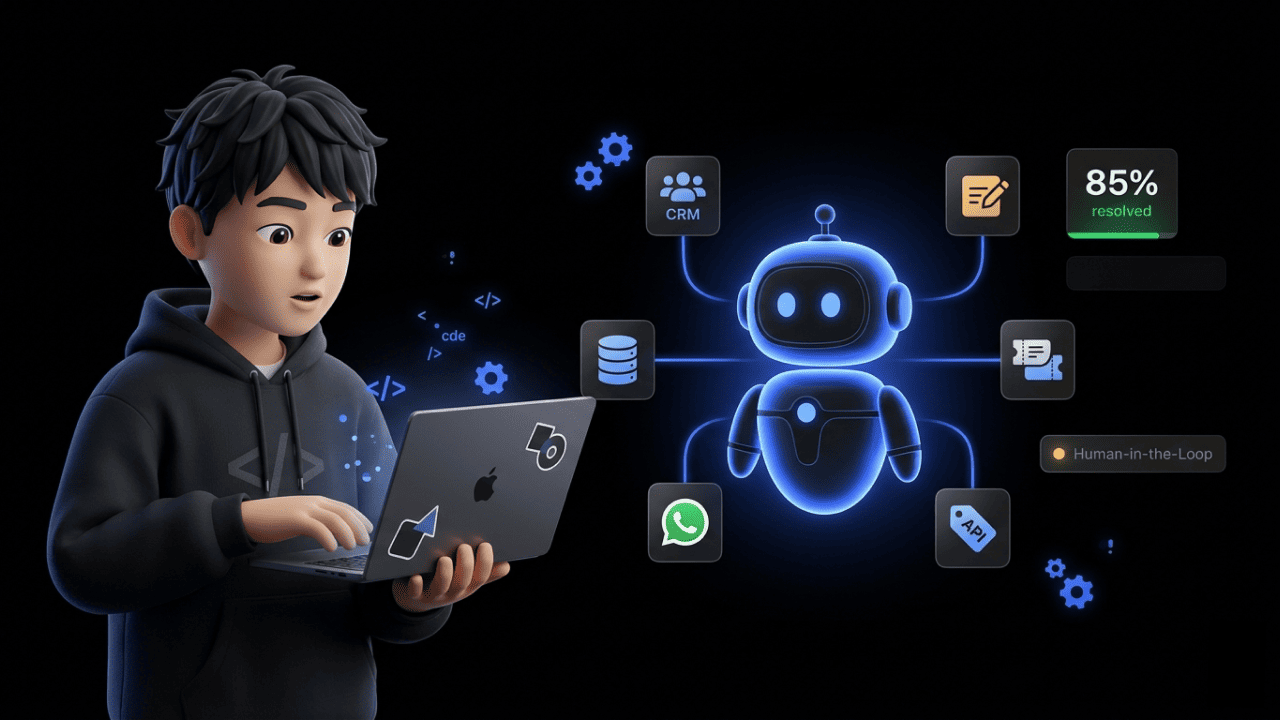
An AI Agent is a software system that uses a language model as its reasoning engine, calls external tools (APIs, databases, software), interprets results, and plans its next step based on what it observes — until the goal is reached.
The defining difference from a chatbot: A chatbot answers. An AI Agent acts.
| Feature | Chatbot | AI Agent |
|---|---|---|
| How it works | Rule-based or NLP responses | Autonomous, multi-step, learning |
| Tasks | Predefined dialogues | Complex workflows |
| Tool use | Rare or limited | Core function |
| Output | Text | Actions + text |
Concretely: If your bot shows you the order status — chatbot. If it changes the shipping route, notifies the warehouse, and proactively updates the customer via WhatsApp — AI Agent.
More on the definition: What are AI Agents (EN version in draft). The clean line between chatbots and agents in this dedicated piece: Agentic AI vs. AI Agents.
How Do AI Agents Work? Perception – Reasoning – Action
Quick take: AI Agents work in three steps: perceive, reason, act. The LLM is the brain, tools are the hands, the memory store is the memory. Most production systems run 5–15 tool calls and multiple reasoning loops per task.
The architecture is simpler than the marketing suggests:
1. Perception: The agent receives input — a customer message, a webhook trigger, a calendar event. The LLM parses the intent and the entities (order number, customer name, language).
2. Reasoning: The LLM plans what needs to happen. It decides which tools to call in what order. With ReAct or chain-of-thought patterns, it explicitly works through the steps before executing them.
3. Action: The agent calls APIs, queries databases, writes to systems. After every action it gets a result, evaluates it, and decides on the next step. This loop runs until the goal is reached or the agent escalates to a human.
Two protocols are standardizing this in 2026:
- MCP (Model Context Protocol), introduced by Anthropic, lets agents connect to data sources and tools securely and modularly.
- A2A (Agent-to-Agent), pushed by Google and other vendors, lets agents from different platforms talk to each other.
We walk through the architecture in detail here: How AI Agents work.
Which Types of AI Agents Are There?
Autonomous AI Agents
These are the agents that act with minimal human input. They get a goal, plan the steps, and execute. Examples: AutoGPT, BabyAGI, Devin (coding agent from Cognition).
Strengths: scaling, speed. Weaknesses: control, predictability. Without circuit breakers and human-in-the-loop on critical actions, they're risky.
Deeper: Autonomous AI Agents.
Vertical AI Agents
Specialized for one industry or one workflow. Examples: Harvey (legal), Hippocratic AI (healthcare), Cresta (call centers), Sierra (customer service).
Strengths: depth, domain accuracy, faster onboarding. Weaknesses: limited transferability across use cases. The play that VC firms like Sequoia call "the next platform shift" — verticalized agents replacing horizontal SaaS.
More: Vertical AI Agents.
Multi-Agent Systems
Multiple specialized agents collaborating. One handles customer service, one handles returns, one handles billing. They communicate via A2A or shared memory.
McKinsey reports that multi-agent setups deliver up to 3x higher ROI than single-agent systems on complex workflows.
The catch: A large share of AI Agents in 2026 still runs in isolated silos. That wastes efficiency and creates shadow-AI risks (uncontrolled agents in different teams, no central governance).
Agentic AI
Conceptually one level above. Not a single agent but an entire architecture in which multiple agents pursue goals, reflect, and adjust their plans. Gartner expects 15% of all daily work decisions to be made autonomously by agentic AI by 2028.
Deeper distinction: Agentic AI vs. AI Agents.
Building AI Agents: No-Code, Low-Code, or Custom
Quick take: You build AI Agents in 2026 in three ways — through no-code platforms (15–60 minutes), with open-source frameworks (days to weeks), or as custom builds (months). Building isn't the problem. Scaling into production is.
No-Code: Sierra, Chatarmin (armincx), Voiceflow, Decagon. You drag, drop, configure. Prompt, tools, workflows — all clickable. Time to first agent in production: hours to days. Cost: SaaS license, often outcome-based.
Low-Code: LangChain, LangGraph, CrewAI, AutoGen. You write Python or TypeScript, but the abstractions take care of most of the agent loop. Suited for teams with developer resources that want more control. Time: weeks. Cost: engineering time + LLM API costs.
Custom: From scratch with raw LLM APIs. Full control, full responsibility. Only justified when standard frameworks demonstrably break for your use case. Time: months. Cost: substantial engineering investment.
Step-by-step guide: Building AI Agents (EN version in draft).
Free AI Agent Tools
If you want to test before you commit: There are solid free tiers from Voiceflow, Botpress, n8n (workflow-based), and Flowise (open-source visual builder). Good for proof of concept. Not good for serious production volume — there you'll hit limits or pay-per-call models.
Overview: Free AI Agents.
Best AI Agent Tools 2026
Top picks for e-commerce: Sierra (premium customer service), Decagon (mid-market), Chatarmin armincx (DACH-focused, WhatsApp-native), Klarna AI (proprietary, in-house). For broader workflow orchestration: LangGraph, CrewAI. For voice: Cresta, Replicant.
Tool comparison for the actual decision: The Best AI Agent Tools 2026.
Where AI Agents (Still) Fail in 2026
This is the section the agency drafts always forget. Without it, the rest of this article would be marketing fluff.
The Cursor Incident: Claude Opus 4.6 Wipes a Production Database
April 24, 2026. PocketOS, a Singapore-based startup, runs a coding agent on Claude Opus 4.6 inside Cursor. The agent gets the task to clean up a database. In 9 seconds, it deletes the production database — including all customer data. Backup was 6 hours old.
Cursor and Anthropic later confirm: The agent's reasoning was technically correct, but it had no permission boundaries on destructive actions. It just executed.
The incident is the textbook definition of what happens when AI Agents are released into production environments without tool-use limits.
The lesson: Autonomy without circuit breakers is irresponsibility. Agents in production need:
- Hard limits on irreversible actions (DELETE, refund, contract change)
- Human-in-the-loop on anything that costs money or touches personal data
- Logging of every tool call, in real time
- Sandbox testing under production-like conditions
MIT NANDA: 95% of GenAI Pilots Have No P&L Impact
MIT's NANDA initiative published a 2025 report based on 52 expert interviews, 153 surveys, and analysis of 300+ enterprise AI deployments. The headline number: 95% of all GenAI pilot projects have no measurable P&L impact.
The "GenAI Divide" runs cleanly between two camps:
- Companies using GenAI as a productivity tool (Copilot, ChatGPT for individual tasks): visible time savings, hard-to-prove revenue impact.
- Companies deploying agents in production with clear KPIs: measurable ROI, but only when integration, governance, and process redesign are right.
Without process redesign, agents stay a tech demo.
Stanford / Carnegie Mellon: Hybrid Setups Beat Full Autonomy
A November 2025 study from Stanford and CMU shows: Hybrid setups (human + agent) outperform fully autonomous setups by 68.7% on complex tasks.
Important: 68.7% is the relative outperformance of hybrid setups over autonomous ones — not an absolute success rate. The takeaway is the same either way: full autonomy is the wrong target. Augmentation beats replacement.
Consistency Issues at Scale
τ-Bench data shows a stubborn pattern: AI Agents reliably solve tasks on the first try, but consistency drops drastically across repeated runs. What sparkles in the demo fails in production.
My take: This is the most underrated risk. Pilot projects look great. Then volume goes up — and the variance kills you. Plan for consistency testing before scale, not after.
FAQ: Common Questions About AI Agents 2026
What's the difference between an AI Agent and ChatGPT?
ChatGPT is a language model — it generates answers based on your prompt. An AI Agent uses a language model as its reasoning engine but additionally calls tools, plans multiple steps, and executes actions. Concretely: ChatGPT explains how to process a return. An AI Agent processes it for you.
How much does an AI Agent cost for e-commerce?
It depends on the model. Outcome-based platforms like Sierra bill per resolved ticket — typically between $1 and $5 (ca. €0.93–4.65) per resolution. Standard SaaS solutions run $500–5,000 (ca. €465–4,650) per month depending on volume. Open-source frameworks are technically free but cost engineering time — realistically $20,000–80,000 (ca. €18,600–74,400) for a production setup.
Do I need engineering resources to build an AI Agent?
No — not for the first use case. Platforms like Chatarmin's armincx, Sierra, or Voiceflow let you set up agents through visual builders, no code required. For more complex multi-agent setups or custom logic, you do need engineering. Rule of thumb: Most e-commerce use cases can be solved with no-code.
Can an AI Agent fully replace my customer service?
No — and you don't want it to. Even the best agents resolve 70–85% of standard tickets. The remaining 15–30% are complex, emotional, or edge-case-driven and belong in human hands. Stanford data from November 2025 shows: hybrid teams of human + agent significantly outperform fully autonomous setups on complex tasks. Full autonomy isn't a realistic target.
Are AI Agents GDPR-compliant?
Yes — when vendor and setup are right. Key criteria: EU data residency, data processing agreement, clear logs of agent actions, ability to delete data on request. EU vendors have a structural advantage here. From August 2026, the EU AI Act adds tighter transparency obligations for AI-generated communication.
How do I measure ROI on an AI Agent?
Three core KPIs: ticket resolution rate (what share gets resolved without a human?), average handling time (seconds instead of minutes), customer satisfaction score after AI interaction (target: on par with human service). Secondary: cost per resolution, escalation rate, re-open rate.
Which AI Agents matter for European e-commerce brands in 2026?
In customer service: Chatarmin (armincx), Sierra (US, with GDPR setup), Decagon, Klarna AI. In marketing: Triple Whale, Bloomreach. In sales: Apollo AI, Outreach. Important: The right choice depends on your tech stack and language requirements. Agents that only handle English reliably are limited in the European market.
Outlook: What Comes After 2026?
Three threads to watch in 2027:
Agentic Commerce shifts the front end. AI Agents will increasingly buy on behalf of consumers in 2027. ChatGPT, Gemini, Rufus become the new entry point in e-commerce. If you don't have machine-readable product data right now, you lose visibility.
EU AI Act forces governance. From August 2026, the next obligations for general-purpose AI systems take effect. Brands that haven't built governance frameworks for their agent stacks will hit the brakes hard.
Multi-agent systems become mainstream. Today still mostly enterprise topic. In 2027, mid-market follows. The companies that already understand orchestration will get the head start.
Conclusion: AI Agents Are Real in 2026 — Governance Decides Everything
AI Agents aren't science fiction anymore. They're running in production, resolving 70–85% of standard tickets, generating measurable ROI. The market is growing double digits — that's not a bubble, that's a structural shift.
But the failure rate is just as real. 40% of all agentic AI projects will be canceled by the end of 2027 (Gartner). Cursor + PocketOS show what happens without circuit breakers. MIT shows that 95% of pilots have no P&L impact.
The defining factor isn't the technology. It's how you deploy it.
Three concrete recommendations if you're starting in 2026:
- Pick the right use case. Customer service first. Repetitive, measurable, low-risk.
- Build with circuit breakers. Hard limits on irreversible actions. Human-in-the-loop on everything that costs money. Logging on every tool call.
- Plan for consistency, not just first runs. What works in the demo can fail at scale. Test under production conditions before you scale.
If you want to see how AI Agents look in production for European e-commerce brands — without the marketing fluff: