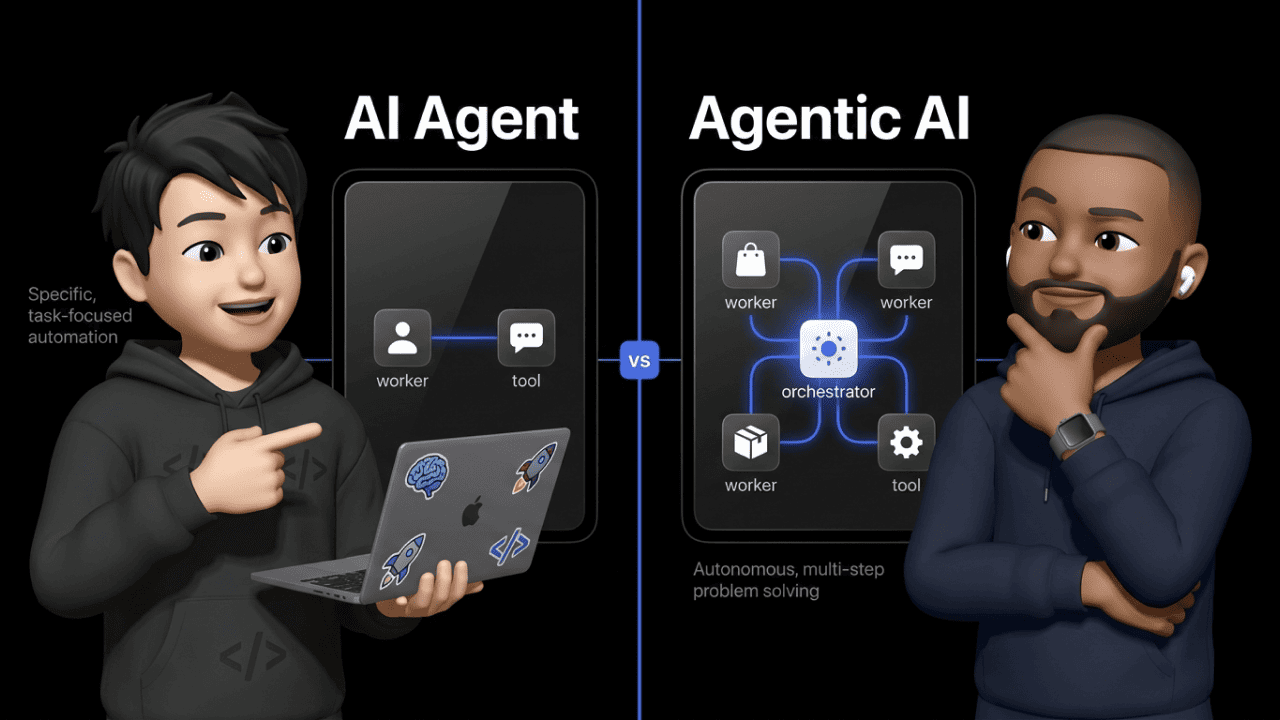

Quick rundown: An AI Agent is the worker. Agentic AI is the orchestrator. An AI Agent executes a defined command — the chatbot answering FAQs, the ticket router sorting emails. Agentic AI is the architecture pattern behind it: a system that pursues its own goals, plans in multiple steps, and coordinates several AI agents at once. If you don't separate these two cleanly in e-commerce, you'll buy "AI agents" today and wonder tomorrow why the bot falls apart on question number four.
The urgency is measurable. Gartner predicts that by 2028, 15 % of all daily work decisions will be made autonomously through agentic AI — up from zero in 2024. And the less-quoted number: Gartner expects that over 40 % of all agentic AI projects will be canceled by the end of 2027. The reasons: unclear business cases, escalating costs, insufficient risk controls. The pressure to act is real. So is the pressure to buy the wrong thing.
Agentic AI vs AI Agents in One Sentence
AI Agent: A task-oriented, rule-based system that waits for a trigger and executes a specific command within fixed parameters. Core question: How do I execute this command?
Agentic AI: An architecture paradigm for systems with high autonomy that pursue goals, plan in multiple steps, and correct themselves when things go wrong. Core question: What steps do I need to take to reach this goal — and how do I adapt if the plan fails?
The difference at a glance:
| Dimension | AI Agent | Agentic AI |
|---|---|---|
| Role | Executor | Orchestrator |
| Autonomy | Low to medium | High |
| Trigger | Needs input (e.g., user query) | Can self-initiate |
| Complexity | Repeatable, predictable tasks | Multi-layered, ambiguous goals |
| Error Handling | Fails or escalates | Reflects, replans |
| Learning | Mostly static | Continuous from feedback |
That's the answer in 60 seconds. Now let's get practical.
What an AI Agent Really Does
An AI Agent does one thing — and it does it 10,000 times a day. The customer asks about their order status. The agent pulls the order ID from Shopify. Grabs the tracking link from the DHL API. Responds. Done. The mechanics behind it — perception, reasoning, action — we've broken down in How Do AI Agents Work.
What it doesn't do: It doesn't recognize that you're in the middle of a shipping crisis with DHL and should proactively message 3,000 customers. It has no goal. It has an assignment.
At Chatarmin, we see this every day. Our AI agents in customer service resolve 56 % of all tickets without a human touching them — but only because we set them up for clearly scoped use cases: order status, returns, product questions, address changes. It works reliably.
An AI Agent isn't "dumb." It's focused. And that focus is exactly why it works in production — while many agentic systems today look better on LinkedIn posts than in actual operation.
What Agentic AI Does Differently
Agentic AI isn't a bot. It's an architecture principle. An agentic system:
- Plans in multiple steps — it breaks a goal into sub-tasks.
- Uses tools autonomously — it decides on its own when to call which API.
- Reflects on errors — if step 3 fails, it builds plan B.
- Orchestrates other agents — it delegates sub-tasks to specialized AI agents.
Here's a scenario that today is more showroom than production:
Your shop suddenly has an 18 % return rate on a new product. An agentic system would:
- Detect the problem in the dashboard (threshold exceeded).
- Analyze the last 200 return reasons from your helpdesk.
- Conclude: 60 % say "runs small."
- Update your Shopify product text to add "fits smaller than expected."
- Modify your WhatsApp post-purchase flow so new customers are warned in advance.
- Notify you via Slack and ask whether to review or auto-approve.
That's agentic AI. The key word is "would." Most productive systems in e-commerce today are AI agents with a thin agentic layer on top. And that's completely fine — because the 80/20 of tickets are covered exactly by that.
Memory & Context: Why Agentic AI Needs a Brain
A basic AI Agent forgets everything after each task. A customer messages on Monday about a return, messages again on Thursday about the same order — the agent doesn't recognize them. It starts at zero. Asks for the order ID, pulls the status, responds. Same answer as Monday. Zero context.
Agentic AI uses two memory layers:
- Short-term memory — holds context for the current task. Within a conversation, the system knows what was said three messages ago, which tools were already called, which decisions were made.
- Long-term memory — typically in the form of vector databases. The system stores who the customer is, what tickets they've had, what preferences they've shown, what worked for them.
What that means for you: personalization that doesn't evaporate after the first turn. The customer writes "I already talked to you last week about the wrong size" — and the system knows instantly what they mean. No "Can you give me your order ID again?"
The difference in practice: An AI Agent can answer 10,000 identical questions. A system with memory can handle 10,000 customers individually.
The catch is data hygiene. Long-term memory is only as good as the data going in. If your helpdesk, shop, and CRM don't play nicely together, you're not building memory — you're building data chaos with AI access. Before you invest in agentic AI, check whether your data sources are even ready for it.
Standards: MCP, A2A, and ACP
For two years, every AI vendor cooked their own soup. Now open standards are emerging. Three you should have on your radar:
- MCP (Model Context Protocol) — Anthropic's open standard. Works like a USB-C for AI models: a universal adapter that lets any AI system connect to Shopify, Zendesk, Klaviyo, PIM, or CDP. What used to be a custom connector project is now often a single configuration.
- A2A (Agent-to-Agent) — Google's standard. Lets agents from different vendors talk securely to each other and delegate tasks.
- ACP (Agent Communication Protocol) — IBM's variant, housed under Linux Foundation AI. Same purpose as A2A, different playing field.
The honest state of things: The standards question isn't settled in 2026. MCP is the most stable of the three — partly because Shopify, GitHub, Slack, and OpenAI now offer MCP servers. A2A and ACP are still competing for market share. For a deep dive on how these work with autonomous agents, read our article on Autonomous AI Agents.
What this means practically: Ask every AI vendor explicitly about MCP support. The answer tells you whether the tool is moving toward open architecture in 2026 — or whether you're walking into a five-year vendor lock-in.
The Direct Comparison: Four Dimensions That Matter
Four axes, no fluff:
1. Role — AI Agent = worker, Agentic AI = manager. The worker does one job right. The manager looks at three jobs at once and decides which goes first.
2. Architecture — Agentic AI often uses AI agents as tools. An agentic system in support can orchestrate an FAQ agent, an order-lookup agent, and a returns agent.
3. Learning — AI agents are mostly static. Train once, run forever. Agentic AI evaluates feedback, stores it in long-term memory, improves over time. In theory. In practice, the best systems are the ones where a human validates the "improvement" steps before they go live.
4. Complexity — AI agents shine on repeatable, predictable tasks. Agentic AI is what you need when the problem is ambiguous and requires planning under uncertainty:
- "Answer customer questions about shipping" → AI Agent.
- "Optimize the shipping experience for our top 20 % customers" → Agentic AI.
Remember the test: Does the task fit in one sentence with a clear output? AI Agent problem. Is the task a goal with multiple possible paths? Agentic AI problem.
Why This Difference Decides Everything for E-Commerce
Here's where it gets tangible. At Chatarmin, we have two products that both use the AI agent label — but operate on different levels.
Use Case 1: armincx — AI Customer Service. Classic AI Agent. Customer writes, the AI recognizes intent, pulls data from Shopify, Shopware, or your helpdesk (Zendesk, Freshdesk, Gorgias), responds. 56 % of all tickets run through automatically. These aren't "hi, how are you" requests — they're order status, returns, address changes, invoice questions. Because the task is clearly scoped, the AI Agent is the right answer. Not some half-baked agentic system that tries everything and is good at nothing.
Use Case 2: WhatsApp Marketing Flows. Here it gets hybrid. An abandoned-cart flow today is a classic AI Agent: trigger (abandonment) → perception (which product) → action (WhatsApp message). Open rates at 85 %. Works because the use case is tight.
It gets agentic only when the system notices: customer Anna has abandoned three times in 90 days. Always at shipping costs. So it proactively sends her a free shipping code, updates her segment, and learns that customers in her segment respond better to shipping incentives than to discounts. That's the step agentic AI enables — and most tools in the DACH market today can't pull off cleanly.
What this means for you: You need to understand both, even if you're only buying an AI Agent today. Otherwise you end up 18 months from now with an architecture that breaks exactly when you want to extend it.
Human-in-the-Loop: Why 100 % Autonomy Is an Expensive Mistake
Here's the uncomfortable truth that's missing from most agentic AI pitches: Absolute autonomy is dangerous. Not philosophically — economically. And the numbers since 2024/2025 are stronger than ever.
Sierra's τ-Bench shows: an AI Agent solves a task with about 60 % success rate on the first try. But solving the same task eight times in a row consistently? Only 25 % of the time. Translated: your customer writes the same problem three weeks in a row — and likely gets three differently-good answers. This consistency problem is exactly why "demo impressive, production disappointing" has become a running joke in the industry.
Even sharper: the Stanford/Carnegie Mellon study from November 2025 ("How Do AI Agents Do Human Work?") shows that hybrid human-AI teams outperform fully autonomous agents by 68.7 %. The human isn't the bottleneck. The human is the productivity multiplier.
The solution is Human-in-the-Loop (HITL): your agentic system runs autonomously until it hits a critical decision point. Then it pauses, requests human approval, and continues. That's the circuit breaker that prevents a hallucinated answer from a single ticket from becoming an automatic bulk refund.
Where you absolutely need HITL in e-commerce:
- Goodwill decisions above a threshold (e.g., discount codes > $50)
- Bulk actions targeting segments (e.g., sending to > 1,000 contacts)
- Product data changes in the shop (copy, pricing, variants)
- Refunds and reimbursements above a set amount
- Automatic segment re-tagging or deep CRM changes
At Chatarmin, we work exactly this way. armincx decides autonomously on routine. For anything requiring judgment, your support team gets the case with full context — one click, approved or corrected. That's not a compromise. That's why our automation stays live instead of getting shut off four weeks in.
When to Use Which System (and When Neither)
The unsexy truth: Almost every e-commerce problem is an AI Agent problem today — not an agentic AI problem.
Reach for an AI Agent when:
- The task is repeatable (order status, FAQ, returns, cart recovery)
- There's a clear start and end
- You can measure success (resolution rate, response time, conversion)
- Errors are tolerable (escalation to a human agent is possible)
Consider Agentic AI when:
- The task is multi-step and unpredictable
- Multiple systems must coordinate (CDP + shop + helpdesk + marketing)
- Context decides what happens next
- You have the budget and technical skill to run the system cleanly
Stay away if:
- Your data foundation is a mess — garbage in, garbage out applies double to agentic AI
- You don't have a clean support process yet. Automating a broken process means a faster broken process.
- You handle fewer than 2,000 tickets or orders per month. The effort-to-benefit ratio breaks.
If you're shopping for tools now, we've put together The 10 Best AI Agent Tools 2026 Compared.
The Shift You Need to Understand as an E-Commerce Marketer
Over the next 18 months, a lot of what gets pitched as "agentic AI" on SaaS slide decks will actually be AI agents with tool use and a few prompts. That's not a disaster — but you should be able to see it before signing a five-year contract.
The 40 % cancellation number from Gartner's forecast isn't random. It happens because companies buy agentic systems without the basics: clean data, clear use cases, HITL checkpoints. What protects you:
- Invest today in AI agents that solve clear use cases. Support, cart, shipping communications — that's where the ROI is right now.
- Pick an architecture that grows agentically. If your tool today doesn't make tool calls against Shopify, helpdesk, and CDP — and doesn't speak MCP — you'll be migrating in 12 months. The migration costs more than the new purchase does today.
- Don't buy into the hype. "Fully autonomous AI employees" don't exist in e-commerce support in 2026. Anyone selling you that has either a PR department or a creative product marketer.
The shift from AI agents to agentic AI is real, but it happens in layers. The brands winning in 2027 are the ones running clean AI agents in 2026. Not the ones piloting a half-baked agentic system today and explaining six months later why the rollout is delayed.
Final Take: Agentic AI vs AI Agents — What Matters
AI agents solve concrete problems today. Agentic AI is the direction. If you're serious about automation in e-commerce, you build on agents that can grow agentically — with memory, MCP support, and HITL where it counts.
At Chatarmin, we do exactly that. armincx takes the routine off your team's plate so your support focuses on cases where a human actually makes a difference. WhatsApp flows turn one-time buyers into repeat customers. Both AI-agent-based today. Both in an architecture that grows agentically when your shop needs it to.
Want to see what's possible for you today — instead of slides about agentic AI? Book a demo, and we'll show you, using your own shop, which tickets you'll have automated in 30 days and which flows will visibly lift your retention.
Frequently Asked Questions (FAQ): Agentic AI vs AI Agents
What is the difference between AI agents and agentic AI?
An AI agent is an executing program for a clearly defined single task, while agentic AI is a higher-level system that sets its own goals, plans in multiple steps, and orchestrates several agents.
What is an AI agent?
An AI agent is a rule-based, task-oriented AI system that reacts to a trigger and executes specific commands within fixed parameters, such as a customer service chatbot.
What is agentic AI?
Agentic AI is an architecture paradigm for AI systems with high autonomy that adapt dynamically, use external tools, and break down complex problems into sub-steps.
Are AI agents fully autonomous?
No, traditional AI agents have only low to moderate autonomy, as they strictly follow predefined paths and typically abort or escalate to humans when unexpected problems arise.
What role does memory play in agentic AI?
Agentic AI uses short-term and long-term memory to retain context across multiple interactions, learn from past mistakes, and make personalized decisions.
What is the Model Context Protocol (MCP)?
The Model Context Protocol (MCP) is an open standard that functions as a universal adapter to securely and consistently connect AI models with external data sources and tools.
What is the Agent Communication Protocol (ACP)?
The Agent Communication Protocol (ACP) is a standardized network protocol that lets different AI agents communicate across platforms and delegate tasks to one another.
Does agentic AI replace human employees?
No, agentic AI takes over complex and time-consuming workflows but still requires strategic oversight and approval by humans for critical, high-risk decisions.
What is Human-in-the-Loop (HITL) for AI agents?
Human-in-the-Loop is a safety concept where autonomous AI systems pause at critical decision points to obtain approval or correction from a human expert.
Which industries benefit most from agentic AI?
Data-intensive and process-heavy industries like e-commerce, software development, finance, and supply chain management benefit the most from agentic AI's orchestration capabilities.