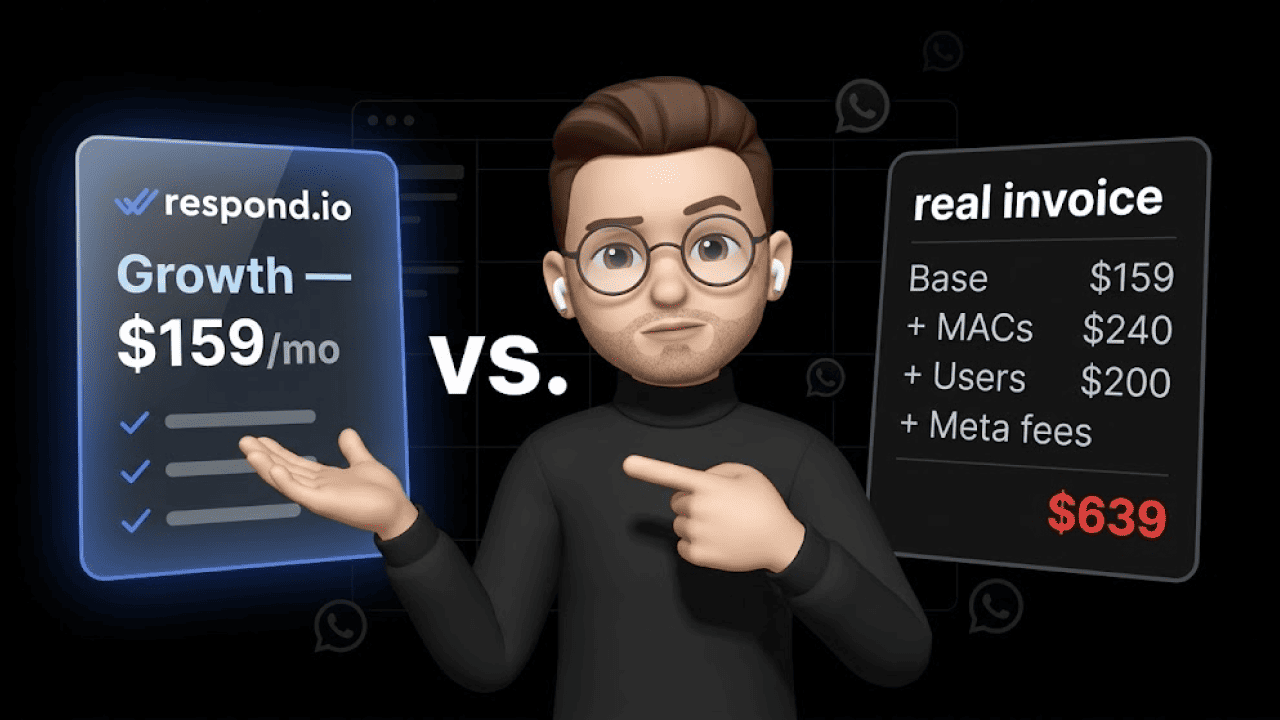

What does respond.io cost in 2026? The four plans start at $79/month for Starter, $159/month for Growth, and $279/month for Advanced — all on annual billing. Monthly billing costs roughly 20 % more ($99/$199/$349). Enterprise is on request. On top of that, you pay Meta's WhatsApp fees and usage-based costs for Monthly Active Contacts as soon as customers reply to your campaigns.
Four plans. Sounds clear. It isn't. Because the sticker price is only part of the actual bill. The rest comes from active contacts, additional users, and Meta fees. Four cost centers. Four levers. All scale independently. We'll walk through each — and run three real-world scenarios.
One thing upfront: respond.io is a serious product. The platform has a G2 rating of 4.8 out of 5 stars across more than 450 reviews, is ISO 27001 certified, and is an official Meta Business Partner. According to its own numbers, over 10,000 brands in more than 85 countries use the platform. The question isn't whether respond.io works. The question is whether the pricing model fits your growth.
The four respond.io plans at a glance
respond.io structures its pricing in four tiers. What stands out: the jumps between plans aren't linear, they're functional. The cheapest plan barely lets you do what you'd actually buy the software for.
Starter — $79/month (annual). Five users included. But: no broadcasts, no workflows, no AI Agents. You get an inbox. For e-commerce teams that want to run WhatsApp marketing, this plan is a dead end.
Growth — $159/month (annual). Ten users included. This is where respond.io becomes a marketing platform: broadcasts, workflows, AI Agents, Zapier integration, WhatsApp Calling. You start with 1,000 Monthly Active Contacts.
Advanced — $279/month (annual). Ten users included. On top: SSO, Salesforce integration, multiple workspaces, HTTP requests in workflows, advanced reporting. The MAC baseline stays at 1,000 — so you pay more for integrations but don't get a higher contact volume.
Enterprise — on request. Custom pricing, a dedicated success manager, higher API limits — and the only plan without hard caps: unlimited user seats, custom MAC quotas.
| Starter | Growth | Advanced | Enterprise | |
|---|---|---|---|---|
| Price/month (annual) | $79 | $159 | $279 | on request |
| Price/month (monthly) | $99 | $199 | $349 | on request |
| Users included | 5 | 10 | 10 | unlimited |
| MACs included | unlimited* | 1,000 | 1,000 | custom |
| Broadcasts | No | Yes | Yes | Yes |
| Workflows / AI Agents | No | Yes | Yes | Yes |
| AI Voice Agents | No | No | Yes | Yes |
| WhatsApp Calling | No | Yes | Yes | Yes |
| SSO / Salesforce | No | No | Yes | Yes |
| Additional user | +$12/mo | +$20/mo | +$24/mo | custom |
*Unlimited contacts in Starter sounds attractive. Without broadcasts and automation, you can't reach them proactively.
Monthly Active Contacts: the mechanics behind your bill
Monthly Active Contacts (MACs) are the central cost driver at respond.io — and the part where most misunderstandings happen.
A MAC is any contact you have an active conversation with during a billing month. You message them and they reply? Counts. They message you? Also counts. A contact you interact with three times in a month stays one MAC — but they still occupy one of your 1,000 included slots.
The key point: Broadcasts do not count as MACs. If you send a campaign to 5,000 contacts and nobody replies, you've used zero additional MACs. Sounds good at first.
But a broadcast without replies is a broadcast that didn't move the needle. The cost question kicks in exactly when your campaign generates resonance. With a 30 % reply rate on 5,000 contacts, that's 1,500 conversations and 1,500 MACs. After the 1,000 included, 500 additional MACs remain — and those cost extra.
My take: The MAC model isn't a bug, it's the business model. At respond.io, the good campaign pays. Higher reply rate, higher bill. Fair model for platforms used primarily as inboxes. For marketing teams that welcome engagement, it's the wrong pricing structure.
If you want to dig deeper into the mechanics, our guide on WhatsApp newsletter costs walks through reply rates and response patterns from the DACH market.
Overage fees: what happens when you exceed your MAC limit
If you go over your MAC limit, your account isn't suspended. Instead, respond.io charges overage fees at the end of your billing cycle:
- Growth plan: +$12 per 100 additional MACs
- Advanced plan: +$15 per 100 additional MACs
respond.io itself notes that on-demand MACs are meant for seasonal peaks. If you're consistently over the limit, upgrading your plan is more cost-effective. In practice: For Black Friday or a one-off product launch, overage fees are fine. For a growing e-commerce team with steady volume, they quickly become the line item that throws off your original plan calculation.
Practical tip: respond.io lets you increase your MAC tier within your plan without switching plans. Concrete example: Instead of paying overage fees every month for 5,000 active contacts on Growth, you can lift the MAC tier directly to 5,000 — which according to Chatimize lands at around $219/month, considerably less than running monthly overage. Volume discounts are available on Growth and Advanced at higher contact tiers.
User costs: every seat is billed separately
The included user seats are enough for small teams. As your support or sales team grows, you pay per additional seat:
- Starter: +$12/month per user (annual billing)
- Growth: +$20/month per user
- Advanced: +$24/month per user
A concrete example: a 20-person support team on Growth. That's 10 additional users × $20 = $200 extra per month — just for the seats. Plus base price. Plus MACs. Plus Meta fees.
Meta fees and zero markup: what respond.io gets right
respond.io passes Meta's official WhatsApp conversation fees through without its own markup. Zero markup. Some competitors add double-digit percentage markups on every Meta conversation — to see how a 20 % markup plays out concretely, check our breakdown of the Wati pricing. At high message volumes, that saves a three-figure amount per month.
The catch: Meta switched to per-message pricing on July 1, 2025. Instead of conversation-based billing (the 24-hour window), every single template message — marketing, utility, authentication — is now billed individually. That makes cost planning more complex and raises the value of the free windows.
Your real monthly bill ends up as a combination of four line items: plan costs, overage fees, user costs, Meta fees. All four vary independently. Meta publishes the exact per-message rates per country and category in its official pricing documentation.
WhatsApp Calling, Coexistence, and Free Entry Points
WhatsApp Calling. respond.io markets WhatsApp Calling as a feature. Inbound calls are free, outbound calls cost Meta's per-minute rates — no markup from respond.io. Important restriction: According to the respond.io help center, business-initiated calls are not available in five countries: the U.S., Canada, Turkey, Vietnam, and Nigeria. In the UAE, Saudi Arabia, Qatar, and Egypt, calls technically work but are unreliable due to local regulations — calls can intermittently fail or drop. For merchants with customers in those markets, both points matter before you commit.
WhatsApp Coexistence. Used to be: WhatsApp Business App or WhatsApp Business API. respond.io offers both in parallel on the same number — the App for simple chats, the API for broadcasts and automation. For teams that want to migrate to the API gradually, this lowers the entry barrier.
Free Entry Points. When a customer starts a chat via a Click-to-WhatsApp ad or Facebook Page CTA and you reply within 24 hours, a 72-hour window opens in which all messages — including marketing templates — are free. That's a Meta rule and applies across platforms. But teams who use it systematically save noticeably on the monthly Meta bill. The mechanic plays particularly well with automated WhatsApp flows that fire right after the ad click.
Three scenarios calculated
Numbers say more than plan listings. Three situations that show how the real bill looks.
Scenario 1: Black Friday broadcast. You send a campaign to 5,000 contacts. At 30 % reply rate, that's 1,500 MACs. On Growth: $159 + 5 × $12 = $219. At 60 % reply rate (strong offer, good segmentation), that's 3,000 MACs. On Growth: $159 + 20 × $12 = $399. The bill rises with campaign performance.
Scenario 2: Steady support with 3,000 active contacts. Not a one-time peak — the new normal for a growing D2C shop. On Growth you pay continuously: $399/month. That's $4,788 per year — for a platform whose pricing page advertises $159.
Scenario 3: 20-person team on Growth. 10 additional users × $20 = $200 just for seats. At 3,000 MACs: 159 + 200 + 240 = $599/month plus Meta fees.
What starts as a $159 promise quickly turns into $400 to $700 in practice — depending on team size and reply rates. Buy the sticker price and you'll be surprised. Run the numbers and you plan realistically. It's not a hidden trick. It's the logic of the MAC model.
Hidden line items in 2026: Authentication-International
For internationally operating merchants, this is the kind of item that often only shows up on the bill: If your WhatsApp Business Account is registered in country A and you send an authentication message (OTP) to a customer in country B, Meta applies the Authentication-International rate. Depending on the market, this rate runs 3× to 20× the domestic authentication rate. Sources like Engagelab cite 3–18×, Message Central reports peaks up to 20×. If you want to dig deeper into how WhatsApp API pricing 2026 breaks down across markets, categories, and volume tiers, you'll find the full breakdown on our blog.
respond.io passes these Meta fees through without markup. Meaning: It's not a respond.io-specific trap, it's a Meta rule. But if you run OTP flows over WhatsApp and verify users internationally, budget for this separately — otherwise you end up with a month-end bill you didn't plan for. A practical workaround: local WABA accounts per country to avoid the Authentication-International rate.
Another note on monthly billing: Pay monthly instead of annually and you pay roughly 20 % more — $99/$199/$349 instead of $79/$159/$279. Not a huge amount for small teams, but at enterprise setups it adds up to a four-figure annual difference.
Where respond.io fits — and where armincx is the better choice
respond.io is a fit if you:
- need an omnichannel inbox (WhatsApp, Telegram, Messenger, Instagram, email in one tool)
- primarily manage inbound messages and want to assign conversations across a team
- have fewer than 1,000 active contacts per month and stay on the Growth plan
- scale internationally and don't need a DACH-specific tech stack
- need ISO 27001 compliance for your procurement department
respond.io becomes a bottleneck if you:
- use WhatsApp actively as a marketing channel — every reply pushes MAC costs up
- have seasonal peaks — that's exactly when MACs explode
- build a team of more than 10 people — user costs add up
- need DACH-specific integrations (JTL, Xentral, Shopware, Billbee) — respond.io focuses on the global market
- need EU hosting and German-speaking support with a DPA — respond.io is headquartered in Kuala Lumpur, Malaysia
- need to rule out U.S.-server compliance for regulated industries (finance, healthcare)
That's exactly where we come in — with two products: Chatarmin for scalable WhatsApp marketing, and armincx for AI-powered customer service. armincx is the direct alternative for e-commerce teams that would use respond.io primarily as a support and inbox tool: all channels in one central inbox, AI Agents that don't just reply but execute actions in Shopify, JTL, Xentral, or Shopware — and a pricing model that doesn't scale with Monthly Active Contacts.
Which path makes sense for your setup depends on volume, growth trajectory, and tech stack. If you're not sure: 30 minutes, no bullshit — we'll run the numbers on your case.
FAQ: Respond.io pricing and costs
How much does respond.io cost per month?
respond.io costs $79 (Starter), $159 (Growth), and $279 (Advanced) per month on annual billing. On monthly billing, it's $99, $199, and $349 — plus Meta fees and overage fees if you exceed your MAC limit.
Are WhatsApp fees included in the respond.io price?
No. Meta's WhatsApp conversation fees are charged separately. respond.io passes them through at zero markup.
What is a Monthly Active Contact (MAC)?
A MAC is any contact you have an active conversation with during a billing month — whether you initiate or they do. Pure broadcasts don't count. Only a reply turns the contact into a MAC.
Do broadcasts count toward MACs?
No. Pure broadcast messages don't count. A contact only becomes a billable MAC when an active conversation occurs — for example, when they reply to your broadcast.
What happens if I exceed my MAC limit?
Your account stays active. Overage fees apply: $12 per 100 additional MACs on Growth, $15 per 100 MACs on Advanced. The charge is billed at the end of your cycle.
In which countries does WhatsApp Calling via respond.io not work?
According to respond.io, business-initiated (outbound) calls aren't available in the U.S., Canada, Turkey, Vietnam, and Nigeria. In the UAE, Saudi Arabia, Qatar, and Egypt, calls technically work but are unreliable due to local regulations.
How much does WhatsApp Calling via respond.io cost?
Inbound calls are free. Outbound calls are billed at Meta's per-minute rates — respond.io adds no markup. Per-minute prices vary by recipient country.
Does respond.io offer a free plan?
No, there's no permanent free plan. respond.io offers a 7-day free trial on all plans — no credit card required.
What is the Authentication-International cost trap?
If you send authentication messages (OTPs) from one country to another, Meta applies the Authentication-International rate — depending on the market, that's 3× to 20× the domestic rate. respond.io passes these Meta fees through without markup.
How do I save on Meta fees with respond.io?
Use Free Entry Points: When a customer starts a chat via a Click-to-WhatsApp ad or Facebook Page CTA and you reply within 24 hours, all messages within the following 72-hour window are free — including marketing templates.
Is the Starter plan from respond.io worth it?
No, not for e-commerce teams with marketing ambitions. Starter lacks broadcasts, workflows, AI Agents, and the WhatsApp Business API — for active campaigns you need at least the Growth plan.
What does onboarding cost at respond.io?
respond.io states that no onboarding or number-porting fees are charged. The 28-day onboarding program for B2C companies is part of the offering — available, but subject to onboarding specialist capacity.
Can I keep my existing WhatsApp number?
Yes. With WhatsApp Coexistence, the WhatsApp Business App and the API can run in parallel on the same number. Number porting is offered by respond.io without additional fees.
What is the respond.io alternative for DACH e-commerce?
armincx is the AI-first Customer Experience Suite from Chatarmin — built for DACH e-commerce with native integrations to Shopify, JTL, Xentral, Shopware, and Billbee. Instead of a MAC model, it works with a flat rate including users and variable costs only for AI-generated replies.