
WhatsApp newsletter costs – that's the question everyone asks. But honestly? It's the wrong question.
The right question is: What does each message bring me in return? Because while you're sending emails for a fraction of a cent, your mail ends up in spam or gets ignored. With WhatsApp, 98% of recipients open your message. With email, it's 20% if you're lucky.
Still, I get it. You want to know what you're getting into. So let's talk straight.
Why "Free" Is No Longer an Option
Maybe you're thinking: "I'll just use the free WhatsApp Business App." Sounds tempting, but it's a risk.
The problem: The Business App accesses your entire phone contacts. That's a GDPR violation that can cost you dearly. Fines in the five-figure range are not uncommon. On top of that: if you send mass messages through the app, Meta will ban your account. Without warning. And even if they don't – you're limited to 256 contacts per broadcast list. That won't get you far.
"Free" here means: You pay with risk. And in the worst case, with your business.
For professional WhatsApp marketing, you need the WhatsApp Business API. It's GDPR-compliant, scalable – and yes, it costs money. But a reputable provider hosts your data on EU servers (ours are in Frankfurt) so you can sleep at night.
The Meta Pricing Model 2026: Per-Message Pricing
Since mid-2025, Meta has completely overhauled its billing model. Forget everything you've read about "cost per conversation." That's history.
Today's reality: You pay per message. More specifically: per template message you send.
Meta distinguishes four categories with different prices:
Marketing messages are the most expensive. This includes promos, offers, discount codes – anything designed to sell. In Germany, you currently pay approximately €0.11 per message. Sounds like a lot? Wait for it.
Utility messages cost less – approximately €0.045. These are transactional messages like shipping confirmations, appointment reminders, or order updates. And here's the kicker: Utility messages are completely free when sent within an open service window.
Authentication messages for one-time passwords (OTPs) are approximately €0.06.
Service messages – replies to customer inquiries within 24 hours – are completely free. This is a massive lever for your support and, as you'll see shortly, for your entire sales process.
Important: Prices vary by recipient country. Germany is one of the more expensive markets. If you're sending to customers in Italy, Spain, or India, you'll pay only a fraction. For internationally operating brands, this can be a real cost advantage.
You'll find all official and current prices directly on Meta's WhatsApp Business Platform Pricing page. For a detailed breakdown, check out our guide on WhatsApp Business Costs 2026.
The Mixed-Template Trap: How You're Burning Money Without Realizing It
⚠️ Pro Tip: The Most Expensive Cost Trap Almost Everyone Falls Into
You think a shipping confirmation is a cheap utility message? Not if you attach a discount code.
Meta scans every template. If your "utility" message contains even one promotional element – be it a discount code, an upsell hint, or a "check this out too" – it's automatically billed as a marketing message. Instead of €0.045, you're suddenly paying €0.11. Per message. With 10,000 shipping confirmations per month, that's €650 in extra costs you could have avoided.
The solution: Separate strictly. Shipping info is shipping info. Promotion is promotion. Two templates, two messages – but clean costs.
The Two Cost Blocks of a WhatsApp Solution
If you want to send WhatsApp newsletters professionally, you have two cost blocks:
Block 1: Meta Fees (Variable Costs)
These are the per-message costs that go directly to Meta. They vary by message category and recipient country. You'll have these costs with any provider – they're pass-through charges that no one profits from.
Good to know: For high-volume senders, Meta now offers automatic volume discounts (Volume Tiers) for Utility and Authentication messages. The more you send, the cheaper it gets per message. For enterprise customers with high volume, this can make a real difference.
Block 2: Software Costs (Fixed Costs)
Here you pay for the tool that gives you access to the WhatsApp API. This includes: flow builder for automations, integrations (Shopify, Klaviyo, HubSpot), analytics, AI features, and support. Prices vary by provider – market standard is starting at approximately €99 per month for professional solutions with real features.
Important: The software fee is fixed. Meta fees scale with your sending volume.
Pro Tips: How to Cut Your Costs
Now it gets interesting. Because if you're smart, you can drastically reduce your WhatsApp costs.
1. Use Free Entry Points
When a customer contacts you through a Click-to-WhatsApp Ad (Facebook or Instagram), you get 72 hours of free messaging. During this period, you can even send marketing templates – without Meta fees. This is the biggest lever for performance marketing.
2. Activate the Service Window
As soon as a customer replies to you, a 24-hour window opens. During this time, all your responses are free – including utility templates. Encourage your recipients to interact: "Reply YES to receive exclusive offers."
3. Segment Instead of Spray-and-Pray
This is where good integration pays off. Those who properly use their Shopify or Klaviyo data send only to relevant segments. The result: fewer messages, higher conversion, lower costs.
4. Separate Marketing from Utility – Consistently
Shipping confirmations are utility, not marketing. Those who separate cleanly (see mixed-template trap above) save about 6.5 cents on every transactional message. With 10,000 messages per month, that's a €650 difference.
From Newsletter to Sales Conversation: Consultational Commerce
This is where the real leverage lies – and where the pros separate themselves from the amateurs.
Most people think of "WhatsApp newsletter" as broadcasting: message out, done. But that's 2020 thinking.
2026 is about Consultational Commerce. This means: Your newsletter isn't the end, it's the beginning of a sales conversation. You send a campaign, the customer replies with a question – and now your AI automation takes over. It advises, recommends products, handles objections. All in chat. All personalized.
The cost trick here: As soon as the customer replies, the service window opens. Your AI can interact with them for 24 hours – for free. The newsletter costs you €0.11 per recipient. The subsequent sales conversation? Free.
The result: The costs of the newsletter aren't just offset by conversion in chat – they're obliterated.
WhatsApp vs. Email: The ROI Calculation
"Email is free!" – Yes, but what good is a message that no one reads?
Let's do the math. You send 10,000 messages:
| Channel | Open Rate | Click Rate | Conversion | Revenue (at avg. €50 cart value) |
|---|---|---|---|---|
| 20% | 2% | 1% | €1,000 | |
| 98% | 15% | 5% | €24,500 |
The WhatsApp campaign costs you about €1,100 at €0.11 per message. Your ROI? Over 2,000%.
Of course, these are average values. But they show: WhatsApp isn't a cost factor, it's a profit center. You'll find the complete channel comparison in our article WhatsApp Marketing vs. Email Marketing.
What Real Companies Achieve with WhatsApp
Numbers are nice. Results are better. Here are some real-world examples:
Alpurial, a supplements brand, achieves an ROAS of 81.9x with WhatsApp campaigns. Yes, you read that right. For every euro invested, almost 82 euros come back. The combination of personalized offers, fast response time, and clever timing makes the difference. View the Alpurial Case Study
PAPER & TEA uses WhatsApp for seasonal campaigns and lead generation – with an ROAS of 13.4x. That's not luck, it's the result of a well-thought-out segmentation strategy. View the PAPER & TEA Case Study
feey, the Swiss plant shop, relies on WhatsApp for restock reminders and product consultation. The channel is perfect for products that need explanation – and the conversion rates speak for themselves. View the feey Case Study
These brands have understood: It's not about the cost per message. It's about the revenue per message.
The Hidden Costs of the "Free Solution"
![Image placeholder: Warning signs or risk icons – GDPR, ban, limit, no tracking]
Finally, a reality check. The WhatsApp Business App is free. But:
GDPR risk: Access to contacts = potential fines
Account ban: Mass messages = Goodbye account
Limit: Maximum 256 contacts per broadcast
No tracking: No idea what's working
No automation: Everything manual, no scaling
No support: Problems? Good luck.
A GDPR fine costs you more than years of software fees. A banned account costs you your direct line to thousands of customers. That's not savings. That's Russian Roulette.
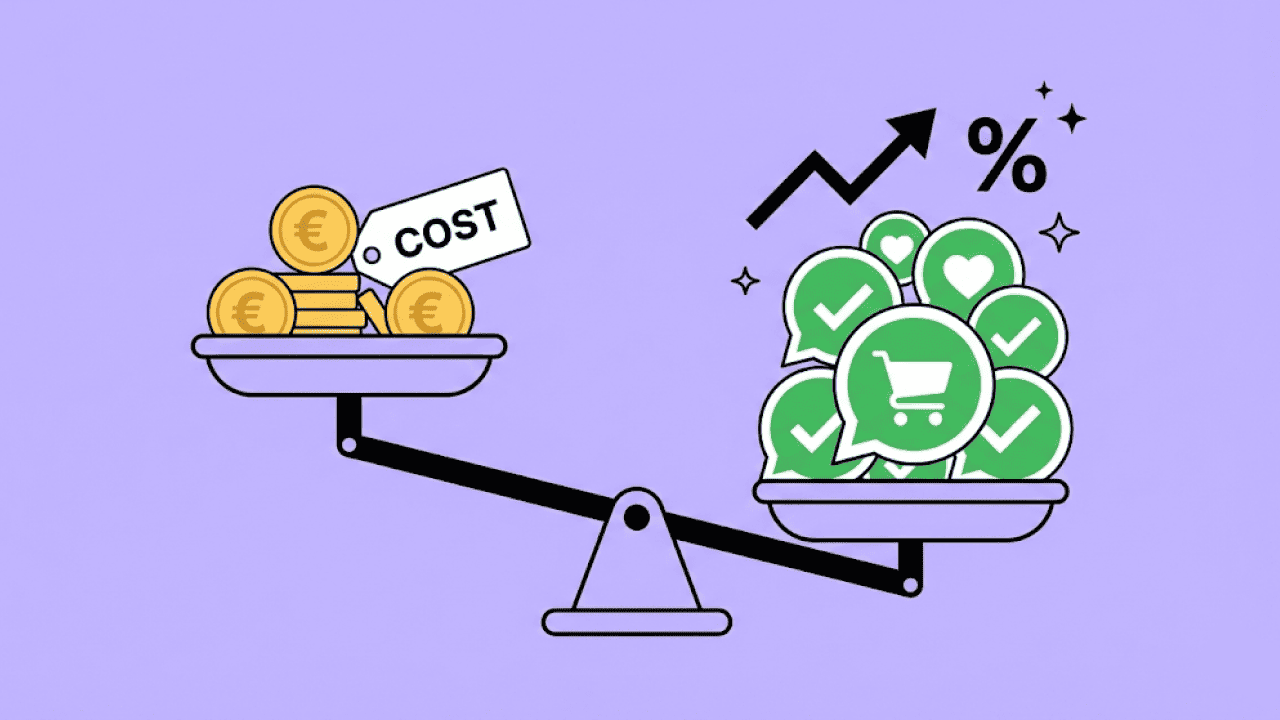
Conclusion: WhatsApp Marketing Isn't Cheap – But It's Extremely Profitable
![Image placeholder: Summary graphic – Costs vs. ROI or "Investment vs. Return"]
WhatsApp newsletters cost money. That's true. But they also make money. Much more than they cost.
The question isn't: "Can I afford WhatsApp marketing?"
The question is: "Can I afford to miss out on 98% open rates?"
Want to know how WhatsApp pencils out for your business? Let's talk. No sales pitch, no PowerPoint battle. Just an honest assessment of whether WhatsApp makes sense for you.
FAQ: The 10 Most Common Questions About WhatsApp Newsletter Costs
What does a WhatsApp newsletter cost per message in 2026?
In Germany, a marketing message (newsletter) costs approximately €0.11. Transactional messages (utility) are around €0.045. Prices vary by recipient country.
Are there free WhatsApp newsletters?
No, commercial newsletters via the WhatsApp Business API always have costs. The free Business App is not GDPR-compliant, limited to 256 contacts, and unsuitable for mass sending.
When are WhatsApp messages free for businesses?
Service messages are free when a customer initiates contact and the business responds within 24 hours. Additionally, the first 72 hours after a Click-to-WhatsApp ad are free of charge.
What makes up the costs for WhatsApp marketing?
Costs consist of two blocks: variable fees from Meta per message (pass-through costs) and monthly software fees from the provider (WhatsApp Business Solution Provider).
What's the difference between marketing and utility pricing?
Marketing messages (advertising, promos) are significantly more expensive than utility messages (shipping info, updates). Important: If a utility message contains promotional elements, Meta automatically charges the higher marketing price.
Is WhatsApp marketing worth it despite the costs?
Yes. With open rates of up to 98% and ROI often exceeding 2,000%, costs typically pay off within the first campaign. Brands like Alpurial achieve an ROAS of over 80x.
Are there volume discounts for WhatsApp Business?
Yes, Meta offers automatic discount tiers (Volume Tiers) for utility and authentication messages once sending volume exceeds certain thresholds.
Why isn't the WhatsApp Business App an alternative for newsletters?
It's limited to 256 contacts per broadcast list, offers no automation, violates GDPR through contact uploads, and risks account suspension for mass sending.
What does WhatsApp Business API software cost?
Professional software solutions typically start at around €99 per month. This includes GDPR compliance, integrations (e.g., Shopify, Klaviyo), automations, and real support.
Are customer replies charged?
No, incoming messages from customers are always free. If you respond within 24 hours (service window), your replies are also free of charge.