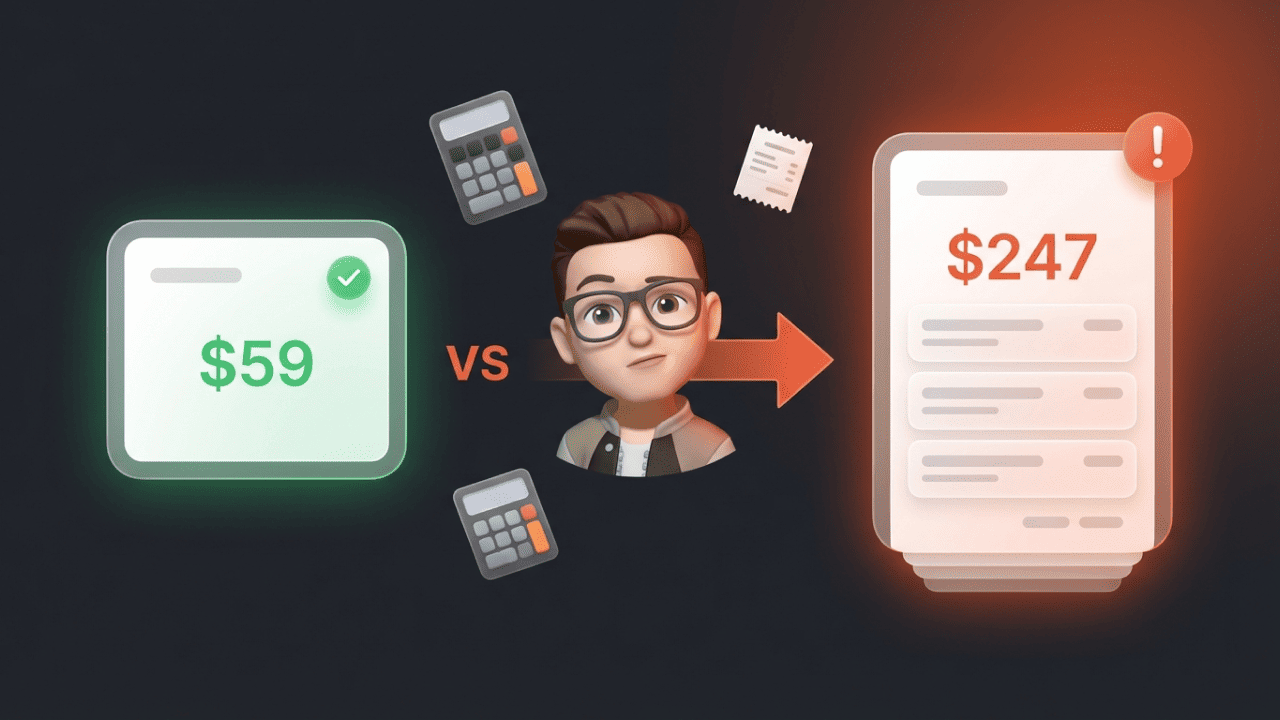

Wati pricing starts at $59 per month according to the pricing page. That's the standard opener in just about every Wati comparison — and it misses the point.
Wati is one of the few BSPs in the market whose total cost of ownership is determined by three independent scaling axes: sending volume, team size, and workflow depth. Each axis has its own mechanics, its own thresholds, and its own multiplier effect. When your shop grows, all three typically grow at the same time.
Most Wati pricing articles list plan tiers and end with an example calculation. This one does the opposite: each of the three mechanics first, then the synthesis in two realistic scenarios. The goal isn't to give you a final number — it's to help you diagnose which axis hits your setup hardest before you sign the contract.
What Wati Officially Costs — Three Plans, Three Ceilings
Wati currently offers three plans plus a separate pay-as-you-go plan (primarily for India). All prices in US dollars on annual billing.
| Plan | $/month (annual) | $/month (monthly) | Users included | Triggers/month |
|---|---|---|---|---|
| Growth | $59 (~€50) | $69 (~€59) | 3 (not expandable) | 1,000 |
| Pro | $119 (~€102) | $149 (~€127) | 5 | 2,000 |
| Business | $279 (~€238) | $349 (~€298) | 5 | 5,000 |
Source: wati.io/pricing, as of May 2026. EUR equivalents at the spot rate ~0.853 EUR/USD.
That's the official pricing table. What it doesn't show: these subscription fees are only the base layer. The actual monthly bill emerges from the interplay with three scaling mechanics — which Wati itself describes in its help documentation as "Subscription Fee + Messaging Fee + Add-Ons." Anyone calculating only the first layer is planning past the actual setup.
Three observations relevant for the axes that follow:
- Growth plan is hard-capped at 3 users. No expansion possible.
- Pro and Business differ by nearly 3× on per-user pricing ($24 vs. $69).
- Trigger limits scale sublinearly with plan tier (Growth → Pro = 2×, Pro → Business = 2.5×).
Axis 1 — Sending Volume: ~20% Markup According to Third Parties
Since July 1, 2025, Meta charges the WhatsApp Business API per delivered template message. Costs vary by category (Marketing, Utility, Authentication) and recipient country. Service messages within the 24-hour customer service window remain free — that rule has been in place since November 1, 2024.
That's the Meta model. Axis 1 starts here.
Wati does not pass through Meta prices 1:1, according to multiple independent sources. Spur, YCloud, Heltar, and QuickReply report a markup of approximately 20% per template message. The most concretely documented case is the Indian market, where QuickReply.ai and Spur record specific figures ($0.0099 Meta rate vs. $0.0119 Wati rate — a 20.2% markup). Wati doesn't publish a country-specific markup figure of its own.
What This Means at European Meta Rates
A marketing message to Germany costs ca. $0.13 at Meta — currently the highest-rate market in Western Europe. At a 20% markup, that's $0.026 additional per message. Translated into typical monthly volumes:
| Monthly volume | Wati markup (DE rate) |
|---|---|
| 5,000 marketing messages | ~$130 |
| 10,000 marketing messages | ~$260 |
| 20,000 marketing messages | ~$520 |
Threshold: This axis becomes quantifiably relevant from ~5,000 marketing messages per month. It scales linearly with volume — meaning the markup is highest in exactly the months when a shop sells the most (Black Friday, Christmas, summer sales).
Axis 2 — Team Size: Hard Caps and a Threefold Per-User Jump
The plan caps for included users look manageable at first glance. What they actually cost depends on when your team grows past the included headcount — and which plan that forces you into.
| Plan | Users included | Per additional user |
|---|---|---|
| Growth | 3 | not possible |
| Pro | 5 | $24/month (~€20) |
| Business | 5 | $69/month (~€59) |
The mechanic has two jump points:
Jump point 1 — the fourth user. Growth plan ends at 3 users. Anyone needing a fourth agent has to upgrade to Pro — that's $59 → $119 plus $24 for the fourth slot. "Growth is enough for us" turns into $143/month at that moment. The pricing logic makes the fourth user the most expensive user in the entire setup.
Jump point 2 — Pro to Business. Anyone needing multi-number setup, IP whitelisting, or Salesforce integration ends up on Business. The per-user price jumps there from $24 to $69 — nearly factor 3, with no change in user functionality. For 8 agents on Business, additional users alone cost $207/month — on Pro that would be $72.
Threshold: This axis becomes relevant from the 4th user (forced plan switch) and quantifiable from the 6th user (recurring per-user costs). For a 10-person team on the Pro plan: $119 + 5 × $24 = $239/month — before a single message is sent.
Axis 3 — Workflow Depth: Trigger Caps, Add-Ons, and Two AI Buckets
The third axis is the least transparent — and the most underestimated in many Wati comparisons. It kicks in once you start automating WhatsApp seriously.
Automation Triggers as a Hidden Volume Cap
Every time a Wati automation (chatbot, keyword rule, workflow) fires, it counts as one trigger. The quota is on the pricing page — the unit price for top-ups isn't.
For a shop with 10,000 monthly orders — order confirmations, shipping updates, abandoned-cart reminders all automated — 1,000 triggers run out within days. Wati doesn't prominently publish a fixed unit price; third-party sources like Prospeo cite ~$40 per 1,000 triggers, varying by region.
Shopify as a Paid Add-On
One of the central e-commerce integrations isn't included in the standard package: the Shopify app costs $4.99/month extra. Without the add-on, abandoned-cart recovery, COD verification, and automated order updates aren't available.
Two AI Functions With Separate Quotas
Wati has two AI functions that get conflated in many comparisons — but they have separate quotas:
| AI Function | What it does | Growth | Pro | Business |
|---|---|---|---|---|
| AI Co-pilot Credits | Reply suggestions for agents | 250 | 500 | 1,500 |
| AI Support Agent Replies | AI bot chats with customers directly | – | 250 | 1,000 |
Source: wati.io/pricing and support.wati.io. Top-up prices aren't prominently disclosed by Wati; third-party sources cite ~$60 per 1,000 additional AI Support Agent replies.
Threshold: This axis becomes relevant from ~5,000 monthly orders or from your first production AI bot. It's the only one of the three axes whose specific top-up unit prices aren't prominently disclosed in Wati's public documentation (as of May 2026).
Where the Three Axes Intersect — Two Realistic Scenarios
Each axis is one thing. What matters is the sum — because in practice, all three apply at the same time.
Scenario A: Small European Shop (~€1M revenue)
5,000 marketing messages/month, 4 agents (Pro plan from day one), Shopify connection, trigger quota sufficient.
| Item | $/month | Driving axis |
|---|---|---|
| Pro plan base fee | $119 | (setup) |
| Additional agents | $0 | Axis 2 (4th user = plan switch) |
| Sending markup (5k DE)¹ | ~$130 | Axis 1 |
| Shopify add-on | $4.99 | Axis 3 |
| Total monthly | ~$254 |
Main cost driver here: Axis 2. Not the markup, but the forced jump into the Pro plan starting at the fourth agent.
Scenario B: Growing European Shop (~€5M revenue)
20,000 marketing messages/month, 8 agents, Shopify connection, 1,000 additional triggers purchased.
| Item | $/month | Driving axis |
|---|---|---|
| Pro plan base fee | $119 | (setup) |
| 3 additional agents (3 × $24) | $72 | Axis 2 |
| Sending markup (20k DE)¹ | ~$520 | Axis 1 |
| Shopify add-on | $4.99 | Axis 3 |
| Extra triggers (1,000) | ~$40 | Axis 3 |
| Total monthly | ~$756 |
Main cost driver here: Axis 1. The sending markup dominates by far and grows linearly with volume.
¹ Assumptions: ~20% markup per third-party reports (Spur, YCloud, Heltar, QuickReply); Germany Meta rate ~$0.13 for marketing messages; Pro plan as a realistic baseline. Calculation: volume × $0.13 × 0.20 = markup share. Exact Meta rates are visible in the Wati wallet or the official Meta rate card; they're updated periodically and vary by recipient country (Austria/Switzerland fall under the "Rest of Western Europe" pricing zone).
The Fourth Theme That Doesn't Fit Any of the Three Axes — GDPR
The three scaling axes are pure pricing mechanics. There's a fourth dimension, however, that operates independently of volume, team, or workflow: compliance.
Wati is operated by Hong Kong-based Clare.AI Limited (Unit 101, 29/F, Tower 5, The Gateway, 15 Canton Road, Tsim Sha Tsui). Sources: Wati T&Cs, privacy policy, LinkedIn, Pitchbook.
For B2C e-commerce in the EU and UK processing personal data via WhatsApp, that means in practice: a clean Data Processing Agreement (DPA), engagement with cross-border data transfers into a country without an adequacy decision, and a Data Protection Impact Assessment (DPIA) where applicable. Solvable — but time-consuming and potentially involving legal fees. Providers headquartered and hosting within the EU — like Chatarmin in Vienna — make this point moot.
Wati vs. Chatarmin: How the Three Axes Compare
The three axes are a diagnostic tool — they also work as a structural BSP comparison framework.
Axis 1 (volume): Chatarmin doesn't add a percentage markup to Meta messages. Identical Meta rates pass through 1:1. For a typical European volume (5,000–20,000 marketing messages/month) and the ~20% Wati markup reported by third parties, the resulting difference works out to $130 to $520 per month — assuming a current Meta rate of ca. $0.13 for Germany.
Axis 2 (team): Chatarmin uses a package-based pricing model with included users instead of hard plan caps with per-user jumps. That makes seasonal scaling easier to budget.
Axis 3 (workflow): Shopify and Klaviyo are natively integrated — no separate add-on, no plugin workaround. Plus WhatsApp Flows out of the box: native forms, calendar picker, and navigation lists directly inside the chat.
GDPR layer: EU servers, Vienna-based company, DPA available from day one, no third-country transfer.
What we don't do: publish prices on the website. We're sales-led — because every use case is different and we build the setup based on actual volume, team size, and workflow depth.
Before You Sign: One Self-Check Question per Axis
- Axis 1 (volume): How many marketing messages per month, into which recipient countries — today and 12 months from now?
- Axis 2 (team): How many agents do you need today? When does the 4th and 6th come on? What does it look like in peak season?
- Axis 3 (workflow): How many automations are running in production? Do you need Shopify depth, an AI bot, or both?
Answer all three honestly and the total cost estimate practically writes itself — and you'll know whether a different BSP is structurally better for one of the axes.
Want WhatsApp as a revenue channel — with transparent pricing and EU hosting? Book a demo with Chatarmin. No markups on Meta messages, DPA from day one, EU servers.
Frequently Asked Questions About Wati Pricing
How much does Wati actually cost for a European shop?
Between $250 and $750 per month for a typical European e-commerce setup. The actual figure depends on three factors: sending volume, team size, and workflow depth. The "from $59/month" claim on the pricing page reflects only the subscription base fee.
Are there hidden costs with Wati?
Three line items only show up after the first month: a ~20% markup on Meta messages (per third-party reports), $24–69/month per additional user above the included headcount, and $4.99/month for the Shopify integration. Plus optional add-ons like Custom Domain ($50 one-time) or Dedicated Hosting ($1,000/month).
Does Wati offer a free version?
No. Wati doesn't offer a permanently free plan, only a 7-day trial without credit card. Plans then start at $59/month (annual) or $69/month (monthly).
How high is Wati's message markup?
Multiple independent BSP comparisons (Spur, YCloud, Heltar, QuickReply) report approximately 20% markup per template message in addition to Meta rates. Wati itself doesn't publish a country-specific markup figure.
Is the Shopify integration included with Wati?
No. The Shopify app costs $4.99/month extra. Without this add-on, key e-commerce features like abandoned-cart recovery and automated order updates aren't available.
How many users are included in the Wati price?
Growth plan includes 3 users — additional agents can't be added on this tier. Pro and Business each include 5 users. Additional agents cost $24/month (Pro) and $69/month (Business).
Can I cancel Wati monthly?
Yes. Monthly plans without cancellation fees are available. However, monthly tariffs are about 20% more expensive than annual billing. Already paid periods aren't refunded per Wati T&Cs.
Is Wati GDPR-compliant for European companies?
Wati is operated by Hong Kong-based Clare.AI Limited — that constitutes a third-country transfer of personal data. For EU and UK companies, this is legally more involved than with providers headquartered and hosting within the EU. Legal review before contract signing is recommended.
What happens when my trigger limit is reached?
Your team replies manually — or you purchase additional automation triggers in the Wati wallet. Wati doesn't prominently publish a fixed unit price; third-party sources cite ~$40 per 1,000 triggers, varying by region. The quota resets monthly and doesn't accumulate.
Wati vs. Twilio — which is cheaper?
Twilio uses a different model without a platform subscription, but with its own surcharge of $0.005 per message (sent and received) on top of Meta rates. Wati charges a base subscription plus a ~20% markup on marketing messages per third-party reports. Which model is cheaper depends on volume, the marketing-to-service message ratio, and whether you need a ready-made interface.
Is the Wati Business plan worth it?
Business ($279/month) brings multi-number setup, IP whitelisting, Salesforce integration, and a dedicated CSM. The "Volume Discounts" advertised aren't quantified publicly; third-party estimates cite ~5%, which by their math only amortizes above ~100,000 messages per month.
Do I pay for incoming messages with Wati?
No. Inbound messages from customers are free per Meta pricing. Costs apply only when you respond with template messages or send marketing broadcasts. Service messages within the 24-hour window are free since November 1, 2024.
What's a good Wati alternative for European shops?
For European e-commerce focused on WhatsApp marketing, candidates include Chatarmin (EU hosting, no markup on Meta messages), Charles, and Superchat. Which alternative fits depends on volume, tech stack, and GDPR requirements.
As of: May 2026. All prices and product information are based on publicly available sources (vendor pricing page, help documentation, T&Cs) as of May 2026. Vendors update pricing structures regularly — USD figures are point-in-time values that can change at short notice. Calculations are based on the assumptions stated in the text and serve illustrative purposes, not contractual ones.
Sources: wati.io/pricing, Wati help documentation on add-ons and pricing structure, Wati T&Cs / Clare.AI Limited Hong Kong, Pitchbook company profile, plus independent BSP comparisons by Spur, YCloud, Heltar, QuickReply, and Prospeo. Third-party claims are flagged in-text. All prices in USD; EUR equivalents at the spot rate ~0.853 EUR/USD (May 2026). Chatarmin has no business relationship with Wati.