
Many e-commerce brands treat WhatsApp as “just another channel” — Snocks, by contrast, treats it as a scalable revenue system with community DNA. That is exactly the difference: Snocks WhatsApp follows a performance logic. This approach is increasingly seen as a benchmark in modern WhatsApp marketing: every message is tied to a clear event, an offer, or a journey trigger. Instead of using WhatsApp as an extension of email, Snocks focuses on dynamic demand generation, reliable measurability, and automations that secure additional revenue along the customer journey beyond classic push channels.
Snocks’ marketing strategy in retention is now considered a true e-commerce best practice — especially in the combination of Snocks WhatsApp newsletter, segmentation, and incrementality measurement.
For this approach to truly scale profitably, a professional setup is required: WhatsApp Business API instead of the app, governance for message templates, segment-based frequency control, and campaign tracking and attribution that supports internal decision-making.
Who is Snocks and why is WhatsApp strategically relevant?
- Snocks as a DACH D2C success brand
Snocks is known in the German-speaking region as a data-driven D2C brand — started with a clear product signature (socks, boxer shorts, and other basics) and scaled over years through processes, testing, and strong brand leadership. Channels are not simply “used,” but managed as revenue systems — including a WhatsApp newsletter. The iconic sock image and a recognizable sock icon further reinforce the visual brand identity — including in the messenger environment.
In parallel, Snocks grew from around 31 million euros in revenue in 2021 to about 57 million euros in 2022. For the following year, further scaling targets in the range of around 70 million euros were communicated. WhatsApp is not a single lever, but part of a structured retention strategy.
Johannes Kliesch, as founder, is emblematic of the performance focus: test, measure, iterate. This mindset shapes the WhatsApp setup — with clear goals, consistent segmentation, and operational scaling logic.
- From an Amazon case to a strong owned audience
Amazon delivers reach, but limits customer relationships, data ownership, and long-term independence. The shift to owned channels (shop, CRM, email, and WhatsApp) reduces dependency on paid ads and algorithm risk. Snocks WhatsApp is used as a direct line for drops, promotions, and dialogue — without additional media costs per contact.
- Why WhatsApp fits the product model perfectly
Recurring-need products (socks, underwear) as well as premium products in collections are ideal for utility and event communication: restock, pre-sale access, bundle offers, size/fit questions, and fast support cases. WhatsApp is the most natural channel for this: mobile, fast, dialogue-oriented.
Why WhatsApp instead of only email or paid ads?
WhatsApp is not “better” than email or paid — but different: faster, more direct, and often with significantly higher attention. Snocks uses this advantage not for more messages, but for more relevant messages tied to events, utility, and journey triggers. This reduces issues like list fatigue and protects engagement and deliverability.
This is exactly where it becomes clear why customer retention via WhatsApp is strategically sensible in the D2C model: direct attention, utility use cases, and recurring purchase occasions meet high engagement values.
While many e-commerce companies are still testing WhatsApp marketing, Snocks scaled the channel systematically early on. The result: 3 million euros in revenue from the Snocks WhatsApp newsletter in one year alone. For event campaigns, messages are sent to up to 150,000 followers. After implementing WhatsApp marketing, open and conversion rates increased by around 150% compared to classic email campaigns.
Attention and usage advantage over email
Email remains a central retention channel, but struggles with crowded inboxes and declining email engagement. WhatsApp is perceived more immediately: high open rates, fast clicks, fast reactions — especially for time-critical events such as drops or flash sales.
While emails often end up in spam folders or crowded inboxes, WhatsApp messages achieve open rates of up to 95%. This attention is one of the key reasons why WhatsApp marketing is gaining increasing strategic importance in Germany.
Owned channel instead of rising media costs
When CAC rises and paid ads become volatile, retention becomes the profit lever. WhatsApp is an owned channel: after opt-in, campaigns can be delivered repeatedly and profitably — without paying for reach every time.
Retention as a profit lever in the D2C model
Profit comes from repeat purchases. Snocks combines event-driven broadcasts with journey-driven automations. This mix increases customer lifetime value, stabilizes revenue, and partially decouples growth from paid performance.
Snocks WhatsApp as a performance channel with clear ROI logic
The core of the strategy is not WhatsApp “as chat,” but WhatsApp as a performance channel: with clear events, contribution-margin-oriented control, and incremental measurement logic. What matters is that WhatsApp is treated internally as a channel with a reliable contribution — not as a gut-feel experiment.
Revenue lever through event logic and pre-sales
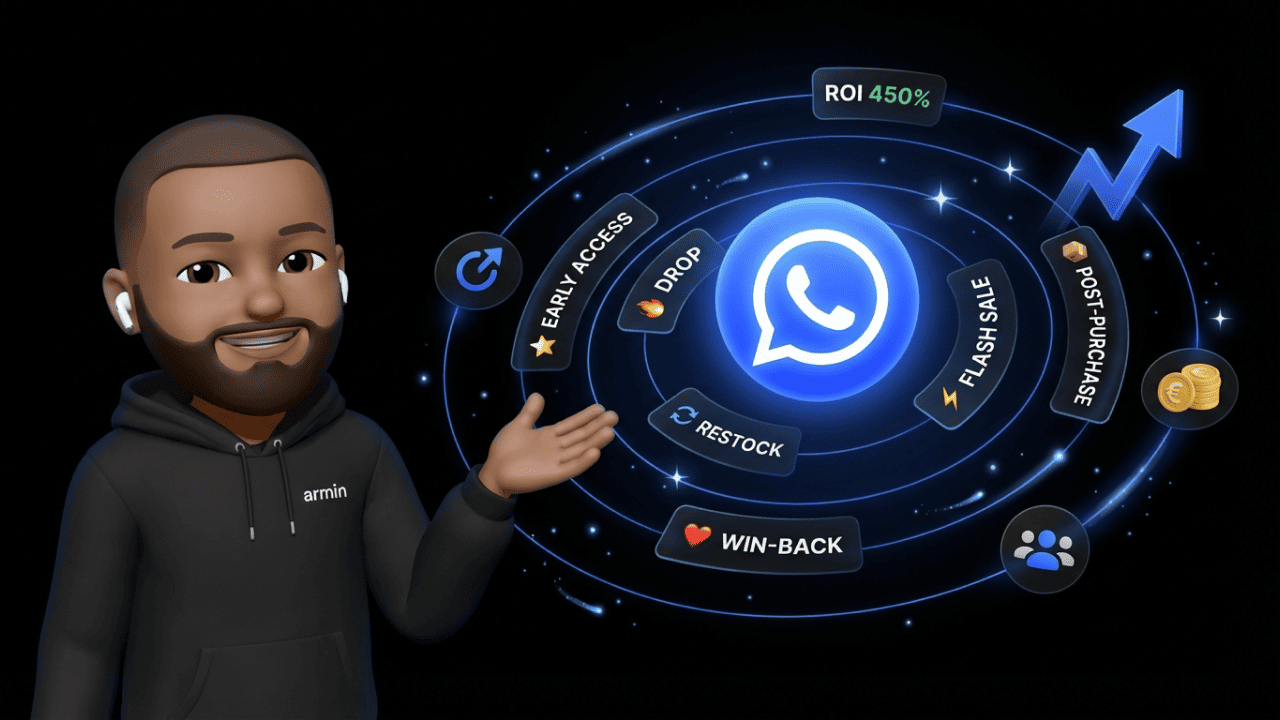
Instead of “newsletter in the messenger,” Snocks focuses on events: drops, flash sales, restocks, early access. Pre-sales work particularly well because exclusivity and time windows bundle demand. Pre-sale access is positioned as a community benefit — not as a standard promo.
Contribution margin instead of only ROAS
ROAS alone is not enough. Snocks thinks in contribution margins: shipping, returns, discounts, payments, and operational effort. This makes it clear which WhatsApp formats are truly profitable — and which only “buy” revenue.
Incrementality instead of pure last-click attribution
Snocks tests incrementally: holdouts/control groups show which share of revenue is actually additional due to WhatsApp. This reduces issues like false success from last-click effects and makes WhatsApp scalable because the contribution is provable internally.
Opt-in strategy: how Snocks systematically builds reach
No opt-in, no scaling. Snocks builds reach through always-on entry points and event-based opt-ins — including a clear value proposition, expectation management, and community framing. It is important that opt-ins do not just mean “more contacts,” but create qualitatively fitting segments.
Always-on funnel with incentive
The funnel is always on: shop, checkout, social. The opt-in is sold via a clear value (e.g., exclusive discount, early access, special drops). A clean note (expectation, frequency, content) reduces unsubscribes and strengthens trust.
Among other things, Snocks uses exit-intent popups in the online shop to direct users into the WhatsApp channel before they leave the page. Immediately after onboarding, new followers automatically receive a discount code — a clear incentive with measurable conversion impact. New followers receive, for example, 10% off their first order as part of the “WhatsApp Family.” In addition, the company plans to further expand opt-in generation via post-purchase flows.
Event opt-ins for sales and drops
In addition, event lists are created: anyone interested in a drop or sale opts in specifically. This creates highly motivated segments with high purchase intent — ideal for broadcasts with high conversion.
Expectation management and community framing
Snocks frames WhatsApp as a community instead of a promo list. This lowers churn and increases engagement. Consistency is key: fewer, but better messages — with clear relevance per segment.
Legal foundation: consent, templates, governance
Legally compliant consent (opt-in) is mandatory — including traceable documentation. In the WhatsApp Business API, proactive messages are sent via approved message templates. Governance means clear rules: who creates templates, how they are approved, and which triggers/automations are allowed. In addition, opt-out processes (e.g., stop wording like “STOP”) must be transparent and easy to use.
Segmentation as the core of success
For Snocks, segmentation is not an add-on, but the basis against list fatigue. Without segmentation, WhatsApp quickly becomes too loud — and loses deliverability, engagement, and revenue. Dynamic segments ensure that every message provides a concrete benefit for the recipient.
RFM, loyalty level, and purchase history
RFM (Recency, Frequency, Monetary Value) prioritizes audiences by value and activity. Loyalty level and purchase history control who gets early access, who sees an upsell, and who should move into reactivation.
VIP, first-time buyers, inactive users as strategic segments
VIPs receive exclusive benefits. First-time buyers get post-purchase content and targeted cross-sells. Inactive users are managed with reactivation mechanisms and sunset logic — not bombarded permanently.
Dynamic segments instead of static lists
Static lists do not work in a performance setup. Dynamic segments update based on shop events, clicks, and purchases — and enable precise frequency control with clear caps per segment.
Broadcast strategy: how Snocks stages demand
Broadcasts at Snocks are not “regular content,” but demand triggers. Every message has a goal, an event, and a target group. This structure prevents WhatsApp from becoming a second newsletter.
Campaign types: drops, flash sales, restocks
Drops and restocks are made for WhatsApp: “now available” is a utility message with high relevance. Flash sales work when the time window and offer are clear — without unnecessary distraction. This is especially true for drops and restocks with many variants — such as limited colorways, lace collections, underwear mixes, or seasonal sock sets. Particularly with highly differentiated product lines such as sneaker socks, tennis socks, or multi-pack mix offers, a time-critical WhatsApp push creates immediate demand because new items are noticed faster in the community than in the classic online shop.
Early access as a psychological lever
Early access creates belonging, status, and FOMO — without constant discount pressure. This keeps the channel healthy and brand-building in the long term.
Fatigue management and frequency rules
Frequency is controlled by segment. Contacts without reactions are reduced instead of being “pushed through” further. This protects engagement KPIs and the list — and reduces issues like unsubscribes and declining clicks.
Copy, tone, and community voice
Snocks communicates directly, approachable, and clearly. Not every message is a sale: polls, voting, and small challenge formats increase engagement and keep the list healthy. Consistency in brand style is crucial — without drifting into generic promo communication.
Automations along the customer journey
Automations are the backbone of scaling: they deliver “always on” revenue, reduce operational workload for teams, and enable precise, data-driven journeys. Combined with segmentation, this creates a system that does not just send, but reacts intelligently.
The goal is end-to-end coverage of customer journeys — from onboarding and cart abandonment to service and reactivation. WhatsApp thus becomes not only a marketing channel, but communication infrastructure across the entire customer relationship.
Cart abandonment with clear escalation logic
Abandonment flows follow stages: reminder, then optionally an incentive (discount only selectively), then a final reminder. Segmentation prevents discounts from becoming an expectation and destroying margins long term.
Post-purchase: reviews, cross-sell, repeat purchase
After the purchase, review and cross-sell flows run. For recurring products, repeat purchases can be triggered through timing and demand — including personalized product recommendations and bundles.
Reactivation: sunset logic instead of permanent blasting
Reactivation is done selectively (e.g., restock alert, exclusive offer, special). Those who do not respond are removed from promo sequences via sunset logic — protecting deliverability and keeping the channel profitable long term.
Conversational commerce: more than just marketing
WhatsApp is not only broadcast — it is dialogue. This is where additional value is created: consulting, service, and conversion happen in the same channel. The prerequisite is a setup that cleanly connects automation and human handover.
Chatbot/automation for consulting and product finder
A chatbot or automation can handle size advice, product finder dialogues, or bundle recommendations — faster than email and more scalable than purely human support. This makes WhatsApp a conversion channel, not only a campaign channel.
Order status via WhatsApp / order tracking as a core service use case
Order status via WhatsApp is a core use case: customers often ask for order tracking directly in the messenger. Typical flow: order number and email address are requested, then the status is delivered automatically. This reduces support load, shortens response time, and strengthens trust. At the same time, recurring customer inquiries are handled automatically, relieving service teams and significantly reducing response times.
Handover between automation and human
Complex cases (e.g., complaint, invoice, return/refund) go to support teams. Context remains available when the WhatsApp Business API, team inbox, and CRM are properly integrated — enabling teams to work efficiently and customers not to explain anything twice.
Community instead of just advertising
The community mechanism is why Snocks WhatsApp does not slip into discount communication. Engagement comes from participation and exclusive benefits — and that is exactly what keeps the channel stable long term.
Snocks & Friends as a loyalty mechanism
Loyalty becomes tangible via WhatsApp: exclusive actions, tests, early access, and community benefits. This strengthens retention more than pure price advantages. Customers become part of an exclusive community instead of just recipients of promotions.
Voting, giveaways, and co-creation
Co-creation (voting) turns customers into participants. This increases engagement and reduces dependency on constant discounts. At the same time, it provides data for product and campaign decisions. Through votes, the community decides, for example, which parts of the product range should be prioritized as new releases or which colors and variants should appear next.
Restock alerts as utility content
Restock alerts are pure utility: relevant, concrete, conversion-strong. They feel like service — and still sell. Messages like these minimize issues like churn because the value is obvious.
KPI system and measurability
Scaling requires metrics that do more than “revenue.” Snocks combines engagement KPIs with profitability metrics and tests incrementally. Performance is not only measured per campaign, but evaluated across channels. This turns WhatsApp into a controllable performance channel.
Engagement KPIs vs revenue KPIs
Engagement: opens, clicks, replies, unsubscribes. Revenue: purchases, revenue per recipient, contribution margin per campaign/flow. Both must be considered together to avoid issues like short-term revenue with declining list quality.
Contribution margin as a scaling filter
Only what remains contribution-margin positive is scaled. This protects profitability with growing send volume, rising return rates, and varying discounts.
Holdouts and incrementality tests
Control groups are mandatory to quantify true uplift. Only then does WhatsApp’s contribution become internally reliable and budget/resource decisions become clean.
Reporting rhythm for sustainable performance
Weekly operational (engagement, fatigue), monthly strategic (contribution margin, uplift, segment performance). This continuously optimizes the setup — instead of reacting only campaign by campaign.
Tech setup for real scaling
Anyone who wants to replicate Snocks must take the technical foundation seriously. Without API, data integration, and governance, many benefits remain theoretical — and the most common problems (missing tracking, unclear attribution, manual processes) prevent scaling.
WhatsApp Business vs WhatsApp Business API
WhatsApp Business (app) is suitable for very small volumes. For performance, automation, templates, routing, team inbox, and integration into shop/CRM, you need the WhatsApp Business API. This is also where setups run via providers/stacks like Charles or specialized platforms like Chatarmin.
WhatsApp Business is an app version for smaller companies with manual communication, while the WhatsApp Business API allows businesses to integrate WhatsApp deeply into CRM, shop, and marketing systems and build scalable automations.
App vs API vs performance system
To make the difference tangible, a direct comparison between the app, API, and Snocks’ performance-system approach helps:
| Criteria | WhatsApp Business App | WhatsApp Business API | Snocks setup |
|---|---|---|---|
| Target audience | Small business | Growing businesses | Scaling D2C brand |
| Sending | Manual | Automation possible | Fully automated & event-based |
| Segmentation | Hardly possible | CRM-based | Dynamic RFM segments |
| Automations | Limited | Possible | End-to-end customer journeys |
| Incrementality tests | No | Technically possible | Strategically implemented |
| Tracking | Very limited | UTM & API-based | Contribution-margin-oriented control for campaigns |
| Scalability | Low | High | Systematically optimized |
This combination of API setup, data integration, and journey logic turns WhatsApp marketing into a scalable revenue channel rather than a manual sending tool.
Template governance and messaging limits
Message templates, quality rating, limits, and clear approval processes determine deliverability. If you scale, you need governance — otherwise quality and reach decline.
Tracking: UTM, coupon logic, server events
UTMs and coupons connect message and purchase. Server events improve attribution and reduce tracking gaps. This makes contribution per campaign/flow measurable — down to contribution margin.
CRM integration and data sources
Shopify/shop integration plus CRM data create dynamic segments and triggers. Without integration, WhatsApp remains an isolated channel. With integration, WhatsApp becomes a system that translates behavior (click, purchase, inactivity) into real journeys.
Verified business account, security, and trust
A verified business account (green check) strengthens trust and reduces doubts about senders. Clear communication about end-to-end encryption & security also helps address privacy concerns — especially in DACH markets.
Typical mistakes when copying the Snocks strategy
Many brands copy the channel — but not the system. The result: declining engagement, rising unsubscribes, and missing profitability. These issues can be avoided if setup, segmentation, and measurement logic are correct from the start.
Discount focus without community building
If you only send discounts, you train price buyers and destroy engagement. Snocks instead focuses on utility, events, pre-sales, and community mechanisms.
Scaling too early without segmentation
Without segments, frequency pressure rises, unsubscribes increase, and deliverability suffers. Segmentation is the foundation — not the optional extra.
Missing incrementality measurement
Without holdouts, it remains unclear whether WhatsApp really drives incremental revenue or just redistributes existing demand. This is one of the biggest problems in internal scaling.
No professional API setup
Without the WhatsApp Business API, you lack governance, automation, tracking, and scaling reliability. Operational reality then quickly becomes a bottleneck for teams.
The Snocks WhatsApp playbook for D2C brands
The fastest path to a working setup is a clear 30/60/90-day plan that builds opt-in, automations, segmentation, measurability, and profit logic in phases.
Snocks is not an isolated case — but an example of how WhatsApp in e-commerce is evolving from a communication channel into an infrastructure. Anyone who sees WhatsApp only as a sending tool underestimates its potential. Anyone who thinks of it as a system unlocks an additional profit layer beyond paid media.
30 days: opt-in and first flows
- Build entry points: click-to-WhatsApp link on landing pages and in ads, WhatsApp QR code on packaging, inserts, and POS, plus entry points in shop/checkout.
- Welcome flow, cart abandonment, first broadcast events for drops/restocks.
- Cleanly integrate GDPR text, opt-in proof, transparent consent and unsubscribe (opt-out via stop wording like “STOP”).
60 days: segmentation and event strategy
- RFM segments, VIP logic, first-time buyer and inactive segments, dynamic updates via shop events.
- Event opt-ins for pre-sales, restocks, flash sales; frequency caps per segment.
- First holdout tests and standardized reporting (weekly operational, monthly strategic).
90 days: profit focus and testing structure
- Contribution margin as the control metric, mature reactivation and sunset logic.
- Systematic testing: copy, offer, segment, timing — scale only with proven incrementality.
- Finalize template governance, quality management, team processes, and integration into CRM/shop.
Data protection / GDPR and WhatsApp: what matters for scaling brands
Especially in the German-speaking region, data protection is a critical success factor — not only legally, but also for trust. A professional WhatsApp setup requires clear transparency, documented consent, clean unsubscribe processes, and governance over templates, triggers, and data access. Transparency about data usage, a clearly visible privacy policy, and documented consent are essential in the German-speaking market. Particularly in Germany, users expect traceable communication and clean processes. This affects not only legal aspects, but also clear brand communication in the German-speaking region (deutsch, de flag) as well as international brand leadership, for example via language labels like deutsch flag or francais flag in global online shops.
Key building blocks include:
- Consent (opt-in) with a clear note on what will be sent, how often, and for what purpose.
- Unsubscribe (opt-out) via a clear stop wording mechanism (e.g., “STOP”) and internal implementation in segments/lists.
- Documentation of opt-ins and traceable governance for message templates.
- Data minimization in service flows (e.g., order number + email address only when necessary) and a clear retention/deletion logic.
Conclusion: what e-commerce brands can take away from the Snocks WhatsApp strategy
Snocks shows how WhatsApp evolves from a newsletter into a scalable revenue system. The difference is not the channel, but the setup: WhatsApp Business API instead of app, segmentation instead of scattergun sending, event logic instead of a posting schedule, automation instead of manual campaigns, and measurability instead of gut feeling. Combined with clean data protection/GDPR processes (consent, transparency, unsubscribe via stop wording like “STOP”) and trust signals like a verified business account (green check), you get a channel that truly moves retention and profit.
For any business — whether an in-house team or a specialized agency — this is the opportunity to see WhatsApp not only as an additional marketing channel, but as strategic infrastructure for news, campaigns, and targeted discount promotions. Anyone who does not want to fall behind should take a close look at this development.
As a specialized WhatsApp Business API platform, Chatarmin regularly analyzes setups of leading D2C brands like Snocks. More practical examples and in-depth analyses can be found in Chatarmin’s case studies, showing how scaling e-commerce companies systematically use WhatsApp marketing as a performance channel.
The patterns are clear: without professional infrastructure, segmentation, and incrementality measurement, WhatsApp remains a channel — with the right setup, it becomes a scalable revenue system.
That is exactly what Chatarmin is built for: WhatsApp Business API, segmentation, automations, tracking, and governance — integrated into shop and CRM.
Frequently asked questions about the Snocks WhatsApp strategy
What is different about Snocks WhatsApp compared to a classic newsletter?
Snocks WhatsApp does not follow a rigid frequency like a newsletter, but an event and journey logic. Messages are tied to drops, restocks, flash sales, early access, or automation triggers — segmented and measurable.
What role does pre-sale access play in the strategy?
Pre-sale access is a community benefit and bundles demand within a clear time window. This increases conversion without building permanent discount pressure.
Do I need the WhatsApp Business API for such a setup?
Yes, for scaling the WhatsApp Business API is practically mandatory: automations, templates, team inbox, routing, integration into shop/CRM, and clean tracking only become reliably possible with it.
How does order status via WhatsApp / order tracking work in practice?
Typically, order number and email address are requested, and then the status is delivered automatically from the shop/shipping system. This reduces support effort, shortens response time, and improves the service experience.
How does Snocks prevent issues like list fatigue and high unsubscribes?
Through segmentation (e.g., RFM, VIP, first-time buyers, inactive users), dynamic audiences, clear frequency caps, and sunset logic. Relevance per message is more important than volume.
How is WhatsApp’s contribution actually made measurable?
Through tracking (UTM, coupons, server events), contribution margin analysis, and incrementality tests with holdouts/control groups. This makes the contribution reliable instead of being purely last-click-driven.
If you want to build WhatsApp like Snocks as a performance system: Chatarmin supports you with the WhatsApp Business API setup, segmentation, automations, tracking, and governance — so every message delivers a measurable contribution to revenue, retention, and profit.