
$52.62 billion. That's how big the global AI agent market will be by 2030, according to Markets and Markets. Gartner predicts that by the end of 2026, roughly 40% of all enterprise applications will use task-specific AI agents. And you? You're running an e-commerce brand, wondering if you can afford to get in on this.
Here's the answer: Using free AI agents in 2026 is no longer an experiment — it's standard practice. 75% of engineers now start their AI projects with free or open-source tools. Not because they're cheap. Because the free frameworks are genuinely that good.
But let's be real: "Free" doesn't mean "zero effort." This guide shows you which tool fits which use case, where the traps are, and how to actually get started as an e-commerce business.
Chatbot vs. AI Agent: Stop Confusing the Two
Half the industry mixes up these terms. That confusion can cost you weeks evaluating the wrong tool. So let's set the record straight:
| Feature | Chatbot | AI Agent |
|---|---|---|
| Logic | Rule-based, fixed dialogue paths | Autonomous, plans and decides independently |
| Tasks | Pre-defined responses | Multi-step processes, tool usage |
| Data access | Pulls from stored FAQs | Reads emails, updates CRMs, researches |
| Learning | None (without retraining) | Context-aware, learns from interactions |
Here's what that looks like in practice: A chatbot answers "What's your return policy?" An AI agent reads the order from your shop, checks the return status in your ERP, and proactively sends the customer an update via WhatsApp. Two completely different worlds.
How AI Agents Actually Work: The 4 Building Blocks
Why do AI agents act autonomously while chatbots just react? Because they're built on four core components:
- LLM Routing (the brain): A language model decides which next step makes sense — the dispatcher that allocates tasks.
- Identity: The agent knows who it is, what role it plays, and where its boundaries are. This prevents it from going off the rails.
- Tools: APIs, databases, CRMs, email systems — everything the agent can access to execute actions.
- Memory: Short-term memory for the current context, long-term memory for learnings from past interactions.
Without these four components, you don't have an agent. You have a chatbot with a marketing label.
And in 2026, there's a fifth dimension: Generative UI. Modern agents no longer reply with walls of text. They generate dynamic user interfaces — clickable forms, interactive tables, live dashboards. "Chat fatigue" (endless text messages) is over. Your agent delivers the exact interface the user needs in the moment.
Open-Source Frameworks: Full Control, Zero License Costs
If you have a dev team, this is where the strongest options live. No vendor lock-in, no monthly license fees, full data sovereignty through self-hosting.
For B2B companies, self-hosting is the key to compliance: it prevents sensitive company data from flowing to third-party providers, protects your intellectual property, and makes you independent from the terms of service of US cloud providers.
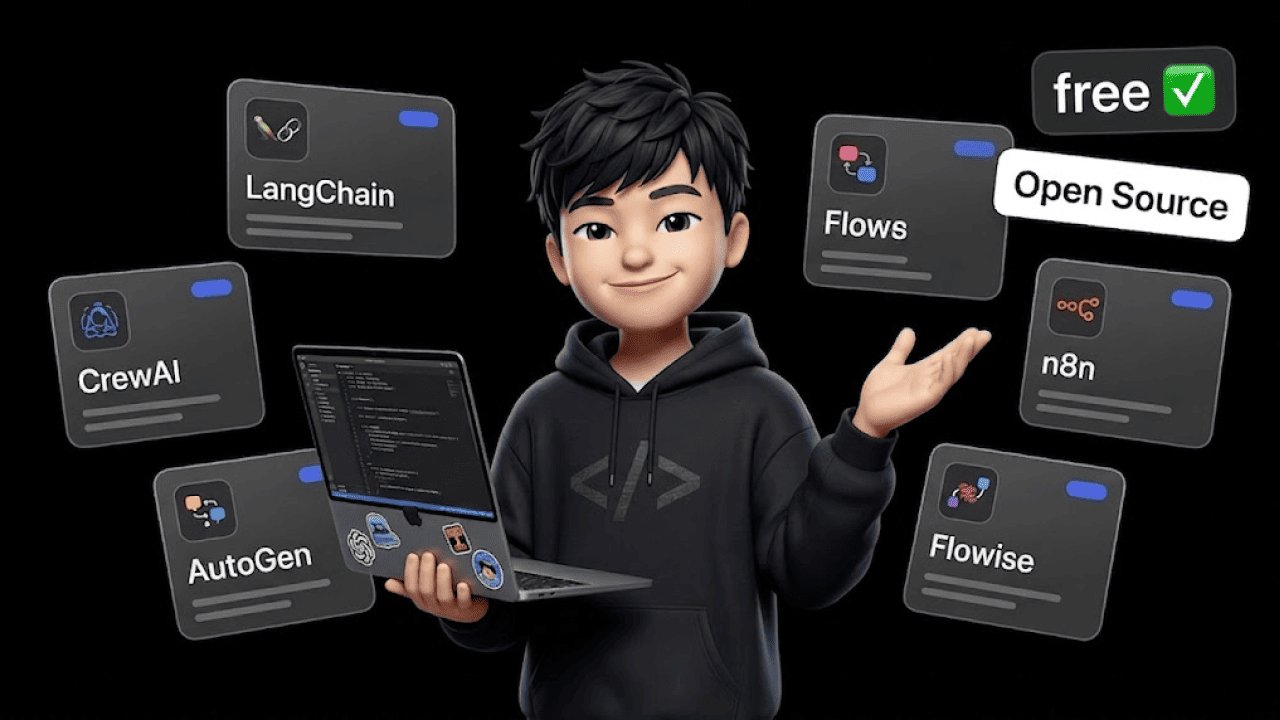
LangChain / LangGraph — The standard framework for AI agents. LangChain provides the building blocks, LangGraph builds stateful agents on top that retain context across long interactions. Ideal for complex agents orchestrating multiple tools.
CrewAI — Thinks in teams, not individual agents. You build a researcher, a writer, and a reviewer that collaborate. Ideal for content pipelines and multi-step analyses.
AutoGen (Microsoft) — Microsoft's solution for multi-agent systems. Multiple agents communicate, delegate, and correct each other. Ideal for enterprise scenarios.
SmolAgents (Hugging Face) — Lightweight Python library for fast prototypes. Minimal footprint, focused, no overhead.
| Framework | Strength | Entry barrier | Multi-agent | Self-hosting |
|---|---|---|---|---|
| LangChain / LangGraph | Ecosystem, community | Medium | Yes | Yes |
| CrewAI | Team-based agents | Medium | Yes (core concept) | Yes |
| AutoGen | Enterprise multi-agent | High | Yes | Yes |
| SmolAgents | Lightweight, speed | Low | No | Yes |
No-Code & Low-Code: Build Free AI Agents — Without Writing a Single Line of Code
No dev team? These platforms offer free entry points with visual drag-and-drop builders.
n8n — The Berlin-based workflow automation platform with a free community edition (self-hosted). Connects hundreds of business apps and builds AI agents directly into existing processes. Strong choice for European companies that value local infrastructure.
Dify — Open-source platform purpose-built for AI agents and RAG applications. Self-hosted version is completely free. The strongest option when your agent needs to access your own company data.
Latenode — Generous free tier with 1,000 credits per month. Perfect for small e-commerce teams that need to get an agent into production fast.
Botpress — Visual builder with a free starter plan. Lowest barrier to entry for conversational agents on WhatsApp, webchat, or other channels.
Flowise — Built on LangChain, but with a drag-and-drop interface. Open source, completely free to self-host. The bridge between code and no-code.
Make.com & Zapier Central — Both have integrated strong AI agent features into their workflow builders. If you're already using Make or Zapier, you can plug AI agents directly into existing automations.
For conversational AI agents, it's also worth looking at specialized providers like Parloa (enterprise voice and chat AI) and Intercom Fin — both strong in customer service automation for e-commerce.
| Platform | Free model | Code required? | Strength |
|---|---|---|---|
| n8n (Berlin) | Community edition (self-hosted) | No | Workflow automation, EU-based |
| Dify | Self-hosted, fully free | No | RAG & document agents |
| Latenode | 1,000 credits/month | No | Fast production deployment |
| Botpress | Free starter plan | No | Conversational agents |
| Flowise | Open source (self-hosted) | No | LangChain without code |
| Make.com | Free tier available | No | Extend existing automations |
| Zapier Central | Free tier available | No | Largest app ecosystem |
The "Free" Trap: Total Cost of Ownership — Honestly
This is where it gets important. Because "free AI agents" can be an expensive illusion if you ignore the total cost of ownership.
The frameworks and platforms above? Free. But the moment your agent uses an external language model like GPT-4 or Claude as its brain, you pay API costs per request. With hundreds or thousands of daily interactions, that adds up.
The solution: Local models. If you want to run AI agents at truly zero cost, combine the frameworks with open-weight models like Llama 3 (Meta) or Mistral — hosted via Ollama or vLLM on your own hardware. No API calls, no external costs, full data sovereignty.
Other hidden costs to keep on your radar:
- Server hosting: Self-hosted means you need a server. A small VPS is enough for prototypes.
- Time investment: Setup, configuration, debugging — the software is free, your time isn't.
- Free-tier limits: Cloud versions cap credits, storage, or user count.
Not an argument against free AI agents. But an argument for eyes wide open instead of blind hype.
Conclusion: Start Free — But Start Now
Using free AI agents in 2026 is absolutely doable. The barrier to entry has never been lower. And the data backs you up: According to the Deloitte Tech Value Survey (October 2025), 70% of companies investing in agentic AI see immediate, measurable efficiency gains.
The question isn't "Can I afford AI agents?" The question is: Can you afford not to start?
While you're deliberating, your competitors are already automating support requests, lead qualification, and order processes — with the exact tools from this guide.
Want to see what AI-powered automation looks like in practice? At Chatarmin, we automate WhatsApp communication for e-commerce brands — from marketing campaigns to customer service. Book a demo and we'll show you how it works for your store.
FAQ: Free AI Agents for B2B
What are AI agents?
AI agents are autonomous software systems that perceive their environment, make logical decisions independently, and operate external tools to achieve a defined goal. Unlike simple chatbots, they act proactively and can execute multi-step processes without human intervention.
Where can I find free AI agents?
The best free AI agents are found in open-source frameworks like LangChain, Flowise, or AutoGen that you can self-host. Alternatively, no-code platforms like n8n or Latenode offer generous free tiers to get started.
Are open-source AI agents really free?
The software frameworks are free, but API costs often apply when you connect external language models like GPT-4. To run AI agents at 100% zero cost, you need to combine them with locally hosted open-source models via Ollama.
Do I need programming skills for AI agents?
No, in 2026 visual low-code and no-code builders like Flowise, Dify, or n8n let you build AI agents via drag-and-drop. Programming skills in Python are only needed if you want to develop highly complex, custom architectures from scratch.
How compliant are free AI agents with data privacy regulations?
Free agents are highly compliant with GDPR and other data privacy regulations when you run them as self-hosted open-source solutions on your own servers. This ensures that no sensitive company or customer data flows to third-party providers in non-compliant jurisdictions.
What's the difference between a chatbot and an AI agent?
A chatbot is typically reactive, responding based on pre-defined scripts or pure text generation. An AI agent, on the other hand, can search the internet, call APIs, write to databases, and autonomously plan solutions for complex problems.
What is Generative UI in AI agents?
Generative UI means that AI agents no longer respond only with long text messages but generate dynamic user interfaces. The agent delivers clickable forms, interactive tables, or live dashboards directly to the user depending on context.
Can I host AI agents locally?
Yes, platforms like n8n, Dify, or Flowise offer free community editions that you can deploy via Docker on your own infrastructure. This guarantees maximum data sovereignty and prevents vendor lock-in.
Which AI models work for local agents?
For fully free, local operation of AI agents, open-weight models like Llama 3 from Meta or Mistral are ideal. These can be run directly on your own hardware via tools like vLLM or Ollama.
What is RAG in AI agents?
RAG (Retrieval-Augmented Generation) is a technique that feeds AI agents with internal company data without retraining the model. The agent searches your specific documents and combines those facts with its language intelligence for precise answers.
Which tools work best for B2B workflow automation?
For B2B automation, tools like Zapier Central or Berlin-based n8n are ideal. They connect AI logic with hundreds of existing business apps like CRMs, Slack, or ERP systems to autonomously handle entire business processes.