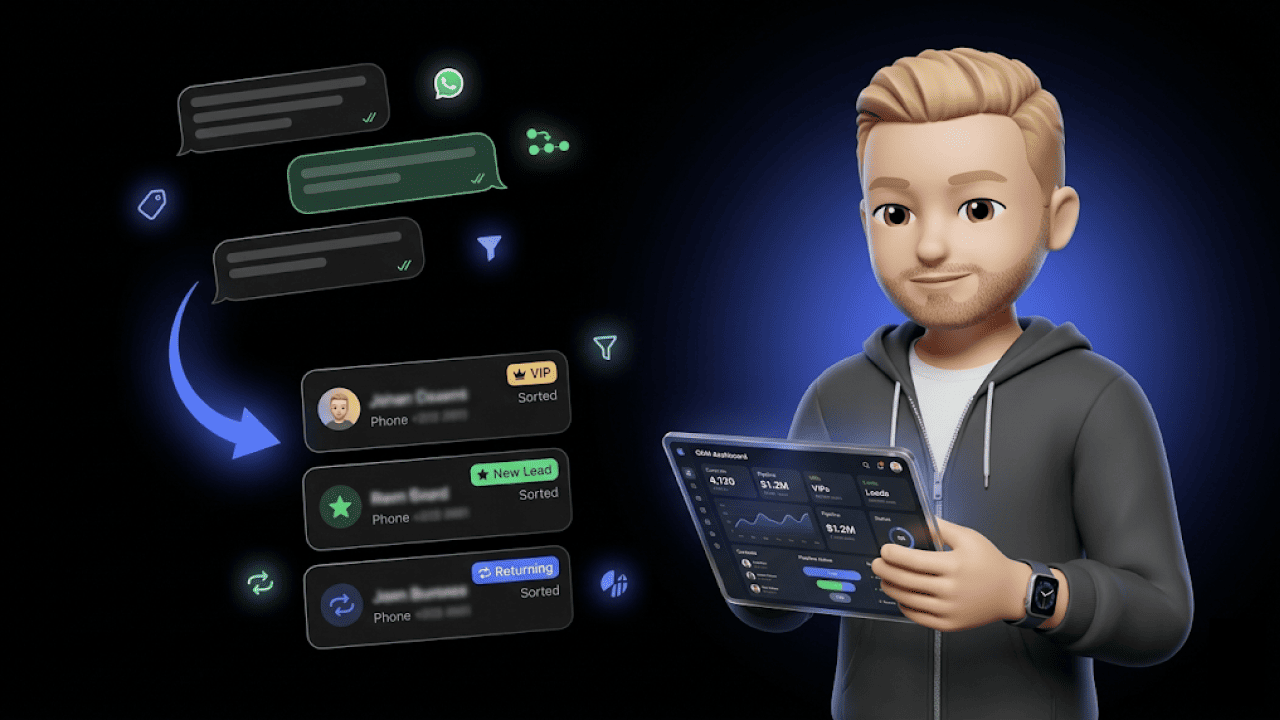

Sales reps spend less than 30% of their time actually selling. Another 17% goes to pure data entry. And while your teams are busy feeding the CRM, your customer is sitting on WhatsApp, waiting. Conversational CRM is the answer to exactly that gap — and it's one of the fastest-growing CRM subcategories out there: Markets and Markets projects the global conversational AI market to grow at roughly 20% per year through 2031. Traditional CRMs like Salesforce or HubSpot don't fix the underlying problem. They're silent. They record what already happened. Conversational CRM records what's happening right now — and acts on it.
What is Conversational CRM?
Conversational CRM is a CRM system where the customer conversation itself becomes the data source. Messaging channels like WhatsApp, Instagram DM, and live chat connect directly to the customer record. Every message is captured, categorized, and tied to the customer journey automatically — in real time, with no manual data entry.
The term was coined in 2022 by Zendesk and later picked up by Slack, Creatio, and others. The core idea: kill the data silo. Instead of a rep typing up a summary after a call, the conversation is the interface. Data gets created as a byproduct.
In plain English: when your customer writes on WhatsApp "I need the blue ones in size M," your system doesn't just know who they are (order history, CLV, last contact) — it knows what they want and what emotion is underneath. No manual work. That's the paradigm shift: from passive archive to active hub.
Conversational CRM vs. Traditional CRM
Traditional CRMs were built for a world where email and scheduled calls ruled. That world is gone. Customers expect answers on messaging — immediately.
| Criterion | Traditional CRM | Conversational CRM |
|---|---|---|
| Primary purpose | Manage data | Manage dialogue |
| Main channel | Email, forms, phone | Messaging (WhatsApp, Instagram, chat) |
| Data entry | Manual by staff | Automatic from the conversation |
| Real-time | No, batch updates | Yes, live in the chat |
| AI role | Reports, lead scoring | Active dialogue, routing, responses |
| Typical vendors | Salesforce, HubSpot, Pipedrive | Zendesk, Intercom, Chatarmin |
The real question isn't "which system is better?" — it's "where do your customer interactions actually happen today?". If your CRM isn't sitting where the conversation happens, it's running a parallel life to your actual customer contact.
The admin problem: why speed is everything
The 5-minute rule is a well-known sales benchmark: leads that get a response within 5 minutes convert at a multiple of the rate compared to a 30-minute delay, according to lead-response research. With a traditional CRM, that speed is practically impossible. Someone has to see the request, triage it, load the context, compose a reply.
A plain math example: a D2C team with 5 customer-service reps and 5,000 tickets per month burns roughly 250 hours/month on manual ticket handling alone, assuming 3 minutes per ticket for typing and documenting. At a loaded cost of $40/hour, that's $10,000/month in admin work no customer ever sees.
Gartner estimates that conversational AI will cut global contact-center labor costs by over $80 billion by 2026. Translated into your daily work: automatic conversation summaries, contact enrichment without manual input, intent and sentiment detection, draft replies ready for one-click review. A Conversational CRM paired with AI agents can eliminate up to 80% of administrative sales work. What you get back isn't "more efficiency." What you get back is time — for the conversations that actually drive revenue.
Why most "Conversational CRM" tools forget the world's dominant messaging platform
Here's something odd about the Conversational CRM category: most market-leading articles on the topic either ignore WhatsApp completely or treat it as a side feature. Zendesk coined the term in 2022. Slack published a 3,500-word guide in April 2026 — without mentioning WhatsApp once. Creatio's 2026 glossary entry mentions "messaging apps" in passing, but never names the one that dominates consumer conversations in most of the world.
Here's the uncomfortable fact: WhatsApp has over 2 billion monthly active users. It's the default messaging channel in Brazil (near-universal adoption), India, Mexico, Argentina, most of continental Europe, Southeast Asia, the Middle East, and large parts of Africa. The US is the outlier, not the rule. SMS and iMessage dominate American consumer messaging — which is exactly why US-built CRM categories tend to treat WhatsApp as an afterthought.
For D2C brands selling internationally, that blindspot is a real problem:
- Open rates on WhatsApp sit between 70% and 95% — email rarely crosses 20%
- Messages land directly on the lock screen, not in a promotions tab
- WhatsApp stays asynchronous: customers can reply hours or days later, and the context is still there
- Via the official Business API, it's GDPR-compliant and enterprise-ready
If your "Conversational CRM" can't handle WhatsApp natively — not as a plugin, but as a first-class channel with full context, AI, and handoff — it isn't conversational in 150+ countries. It's just a chat widget with a fancier backend. The operational depth on this is in our separate WhatsApp CRM guide.
Core features of a real Conversational CRM
Not every tool that labels itself "Conversational CRM" is one. What actually matters:
- Shared team inbox. One interface for WhatsApp, Instagram DM, live chat, email. No more jumping between Outlook and Zendesk.
- AI agents, not chatbots. Chatbots follow decision trees and break on anything the builder didn't anticipate. AI agents read the request, pull the context, and generate a response. At Chatarmin, they resolve 56% of all incoming tickets without a human touch.
- Deep integrations. Shop (Shopify, Shopware), email (Klaviyo, Brevo), CRM (HubSpot, Salesforce), ERP. Without integrations, your "Conversational CRM" is just another silo.
- Automations and flows. WhatsApp automations for abandoned carts, post-purchase, winback, review requests.
- Centralized customer profile. A centralized CRM view showing every order, chat, and ticket per customer — no matter which channel it came in through.
The single most important piece is a clean handoff logic between AI and human. The AI handles 80% of routine volume. For complex cases, it hands off — including summary, sentiment, and buying intent — to a person. Without that context transfer, every conversation restarts from zero.
What does a Conversational CRM cost?
The price spreads between vendors are wild. Here's a snapshot of list prices at the time of writing (Q1 2026):
| Vendor | Entry (per user/month) | With full AI functionality |
|---|---|---|
| Salesforce Sales Cloud | from ~$165 | from $550 + Marketing Cloud from $3,250/year, AI add-ons $8,000–20,000/year |
| HubSpot Smart CRM | from $45 | from $75; Sales/Service Hubs from $90; Marketing Hub from $800/month for 3 users |
| Zendesk Support Suite | from $55 | up to $169; AI typically reserved for top tier or paid add-on |
| Freshworks Freshdesk | from $15 (basic) | from $78 with full functionality; AI agents as add-on |
| Creatio | from $40 | $40 (AI included) |
Run that on a typical D2C brand with 10 seats, and Salesforce alone costs you ~$66,000 per year — before any enterprise AI is even activated. That's exactly why so few modern commerce brands go Salesforce-first, and so many choose WhatsApp-focused tools instead.
Two things list prices hide:
- AI is almost always an upsell. What reads as "AI-powered" on the landing page rarely comes in the entry-level license. With Salesforce, "with Einstein" nearly always means a tier jump.
- Per-seat pricing doesn't fit commerce. A D2C brand doesn't have 50 salespeople. It has 3–8 customer-service agents and a marketing manager. Per-seat tools like Salesforce were built for B2B enterprise with large sales teams. Per-interaction cost for commerce teams gets absurd fast.
Chatarmin itself operates sales-led — pricing depends on volume, channels, and integrations, so there's no rigid price list. The table above is a market overview, not a recommendation.
Consultational Commerce: the next step
At Chatarmin, we don't just talk about Conversational CRM. We talk about Consultational Commerce.
The industry buzz for 2026 is Agentic CRM: AI agents as "digital teammates" that resolve tickets autonomously, update CRM records, and push tasks proactively. For B2B enterprise service teams, that's the lever. For commerce teams with thousands of consumers in chat, it's only half the jump.
The other half is Consultational Commerce: AI agents don't just react — they advise and actively sell. Here's what that looks like in practice:
Customer: Hi, looking for something for sensitive skin, under $40. I tried your Nourishing Cream — too rich for me.
AI agent: Got it. Based on your March 14 order and that feedback: our Light Hydration Serum might work better — lighter texture, same calming actives. It's $34 and in stock. Want me to drop it in your cart?
Customer: Yes please. Got anything for eye care?
AI agent: For sensitive skin, I'd pair it with our Calming Eye Balm ($28) — customers often buy them together. That brings you to $62, which puts you over our $50 free-shipping threshold. Add both?
Three things happen simultaneously that no classic chatbot can pull off: the agent references actual order history, checks live inventory, and optimizes for a second conversion lever (free-shipping threshold). The chat window becomes the sales floor — with no human in the loop.
That's the jump from support tool to revenue tool. Conversational CRM makes dialogue visible. Consultational Commerce makes dialogue monetizable.
When do you actually need Conversational CRM — and when not?
Makes sense if:
- You do more than 1,000 orders per month and support volume is becoming noticeable
- Your customer-service team is 3 or more people
- Retention and CLV matter more to you than new-customer acquisition
- You're running D2C commerce and can realistically generate messaging opt-ins
Honestly: save your money if…
- You're B2B SaaS with 20 enterprise deals per year — a traditional HubSpot or Salesforce setup serves you better, because you need pipeline stages, forecasting, and complex account structures
- Your shop does under 500 orders per month — the overhead outweighs the return at that scale
- Your customers communicate by phone (traditional mid-market, trades) — messaging isn't the lever there
A Conversational CRM isn't a universal fix. It's a tool for a specific reality: direct consumer contact at high volume through messaging channels.
Conclusion: the label is irrelevant, the execution isn't
Whether you call it "Conversational CRM," "WhatsApp CRM," or "Consultational Commerce" doesn't really matter. What matters: your CRM sits where the conversation happens. It feeds itself. It responds faster than a human could. And it gives your team back the time for the conversations that actually count.
If you want to see what that looks like in daily operations — book a demo. 20 minutes, no sales pitch, just a live look at what would be possible for your setup.
FAQ
What is Conversational CRM?
A CRM system that connects customer conversations from messaging channels (WhatsApp, Instagram DM, live chat) directly to the customer record. The conversation itself is the data source — entry happens automatically in real time.
What's the difference between Conversational CRM and WhatsApp CRM?
Conversational CRM is the broader category term (coined by Zendesk). WhatsApp CRM is the most common real-world implementation in markets where WhatsApp dominates consumer messaging — which is most of the world outside the US. Same core concept, different level of abstraction.
What's the difference between Conversational CRM and traditional CRM?
Traditional CRMs (Salesforce, HubSpot) are data archives: a human logs what happened. Conversational CRMs are dialogue hubs: the chat itself generates the data, live, with no manual work.
Which tools count as Conversational CRM?
Globally: Zendesk, Intercom, Slack. For D2C commerce with strong WhatsApp presence: Chatarmin and comparable messaging-first vendors. Traditional CRMs like Salesforce and HubSpot are not Conversational CRMs — they can plug in via integrations, but the dialogue-first architecture isn't there.
Is Conversational CRM GDPR-compliant?
Yes, provided the vendor runs EU-based servers, offers DPAs, and uses the official WhatsApp Business API. At Chatarmin, GDPR compliance is standard — full details in our WhatsApp CRM guide.
Do I need Conversational CRM if I already have HubSpot or Salesforce?
It's not either-or. Conversational CRMs plug into your existing CRM via integration. HubSpot stays your lead and deal management layer. Chatarmin handles the dialogue layer — WhatsApp, AI agents, automation. Both sync bidirectionally.
What does a Conversational CRM cost?
The range is wide: from around $40 per user per month (Creatio) up to $550 plus five-figure annual add-ons (Salesforce with full AI). HubSpot and Zendesk sit in between. More important than list price is whether AI features are included or extra — and whether the per-seat model actually fits your commerce team. Messaging-focused vendors like Chatarmin typically run sales-led and price by volume rather than per seat.
How long does it take to implement a Conversational CRM?
Anywhere from 2 to 12 weeks depending on complexity. A basic WhatsApp inbox connection with a few flows can be live in 2 weeks. A bidirectional integration with shop, email platform, ERP, and custom AI-agent training is closer to 6–10 weeks. Enterprise rollouts with internal compliance reviews can take longer.

![WhatsApp CRM: How to use WhatsApp in CRM [2026 GUIDE]](https://cdn.sanity.io/images/vmmgqf0p/production/026d52f82db695aef48adbf745d132b43463cd9a-1024x1024.png?fit=max&q=75&w=3840&auto=format)