
You're here because you saw the "Request a Demo" button on forethought.ai and thought: just tell me what it costs. Welcome to enterprise sales hell. Except since March 2026, hell has new management.
I'm Johannes, CEO of Chatarmin. Over 300 e-commerce brands across the DACH region use us for WhatsApp marketing and AI customer service – Zelesta, CATRICE, Firebox, and ~447 others. Forethought and we play in different leagues. That's exactly why I can give you an honest take without trying to sell you anything.
In this article you get the numbers Forethought wouldn't reveal until the third sales call. Plus the question everyone has to ask now: what does the Zendesk acquisition mean for your budget, your integrations, and your exit path.
The News That Changes Everything: Zendesk Bought Forethought
On March 11, 2026, Zendesk announced the acquisition. On March 26, 2026, the deal closed. All-cash, value not officially disclosed, but TechCrunch called it Zendesk's largest acquisition in nearly 20 years. Forethought had previously raised $115M across multiple rounds.
The official line: Forethought continues under the label "Forethought AI Agents by Zendesk" and remains available for non-Zendesk customers. Zendesk CEO Tom Eggemeier said the acquisition accelerates Zendesk's product roadmap by "more than a year".
Sounds great. What it actually means for you as a prospect:
1. Pricing uncertainty during negotiation. Before the acquisition, Forethought contracts had an average 22.4% negotiated discount. Now Zendesk's enterprise sales team sits at the table. And that team plays a different game.
2. Strategic dependency on Zendesk. If your helpdesk today is Gorgias, Freshdesk, Intercom, Salesforce, or Kustomer: you're building your ticket automation setup on a product that will likely be more tightly coupled to Zendesk over the next 18 months. Zendesk says the other helpdesks will continue to be supported. But: whoever can get a feature for free in-house rarely invests in maintaining the competition's integration.
3. Integration uncertainty. Forethought had 70+ integrations. Their Zendesk Marketplace listing was telling: 25+ installs, zero reviews. It's unclear which integrations will be prioritized short-term – and which will simply be frozen.
4. A "Proof of Value" at the worst possible moment. Any Forethought evaluation you start today lands during a phase where product strategy, pricing, and roadmap are freshly being reshuffled. That's not a bug. That's a freshly reworked feature.
My take: Anyone booking a 30-day Forethought demo today is buying a product whose contract terms, roadmap, and integration strategy have been under new ownership for three weeks. It could turn out great. It could also backfire spectacularly. Before you sign: explicitly ask for guarantees on the continuation of your specific integration and on price stability over the contract term.
What Forethought Actually Costs – The Vendr Data
Forethought has no public pricing page. The most reliable data source is Vendr, which aggregates real transaction data from procurement processes. Based on their latest 42 purchases:
| Metric | Value |
|---|---|
| Median annual contract | ~$59,500 |
| Lower bound | $40,000 |
| Upper bound | $155,000 |
| Average negotiated discount | 22.4% |
| Unit rate per deflection (example) | $0.12 (negotiated down to $0.07) |
| Best months to buy | January, June |
The billing model is hybrid: a fixed platform fee plus a usage-based component that combines deflection volume (per resolved customer contact) and ticket volume (for agent handoffs). The more successful the AI, the higher your variable bill. The more tickets escalated to humans, the higher the fixed side.
Classic scaling problem. You can't cleanly forecast at the start of the month what the end-of-month bill will be. In Q4 with Black Friday volume spikes, it becomes a lottery.
Three tiers are documented – Basic, Professional (most chosen), and Enterprise – with different feature sets, but the same opaque pricing structure across all. What's included in each tier and what's an add-on: you find out only after your budget is on the table.
The 20,000-Ticket Minimum: The Hidden Entry Fee
The most important detail that appears in almost no comparison article: Forethought requires at least 20,000 historical tickets and 2,000+ tickets per month ongoing to function meaningfully.
The number is in Forethought's own official FAQ. The reason: the AI trains a fine-tuned model per customer on your data. With less volume, the resolution rate becomes a coin flip.
What that practically means:
- A D2C shop with 2,000 tickets/month hits the 20,000 threshold in a year. But then the model is ten months old before it even sees minimum volume.
- A shop with 500 tickets/month? Wait three years – or forget Forethought.
- A new shop with no ticket history? No chance. Basic chat features work with help center articles alone, but the Autoflow magic that Forethought sells as its USP doesn't kick in.
For context: YAZIO (5–8 agents) and Spordle (3–4 agents) are Forethought's smallest public case studies. Both are highly optimized support teams with enormous relative ticket volume per agent. That's not your average e-commerce shop.
The Five Agents – And What Each One Costs You Separately
What many comparisons still get wrong ("Solve, Triage, Assist") is outdated. Forethought currently has five specialized agents:
| Agent | Function | Availability |
|---|---|---|
| Solve | Autonomous AI agent for chat, email, voice, SMS, Slack. Autoflows instead of decision trees | Basic (chat only), Pro/Enterprise (all channels) |
| Triage | Classification, routing, sentiment and intent detection | Basic (standard models), Pro (3 custom), Enterprise (6 custom) |
| Assist | AI copilot as Chrome extension for agents | Add-on or bundle |
| Discover | Detect knowledge gaps, auto-generate articles | Enterprise-only (add-on for others) |
| Agent QA | Scores 100% of conversations for empathy, grammar, relevance, resolution quality | Add-on across all tiers |
The catch: every agent is priced separately. If you want the full package (Solve + Triage + Assist + Discover + Agent QA), three to four add-on line items stack up fast. Which agent you actually need: you find out during the sales call. After your budget is revealed.
A specific point: Assist is a Chrome browser extension, not a native helpdesk integration. If your team uses Firefox or Safari, or if you have a locked-down IT setup that doesn't allow extensions, you can't use Assist. This rarely gets highlighted in sales presentations.
For a structured overview of where generative AI in customer service shines and where it fails – independent of the tool – check our article on the challenges of AI in customer service.
Hidden Costs: Implementation, Training, Internal FTE
Forethought's actual pricing is the tip of the iceberg. Five cost blocks that get minimized during the sales conversation:
1. Your existing ticketing system keeps running
Forethought doesn't replace anything. It sits on top. Zendesk Suite costs $55 (Team) to $209 (Enterprise) per agent per month. For 10 agents on Suite Professional ($115), that's $1,150/month just for the ticketing system – before Forethought executes a single line of code.
2. Onboarding takes 30 to 90 days
You pay the full rate from day one. Meaningful results come, per Forethought's own FAQ, only after 30 to 90 days. That's a quarter of your annual cost during which the system is in learning mode. Grammarly did it in 1.5 weeks – Grammarly also has its own AI ops team that other brands don't.
3. Data cleaning on your dime
Before Forethought can learn meaningfully, your ticket archive needs to be cleaned up. Inconsistent tags? Duplicates? Chaotic categories? Garbage in, garbage out. The cleaning is either done by your team (internal cost) or a consultant (external cost). No Forethought invoice itemizes this. Reality still charges you for it.
4. Contract price increases
Vendr data shows: Forethought's standard contracts include automatic price uplifts at renewal. Customers routinely negotiate those out – if they know they're in there. Who doesn't ask, pays. Period.
5. Internal FTE for AI maintenance
G2 reviewers describe the reality consistently: "constantly monitor the data and tweak the AI's intents." This isn't set-and-forget. Count on at least half an FTE to adjust Autoflows, maintain QA rubrics, and fix knowledge gaps. That's another $25,000 to $40,000/year nowhere on the Forethought invoice.
This kind of structured AI maintenance always hinges on cleanly built workflow automation in your CX stack. Without that, any AI – Forethought, Gorgias Automate, or a native bot – becomes unstable.
The 98% Deflection Lie (And What's Actually Realistic)
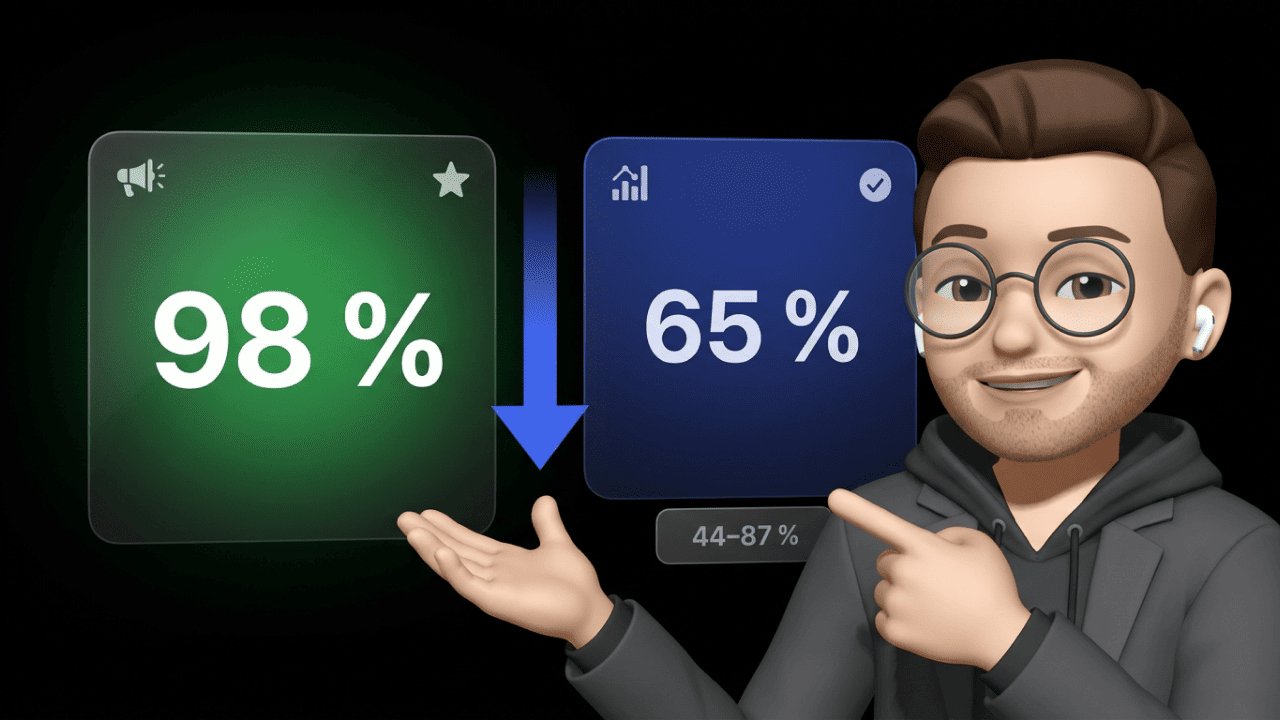
Forethought prominently advertises "up to 98% resolution rate". The reality from their own published case studies:
| Customer | Deflection/Resolution | Context |
|---|---|---|
| Grammarly | 87% | CSAT 4.2, 1.5 weeks setup |
| YAZIO | 80% | After 6 months, CSAT 3.1 → 4.0 |
| Spordle | 86% (self-serve) | 142% ROI in 3 months |
| Upwork | 52–65% (chat) | 75% via widget |
| YNAB | 70% | Previously 25% with another bot |
| Kickfin | 72% (self-serve) | — |
| Achievers | 44–69% | Expectation started at 10% |
| ActiveCampaign | 60%+ | Chat only |
The honest average per Forethought's own benchmark report: 65%. The 98% is a marketing ceiling, not an expectation. The realistic range sits between 44 and 87%, depending on data quality, ticket volume, use-case complexity, and implementation maturity.
Important – and no other comparison article mentions this: High deflection doesn't automatically mean high customer satisfaction. A bot can "deflect" by looping the customer until they give up. Trustpilot reviews show exactly that frustration across multiple Forethought deployments. Buyer satisfaction sits at 4.3/5 on G2. End-user satisfaction on Trustpilot sits at 2.5/5. That's not a statistical anomaly. That's a structural signal.
Real-World Calculation: What a 10,000-Ticket Team Pays Per Year
Theory aside. Let's do the math.
Scenario: DACH D2C shop, 10,000 support tickets/month, 50% AI resolution target, 8 support agents on Zendesk Suite Professional
| Line item | Monthly cost |
|---|---|
| Zendesk Suite Professional (8 agents × $115) | $920 |
| Forethought platform fee (estimated, Vendr midpoint) | ~$3,500 |
| Forethought usage (5,000 deflections × $0.12) | $600 |
| Assist Agent (add-on, 8 agents) | ~$400 |
| Agent QA (add-on) | ~$350 |
| Internal FTE share for AI maintenance (0.5 FTE × ~$5,500) | $2,750 |
| Total per month (excluding one-time setup fee) | ~$8,520 |
| Annual total | ~$102,000 |
Plus a one-time setup fee, which in Vendr deals typically lands between $5,000 and $25,000. Plus data cleaning, which can easily hit five figures depending on the state of your archive.
The honest number for a mid-sized DACH team: $100,000 to $130,000 per year, all-in. That's not a tool purchase. That's a strategic investment with a depreciation timeline.
To Be Fair: Where Forethought Genuinely Delivers
Criticism alone would be cheap. And the 4.3/5 on G2 doesn't come from nowhere.
Multi-agent architecture. Five specialized AI agents that orchestrate together – few competitors offer this depth. Many have Solve-equivalents, but the combination of autonomous resolution, triage, agent copilot, knowledge-gap detection, and QA in one integrated system is technically impressive.
Per-customer fine-tuned models. Forethought hosts several hundred individually trained models – one per customer. More operationally expensive than a generic GPT setup, but delivers measurably better accuracy for complex, vertical-specific support environments (fintech, regulated industries).
Autoflows. Patent-pending technology that lets you define business logic in natural language instead of decision-tree diagrams. Upwork reports a 27% CSAT increase after switching from manual workflows to Autoflows. That's real. That's not marketing fluff.
Enterprise security by default. SOC 2 Type II, HIPAA, GDPR, CCPA-compliant. Automatic PII/PHI redaction is standard, not an add-on. A genuine plus for brands in regulated industries.
Agent QA on 100% of interactions. While other teams manually quality-check 5% of their tickets, Forethought scores every single interaction for empathy, grammar, relevance, and resolution. For support ops teams, that's a data goldmine.
All of it is real. The only question: do you need this depth – and is it worth $100,000+ a year?
Forethought vs. Intercom Fin vs. Zendesk AI: The Honest Comparison
Things get interesting in the competitive landscape. Now that Forethought belongs to Zendesk, the front lines are shifting.
| Criterion | Forethought | Intercom Fin | Zendesk AI Copilot | Gorgias Automate |
|---|---|---|---|---|
| Pricing model | Quote-based, hybrid (platform + usage) | $0.99 per resolution (published) | $50/agent/month add-on | Included in Gorgias plans |
| Standalone? | Add-on to helpdesk | Ships with own helpdesk | Zendesk-bound | Ships with own helpdesk |
| Ticket minimum | 20,000+ historical | None | None | None |
| Setup time | 30–90 days | Days | Days | Hours to days |
| Transparency | Zero | High (fixed unit price) | Medium | High |
| DACH support | English only | Limited | Yes | Limited |
| DACH ERPs (JTL, Xentral, Billbee) | None | Basic | Basic | Basic |
| E-commerce fit | Generic | Good | Good | Very good (Shopify-native) |
Intercom Fin offers the most transparent comparison. $0.99 per resolution, 50% automation guarantee (fees are refunded if the threshold isn't met), no ticket minimum. For shops with 1,000 resolutions/month: plannable $990 plus seat costs. For shops with 5,000 resolutions/month it climbs to $4,950 – at that point volume models start to look better. For more context on helpdesk comparisons and Intercom's limits, check our Intercom alternatives guide.
Zendesk AI Copilot ($50/agent/month) is the direct alternative in-house. If you're already on Zendesk Suite Professional ($115/agent), adding Copilot costs another $50 and gives you AI suggestions, intelligent triage, and automated resolutions. For a 10-agent team: $500/month flat. Under 505 resolutions/month, Intercom Fin is cheaper. Above that, Zendesk's flat fee wins.
Gorgias Automate is often the more pragmatic choice for Shopify stores. AI directly in the helpdesk, native access to Shopify data. Check order status, trigger returns, look up customer data – no detour. All things Forethought has to route through the ticketing system.
When Forethought Is Worth It – And When It Isn't
Forethought is worth it if:
- You have 20,000+ historical tickets and 2,000+ per month
- Your annual budget for AI customer service is at least $60,000
- You have a dedicated CX ops team for 30–90 day implementation and ongoing AI maintenance
- Your helpdesk is Zendesk (the logical combo after the acquisition) or Salesforce Service Cloud
- You need the full multi-agent architecture: Solve + Triage + Assist + Discover + QA as an integrated system
- You're a brand like Grammarly, Upwork, or Datadog – meaning a SaaS product with standardized, text-heavy support flows
Forethought is probably not worth it if:
- You're under 5,000 tickets per month or your ticket archive is small
- You need to go live in days, not months
- Transparent, predictable pricing is a decision criterion
- You run an e-commerce shop with a deep DACH stack (JTL, Xentral, Billbee, Shopware)
- You want a tool that doesn't just cut costs but also generates revenue
- Chatbot quality shapes your brand experience (Trustpilot reviews show: buyers and end-users judge Forethought very differently)
- You want the flexibility to switch helpdesks – after the Zendesk acquisition, your exit path from Zendesk is automatically your exit path from Forethought too
On the last point: DACH brands with JTL or Xentral integrations do much better with a natively integrated customer service suite like armincx. No ticketing system underneath, no add-on setup, direct connection to your European ERP stack. What does it cost? On request – but without the sales-call marathon.
DACH Specifics: GDPR After the Zendesk Deal
The section no US comparison article covers. And one that's gotten more complicated after the acquisition.
Data processing. Forethought is SOC 2 Type II, HIPAA, GDPR, and CCPA compliant. Automatic PII/PHI redaction runs by default. Servers are US-based by default.
The Zendesk dimension. Zendesk itself offers EU hosting in higher tiers. How Forethought's data flows integrate into Zendesk's infrastructure post-acquisition is currently not publicly documented. For DACH businesses, that means: before signing, explicitly clarify where data is hosted, which data flows run through Zendesk systems, and whether a separate DPA (data processing agreement) under GDPR Art. 28 is required with both entities.
Schrems II remains a topic. Standard Contractual Clauses (SCCs) or certification under the EU-US Data Privacy Framework (DPF) are still your options. Both require legal team effort. And if the political landscape shifts again (Safe Harbor, Privacy Shield, DPF – knocked down three times, revived twice), both tools are back on legally shaky ground.
Language support. Forethought's support is English-only, US time zones. The Solve AI can reply in 28 languages, but technical admin support can't. If your Zendesk breaks on a Tuesday morning at 9 AM CET, your Forethought support ticket waits until US afternoon. That's six to nine hours of radio silence on a live channel.
Bottom Line: A Ferrari With Zendesk's Logo on the Steering Wheel
Technically, Forethought is excellent. The multi-agent architecture, SupportGPT with per-customer fine-tuned models, Autoflows, and the honest deflection range of 44–87% – that's an enterprise-grade product. If you're Grammarly, Upwork, or Datadog, it pays off.
For most DACH e-commerce brands, it's a solution to a problem they simply don't have at this scale. You buy a tool built for Fortune 500 companies to optimize your Shopify or Shopware store. 20,000-ticket minimum, 30–90 days of setup, $60–$155k per year, half an FTE for AI maintenance – and since March 2026, Zendesk sits at the table as strategic owner.
My honest take: before booking a Forethought demo, ask yourself three questions. First: is the native AI in your helpdesk (Zendesk Advanced AI, Gorgias Automate) enough? Second: do you really need five specialized agents – or is a clean Solve-equivalent enough? Third: is email support even the channel with the biggest lever for you – or does WhatsApp with its 90% open rate deliver more revenue than any AI could ever save in your email inbox?
Forethought optimizes the past – namely the email ticket archives you already have. The more interesting questions for DACH brands in 2026 are about the future. For example: how every support chat becomes an upsell moment.
Bottom line: Forethought is an enterprise tool. The Zendesk acquisition turns it into a Zendesk enterprise tool. If you're neither enterprise nor on Zendesk – why spend part of your annual budget on a foreign ecosystem? Before booking the demo call, run the math. With all hidden costs. With all strategic dependencies.
15 minutes. Free. Clear numbers. No sales pitch.
FAQ: Forethought Pricing, Setup, Billing Model
Does Forethought AI cost less than $5,000 per month?
No. Median costs per Vendr data from 42 purchases are around $59,500 per year, roughly $4,960 per month – with a range from $40,000 to $155,000 annually.
Is there a free trial of Forethought?
No. Forethought offers no free trial, only a guided "Proof of Value" through the sales team with your real data.
Does Forethought setup take longer than a month?
Yes. Per Forethought's own FAQ, most teams need 30 to 90 days for implementation. Grammarly managed it in 1.5 weeks with a dedicated AI ops team.
Is there a minimum ticket volume for Forethought?
Yes. Forethought recommends 20,000+ historical tickets and 2,000+ ongoing tickets per month so the AI can train properly.
Does a Forethought deflection cost more than one dollar?
No. Vendr averages sit at $0.12 per deflection, negotiable down to $0.07 at higher volumes.
Does Forethought have three products?
No. Forethought has five specialized agents: Solve, Triage, Assist, Discover, and Agent QA. Each is priced separately.
Is SupportGPT the name of Forethought's AI engine?
Yes. SupportGPT combines large language models with retrieval-augmented generation and per-customer fine-tuned models built on your ticket history.
Does Forethought actually achieve 98% deflection?
No. The 98% marketing claim is a technical ceiling. Case studies show realistic 44 to 87%, with the honest average at 65% per Forethought's own benchmark.
FAQ: Zendesk Acquisition, Alternatives, DACH
Was Forethought acquired by Zendesk?
Yes. Zendesk completed the acquisition on March 26, 2026 – the largest Zendesk acquisition in nearly 20 years.
Will Forethought remain available for non-Zendesk customers?
Yes, at least short-term. Long-term, the integration maintenance for competing helpdesks like Gorgias, Freshdesk, and Intercom is uncertain.
Is Forethought GDPR-compliant?
Yes. Forethought is SOC 2 Type II, HIPAA, and GDPR-compliant with automatic PII/PHI redaction. After the Zendesk acquisition, DACH brands should re-check data flows and DPAs with their data protection officer.
Are there cheaper alternatives to Forethought?
Yes. Intercom Fin ($0.99 per resolution), Zendesk AI Copilot ($50/agent/month), and armincx for DACH e-commerce shops running on JTL, Xentral, or Shopware.
Does Forethought work with Shopify?
Yes, but only indirectly through helpdesks like Gorgias or Zendesk. There's no native Shopify admin integration for actions like cancellations or returns without an agent.
Is Forethought sensible for small e-commerce shops?
No. The 20,000-ticket minimum, $40,000+ annual contracts, and 30 to 90 day setup make Forethought a clear enterprise tool.
Is there German-language support at Forethought?
No. Forethought support is English-only and operates in US time zones. The AI itself speaks 28 languages, but admin and legal support run exclusively in English.
Is Forethought a classic chatbot?
No. Classic chatbots follow decision trees, while Forethought uses generative AI with per-customer fine-tuned models. For more detail, see our AI chatbot guide.
Is Zendesk AI now the same as Forethought?
No, not yet. Zendesk AI Copilot and Forethought currently run as separate products. Integration into Zendesk's Resolution Platform is announced but without a concrete timeline.