
The EU AI Act was postponed. The AI disclosure requirement still arrives: on August 2, 2026, Article 50 of the AI Act becomes applicable. What got postponed are the high-risk obligations. Article 50 concerns you as soon as an AI chatbot answers customer questions in your shop. The good news: implementation takes one afternoon, and brands like T1TAN already show what it looks like.
What is the AI disclosure requirement?
The AI disclosure requirement is part of the EU regulation on artificial intelligence, usually called the EU AI Act. You find it in Article 50, the so-called transparency obligations. The core idea is simple: people should be able to recognize when they interact with an AI and when content was artificially generated or manipulated.
Article 50 distinguishes four situations:
- AI systems that interact directly with humans (chatbots, voice assistants): users must be informed that they are dealing with an AI. The only exception applies when this is obvious from the context.
- AI-generated content (text, image, audio, video): providers of these systems must mark the content as artificially generated in a machine-readable way.
- Deepfakes: anyone publishing image, audio, or video content that deceptively imitates real people or events must disclose the artificial origin.
- AI texts on matters of public interest: a disclosure duty applies here as well. It lapses when a human reviews the text editorially and takes responsibility for it.
Important for practice: the disclosure must be clearly recognizable at the first point of perception. A note on page three of your terms and conditions is not enough.
When does the AI disclosure requirement apply?
The AI Act has been in force since August 1, 2024, and its obligations phase in over time. One row in this table matters most for you:
| Deadline | What applies from then |
|---|---|
| February 2, 2025 | Prohibited AI practices; proof of AI literacy under Article 4 |
| August 2, 2025 | Obligations for general-purpose AI models (GPAI) |
| August 2, 2026 | AI disclosure requirement: disclosure for chatbots, deepfakes, and AI texts (Article 50 paragraphs 1, 3, 4) plus watermarking for new systems (paragraph 2) |
| December 2, 2026 | End of the watermarking transition period for systems already on the market before August 2, 2026; newly prohibited: AI systems for sexualized deepfakes and abuse imagery (Digital Omnibus) |
| December 2, 2027 | High-risk obligations under Annex III (postponed by the Digital Omnibus) |
The background to the much-cited postponement: with the Digital Omnibus, Parliament and Council reached a trilogue agreement in May 2026 and formally adopted the amendment in June. The high-risk obligations move to the end of 2027 as a result. The disclosure obligations under Article 50 remain untouched and apply from August 2, 2026. Only the machine-readable watermarking under paragraph 2 comes with a transition period until December 2, 2026, and it applies exclusively to systems that were already on the market before August 2, 2026.
Violations carry fines of up to 15 million euros or 3 % of global annual turnover, whichever is higher (Article 99 paragraph 4 EU AI Act).
Who does the AI disclosure requirement affect?
The regulation knows two roles. Providers develop AI systems and bring them to market. Deployers put these systems to use. As an e-commerce brand, you are almost always a deployer: you use a tool for AI in customer service, an image generator, or a language model that others have built. The disclosure obligations are what count for you. The machine-readable watermarking is the providers' job, meaning the tools you use.
The topic already affects the majority of your competitors. According to the Bitkom AI study 2026(available in German), 41 % of German companies actively use AI and another 48 % plan to. Among AI users, 42 % run it directly in customer service. In short: whoever runs a shop in 2026 most likely also runs an AI system that falls under Article 50.
What exactly do you need to label?
Your AI chatbot or AI agent is the clearest case. When an AI answers questions like "Where is my order?" on your website or via WhatsApp, it interacts directly with humans. Your customer must be able to recognize that they are chatting with an AI. This applies regardless of whether the AI only answers FAQs or resolves complete tickets, the way modern AI agents in customer service do.
AI-generated content in your marketing is the second area. Product images from an image generator, AI videos, or synthetic voices fall under the marking obligation of the systems that created them. As a deployer, you should know which of your assets are AI-generated and actively disclose the artificial origin for deepfake-like depictions.
Editorial AI texts such as blog articles mostly stay out of scope, as long as a human reviews them and takes responsibility. Pure product texts also rarely aim to inform the public on matters of public interest.
Internal AI use stays disclosure-free. When your team drafts replies with AI and a human reviews and sends them, the customer interacts with a human. The obligation applies where the AI communicates externally on its own. The industry calls this principle Human in the Loop: a human stays in the loop, reviews every AI output, and takes responsibility for it.
How to implement AI disclosure in customer service
For customer service, the core rule reads: the AI identifies itself before the customer trusts it. In practice, three levels have proven themselves.
Level 1: The visible label. The chat carries a label such as "KI-Agent" (AI agent) directly in the widget header. The customer sees it the second they open the chat. That fulfills the requirement "recognizable at first perception" to the letter.
Level 2: The active introduction. The AI's first message makes clear who is answering. T1TAN, the goalkeeper glove brand from Germany, leads the way: "Hey, schön dass du hier bist! Ich bin der Goalkeepers Bot von T1TAN und möchte dir gerne bei deinem Anliegen weiterhelfen! Was kann ich für dich tun?" (in English: "Hey, great that you're here! I'm the Goalkeepers Bot from T1TAN and happy to help with your request! What can I do for you?") After one sentence, the customer knows what they are dealing with, and the brand still feels approachable.
Level 3: The clean frame. A privacy notice before the first message is sent rounds off the transparency. At T1TAN, it sits directly above the input field.
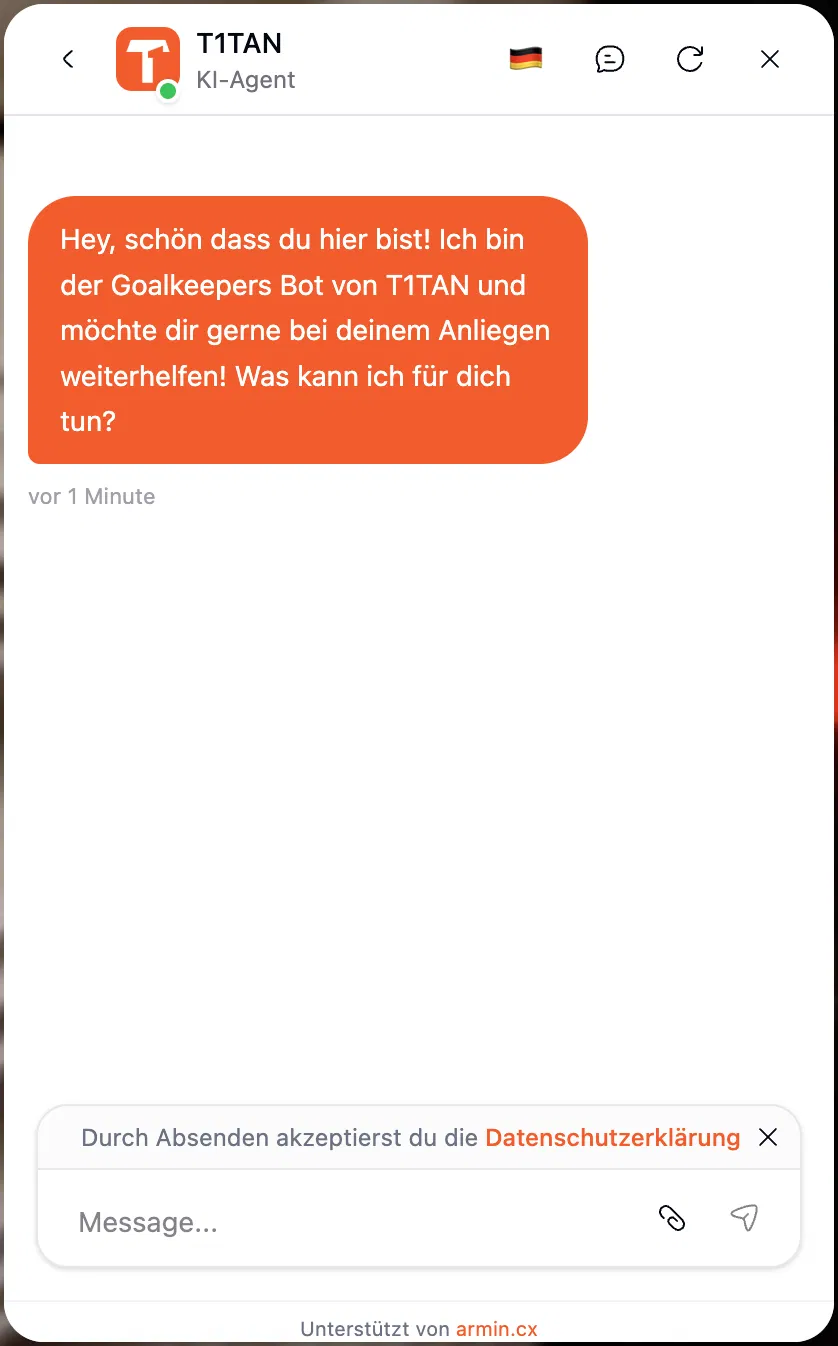
With the AI agents from armincx, level 1 is already built in: armincx sets the AI agent label in the widget header automatically as soon as the agent is active. When a human answers, the label switches accordingly. You write the welcome message for level 2 yourself. That is exactly how T1TAN solved it, and over 450 brands already use Chatarmin for WhatsApp marketing and customer service.
For the rest of your checklist:
- Label every channel where your AI answers on its own. A WhatsApp flow that automatically answers order status questions needs the disclosure just like the web widget.
- Keep the handover to humans visible. When a customer asks for a staff member, it should be recognizable from what point a human takes over.
- Document your implementation. A screenshot of your labeled widget in the compliance folder saves you discussions if anyone asks.
Practical guidance for everything beyond the chatbot comes from the Code of Practice on the transparency of AI-generated content, published by the EU Commission on June 10, 2026. It is voluntary but comes with official EU icons for labeling, in German simply "KI". Companies that sign the code benefit from a presumption of compliance with the transparency obligations. Joining the code later remains possible.
My take: The AI disclosure requirement is narrower than many headlines claim, and it is an opportunity for shops. A visible AI label lowers the expectation of human small talk and raises acceptance when the agent answers fast and precisely. Trust comes from clarity. And clarity costs you exactly one afternoon here.
Limits and open questions
Honest is honest: some points are still moving. The Code of Practice replaces no case law, and how supervisory authorities will enforce the obligations from August onwards remains to be seen. The Digital Omnibus only becomes formally effective upon publication in the EU Official Journal. A blanket obligation to label every AI-generated text does not exist in the AI Act. The obligations attach to specific use cases and roles.
This article is not legal advice. If you are unsure whether your AI applications fall under Article 50, talk to your data protection officer or a specialized law firm.
FAQ on the AI disclosure requirement
Wasn't the EU AI Act postponed?
Yes, partially. The Digital Omnibus moves the high-risk obligations to the end of 2027, but the AI disclosure requirement under Article 50 applies to chatbots and the like as before from August 2, 2026.
When does AI use in a company need to be disclosed?
As soon as an AI interacts with humans on its own or publishes content subject to disclosure, at the latest from August 2, 2026. Internal AI use with human review stays disclosure-free.
Do I need to label every AI-generated text?
No. The obligation applies to texts that inform the public on matters of public interest, and it lapses when a human reviews them editorially and takes responsibility.
What is the disclosure requirement for AI content under Article 50 EU AI Act?
Article 50 requires disclosing AI interactions and certain AI-generated content: for chatbots, synthetic media, deepfakes, and AI texts of public interest. The EU Code of Practice from June 2026 provides practical guidance for it.
How do I label an AI image?
As a deployer, you label visibly with the EU "KI" label, in the shop directly at the image or on social media via the platform toggle such as "AI-generated". The machine-readable marking in the metadata is the providers' duty and happens automatically with common image generators.
What are the penalties for violating the AI disclosure requirement?
Fines of up to 15 million euros or 3 % of global annual turnover, whichever is higher. The legal basis is Article 99 paragraph 4 EU AI Act.
Is an internal AI policy mandatory?
No, the AI Act does not require one. It still makes sense, to govern review and labeling internally in a verifiable way.
Conclusion: Labeling beats waiting
The AI disclosure requirement arrives on August 2, 2026, and it is very manageable for e-commerce brands. A visible AI agent label, a welcome message that introduces itself honestly, and a privacy notice cover the customer service case. T1TAN shows that transparency and brand experience go together. Whoever labels now has the topic done before the deadline and earns customer trust instead of legal risk.
See in a demo how you set up your AI agent in armincx and label it properly. 15 minutes. Free. Clear answers.
Expert-reviewed: Special thanks go to Elisa Drescher of datenschutz-fix for the expert input and the review of this article. As an external data protection officer, among others for Chatarmin, she helps companies implement data protection and AI compliance together. She is also the author of the book "Deepfakes im Marketing".
![Is WhatsApp GDPR compliant? WhatsApp privacy in the spotlight [Update 2026]](https://cdn.sanity.io/images/vmmgqf0p/production/66abe4df0b987a9dff483b3a7599b54edaccd441-1920x1305.webp?fit=max&q=75&w=3840&auto=format)