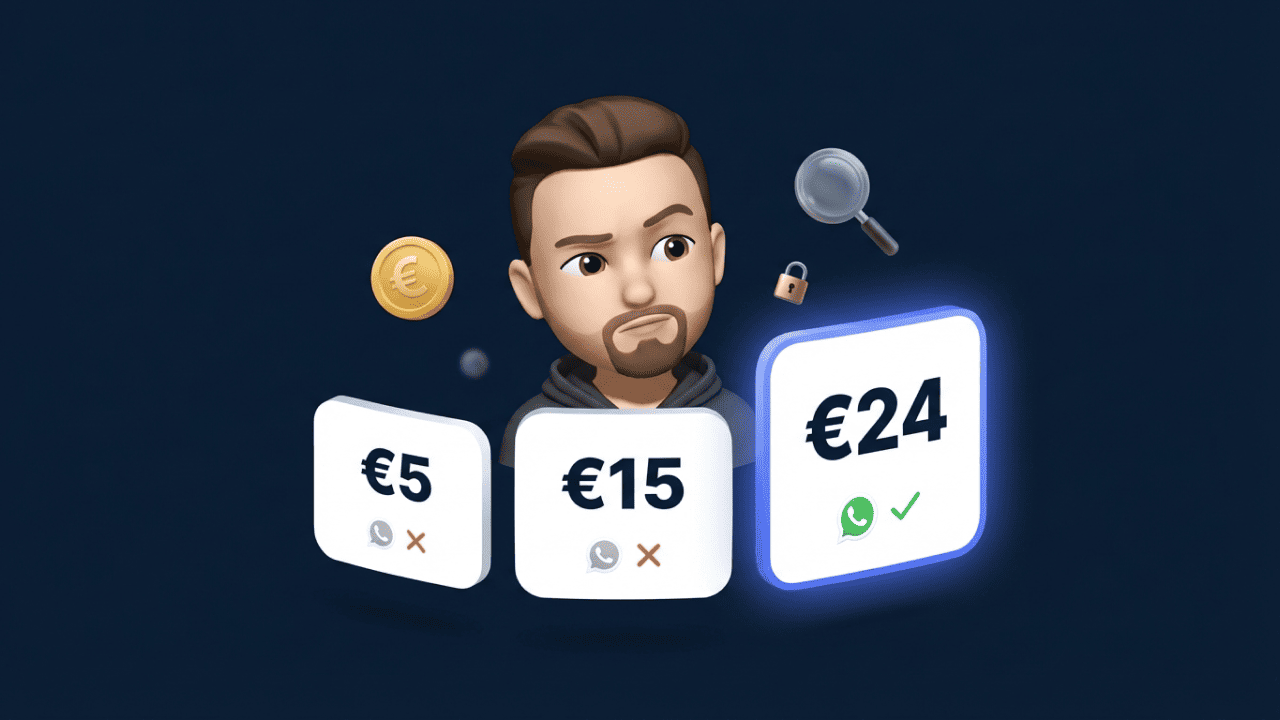

Your support team is growing to 12 people. You need WhatsApp in customer service. You want a GDPR-compliant helpdesk hosted in Europe. Zammad lands on your shortlist — and the entry price of €7 per agent sounds almost too good.
Spoiler: it is. At least for e-commerce.
The €7 Starter plan can't do chat, WhatsApp, or Telegram. No SLA management, no knowledge base. For a three-person team handling nothing but email tickets, that's fine. For everyone else, it isn't.
I'm Johannes, founder of Chatarmin. We serve 450+ e-commerce brands across the DACH region and work with messaging and support tools every day — so I know the pricing structures of the major helpdesks pretty well. Here's what Zammad actually costs after the v2 update in early 2026, when each plan starts paying off, and which features (AI, in particular) suddenly trigger add-on fees.
Open Source, Closed Features: What You Get for €7, €16, and €25
Zammad offers three cloud tiers — with higher prices since the v2 update, but also a lot more storage. Prices are per agent per month. Annual billing saves you roughly 10%. The feature gaps between tiers, however, are substantial.
The Current Pricing Table
| Starter v2 | Professional v2 | Plus v2 | |
|---|---|---|---|
| Price (annual) | €7/agent | €16/agent | €25/agent |
| Price (monthly) | €9/agent | €18/agent | €27/agent |
| Max. agents | 5 | 35 | Unlimited |
| Channels | Email, web form, SMS | + Chat, Telegram | + WhatsApp, Facebook |
| Knowledge base | No | Yes (single language) | Yes (multilingual) |
| SLAs | No | Yes | Yes |
| Core Workflows | No | No | Yes |
| GitHub/GitLab | No | No | Yes |
| AI add-on available | No | Yes (€0.03/call) | Yes (€0.03/call) |
| Storage | 20 GB | 50 GB | 150 GB |
| Max. attachment size | 10 MB | 35 MB | 50 MB |
| Support | Email (8×5) | Email (8×5) | Email + phone (8×5) |
Starter v2 (€7/agent): Who This Works For
Maximum five agents. Email and web forms only. No chat, no messaging, no SLA tracking. Works for small B2B teams with manageable ticket volumes. For an e-commerce shop running serious customer service in 2026, the Starter is too limited.
20 GB of storage sounds generous. Until you realize how fast email attachments and images in tickets eat through it. If your team regularly handles product photos or PDF invoices in support, you'll hit that ceiling within months.
Professional v2 (€16/agent): The Sweet Spot Without WhatsApp
Chat and Telegram come on board. Zammad claims their Smart Chat resolves inquiries up to 7× faster than classic email tickets. SLAs and a single-language knowledge base are included, plus custom roles and ticket objects. The agent limit sits at 35 — enough for most mid-sized teams.
What's missing: WhatsApp and Facebook. You're paying more than double the Starter price and still don't get the channel a large share of customers prefer in many markets.
My take: If your business model works without messengers — IT service provider, agency, internal helpdesk — buy here and skip the Plus markup. The moment WhatsApp enters the picture, the jump to Plus v2 pays off immediately.
Plus v2 (€25/agent): Omnichannel With Everything Included
This is where WhatsApp and Facebook get unlocked. Add Core Workflows, a multilingual knowledge base, GitHub/GitLab integration, and unlimited agents. Phone support from Zammad is also only available starting from this tier.
€25 per agent for a helpdesk with German servers, ISO 27001 certification, and omnichannel capability — that's fair by market standards. For comparison: Zendesk Suite Team costs around $55 (approx. €47) per agent.
The point: Budget for €25 from day one, not €7. Starting on the Starter plan and upgrading to Plus three months later just means you've done the onboarding twice.
Self-Hosting: License-Free Doesn't Mean Cost-Free
Zammad is open source under the GNU AGPLv3 license. You can download the Community Edition and run it on your own servers without paying Zammad GmbH a cent. The software is free. Everything around it isn't.
The Bill That Doesn't Show Up on Any Pricing Page
| Item | Estimated cost/month |
|---|---|
| Server (depending on team size/traffic) | €15–120 |
| Backup storage, SSL, load balancer if needed | €10–50 |
| Admin hours (4–8 h/month at €80) | €320–640 |
| Total | €345–810 |
For a 10-person team on the cloud, you'd pay 10 × €25 = €250 per month on the Plus v2 plan. Self-hosting costs more in maintenance alone — before you've handled a single support ticket.
Rule of thumb: Below 20 agents, self-hosting almost never pays off. Above 50 agents, the math flips because per-agent fees disappear and fixed infrastructure costs spread across more users.
Managed Hosting: The Grey Zone Between Cloud and Self-Hosted
Something Zammad doesn't advertise on its own website: third-party providers host Zammad as a managed app — cheaper than the official cloud, but without vendor support.
- CloudClusters: from around $5/month for small instances, Docker-based
- Elestio: from around $16/month, dedicated VMs with automated backups and SSL
- AWS Marketplace (e.g., via ATH Infosystems): usage-based EC2 costs depending on instance type
The upside: you skip the maintenance and pay significantly less than the official cloud. The downside: no vendor support. When problems arise, you're relying on the community and your hosting provider. For technically capable teams, a real option — for everyone else, a risk.
Support Contracts for Self-Hosters: Where "Free" Suddenly Goes Four Figures
If you self-host but want vendor support, you pay extra. Important: service hours differ by plan — not all three packages are equal.
| Plan | Price/year | Service hours | Response time | Service requests |
|---|---|---|---|---|
| Business | €2,999 | Mon–Fri, 9:00–17:00 CET | max. 6 h | 15 |
| Enterprise | €5,999 | Mon–Fri, 8:00–18:00 CET | max. 4 h | 45 |
| Corporation | €9,999 | Mon–Fri, 8:00–20:00 CET | max. 2 h | 95 |
With the Business plan at €2,999 per year, you get 15 requests. That works out to roughly €200 per individual support ticket. The word "free" loses its shine fast.
Corporation also includes patch-level and security-patch updates plus a 10% discount on additional services. For banks, government agencies, and enterprises with compliance requirements, that's often the only viable option.
Zammad with AI: The New 2026 Add-on and Its Honest LLM Choice
With Zammad 7.0 (released March 4, 2026), AI features moved into the helpdesk for the first time — as an add-on, optional in Professional v2 and Plus v2. The price: €0.03 per AI call. An AI call is a single action, like a generated ticket summary or a writing-assistant suggestion.
What Zammad Gets Right
You pick the language model yourself. Zammad supports seven providers: Zammad AI (hosted in the EU, GDPR-compliant), OpenAI, Anthropic Claude, Azure AI, Mistral AI, plus local deployment via Ollama — and "Custom (OpenAI Compatible)" for providers like Google Gemini that aren't natively supported. By default, all AI features are disabled and need to be activated per group.
Hands down, this is the most honest AI implementation in the helpdesk market in 2026. Zendesk locks you into its cloud, OpenAI as default. With Zammad, you configure the provider once and decide whether your support data flows to US providers or stays on your own server.
Where It Still Falls Short
Pay-per-call adds up faster than you'd think. With 1,000 tickets per month and three AI calls each (summary + two writing assists), you're at €90. Sounds light, but: you also pay the LLM API costs at the provider you chose. OpenAI, Anthropic & co. bill separately.
What Zammad doesn't do: real AI agents that handle tickets autonomously. You get summaries, translation prompts, writing assists — all co-pilot logic. The final reply is still written by a human. In e-commerce shops, 40–60% of tickets are classic WISMO inquiries ("Where is my order?"). Answering those with summaries instead of autonomous agents leaves the actual automation potential on the table.
ArminCX Prices Differently
Our AI-first platform ArminCX includes AI agents — not per call, but as part of the model. These agents resolve standard inquiries autonomously and automate up to 70% of ticket volume. For e-commerce teams with high ticket throughput, that often works out cheaper than pay-per-call.
Zammad vs. Zendesk: Half the Price, Different Trade-offs
Most e-commerce teams compare Zammad with Zendesk. The price difference is clear — the question is what you get for it.
Where Zammad wins:
- Hosting in German data centers (ISO 27001)
- GDPR compliance without US cloud risks
- Open-source transparency: you know what's under the hood
- Plus v2 at €25/agent vs. Zendesk Suite Team $55 (approx. €47) — less than half
Where Zendesk leads:
- Significantly larger app ecosystem and marketplace
- More native integrations (Shopify, Salesforce, etc.)
- AI features in higher tiers without pay-per-call logic
- Better reporting out of the box
On Capterra, Zammad scores 5.0 out of 5 in the "Value for Money" category, Zendesk Suite sits at 4.2. Important context: Zammad's score is based on 6 reviews, Zendesk's 4.2 on around 2,655. The direct comparison isn't statistically robust — but as an indicator of customer sentiment, it's usable. On G2, Zammad is consistently listed as a "High Performer" in the helpdesk segment, which backs the read with a second source.
For a European support team with 10–30 agents that values data sovereignty, Zammad is the more economical choice. For an international team with 100+ agents and complex automations, Zendesk often delivers more despite the higher cost.
Zammad vs. ArminCX: Ticketing System Meets Revenue Channel
The Zendesk comparison is the classic one. But if you run an online store, a different question comes up: what happens when you need WhatsApp not just as a support channel, but as a revenue driver?
That's where the line sits between a helpdesk and an e-commerce platform for customer communication.
| Zammad Plus v2 | ArminCX | |
|---|---|---|
| Pricing model | Per agent (€25/month) | Usage-based, not per agent |
| Plus v2 only | Native across all plans | |
| AI automation | Add-on, €0.03 per call (co-pilot) | AI agents autonomous, up to 70% ticket automation |
| Shopify integration | Not native | Native (+ WooCommerce, Klaviyo, Billbee) |
| WhatsApp marketing | Not included | Campaigns, flows, newsletters included |
| Hosting | DE (ISO 27001) | EU hosting, GDPR-compliant |
Zammad is the better choice if you need a classic IT ticketing system, want self-hosting, or your support runs primarily through email. Zammad also serves government agencies, NGOs, and internal IT teams — ArminCX doesn't.
ArminCX is the better choice if you run a Shopify or WooCommerce store and want to use WhatsApp as a full channel for support and marketing. No per-agent pricing — instead, AI agents that resolve standard inquiries around the clock.
The key difference: Zammad manages tickets. ArminCX automates customer service and generates revenue through WhatsApp at the same time. For e-commerce teams that need both, that's the more relevant comparison.
Three Details That Get Lost in the Price Comparison
Feature Sponsoring
Something I genuinely appreciate about Zammad: if you're missing a feature, you can fund its development through Feature Sponsoring. The feature then becomes part of the open-source core and is available to everyone. That's how the ServiceNow integration came about (sponsored by Adfinis AG, released in June 2020), and the Mentions feature was built the same way. A model that's rare in SaaS — and one I'd like to see from more vendors.
Worth noting: the typical lead time is 12+ months, because the roadmap is already booked.
Migration from OTRS and Jira
If you're switching from OTRS (Community Edition discontinued) or Jira Service Management (too complex and expensive for pure customer support): Zammad offers free migrators for both systems. Data transfer runs directly through the admin interface, importing tickets, users, and attachments. Migrations from Zendesk, Freshdesk, or classic mailbox solutions are also covered.
NGOs and Non-Profits
Zammad doesn't offer special cloud discounts for non-profit organizations. For NGOs with their own IT, self-hosting often remains the most economical option — no license fees, full data transparency. Zammad lists customers including Amnesty International Germany and Junges Theater Bonn (a German regional theater). Which hosting model each one uses isn't publicly disclosed by Zammad.
Which Zammad Plan Pays Off for Whom?
Starter v2 (€7/agent): Small B2B teams (max. 5 people) handling support exclusively via email. No messaging, no chat, no SLAs. Too limited for most e-commerce scenarios.
Professional v2 (€16/agent): Teams that need chat and Telegram but can do without WhatsApp and Facebook. SLAs and knowledge base included, AI add-on optional. Up to 35 agents. The sweet spot for teams without a WhatsApp-centric customer base.
Plus v2 (€25/agent): The plan for growing e-commerce teams that take omnichannel seriously. WhatsApp, Facebook, Core Workflows, multilingual knowledge base, GitHub/GitLab integration, unlimited agents. If you're looking for a real omnichannel inbox for European e-commerce, don't skip the ArminCX comparison here — Zammad Plus covers the channel, ArminCX covers the automation behind it.
Self-Hosted: Organizations with their own IT department and strict compliance requirements — banks, government agencies, enterprises with 50+ agents. If you're a Shopify shop with 12 employees, stay away.
Frequently Asked Questions About Zammad Pricing
Is Zammad really free?
No. Only the self-hosted Community Edition has no license fees. In practice, hosting, maintenance, and IT staff cost €345–810 per month. The cloud version starts at €7 per agent per month (Starter v2, annual billing).
How much does Zammad cost with WhatsApp?
WhatsApp is only available in the cloud on the Plus v2 plan at €25 per agent per month. Self-hosting has no license fees, but setting up the WhatsApp Business API is technically complex.
How much do Zammad's AI features cost?
AI features are an optional add-on in Professional v2 and Plus v2. You pay €0.03 per AI call (e.g., ticket summary or writing assist). With external LLM providers, their API costs apply on top — only with Zammad AI as provider are the calls already covered.
Which language model does Zammad use for AI?
You choose. Zammad supports seven providers: Zammad AI (hosted in the EU), OpenAI, Anthropic, Azure AI, Mistral AI, local deployment via Ollama (e.g., with Meta Llama), and "Custom (OpenAI Compatible)" for providers like Google Gemini. By default, all AI features are disabled and have to be activated per group.
Can I cancel Zammad monthly?
Yes. With monthly billing, you can cancel any time at the end of the month. Annual contracts lock you in for 12 months but save 10%.
What's the cancellation period for self-hosted contracts?
At least 90 calendar days before the end of the contract year. Miss that, and the contract auto-renews for another year.
How much storage is included with Zammad?
Tiered: 20 GB (Starter v2), 50 GB (Professional v2), 150 GB (Plus v2). If your team handles many attachments, budget for the Plus plan from the start.
Is there a Zammad app for iOS or Android?
No, Zammad doesn't have a native app. The interface is responsive and works fine in mobile browsers.
Can I buy missing features from Zammad?
Yes — through Feature Sponsoring. Companies fund the development of desired features, which then move into the open-source core. The implementation timeline is 12+ months.
Is Zammad GDPR-compliant?
Yes. Zammad GmbH hosts cloud instances in ISO 27001-certified German data centers. With self-hosting, you have full control over all data.
Is migration from OTRS or Zendesk to Zammad straightforward?
Yes. Zammad provides free migrators that automatically import tickets, users, and attachments — from OTRS, Zendesk, Freshdesk, and mailbox solutions. The migration runs directly through the admin interface.
Zammad vs. Zendesk: Which is cheaper?
Zammad costs less than half the Zendesk price for comparable features. Plus v2 (€25) includes functionality that starts at $55 per agent (approx. €47) on Zendesk Suite Team.
Are there discounts for NGOs?
No, no cloud discounts for non-profit organizations. Many NGOs use the free self-hosted version instead.
What's the difference between Cloud and Self-Hosted?
In the cloud, Zammad handles updates, backups, and data security. Self-hosted runs on your own servers, with you responsible for everything. For teams under 20 agents, the cloud is usually cheaper.
Bottom Line: Honestly Calculated, Fairly Priced
Zammad is one of the most transparent helpdesk vendors on the market. Pricing is clear, feature boundaries between plans are logical, and the open-source foundation creates a level of trust that proprietary vendors can't match. The v2 update in early 2026 raised tariffs slightly while massively expanding storage — Plus v2 now ships with 150 GB instead of the previous 50 GB.
If you don't need WhatsApp, Professional v2 at €16 per agent offers one of the best price-to-value ratios in the helpdesk segment. If you want omnichannel, budget for €25. If you want to use AI seriously, factor in both the €0.03-per-call lever and the additional LLM API costs realistically. Self-hosting only pays off above 50 agents — and only if admin hours are calculated honestly.
If you want to use WhatsApp as a real revenue channel — with campaigns, automations, and AI agents that resolve standard inquiries autonomously — a classic ticketing system alone won't cut it. That's exactly what we built Chatarmin and ArminCX for.
Book a demo and we'll show you in 15 minutes what's actually possible with WhatsApp and AI in e-commerce in 2026.