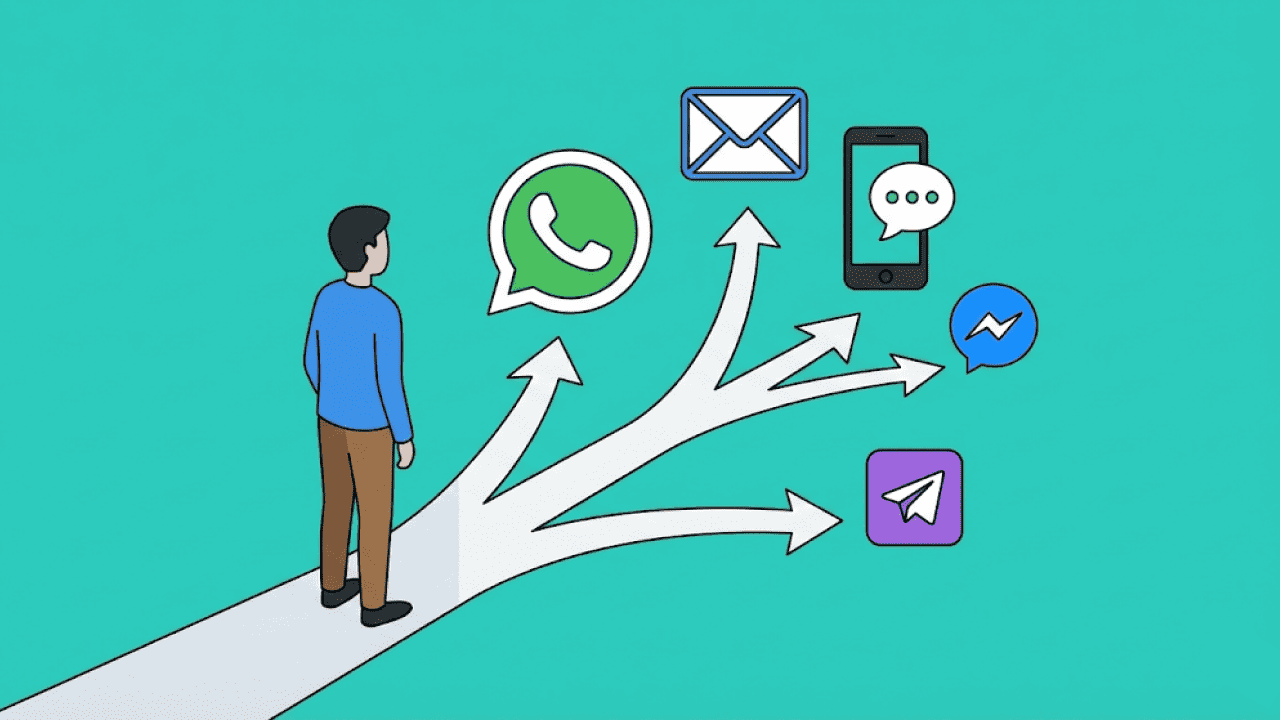

Whether for e-commerce businesses, brands, or agencies, the search for a WhatsApp newsletter alternative is more relevant in 2026 than ever. As the dominant player among messenger apps, WhatsApp still leads customer communication, but topics such as data protection, end-to-end encryption, costs, dependence on the Meta corporation, or a lack of flexibility are prompting companies to evaluate alternative marketing channels. Alongside classic options like email or SMS, messenger apps such as Telegram, Signal, or Threema, as well as live chat and all-in-one marketing tools, are also moving further into focus.
Professional companies therefore evaluate WhatsApp alternatives not based on gut feeling, but in a data-driven and strategic way: Which chat app fits your target audience? Which solution meets GDPR requirements in Germany? And which channel offers the best long-term performance in terms of reach, interaction, automation, and cost-effectiveness within the marketing mix?
WhatsApp newsletter alternatives at a glance for businesses
The most important channels in direct comparison—reach, automation, and GDPR at a glance:
| Channel | Reach | Engagement rate | Automation / API | GDPR compliance | Typical use cases |
|---|---|---|---|---|---|
| WhatsApp Newsletter | very high | very high (strong depending on use case) | very good (WhatsApp Business API) | possible with a professional provider | time-sensitive offers, conversion-driven campaigns, customer retention |
| Email Newsletter | very high | medium | good | GDPR-compliant with proper opt-in | longer content, B2B communication, information distribution |
| SMS Marketing | medium | high in the short term | low | GDPR-compliant with proper opt-in | one-time passwords, appointment and status notifications |
| Messenger alternatives (Telegram, Signal) | medium | fluctuating | limited | often problematic | community communication, niche target groups |
| Live Chat | low | high with active use | good | standard | customer service, support, consulting |
Key criteria: what a WhatsApp newsletter alternative must deliver
Companies looking for an alternative to WhatsApp newsletters should not view channels in isolation, but compare them against clear evaluation criteria. The most important factors are reach and acceptance, legal certainty, and automation capabilities in everyday marketing operations.
User reach and acceptance
A channel’s real reach determines whether marketing messages actually land in users’ daily lives or fizzle out. At the same time, acceptance of push messages plays a central role.
WhatsApp newsletters reach nearly all smartphone users, are deeply embedded in everyday life, and achieve very high open rates.
Email newsletters are universally widespread and remain relevant especially in B2B, but lose effectiveness when it comes to spontaneous reactions and short-term promotional messages.
SMS stands out with high delivery rates and immediate impact, but the format is strongly limited and many users accept marketing messages only to a limited extent.
Messenger alternatives like Telegram or Signal work well in specific communities, but compared to WhatsApp they remain niche—especially in traditional industries.
Live chat is excellent for customer service on a website, but it does not replace a proactive newsletter channel.
Costs, GDPR, and legal requirements
No matter the channel, a WhatsApp newsletter alternative must be legally compliant, transparent, and economically viable. Especially for marketing messages, data protection and infrastructure play a central role.
GDPR compliance is mandatory—including proper opt-in, clear purpose limitation, and secure processing of personal data.
EU data storage, controllable cloud infrastructure, and documented processes are required, especially for messenger and all-in-one solutions.
Beyond pure sending costs, you must also consider operational effort, tool complexity, and real conversion rates—cheaper channels are not automatically more cost-effective.
Engagement rates and automation capability
A modern marketing channel must be scalable and integrate with existing systems. Without automation and structured data connectivity, many alternatives hit their limits quickly. Professional marketing tools also enable personalized messages through dynamic placeholders (e.g., name, product, or status) as well as detailed reporting on open and click rates—an essential requirement for data-driven campaign management.
WhatsApp newsletters lead in engagement and API-driven automation via the WhatsApp Business Platform—including segmentation, triggers, and CRM integration.
Email marketing enables complex automations but achieves significantly lower engagement than messenger-based channels.
SMS is very direct, but offers hardly any automation or personalization features and can become expensive with larger sending volumes.
Messenger alternatives often fail in a business context due to missing APIs, limited features, and weak integration into marketing tools or customer service systems.
Messenger apps and other channels compared
Depending on target audience, use case, and technical maturity, common marketing channels differ significantly. The overview below shows where individual solutions play to their strengths—and where typical disadvantages emerge in day-to-day use.
WhatsApp newsletters & Business API
For many companies, WhatsApp is the central messaging channel and, together with the WhatsApp Business API, forms the technical foundation for professional messenger marketing.
Strengths:
Market-leading reach and high acceptance among end customers
Extensive automation options via API, for example for broadcasts, chatbots, and segmentation
GDPR-compliant use when leveraging specialized WhatsApp marketing software and certified providers like Chatarmin
Deep integration into CRM, e-commerce, and marketing tools for end-to-end customer processes
Weaknesses:
High requirements for opt-in, data protection, and documentation
Higher entry costs and setup effort compared to classic channels like email
Typical use cases: Always-on campaigns, fast product communication, event reminders, dialog-based customer service, and transactional messages.
Email newsletters
Email remains an established marketing channel, especially in B2B and for more in-depth content. Despite declining engagement, email marketing remains one of the most-used channels because it allows companies to inform customers in a structured and scalable way.
Strengths:
Universally used and comparatively cost-efficient for sending large volumes
Mature marketing tools with extensive automation capabilities
Well suited for longer texts, attachments, and legally compliant archiving
Weaknesses:
Significantly lower open and click rates than messenger channels
Spam filters, promotion tabs, and inbox overload reduce visibility
Declining engagement, especially among younger audiences
While email newsletters often reach open rates of around 20–25% in practice, WhatsApp newsletters frequently achieve open rates above 90% depending on industry and use case, which directly affects response speed and conversion.
Typical use cases: B2B communication, product information, offer documents, newsletters with high information density.
SMS marketing
SMS is a direct but highly limited channel, primarily used for time-critical information.
Strengths:
Very high delivery rates and immediate attention
Independent of apps or an internet connection
Weaknesses:
High cost per message, especially with frequent sending
Very limited automation and personalization capabilities
Limited format and low acceptance for promotional messages
Additionally, many recipients increasingly perceive SMS as promotional or disruptive because interactive elements like images, buttons, or structured calls to action are missing.
Typical use cases: One-time passwords, appointment or pickup notifications, short-term alerts.
Messenger alternatives: Telegram, Signal, Viber
Alongside WhatsApp, other messenger apps exist that can be interesting in certain scenarios.
Strengths:
Telegram: Large communities, flexible channel and group structures, low entry barriers
Signal: Very high security standards, strict end-to-end encryption
Viber: Strong reach in certain countries, good multimedia support
Facebook Messenger: Closely connected to Facebook and Instagram, broad reach within the Meta ecosystem, usable for customer service and basic automations
Weaknesses:
Missing or non-standardized business APIs for opt-in management, template approvals, reporting, and audit-proof automation
Little to no integration into CRMs, shops, or marketing tools
Limited reach and low acceptance in B2B contexts
Typical use cases: Community building, niche audiences, privacy-oriented communication without complex automation.
Live chat & chatbots
Live chats are not a classic newsletter channel, but they play an important role in digital customer interaction.
Strengths:
Direct, personal real-time communication
Strong integration with CRM and customer service systems
Automatable for support and after-sales processes
Weaknesses:
No proactive sending of marketing messages possible
Usually only makes sense in combination with other channels
Typical use cases: Customer service, product consulting, support for complex requests.
Decision matrix: when which alternative can stand out
| Criteria | WhatsApp Newsletter | Email Newsletter | SMS Marketing | Messenger alternatives |
|---|---|---|---|---|
| Reach | very high | very high | medium | low–medium |
| Engagement rate | excellent (≈ 30%+ ) | low (≈ 2–7%) | high, but short-lived | fluctuating |
| Cost per 1,000 messages | medium | low | very high | low (theoretically) |
| Opt-in friction | high | medium | high | low |
| Automation / API | very good (Business API) | good | poor | weak / not available |
| GDPR compliance | possible with provider | standard | standard | often problematic |
| CRM integration | extensive (API-based) | extensive | low | hardly any |
Matrix conclusion: No WhatsApp newsletter alternative covers all “jobs” at once. Email excels in depth and reach, SMS in urgency, messenger alternatives in community and privacy—only WhatsApp newsletters currently deliver the full package of reach, engagement, automation, and economic efficiency that matters in e-commerce and marketing.
Quick practical choice: Email is especially suitable for longer content, formal communication, and preparatory information. WhatsApp is the better channel for time-critical messages, activating campaigns, reminders, and all initiatives where fast response and high attention are decisive.
Practical examples: typical scenarios & business cases
Depending on goals, industry, and communication needs, different channels fit very different use cases. The examples below show how companies can reach customers in targeted ways through different routes.
Email newsletters:
Especially established in B2B, for example for sending offer documents, whitepapers, contract information, or product updates that require more reading time. Recurring company news, invoices, or legally relevant documentation (e.g., price lists, changes to T&Cs) are also still preferably sent via email.
WhatsApp newsletters:
As a direct messenger service, WhatsApp is ideal for time-critical and attention-grabbing communication: product launches in e-commerce, exclusive discount campaigns, back-in-stock notifications, or event reminders. Companies use WhatsApp deliberately as an always-on channel to address customers personally and directly, trigger interactions, and measurably increase conversions.
SMS marketing:
Frequently used for critical information with immediate impact, such as one-time passwords (2FA), pickup or delivery notifications, appointment confirmations, or short-notice updates like cancellations. For extensive, dialog-driven marketing campaigns, SMS is less suitable due to the limited format and cost structure.
Telegram / Signal:
In practice often used for community-based communication, for example in media projects, crypto or tech communities, associations, or data-sensitive audiences. The focus is less on conversion and more on exchange, reach within a clearly defined niche, and a high level of privacy.
Data protection requirements for WhatsApp alternatives: which obligations apply?
Regardless of whether companies use WhatsApp newsletters, email, SMS, or other messenger solutions, data protection is not optional but a mandatory prerequisite. Every professional alternative must meet the same fundamental data protection requirements:
Explicit opt-in with proof
For every promotional outreach to customers.
Transparent data processing and purpose limitation
Clearly separated from service or support communication.
Preferred data storage in the EU
Plus technical and organizational measures to protect personal data.
In practice, email newsletters and SMS marketing are considered established, GDPR-compliant alternatives when implemented correctly from a technical standpoint. They offer clear opt-in mechanisms, documentable processes, and are legally well categorized.
For messenger alternatives such as Telegram, Signal, or Facebook Messenger, the situation is more nuanced. While these messenger services offer advantages in reach or security, professional business APIs, audit-proof opt-in flows, or a clear separation between private communication and marketing messages are often missing. Telegram has more than one billion active users worldwide and is particularly suitable for media companies or community-driven channels. In classic e-commerce and B2B marketing, however, professional business APIs, standardized opt-in flows, and deep CRM integration are often lacking.
For WhatsApp newsletters, Chatarmin provides the necessary legal certainty: with EU-based hosting, full encryption, automated opt-in processes, and properly documented consents. This allows WhatsApp newsletters and combined channel strategies to be implemented professionally, at scale, and in a GDPR-compliant way.
Price-performance comparison: cheaper is not always better
Since July 2025, Meta has significantly adjusted the cost structure for WhatsApp newsletters. For many companies, WhatsApp is therefore no longer a low-cost channel, but an investment whose profitability must be evaluated against engagement, conversion, and revenue per message.
| Channel | Cost structure | Engagement & profitability |
|---|---|---|
| Email Newsletter | Very low sending costs | Often low open and click rates, therefore limited conversion |
| SMS Marketing | High cost per message | Strong for individual cases and time-critical alerts, but not scalable |
| Messenger alternatives | Seem cheap at first glance | Missing integration, reporting, and automation increase cost per conversion |
| WhatsApp Newsletter | Higher entry costs | Very high conversion rates, strong automation, and sustainable customer retention |
Conclusion: Only a well-thought-out cost-engagement comparison decides. The most economically effective approach is usually a channel mix: WhatsApp for active and timely communication, email for preparatory or accompanying information, SMS for critical alerts.
What matters is not the price per message, but the ratio of cost, engagement, and revenue generated. Thanks to significantly higher open, click, and conversion rates, WhatsApp newsletters often generate higher revenue per message in many e-commerce scenarios than email or SMS—despite higher individual costs.
Integration & channel mix: synergies for efficient marketing
A well-designed channel mix is one of the biggest levers for sustainable marketing success today—especially when WhatsApp is deliberately used as a performance channel within an overarching WhatsApp marketing strategy. Strategically combined channels not only increase ROI, but also ensure customers are reached at the right time through the right touchpoint.
Targeted combination instead of siloed solutions
WhatsApp for timely, dialog-oriented communication, email for accompanying information and content, SMS for critical alerts or transactional messages.
Central control via one platform
Chatarmin enables integrated management of WhatsApp newsletters, email, SMS, and live chat—GDPR-compliant, transparent, and with full control over opt-ins, automations, and reporting.
More resilience and better performance
Companies reduce dependency on single channels, optimize conversion rates across channels, and can address individual customer needs across the entire customer journey.
Why Chatarmin is your ideal partner in multi-channel marketing
Chatarmin is not only a WhatsApp tool, but a resilient infrastructure for professional messenger and multi-channel marketing. Companies that want to combine WhatsApp newsletters with alternatives get a central, GDPR-compliant platform from Chatarmin for opt-ins, automation, segmentation, and reporting.
Independent reviews also confirm its practical value: Chatarmin is rated 4.9 out of 5 stars on G2 (37 reviews, as of January 2026). Users especially praise the ease of use, fast support, and suitability for scalable WhatsApp and multi-channel marketing.
Conclusion: evaluate WhatsApp newsletter alternatives objectively
No single WhatsApp newsletter alternative can fully replace all of WhatsApp’s advantages. Successful companies make their decision based on data and realistically compare reach, engagement, costs, and technical capabilities. Email remains a reliable channel for large volumes and structured B2B communication, SMS is best suited for time-critical notices, while messengers like Telegram or Signal serve specific niches.
For the combination of reach, engagement, and automation, WhatsApp remains the most powerful marketing channel—provided it is operated through a professional, GDPR-compliant infrastructure. This is exactly where Chatarmin supports you as an experienced business solution provider with powerful technology, proper opt-in management, and full compliance.
Frequently asked questions (FAQ) on the topic of WhatsApp newsletter alternatives
Which WhatsApp newsletter alternative is suitable under strict data protection policies?
Email newsletters and SMS, if implemented in a technically GDPR-compliant way, are safe. WhatsApp newsletters should only be used via the WhatsApp Business API and additionally via a certified marketing tool with European hosting and opt-in processes. The WhatsApp Business app alone does not provide legal certainty.
When is it useful to combine multiple channels?
Whenever different target groups need to be reached or specific message types require different touchpoints.
Do WhatsApp newsletters and email marketing differ in engagement?
Yes. WhatsApp regularly achieves up to 90% opens, email usually only up to 25%. Due to direct communication in the messenger, WhatsApp is not only better for time-critical content, but generally delivers significantly higher engagement and stronger customer retention.
Are free messenger newsletter tools really free?
Freemium models exist, but they rarely cover professional needs. The investment in an API-based solution usually pays off through higher conversion rates.
What should I consider when switching channels?
Proper opt-in management, consistent GDPR compliance, and clear communication are essential so customers are willing to follow the new channel. You should also assess whether technology, automation, and content match your target audience’s usage behavior.
Chatarmin is your reliable infrastructure if you want to stay with WhatsApp or implement a modern mixed messaging approach—including legally compliant opt-in, maximum automation, and full cost transparency.