
In e-commerce and for brands, email marketing ROI determines the success of your digital customer acquisition. But how do you calculate the true return on investment for email marketing campaigns, which benchmarks matter – and why is WhatsApp as a marketing channel overtaking classic email in terms of performance? Here you’ll find current figures, measurable metrics, calculation formulas and practical examples. The clear focus: How do companies and agencies benefit from a cross-channel strategy that uses email and WhatsApp at the same time?
What is Return on Investment (ROI) in email marketing?
Email marketing ROI indicates how much revenue you generate per euro invested in email marketing. The ROI formula: (Revenue – Costs) / Costs × 100. Included are tool costs, creation and sending, service, agency and manpower. The result is a metric that allows you to compare the effectiveness of your marketing channels directly.
Unlike general marketing ROI, email ROI refers exclusively to the email channel: from lead generation through newsletter sending to conversion, all costs and revenues are measured specifically. This way, marketers know exactly whether campaigns are truly worth it—or whether other channels, such as WhatsApp, deliver more profit per euro invested.
Key metrics (KPIs) for email marketing ROI – what matters
Open rate: On average 18–22%. Considered an indicator of reach, but declining across industries due to spam filters, privacy rules and highly competitive inboxes.
Click-through rate: 2–4% according to current reports. Measures how many recipients click links in your marketing emails—the bridge between reach and conversion.
Conversion rate: 1–2% are considered solid benchmarks; top performers often reach 4% or more with segmentation. Decisive for true campaign success.
Bounce rates: 0.3–0.7% is typical across industries. Valuable as a quality indicator for lists and deliverability.
Customer lifetime value (CLV): How much revenue does a customer generate across all campaigns? Especially relevant for brands with longer customer journeys.
Only those who track these KPIs continuously identify weak points and can improve email marketing ROI. Stagnant open rates, low clicks or high cost per conversion signal that adjustments and investments in campaign efficiency are needed.
Benchmarks & current numbers for email marketing campaigns
According to Litmus and Statista, well-managed email campaigns in 2025 achieve an average ROI of 36:1. This means: for every euro invested, an average of 36 euros in revenue is generated. But values vary depending on industry, data basis and segmentation:
Retail & e-commerce: Open rates 17–22%, conversions 1–2%.
Professional services/NGOs: Often open rates above 25%.
Conversion benchmarks: With targeted segmentation and automation, 4% conversion or more is achievable.
Investment costs: €0.08–€0.70 per send according to Statista; depending on tool, scope and personnel costs.
Background: declining opens and clicks are the norm. Privacy factors, rising inbox competition and algorithms put pressure on classic newsletters. Anyone who wants to quantify email marketing ROI realistically therefore needs regular data collection and a comparison with industry benchmarks.
Email marketing ROI statistics: investment, cost structure & profit
Email marketing consists of fixed and variable investments:
Fixed costs: Licenses for email marketing tools, templates, integrations, API.
Variable costs: Sending costs (depending on email list size), manpower, agency, ongoing optimization (e.g., A/B tests, data maintenance).
Return on investment (ROI) is calculated with the standard formula—ideally with an email marketing ROI calculator: (Revenue – Costs) / Costs × 100
Example: A campaign generates €10,000 revenue, total costs are €1,500. Email ROI is 566%. Important: it’s not only short-term one-off campaigns that matter—long-term improvements through segmentation, lead quality and automation are also valuable.
How to calculate ROI: tools & methods
To measure precisely, leading companies use email marketing ROI calculators and specialized tools such as Litmus, HubSpot or Mailchimp. These enable:
Capturing revenue, conversions, click rates and costs per campaign.
Evaluating bounce rates, revenue per recipient, value per contact.
Analyzing segments, subject lines and sending times via A/B tests.
Granular attribution via UTM parameters into the CRM—for cross-channel figures for email and WhatsApp.
With complementary ROI calculators for automation, you can for example calculate your chatbot ROI and include cross-channel performance assessments in your statistics.
A practical chatbot ROI calculator visualizes all relevant metrics and simplifies reporting for e-commerce, brand marketers and agencies. This makes investment versus profit instantly transparent—and usable for optimized marketing decisions.
Success stories & cases: what makes high-performance campaigns?
Brand and B2B examples show: data-driven segmentation, automation and targeted A/B tests are the ultimate ROI boosters. A fashion brand increases newsletter conversion by 40% and average order value by 18% within three months. Clean data maintenance also noticeably reduces bounce rates. A SaaS company gains 25% more active users and 12% higher lifetime value per customer thanks to automated onboarding emails. Top companies track every open, every click and analyze the complete path to purchase—the result: maximum optimization and sustainable email marketing ROI.
Why WhatsApp is becoming the strongest ROI marketing channel
Open rates: 90–98% for WhatsApp messages—far above established email benchmarks.
Click rates: 35–45% (instead of 2–4% for email).
Conversion rate: 6–12% through conversational commerce and direct interaction.
Cost structure: Cheaper than email sending, with massively higher revenue per euro invested.
WhatsApp messaging enables true conversational commerce: customers respond immediately, buy directly, interact with automated recommendations or support. AI automation and CRM integrations streamline workflows, reduce costs and demonstrably increase conversion—measured by marketing ROI per campaign.
How to integrate WhatsApp strategically—and increase total ROI
The right integration is crucial: WhatsApp does not replace a newsletter, it complements it with fast, dialogue-based contact. With Chatarmin, you orchestrate email, WhatsApp and other channels centrally. The advantages:
Bulk messaging and segmented campaigns from one platform
Automated follow-ups via API and personalized triggers
Central CRM for contacts from both channels
Real-time ROI measurement and email vs WhatsApp comparison
Reduced manual processes thanks to AI automation
Reporting and KPI tracking run cross-channel in real time. This creates transparency, measurability and immediate control options.
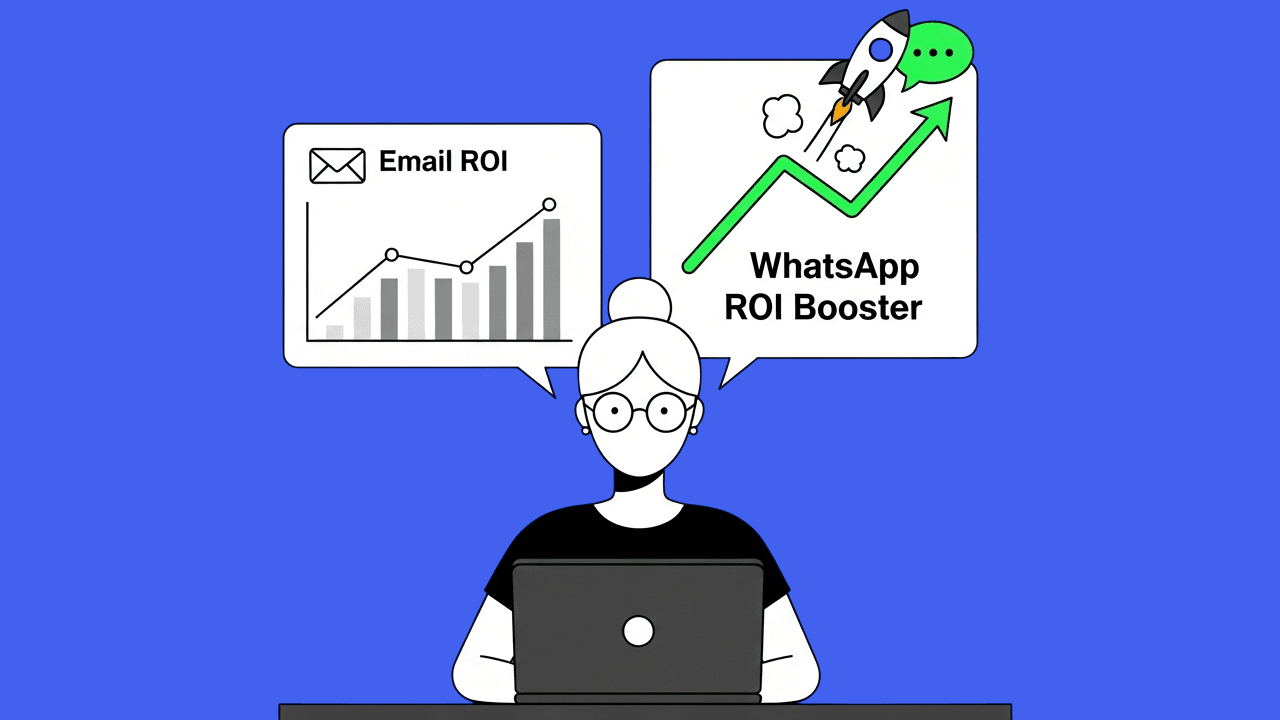
Comparison: email marketing vs WhatsApp – ROI compared
| Channel | Open rate | Click rate | Conversion rate | Campaign costs | Revenue per €100 |
|---|---|---|---|---|---|
| 18–22% | 2–4% | 1–2% | moderate – rising | €360–€400 (on average) | |
| 90–98% | 35–45% | 6–12% | low – scalable | €700–€1,200 (5–10× email) |
The difference is clear: compared to classic email marketing, WhatsApp generates significantly more revenue and conversions per campaign with lower costs per interaction. Companies that use both channels gain a real competitive advantage.
Conversational messaging & automation: how your ROI keeps growing
The merging of email and WhatsApp into an orchestrated conversational messaging strategy is the next efficiency leap. AI-powered automation controls follow-ups, segments contacts, distributes offers contextually and tracks all KPIs across channels.
Each reaction in the email channel triggers messenger processes—and vice versa. With solutions like Chatarmin, you manage everything centrally, automate campaigns and gain a complete ROI overview across all touchpoints of your customer journey.
Marketing ROI trends: what does the future bring?
Full automation: AI analyzes open and click behavior, determines send times and varies content based on data. Result: up to 50% more clicks and halved bounce rates (source: Litmus & Statista).
Omnichannel integration: ROI measurement and budget control run across platforms, e.g., via Chatarmin interfaces for WhatsApp, email and other marketing channels.
Practical benchmarks: Top examples show that email is losing efficiency while messaging apps are gaining massive shares of marketing budgets.
Continuous performance testing: With UTM tracking and A/B testing, changes in design and sending time are mapped to ROI in real time.
Our recommendation: anyone who mixes email and WhatsApp messaging data-driven now not only maximizes return on investment, but also secures sustainable growth, control and scalability for all future marketing campaigns.
Why and how Chatarmin increases your ROI
For companies that want to improve ROI in a data-driven way, it is particularly relevant that Chatarmin supports both data-driven campaigns and A/B tests, UTM tracking and cross-channel email marketing benchmarks. This gives you the ability to monitor changes, performance and revenue contributions in real time—and to compare and optimize your entire email marketing strategy with WhatsApp messaging.
The following factors contribute to increasing your ROI with Chatarmin:
Higher conversion rates through personalized WhatsApp flows and automated triggers instead of static email campaigns
Reduced costs per contact, as messages are cheaper and more efficient than classic email broadcasts
More revenue per recipient, as interactions via WhatsApp are faster, more dialog-oriented and more relevant
Direct measurability of all ROI metrics via cross-channel data pipelines and UTM tracking
Optimized team collaboration, since marketing, sales and support work centrally in one system
Better customer satisfaction, as users receive answers immediately instead of waiting for email response times
Efficient developer workflows thanks to clear API structure, templates and automated processes
Strong effort-to-output ratio, since automation handles repetitive tasks
Scaling opportunities, for example through segmented messaging, automated chatbots or personalized calls to action
Customer reviews & ROI experiences with Chatarmin
How strongly WhatsApp and automation impact actual marketing ROI is shown by independent reviews on G2. Chatarmin scores 4.9 out of 5 stars there (37 reviews)—an exceptionally strong result that is primarily driven by usability, short time-to-value and strong value for money. These are exactly the factors that determine effectiveness in modern email marketing strategies, messaging setups and multichannel systems—and the relationship between costs and results.
A G2 reviewer summarizes the ROI value of Chatarmin perfectly:
“Rarely have we experienced such effective and customer-oriented onboarding. In addition, Chatarmin makes it easy to build flows and automations. For example, automated onboarding journeys can be set up in just a few minutes. All of these features are offered at a very attractive price-performance ratio.”
In direct comparison, it becomes clear: while other tools such as Lime Connect are rated 4.4 out of 5 stars on G2, Chatarmin clearly positions itself in the high-performance segment.
Conclusion: rethink ROI in marketing—messaging beats classic email marketing
Successful companies and brands maximize their email marketing ROI by intelligently combining WhatsApp messaging and automation. Classic email marketing campaigns remain relevant, but true revenue boosters are dialogue-oriented, AI-powered messaging campaigns. Tools like Chatarmin connect bulk messaging, CRM, AI automation and cross-channel ROI analysis for sustainable growth, rising conversion and maximum profitability.
Frequently asked questions (FAQ): email marketing ROI & WhatsApp—numbers, measurement & best practices
What is the easiest way to calculate email marketing ROI?
Use the formula: (Revenue – Costs) / Costs × 100. Practical tools such as the ROI calculators from Litmus, HubSpot or Mailchimp make analysis simple and include costs, open and click rates, conversion rate and revenue per recipient.
What email marketing benchmarks apply for open and click rates?
Across industries, opens are between 18–22%, clicks are usually 2–4%. Add bounce rates of around 0.3–0.7% and conversion rates of 1–2%. Automation and segmentation demonstrably increase these values.
Why does WhatsApp perform significantly better in KPIs and ROI?
WhatsApp messages are almost always opened and directly answered. Interaction is more personal and dialogue-driven—this increases click and conversion rates, reduces waste and costs, and boosts measurable revenue per campaign. Overall, this makes WhatsApp KPIs and ROI superior compared to email.
How do I measure the return on investment of WhatsApp campaigns specifically?
With Chatarmin, you can see all campaigns, conversions and revenues per contact in real time—UTM parameters, tracking and tagging included. This allows WhatsApp ROI to be compared separately or cross-channel.
What role do A/B tests play in marketing ROI?
A/B tests are essential. They show which version of your email or WhatsApp message achieves the best KPIs. With data-driven decisions, you continuously increase performance, results and return on investment.
Try it now: experience how easily you can orchestrate email, WhatsApp and multichannel campaigns with Chatarmin—and how you can get more value and real direct customer contact with every euro invested.