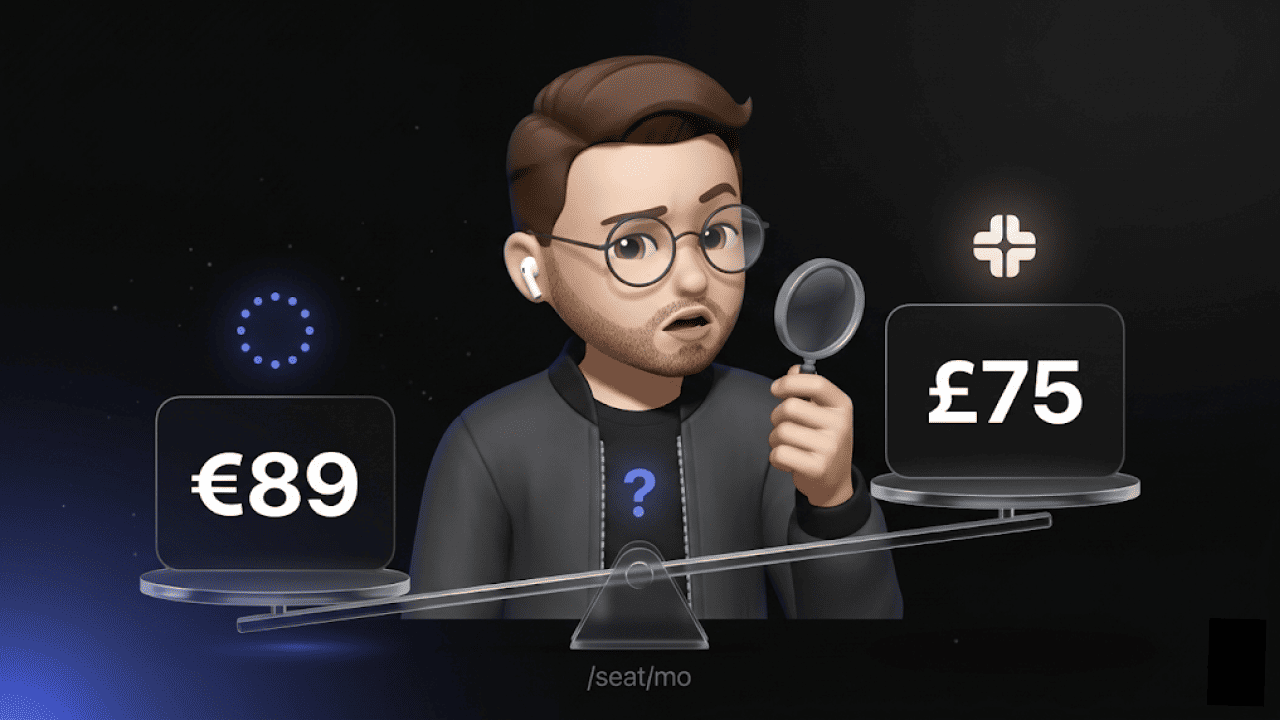

Quick quiz: who pays more for Dixa Growth — a London-based brand or one in Berlin? You'd expect the UK customer to take the bigger hit (Brexit, weaker pound, all that). You'd be wrong.
A Berlin team pays €89/agent/month. A London team pays £75. Translated to dollars at current rates ($1 = €0.85 = £0.74, April 2026): the EU customer hands over $104, the UK customer $101. The EU buyer eats a 17.6% surcharge versus the US listing of $89, the UK buyer 13.9%. Both pay more than US customers — but EU more than UK. Counter-intuitive, but verified.
This is the part of Dixa's pricing nobody else writes about. The pricing page has a USD/EUR/GBP toggle that looks like a 1:1 currency swap, but isn't quite. The numbers are calibrated by market — Pricing-to-Market in action — and the maths only show up when you do the conversion yourself.
If you're thinking "but that must be VAT" — read on. It's not. And currency premium is just one of three twists that make Dixa's 2026 pricing worth a closer look. The Essential plan is gone. Mim AI changed how it bills. And the legacy aggregator pages still showing "$39 entry" are years out of date.
This article walks through the real Dixa numbers for 2026. Where the add-ons inflate the bill. And when a generic conversational helpdesk is simply the wrong tool for an e-commerce brand.
What Dixa Actually Costs in 2026: The Plan Overview
Dixa runs a classic per-seat model with three active plans. As of April 2026 (verified directly on dixa.com/pricing #nofollow), the annual billing list prices are:
| Plan | USD (Annual) | EUR (Annual) | GBP (Annual) | What It's Built For |
|---|---|---|---|---|
| Growth | $89 | €89 | £75 | Multi-channel entry: phone, email, chat, social |
| Ultimate | $139 | €139 | £117* | Standard AI Intent Detection, advanced automations |
| Prime | $179 | €179 | £151* | Enterprise: SSO, advanced AI, multi-organization |
*GBP prices for Ultimate and Prime estimated based on the same Growth-tier ratio (£75/$89 ≈ 0.84). Verify directly with Dixa for higher tiers.
Important caveat: Monthly billing adds roughly 15–20% on top of annual prices. The Dixa Shopify app, for example, lists Growth at $109/month for monthly billing — that's the same plan you'd otherwise pay $89 for on annual.
Three things stand out immediately:
First: Voice and telephony are included in every plan. That's a real differentiator from tools like Re:amaze or Richpanel, where Voice runs through Aircall or Twilio as a separate cost. If your team makes a lot of phone calls, this matters. Dixa's own pricing FAQ proudly cites Sigma Sports making the switch despite paying double the license cost vs. Freshdesk.
Second: AI is not in the base price. Mim AI Agent, AI Co-Pilot, AI Auto QA and Voice Transcription are all add-ons. On Growth and Ultimate, you pay extra for them. Only Prime includes SSO and Advanced Insights. The actual AI stack stays add-on territory.
Third: Jumping from Growth to Ultimate costs +$50 per agent per month. For a 10-agent team, that's $6,000 extra per year. Before AI gets added.
Whatever the WhatsApp Business API costs add on top depends on volume. Meta charges per conversation, not per plan. Those costs hit regardless of whether you run Dixa, Zendesk or a specialist.
What Changed in 2026 — Essential Is History
If you've been reading aggregator sites like G2, Capterra or Tekpon, you've probably seen the Essential plan at $39 or $49. That data is outdated. Dixa's own pricing page now shows only three plans: Growth, Ultimate, Prime.
This has consequences:
- The entry price doubled. If Essential was still in your mental model, you're planning with the wrong numbers. $39 → $89 is a massive jump.
- Mid-market is now the floor. Dixa themselves write in the FAQ: "Dixa is structured for mid-market teams rather than small operations." If you wanted to start with three agents, you're not the target audience anymore.
- Custom is dead, Prime is the new ceiling. The top tier used to be a sales-call negotiation. Now there's a public number on it. You can still negotiate — but the list price is out in the open.
My take: This pivot is a clear signal that Dixa is prioritizing enterprise customers. For SMB e-commerce, the platform got less attractive in 2026. If you've got 5–8 agents and you're looking for an affordable setup, look elsewhere. Don't reach for Dixa.
The Currency Premium: Why EU Customers Pay $104 for an $89 Plan
Here's the part of Dixa's pricing nobody else writes about. The pricing page offers a USD/EUR/GBP toggle. Looks like a clean swap. Isn't.
When you do the maths at current exchange rates (April 2026, ECB reference), the prices reveal a deliberate Pricing-to-Market structure:
| Currency | Growth Listed | USD Equivalent | Surcharge vs. US |
|---|---|---|---|
| USD | $89 | $89 (baseline) | – |
| EUR | €89 | $104.71 ($89 × 1/0.85) | +17.6% |
| GBP | £75 | $101.35 ($75 × 1/0.74) | +13.9% |
The counter-intuitive bit: EU customers pay slightly more than UK customers. You'd expect the opposite — Brexit, weaker pound, all that — but the data goes the other way. Dixa charges €89 in the eurozone and £75 in Britain, which translates to $104 and $101 respectively. Both above the US listing, but EU sits at the top.
For a 10-agent team on Growth annual:
- US team: $89 × 10 × 12 = $10,680/year
- EU team: €89 × 10 × 12 = €10,680/year ($12,565 equivalent — $1,885 more than US)
- UK team: £75 × 10 × 12 = £9,000/year ($12,162 equivalent — $1,482 more than US)
Across a 24-month contract, that's nearly €3,800 / £3,000 in pure currency premium for nothing operationally different.
Why It's Not VAT
The most common myth: "European list prices are gross of VAT, so it just looks like a surcharge." Wrong. For B2B SaaS, USD, EUR and GBP list prices are all net of tax. The reverse charge mechanism handles VAT — EU and UK B2B customers self-account for VAT through their VAT-ID, and immediately reclaim the same amount as input tax. Cashflow impact: zero.
In practice: if your shop is in Berlin and you sign up for Dixa Growth, you receive an invoice for €89 net, no VAT applied. You handle the 19/20/22% VAT in your own filings. Dixa never collects a penny of EU or UK VAT. Same applies for any UK B2B customer on a Dixa contract. The surcharge isn't tax — it's pricing strategy.
The Real Reasons Behind the Currency Premium
It's not about taxes. It's about three other things:
- Pricing-to-market. US/UK SaaS companies have known for years that European buyers tolerate higher list prices in their local currency. Buyers see €89 and benchmark against other EUR vendors. Nobody opens a parallel currency converter. That's behavioral economics, not exchange-rate math.
- FX risk buffer. On a 24-month contract, USD/EUR can swing 5–10%. A premium-pricing structure protects the vendor from that. At your expense.
- Operational simplification. A few discrete tiered prices, no daily FX updates, uniform contracts. The CFO sleeps better.
The interesting question is why EU pays more than UK, given both currencies are stronger than the dollar. The most likely answer: SaaS willingness-to-pay benchmarks. The eurozone B2B-SaaS market has years of conditioning to higher list prices (legacy Salesforce, SAP, Oracle pricing pulls the whole market upward). The UK SaaS market is more US-influenced, sits closer to native US pricing, and Brexit-era price pressure pulled UK pricing slightly down. Dixa is reading those signals correctly.
This isn't a Dixa-only thing. Replyco does it. Re:amaze does it. But: with transparent WhatsApp tool pricing, this premium effect doesn't exist. EUR list prices are real prices.
Counterpoint: If your team bills in USD (e.g. through a US holding entity), the premium disappears. Same for annual prepayment in dollars — you usually get the nominal list price. You take on the FX risk yourself, but you skip the premium. For mid-sized teams (15+ agents), this is a real optimization lever — and a concrete negotiation point in the sales call.
Mim AI, Add-ons & Hidden Costs
Here's where the math gets messy. Dixa rolled out an important AI pricing change in recent months — and they've been actively promoting it.
Mim AI is now flat-rate, no longer pay-per-resolution. Verbatim from Dixa's FAQ: "Dixa's AI is add-on priced too, but at a flat rate — your AI costs don't increase as your contact volume grows." This is a deliberate counter to Intercom's $0.99 per AI resolution. And to Gorgias' per-ticket model. At high volume, this is attractive. At low volume, you pay the full flat rate every month. Even if Mim only resolves 50 tickets.
On top of that, more add-ons that aren't openly communicated:
| Add-on | What It Costs | When It Makes Sense |
|---|---|---|
| Mim AI Agent | Flat rate (sales quote required) | High volume of routine queries |
| AI Co-Pilot | Add-on (billed separately) | Agents handling multiple languages |
| Quality Assurance + AI Auto QA | Add-on | 15+ agent teams needing QA |
| Advanced Insights | Add-on (included in Prime) | Data-driven CX teams |
| Voice Transcription | Add-on | Compliance / search in voice logs |
| Single Sign-On | Add-on (included in Prime) | IT compliance from mid-market up |
| Seasonal Agents | Add-on | Black Friday scaling |
| Collaboration Users | Add-on | Cross-team collaboration |
This makes TCO comparison brutally hard. Dixa themselves admit in the pricing FAQ: "The per-seat price is higher, but the total cost of ownership is usually comparable or lower." Believe that only under one condition. You walked through the add-on list with your sales rep ahead of time. And you have it in writing what you actually need. For an honest counter-calculation, take a look at Intercom pricing where Fin AI is also priced separately.
Concrete example: a 10-agent team on Ultimate with Mim AI, Quality Assurance and Voice Transcription lands at $1,500–2,000 per month for software alone. Before any Meta WhatsApp fees. Before implementation. On the year: $18,000–24,000.
The Renewal Trap: When 12 Months Quietly Becomes 24
The most underestimated cost trap isn't on the price list. It's in the contract. Capterra users report a specific pattern. One customer summarizes it bluntly: "we suddenly got a massive price increase per agent + 2 years more binding period."
What happens here? You're mid-contract. You want to test a new feature — Voice, Multi-Brand, something else. The sales call tells you that requires an upgraded plan. You agree. What you don't always get told explicitly: the upgrade resets your minimum term. Often straight to 24 months.
It's not illegal. It's in the contract. But when you're moving fast in day-to-day operations and you click through to enable a feature, it's easy to miss.
What to actually do:
- Before any upgrade: Get written confirmation of whether the minimum term resets.
- At renewal: Negotiate 60–90 days ahead, not when auto-renewal hits.
- Price increases: 5–15% annually is documented in G2 reviews. A cap clause in the contract protects you.
- Monthly billing is available. But it costs 15–20% more than annual.
My take: Anyone signing Dixa fresh should never accept a 24-month contract on the first round. 12 months, with a clear cap on renewal increases, is the norm. Anything beyond that is a negotiation loss.
Dixa vs. Chatarmin: Helpdesk vs. Revenue Channel
Both tools play in the conversational space. But they solve completely different problems.
Dixa is omnichannel helpdesk with strong voice. WhatsApp is one channel of many. Functionally embedded. But not the centerpiece. Chatarmin is WhatsApp-first for e-commerce: marketing campaigns, automated flows, segmented newsletters and service in a single platform.
| Function | Dixa | Chatarmin |
|---|---|---|
| Core function | Omnichannel helpdesk + voice | WhatsApp marketing & conversational commerce |
| WhatsApp campaigns | ❌ Inbox support, no bulk sender | ✅ Native campaign engine |
| WhatsApp newsletters | ❌ Not core | ✅ With segmentation & A/B testing |
| Flow builder | ⚠️ Helpdesk routing | ✅ Visual flow builder for e-commerce |
| Voice / telephony | ✅ Included in every plan | ✅ AI voice assistant available |
| EU hosting / GDPR | ✅ Danish, EU hosting | ✅ Frankfurt hosting |
| Shopify integration | ⚠️ Available, less deep | ✅ Native, deeply integrated |
| Pricing model | Per seat, from $89 (1:1 EUR/GBP) | Volume-based, transparent |
| Contract lock-in | 12–24 months typical | Flexible |
| E-commerce use case | ⚠️ Service-focused | ✅ Marketing + service combined |
What the numbers say: Smilodox generated €481,000 revenue per WhatsApp campaign with Chatarmin on Black Friday. YFM €225,000 in 30 days. VITAFORM 40.7× ROI. These aren't service tickets — they're revenue. (Note: these are DACH-based brands, but the pattern translates to any market where WhatsApp adoption is high.)
The structural question isn't "which tool is better." It's: "what's your primary lever?" If your business runs on phone, email and a shared inbox, Dixa is solid. If your business runs on WhatsApp conversion, you're paying Dixa for the wrong capacity.
GDPR, EU Hosting & Local Support — The European Reality
Dixa is Danish. That means: EU hosting available, no Standard Contractual Clauses needed, no Transfer Impact Assessment for US data flows. This typically saves your data protection officer 20–40 hours of legal review per tool. A real advantage over US vendors like Front, Gorgias or Intercom.
But: Dixa doesn't have strong local-language account management for non-English markets. Support runs primarily in English and Scandinavian languages. If you're an English-first international team, that's fine. If you're a French, German or Spanish-first team expecting customer success in your language, expect friction.
Translation: compliance-wise, Dixa is solid. Operationally, an EU-based GDPR-ready WhatsApp platform with localized support — like Vienna-based Chatarmin — is often the smoother choice. How that plays out in practice is documented in the customer stories with concrete numbers.
Who Dixa Fits — and Who It Doesn't
Dixa fits if you:
- Use Voice/telephony as a core channel — and would otherwise pay for Aircall + helpdesk separately
- Have 20+ agents and bring negotiating leverage to the sales call
- Run multi-brand or multi-country (the Prime use case)
- Treat WhatsApp as a service channel, not a marketing channel
- Are okay with English-language account management
Dixa doesn't fit if you:
- Are SMB (5–15 agents) and want self-service onboarding
- Use WhatsApp as your #1 conversion channel
- Need bulk campaigns, newsletters and automated flows on WhatsApp
- Don't want a 12–24-month commitment
- Have procurement that won't tolerate a 17% (EU) or 14% (UK) currency premium
For e-commerce brands with a WhatsApp-first strategy, the combination "specialized helpdesk + specialized WhatsApp tool" is often cheaper and more effective. More effective than a generic conversational all-in-one. Want to see what a WhatsApp specialist looks like in daily operations? The bottom of this article has the right entry point.
Counterpoint: Two tools means two contracts, two integrations, two logins. If staying operationally lean is the priority, sometimes the weaker all-in-one wins. And you pay for that with conversion potential. This trade-off isn't a tooling question. It's a strategic one.
Frequently Asked Questions About Dixa Pricing
What does Dixa cost per agent per month?
Dixa costs between $89 and $179 per agent/month in 2026 with annual billing. Split across Growth ($89), Ultimate ($139) and Prime ($179). Add-ons like Mim AI or Quality Assurance come on top.
Does Dixa still offer the Essential plan?
No, Essential was discontinued in 2026. The current entry plan is Growth at $89 per agent/month.
Does Dixa offer real EUR or GBP pricing?
No. Dixa shows EUR (€89) and GBP (£75) on the pricing page, but those are tiered list prices, not direct conversions. At current exchange rates, EU customers pay ~17.6% more than the USD equivalent, UK customers ~13.9% more.
Is the EUR/GBP premium due to VAT?
No. For B2B SaaS, USD, EUR and GBP list prices are all net of tax — reverse charge means buyers self-account for VAT and reclaim it. The currency premium is pricing strategy, not tax.
Is Mim AI billed pay-per-resolution?
No, Mim AI is a flat-rate add-on in 2026. Monthly costs don't change with volume. At high ticket counts, this is cheaper than Intercom Fin or Gorgias.
Does Dixa have a minimum contract term?
Yes, 12 months is standard. 24-month contracts at renewal or upgrade are documented in Capterra reviews. Always get the new term confirmed in writing before agreeing to any upgrade.
Is Dixa GDPR-compliant for EU e-commerce?
Yes. Dixa is a Danish company with EU hosting and full GDPR compliance. But anyone expecting localized customer success in German, French or Spanish will be disappointed — account management runs primarily in English.
Does Dixa support the WhatsApp Business API?
Yes, WhatsApp is integrated as a channel in every plan. But bulk campaigns, newsletters and granular template management are weaker than WhatsApp-specialized tools.
Is Dixa worth it for small teams under 10 agents?
No. Dixa positions itself as a mid-market platform — for 5–8 agents, you're paying $530–710 just for software. SMBs are usually better served by transparent self-service tools.
Can Dixa be billed monthly?
Yes, monthly billing is available. But it typically costs 15–20% more than annual prepayment. For best terms, annual is the standard.
Does Dixa have hidden costs?
Yes, several: Mim AI (add-on), AI Co-Pilot (add-on), Quality Assurance (add-on), Voice Transcription (add-on), onboarding fees, annual renewal increases of 5–15%. Plan for 30–50% on top of list price.
Does Dixa replace a WhatsApp marketing tool?
No. Dixa is helpdesk-first. Anyone using WhatsApp as a marketing channel — bulk campaigns, segmentation, abandoned-cart flows — needs a WhatsApp-specialized tool either alongside or instead.
Does it pay to switch from Dixa to a WhatsApp specialist?
Yes, if WhatsApp is your primary conversion channel. Brands like Smilodox (€481,000 per campaign), YFM (€225,000 in 30 days) and VITAFORM (40.7× ROI) show it clearly. Specialized WhatsApp tools deliver higher marketing returns than generic helpdesks.
Bottom Line: Dixa Is Solid — Rarely the Right Choice for E-commerce Brands
Dixa in 2026 is a grown-up conversational helpdesk with Northern European DNA. EU hosting. Voice in every plan. Flat-rate AI as a fair add-on model. For mid-to-enterprise CS teams with voice needs and English working language, it's a serious option.
But for e-commerce brands taking WhatsApp seriously, Dixa is rarely the answer:
- 17.6% premium for EU, 13.9% for UK customers vs. US listing
- $89 entry minimum locks SMBs out
- WhatsApp is a service channel, not a marketing channel
- 12–24-month lock-in with documented renewal trap
- Add-on stack (Mim, QA, Insights, Voice Transcription) pushes TCO 30–50% above list
If WhatsApp volume drives your revenue, you're paying Dixa for capacity that isn't your lever. And missing the capacity that would be. The Smilodox and YFM numbers aren't marketing folklore. They're the output of a specialized tool on a channel with 90%+ open rates.
Want to think about WhatsApp as a conversion channel instead of a support channel? Book a Chatarmin demo and see what's possible. Transparent terms. EU hosting in Frankfurt. No sales-call marathon.