
Your support is spread across several inboxes, part of it still runs through Outlook, and on top of that come requests from your own shop and from marketplaces like Amazon, Otto or Kaufland. The most common question stays the same: „Where is my order?". At some point you start evaluating a tool like Intercom, and the Intercom pricing on the pricing page looks manageable at first.
The seat price is only the first layer, though. Intercom bills in two parts: a fixed price per agent plus a usage-based part for AI and channels. That second part decides what your invoice says at the end of the month. The AI customer service market is worth around 15 billion US dollars in 2026 according to market analyses, and almost every vendor bills differently. In this article we look at Intercom through the lens of a DACH e-commerce operator (the German-speaking region of Germany, Austria and Switzerland): what the tool does well, where costs grow with volume, and what to plan for before you commit.
What Intercom is and who it's built for
Intercom positions itself in 2026 as an AI-first customer service platform. Two building blocks sit at the core: the Fin AI agent and a modern helpdesk with a shared inbox, messenger and help center. Workflows, reporting and outbound features round it out. According to the vendor, Intercom meets compliance standards such as SOC 2, GDPR and HIPAA.
Its strength is clearly in in-app and SaaS support. If your product runs in a browser or an app and you want to onboard users directly inside the product, Intercom is strong. The messenger is well built, the onboarding ranks among the best on the market, and Fin resolves on average around two thirds of requests without human involvement, per Intercom.
For e-commerce brands in the DACH region, two things are worth sorting out early. First, Intercom is a US tool focused on the US market. Deep integrations with DACH systems like JTL, Xentral, Shopware or Billbee are not its focus. Second, the billing is usage-based, which takes planning when ticket volume fluctuates. Both points belong in your calculation before you commit.
The three seat plans: Essential, Advanced and Expert
Seat prices are the predictable part of Intercom pricing. Per Intercom (as of May 2026), there are three plans, each cheaper on annual billing:
| Plan | Per seat/month (annual) | Per seat/month (monthly) | Included (excerpt) | Lite seats |
|---|---|---|---|---|
| Essential | ~$29 | ~$39 | Shared inbox, basic automations, messenger, help center | 0 |
| Advanced | ~$85 | ~$99 | Workflows, multiple team inboxes, multilingual, proactive options | 20 |
| Expert | ~$132 | ~$139 | Workload management, SLA rules, custom roles, multibrand | 50 |
Two things stand out. The markup for monthly billing varies by plan. Per third-party sources, it's around 34 percent on Essential, around 16 percent on Advanced and around 5 percent on Expert. In other words: if you want flexibility, you pay the most for it at the entry level.
Intercom also bills in US dollars, regardless of your location. For a DACH company that adds a currency factor to budget planning. Five agents on the Advanced plan (annual) lands you at 5 × $85, around $425 per month. That's the number you take into your budget. It only describes the seat layer, though.
Fin AI: the usage-based part of the bill
Fin is Intercom's AI agent that answers requests on its own. Per Intercom, Fin is billed separately from the seat price, per resolved query. A so-called resolution costs around $0.99 according to the vendor. A resolution counts when Fin closes a conversation without a human stepping in. You're charged once per conversation, even if Fin answers several questions.
The logic matters for e-commerce because your ticket volume fluctuates. In our demos the range runs from 20 to 30 requests per day up to several thousand tickets per month. The higher your volume, the more the Fin share shows up on the bill. A quick calculation: your shop gets 50 requests per day, Fin resolves 30 of them automatically. That's 30 × $0.99, just under $30 per day and roughly $900 per month, on top of the seats. In peak season this shifts. If your volume triples around Black Friday, the Fin share grows with it. Unexpected usage costs show up regularly as a point of criticism in reviews and comparison sites.
My take: usage-based billing is mainly harder to plan than a fixed line item, especially during peaks. This is exactly where our AI logic at armincx works differently. armincx runs on a fixed base plus an included AI allowance, instead of billing every resolved request individually. That keeps your support budget easier to plan.
Add-ons and channel fees: Proactive Support, Copilot, WhatsApp
Beyond seats and Fin there's a third layer: add-ons and channels. The most important ones per publicly available sources (as of spring 2026):
| Item | Approx. price | What it is |
|---|---|---|
| Proactive Support Plus | ~$99/month (incl. 500 messages) | Outbound messages, onboarding flows, product tours |
| Copilot | ~$29 to $35 per seat/month | AI assistant for agents |
| SMS | ~$0.07 per message | Channel fee |
| WhatsApp / phone | usage-based | Channel fees per message or per minute |
| Additional lite seats | ~$39 per seat | for observers beyond the included allowance |
The WhatsApp point is relevant for DACH e-commerce. WhatsApp is a primary channel here, and Intercom charges channel usage on top of the seat and Fin layers. In other words: every customer contact over WhatsApp becomes its own line item, on top of everything else. How the plain Meta fee for WhatsApp is structured is something we break down in our WhatsApp Business API guide.
Lite seats are a detail that's easy to miss. They're meant for team members who only read along but don't actively reply, such as team leads. The Advanced plan includes 20, the Expert plan 50. On the Essential plan you pay the full seat price for them too, per third-party sources.
The Early Stage Program: a three-year discount staircase
Intercom runs a program for young companies, the Early Stage Program. It's the item where many comparison articles carry errors, so here are the facts straight from Intercom's help center (as of May 2026).
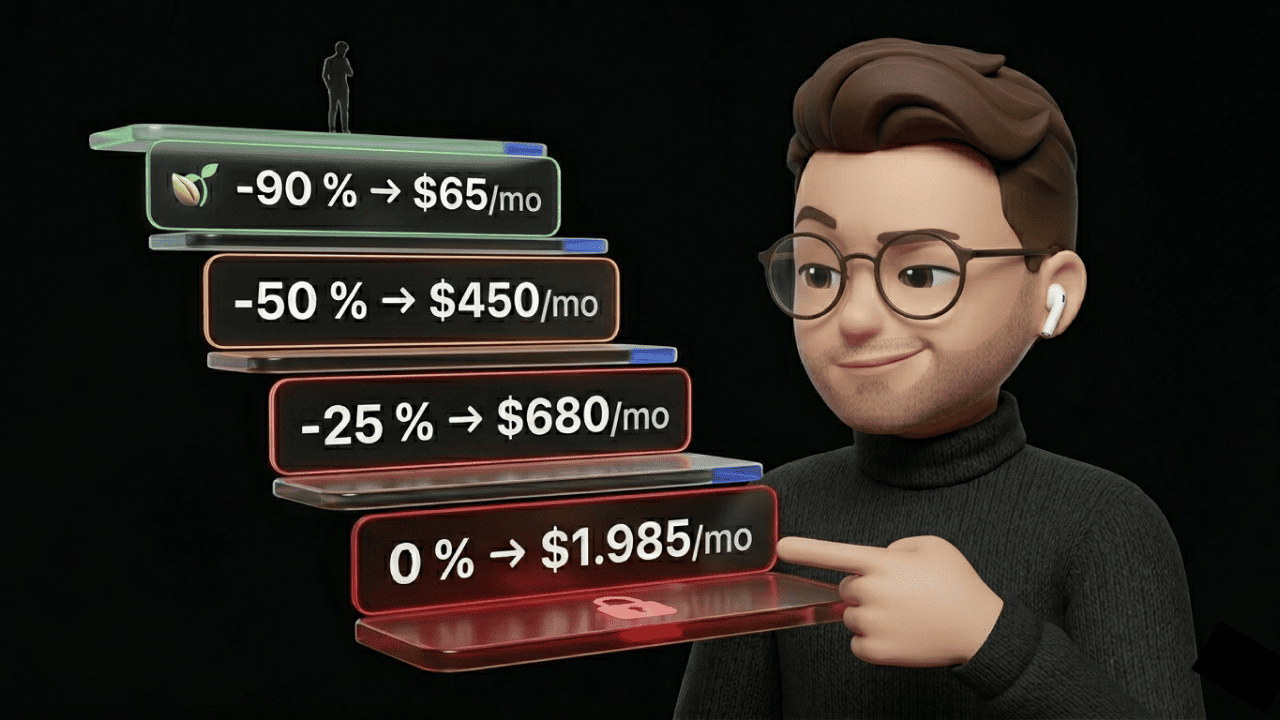
Eligibility per Intercom: up to $10M in funding, fewer than 15 employees, and not an existing Intercom customer. The discount is staggered over three years and applies to the Advanced plan: around 90 percent in year one, 50 percent in year two, 25 percent in year three. Intercom itself quotes a first-year price of around $65 per month for the bundle (six seats, against a list price of around $903).
Important, because it's often misreported: Fin is not completely free in the program, and it is not at full list price either. Per Intercom, up to around 315 Fin outcomes per month are included in year one. Usage beyond that, plus SMS, outbound WhatsApp messages and phone, runs at list price.
In other words: for the first months this is a good runway. Just plan from the start for the costs once the discount runs out. Your setup, your workflows and your integrations live inside Intercom by then, and the price rises each year. If the year-three number blows your budget, the decision is harder later than at the start.
A sample calculation: what a 5-person team should plan for
A realistic calculation for an e-commerce team using Intercom seriously, for an average month. All figures are orders of magnitude and rest on vendor and third-party data.
| Item | Monthly cost (approx.) |
|---|---|
| 5 Advanced seats (monthly, $99 each) | $495 |
| Fin AI (~900 resolutions) | $891 |
| Proactive Support Plus | $99 |
| WhatsApp/SMS channel fees (estimated) | $200 to $500 |
| Total | around $1,685 to $1,985 |
So the $425 of the pure seat calculation becomes roughly four times that in this scenario. With higher volume or heavier Fin use, the total runs above it. The exchange rate adds to this. Depending on the euro-dollar rate (recently roughly in the 1.05 to 1.15 range), $1,985 corresponds to around €1,730 to €1,890. So plan a buffer, because the euro figure shifts without anything changing in your usage.
If you want a broader plan comparison, our overview of the best AI customer service tools sorts through several vendors and their ratings.
Intercom from an e-commerce angle: where it fits, where DACH shops should look closer
Intercom is a strong tool for certain setups. It makes sense if you run a SaaS product with in-app messaging, need complex onboarding flows, budget for the usage layer and have someone on the team to maintain the setup.
As a DACH e-commerce operator you should look closer at several points. If WhatsApp is your primary channel, you pay channel usage on top of seats and Fin. If your ticket volume swings seasonally, the Fin share grows during peaks. If you need deep connections to JTL, Xentral, Shopware or Billbee, that's not Intercom's home turf. The USD billing brings a currency factor into every plan. And topics like data location, EU hosting and a data processing agreement are worth clarifying actively with any US tool, since for many DACH shops that's a decision criterion of its own.
For these cases a specialized tool is worth a look. That's exactly why we built armincx: an AI-first support tool for DACH e-commerce. Instead of bolting AI onto an old ticketing system, the AI agents execute real backend actions, such as cancellations, address changes or returns, directly through the connected shop and ERP systems. From our experience, teams reach 40 to 60 percent automation after launch and 70 to 80 percent with well-tuned workflows. armincx is built for DACH and GDPR compliance. Over 450 brands already use Chatarmin. For a detailed comparison with real prices and ratings, see our roundup of Intercom alternatives.
To put another helpdesk model in context, our post on Gorgias pricing breaks down a Shopify-focused tool with its own usage-based logic.
Frequently asked questions about Intercom pricing (FAQ)
How much does Intercom cost per month?
Seat prices start at around $29 per seat per month per Intercom (Essential, annual). On top come usage-based costs for Fin AI and channels, so the real monthly bill rises with team size and request volume.
How much does Intercom Fin AI cost?
Per Intercom, Fin costs around $0.99 per resolution, meaning per request the AI agent resolves without human involvement. At 30 resolutions a day that's roughly $900 a month, on top of seat costs.
Is there a free version of Intercom?
No. Intercom doesn't offer a permanently free version. Per the vendor there's a 14-day trial without a credit card, plus the Early Stage Program with a staggered discount.
What's the difference between Essential, Advanced and Expert?
Essential offers a shared inbox and basic automations. Advanced adds workflows, multiple team inboxes, multilingual support and 20 lite seats. Expert adds workload management, SLA rules, custom roles and 50 lite seats. The biggest cost jumps usually come from add-ons and usage rather than the plan itself, per third-party sources.
Is the Intercom Early Stage Program worth it?
It depends. Short-term, the roughly 90 percent discount in year one is attractive. Over three years it drops to 50 and then 25 percent while your setup sits inside Intercom. Plan for the costs after the discount ends from the start.
Are WhatsApp and SMS included in the Intercom price?
No. Per Intercom, WhatsApp and SMS carry additional per-message channel fees, on top of the seat price, Fin costs and any add-ons.
What are resolutions in Intercom Fin?
A resolution counts, per Intercom, when Fin resolves a customer request on its own without a human stepping in. You're charged once per conversation, even with multiple questions.
How much does Intercom cost in euros?
Intercom bills in US dollars. For DACH companies the euro figure fluctuates with the exchange rate. At a rate around 1.10, $1,985 corresponds to roughly €1,800, more or less depending on the daily rate.
What's an Intercom alternative for DACH e-commerce?
For shops in the DACH region focused on WhatsApp and deep ERP connections, armincx is a specialized alternative with flat-rate logic instead of per-resolution billing. For a detailed comparison, see our post on Intercom alternatives.
Bottom line: understand the pricing logic before you decide
Intercom is a capable AI-first support platform with strong onboarding and a good messenger. The decisive point with Intercom pricing is the structure: the seat price is predictable, the usage-based part from Fin resolutions and channel fees grows with your volume. On top of that comes billing in US dollars.
For a DACH e-commerce team that uses WhatsApp as a primary channel, runs seasonal peaks and needs deep connections to shop and ERP systems, a specialized tool is worth comparing. That's exactly the case armincx is built for.
Book a demo and see how armincx automates your support. Around 30 minutes. Free. With a clear read on your shop.
Disclaimer: All Intercom prices cited are based on publicly available information (as of spring 2026) and are subject to change. For current terms and add-on costs, we recommend contacting Intercom directly. Sources: Intercom Early Stage Program, vendor data and third-party sources like Vendr, G2 and Capterra.