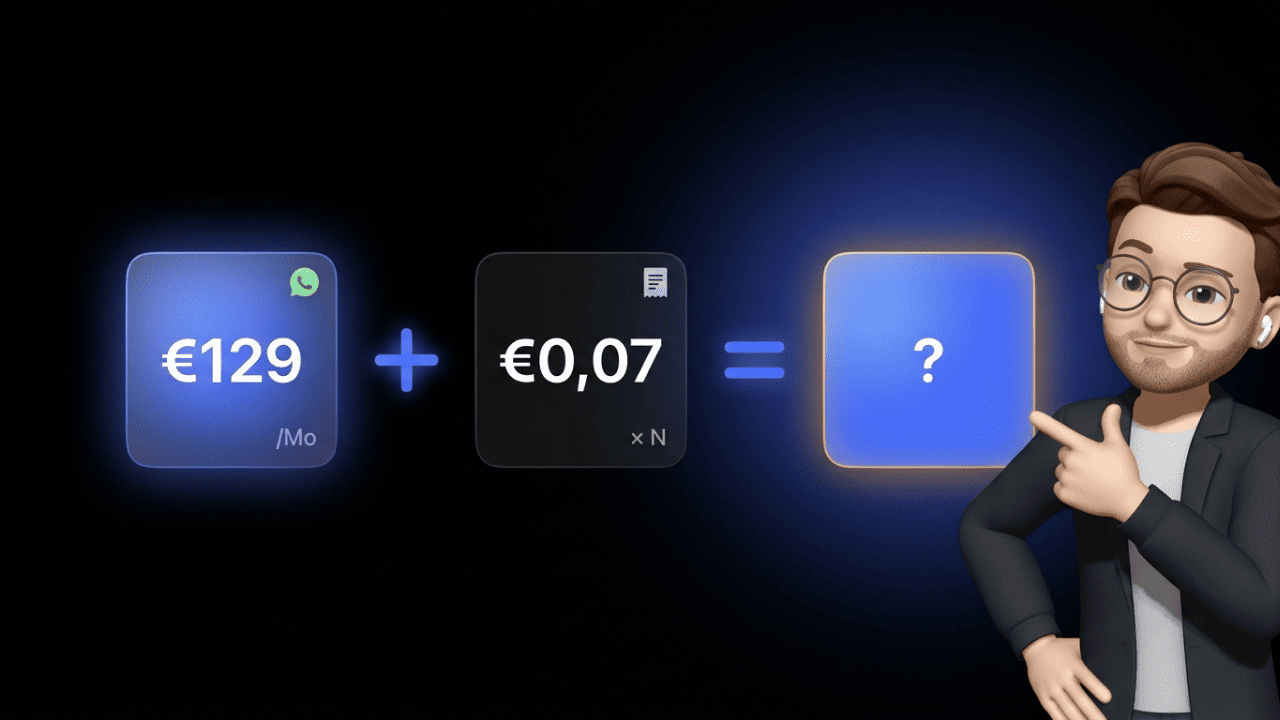

Superchat lists five plans. Free to Enterprise, monthly or yearly. Sounds simple.
It isn't. The plan prices are only half the story. If you're evaluating Superchat as a Shopify brand or DACH e-commerce team, three things need clarity before the demo call: what the plans actually cost, what the Free plan covers — and where the Meta fees of the WhatsApp Business API land on top.
Superchat Pricing 2026 — the Official Overview
Superchat currently lists five plans on its pricing page. The list looks compact — the picture gets more complex once Meta conversation costs and bonus mechanics come into play. As of May 27, 2026:
| Plan | Monthly | Yearly | What's included |
|---|---|---|---|
| Free | €0 | €0 | 1 WhatsApp number, 1 user, 30 active contacts |
| Basic | €89 | €79 (–11 %) | 1 number, 3 users, unlimited contacts |
| Professional | €149 | €129 (–13 %) | 3 numbers, 10 users, "Most popular" |
| Advanced | €299 | €249 (–16 %) | 5 numbers, 25 users, dedicated account manager |
| Custom | On request | – | Enterprise, individual configuration |
Translation: Annual billing saves between 11 % and 16 % compared to monthly. The jump from Basic to Professional triples the number of WhatsApp lines and more than triples user seats. What the table doesn't show: the Meta fees for WhatsApp conversations run separately. More on that below.
What the Free Plan Covers — and Where the Catch Is
The Free plan is Superchat's entry offer: no cost, no time limit, with real WhatsApp Business API access. You get one WhatsApp number, one user seat, and access to 30 active contacts.
In short: you can test the platform properly — inbox, newsletter, automations, AI agent are all available in Free. For local self-employed professionals with a handful of customers, that's enough.
For e-commerce brands, the 30-contact ceiling is the hard stop. The moment you launch a welcome sequence, a restock alert, or an abandoned cart flow, 30 active contacts are hit within hours of a traffic spike. The Free plan isn't a pilot for productive WhatsApp marketing — it's a test balloon to check the UI. Anyone serious about WhatsApp lands in the Basic plan quickly.
Plan Prices vs. Real Total Cost: The Meta Conversation Trap
The biggest gap between "plan price" and "actual monthly invoice" sits in Meta conversation costs. Since July 1, 2025, Meta charges per delivered WhatsApp template rather than per conversation. Service conversations have been free since November 2024. What you initiate as a brand — marketing sends, utility templates — you pay on top.
For German recipients, utility templates currently run at around €0.07 per delivered message, marketing templates higher. Superchat, according to its own communication, adds a monthly bonus that covers part of this cost. The bonus level depends on the plan — but it isn't published on the pricing page and only becomes transparent during onboarding or the demo call.
Concretely: anyone scaling marketing sends needs to calculate two cost lines — the software licence and the Meta volume. A simple example: a Shopify shop with 5,000 newsletter opt-ins running two WhatsApp newsletters per month sends 10,000 marketing templates. Even with Superchat bonus, the Meta cost often lands in the three-figure euro range — on top of the plan price. More on the mechanism in our guide to WhatsApp Business API costs.
Which Superchat Plan Fits Which Business?
Superchat structures its plans by team size, not by industry. In the sales call you typically get a recommendation based on headcount and volume. From the publicly available plan details, a rough mapping looks like this:
- Free: test setup or mini use case under 30 active contacts. Not for production.
- Basic (€89/€79): self-employed, small service businesses, local operations. One number, three users in parallel.
- Professional (€149/€129): growing teams with multiple locations or brands — three WhatsApp numbers, ten users. Superchat's own bestseller.
- Advanced (€299/€249): multi-brand setups, larger teams, need for an account manager and priority support.
- Custom: enterprise or special configuration. Price and scope negotiable.
What the plans don't differentiate: WhatsApp depth. A Pro plan gives you more numbers and users, but not necessarily more e-commerce-specific flow logic. If you're booking as a Shopify brand, ask directly during the demo: how many templates are included in the bonus, what does the Klaviyo connection look like, are there native abandoned cart flows?
What Superchat Does Well — and Where It Falls Short for E-Commerce
Superchat is a solid multichannel tool. Over 9,000 companies use the platform — including Edeka, Engel & Völkers, and Enpal, according to OMR Reviews. Strengths sit in the unified inbox (WhatsApp, Google, Facebook, email), the AI agent for standard inquiries, and consistent German localization. GDPR compliance is communicated as standard by the vendor.
From an e-commerce perspective, three things are missing that matter for Shopify brands:
- No native Shopify app: the Shopify connection runs officially through Zapier, Make, or the Public API. No one-click install from the Shopify App Store, no bidirectional data flow out of the box.
- Klaviyo integration only indirect: anyone using Klaviyo as the central email and data layer has to build the bridge themselves.
- Abandoned cart, restock, and post-purchase flows can be built as generic automations, but they don't ship as pre-configured e-commerce templates.
These gaps aren't bugs — they follow from the positioning. According to Capterra, Superchat serves "any business regardless of industry". That's a deliberate generalist strategy. For e-commerce brands, that means more DIY work at setup. For a deeper look at native Shopify-WhatsApp connections, see our Shopify WhatsApp integration overview.
How Superchat Users Actually Rate the Tool
User feedback is mixed. On Capterra and OMR Reviews, most voices are positive — support responsiveness and ease of use get the most praise.
OMR's AI-assisted review summary also notes verbatim: some users report "occasional technical issues, limitations in Meta integrations, and a somewhat complex pricing structure". This aligns with what we keep hearing in our own sales calls — particularly when e-commerce brands move away from Superchat and need deeper integrations.
On Capterra, marketing manager Tim W. mentions "good value for money" and responsive support. Those reviews are valid. Worth knowing: many of these reviews come from sectors like trades, consulting, or local services — not D2C e-commerce. If you're evaluating as a Shopify brand, look for reviews from your own vertical specifically.
Which Features Cost Extra?
Not every feature ships with every plan. Anyone booking Basic and expecting Pro features quickly lands at add-ons. What's publicly communicated:
- Advanced analytics: "available as add-on" from Professional onwards, according to the pricing page. Standard reporting is included; deeper analyses cost extra.
- Review management (Google, Trustpilot, etc.): available from Basic onwards, not in Free.
- Personalized web widget: from Professional onwards.
- Account manager: from Advanced.
- Team training: from Advanced.
- Campaign packages for higher send volumes: must be booked separately.
The AI agent is included across plans according to the pricing page — but usage limits aren't public. Which queries, what complexity, what data volume is covered gets clarified in the sales call. That's a typical SaaS pricing pattern — but for a clean comparison you should ask about those limits explicitly.
If you're running Klaviyo in parallel, check how deeply data actually flows between the two systems. Our Klaviyo WhatsApp integration overview shows what a real bidirectional connection looks like.
What This Means for DACH E-Commerce Brands
Superchat is a multichannel generalist. That isn't a weakness, it's strategy — and for many sectors (local services, trades, B2B service) the approach works well. For DACH e-commerce brands on Shopify, Shopware, or JTL, the question is different: how deeply does the tool go into your e-commerce stack?
Anyone who needs a native Shopify app, bidirectional Klaviyo sync, ready-made abandoned cart flows, and revenue attribution per WhatsApp campaign quickly ends up with e-commerce-specialized WhatsApp tools. Chatarmin is built exactly for that — DACH-focused, Shopify- and JTL-native, with Klaviyo depth and revenue tracking per flow.
If you also want to automate customer service — the area Superchat positions its "AI agent" in — take a look at armincx. It's Chatarmin's AI customer experience suite, also e-commerce-specialized, with depth in order status, returns, shipping, and product questions instead of generic FAQ answering.
Superchat Alternatives in the DACH Region
Anyone comparing Superchat should distinguish between three tool categories:
- Multichannel generalists: tools like Superchat itself, Trengo, or Userlike. Strong at inbox bundling, industry-agnostic.
- E-commerce-specialized WhatsApp tools: Chatarmin, Charles, Mateo. Deeper in Shopify, Klaviyo, JTL — leaner on multichannel.
- Email tools with WhatsApp add-on: Klaviyo, Brevo, Emarsys. WhatsApp is a side product, email is the core.
The rule of thumb: the closer your use case is to D2C e-commerce on Shopify or JTL, the more sense an e-commerce specialist makes. The more your use case leans toward local service, multi-industry setups, or consulting, the more sense a generalist makes.
A detailed comparison of alternatives with concrete evaluation criteria sits in our WhatsApp marketing software comparison 2026.
Conclusion: When Superchat Fits — and When to Look Elsewhere
Superchat fits if you need multichannel communication, want to bundle multiple locations or brands on one platform, and aren't primarily in e-commerce. The Free plan is a fair entry point for testing. The Professional plan covers most use cases — provided you budget Meta conversation costs on top.
Superchat doesn't fit ideally if you're a Shopify brand running WhatsApp as a marketing channel with revenue targets. Then you need native integrations, pre-built e-commerce flows, and deep reporting — areas where Superchat as a generalist doesn't lead.
If you're weighing generalist versus e-commerce specialist and you're already in conversation with Chatarmin: in the demo we'll show you concretely where the difference sits in the Shopify stack. Bring your three biggest use cases — then we'll see together whether it's a fit or not.
FAQ
What does Superchat cost in 2026?
Superchat costs between €0 (Free plan) and €299 monthly (Advanced) — with annual billing between €0 and €249 monthly. On top come Meta conversation costs per delivered WhatsApp template, which Superchat partially covers with a monthly bonus. As of May 27, 2026.
Does Superchat have a Free plan?
Yes. The Free plan is free of charge and includes one WhatsApp number, one user seat, and 30 active contacts. Features like inbox, newsletter, automations, and AI agent are available. For productive e-commerce use, the contact limit is too low.
Which Superchat plan is the most popular?
According to Superchat itself, the Professional plan is the most-booked tier. It costs €149 monthly or €129 with annual billing and includes up to three WhatsApp numbers and ten user seats.
Are Meta fees included in Superchat pricing?
No. Since July 1, 2025, Meta charges fees per delivered WhatsApp template. These costs come on top of the Superchat plan. Superchat adds a monthly conversation bonus — the amount varies by plan and is not publicly disclosed on the pricing page.
What is the Superchat bonus?
The Superchat bonus is a monthly conversation credit in euros that Superchat, as a WhatsApp Solution Provider, gives to its customers. It covers part of the Meta cost for business-initiated WhatsApp templates. The amount depends on the booked plan.
Does Superchat have a native Shopify integration?
No, not in the Shopify App Store. According to Superchat's own help center, the Shopify connection runs through Zapier, Make, or the Public API. A native, bidirectional integration like with e-commerce-specialized WhatsApp tools is not available.
What does the AI agent cost on Superchat?
The AI agent is included in every plan according to the pricing page, including Free. Concrete usage limits — number of queries, complexity caps, data volume — are not publicly communicated. Ask about these limits explicitly in the sales call.
What contract terms does Superchat offer?
Superchat offers monthly and annual billing. With annual payment, the discount sits between 11 % and 16 %, depending on the plan. Concrete conditions for cancellation and contract renewal get clarified during onboarding.
How much is the annual discount?
With annual billing, you save 11 % on the Basic plan (€79 instead of €89), 13 % on the Professional plan (€129 instead of €149), and 16 % on the Advanced plan (€249 instead of €299). As of May 27, 2026, source: superchat.de/preise.
Is Superchat GDPR-compliant?
According to the vendor, yes. Superchat is a Meta Business Partner and communicates GDPR compliance as standard. For regulated sectors (healthcare, finance, legal), it's worth reviewing the data processing agreement and hosting region in detail. A checklist sits in our guide to WhatsApp newsletters and GDPR.
Which features are missing from the Basic plan?
Basic doesn't include, among other things, the personalized web widget, more than one WhatsApp number, the dedicated account manager, team training, and a large part of the advanced analytics. These become available from Professional or Advanced.
What are the main criticisms of Superchat?
According to OMR Reviews' AI-assisted summary, users mention three recurring points: occasional technical issues, limitations in Meta integrations, and a somewhat complex pricing structure. On the positive side, ease of use and support responsiveness get highlighted.