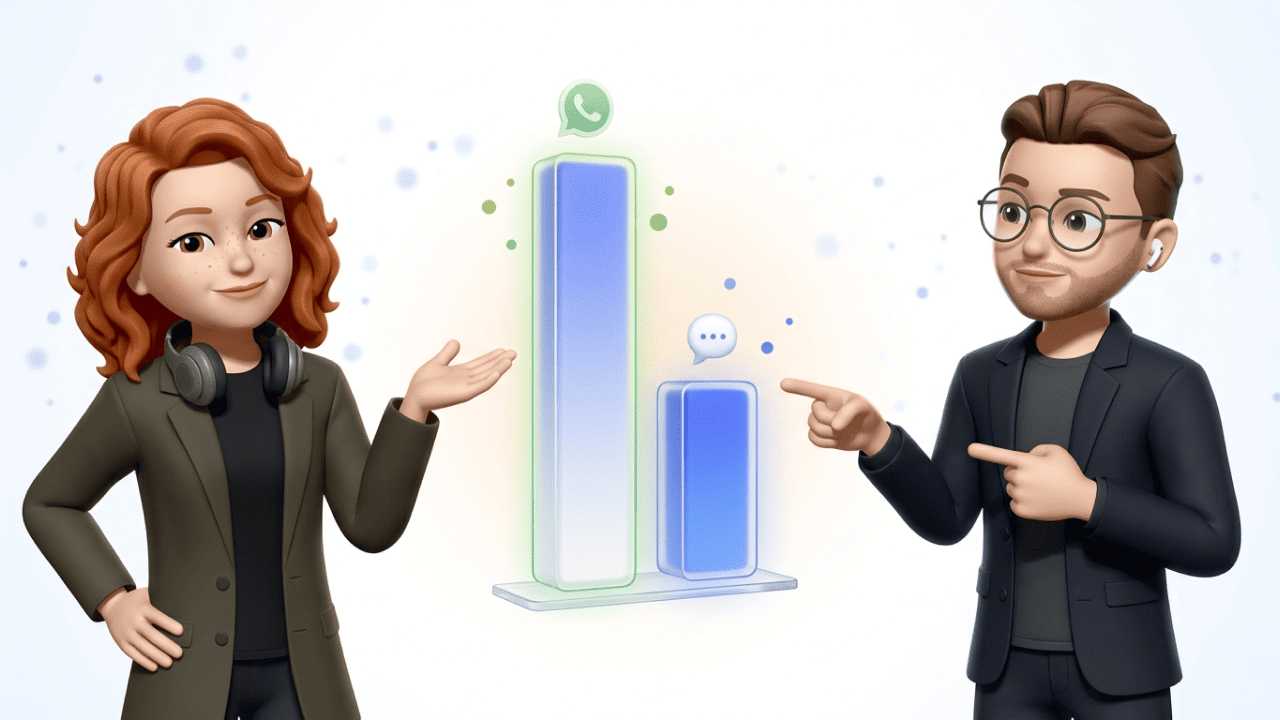

RCS vs WhatsApp — the debate is almost always framed as a tech comparison: who has the better protocol, the slicker rich cards, the stronger encryption? Wrong question.
The numbers look like a catch-up race at first. Google Messages crossed one billion monthly active RCS users back in 2023, and with Apple joining via iOS 18, that base keeps growing. WhatsApp sits at around 3 billion. A catch-up race? Not in marketing. At least not in DACH.
Which means: in marketing, the feature set doesn't decide. What decides is where your customers are already scrolling, tapping, buying. RCS is functional. WhatsApp is behavioral. And in marketing, behavior wins — almost every time.
Let's go through this in detail. Including the cases where RCS actually is the better option (spoiler: 2FA in the US and France).
What Really Separates RCS and WhatsApp
RCS (Rich Communication Services) is the official successor to SMS. Backed by Google, the GSMA, and since 2024 by Apple as well. It runs inside the native Messages app on Android and iPhone. No installation, no sign-up — your phone number is enough.
WhatsApp is an over-the-top messenger by Meta. The app has to be installed. Account-based. Over 3 billion monthly active users globally (Meta, 2025). In Germany, around 70% use WhatsApp daily and more than three quarters at least weekly (ARD/ZDF). No other messenger comes close.
The real difference isn't technical. The real question is: where do people actually spend their time?
RCS vs WhatsApp: The Honest Comparison Table
| Criterion | RCS | |
|---|---|---|
| Global reach | ~1B+ MAU (Google Messages, 2023, growing) | ~3B MAU (Meta, 2025) |
| Reach in DACH | ⚠️ ~80% of devices RCS-capable, active usage fragmented | ✅ ~70% daily, >75% weekly |
| App install required | ❌ No | ✅ Yes |
| iPhone support | ✅ Since iOS 18 (2024) | ✅ Since 2009 |
| Rich media (cards, carousels) | ✅ Yes | ✅ Yes |
| End-to-end encryption | ⚠️ Cross-platform only rolling out since 2025/26 (previously Android↔Android only) | ✅ Standard for all chats, for years |
| Business platform maturity | ⚠️ Young RBM APIs | ✅ Cloud API mature |
| Conversion tracking & funnel | ❌ Limited | ✅ Established |
| Carrier dependency | ❌ Yes (operator has to play along) | ✅ No |
| Marketing use case in DACH | ❌ Practically non-existent | ✅ Mainstream |
| 2FA / OTP use case (US/FR) | ✅ Strong | ⚠️ Possible, atypical |
The short version: on paper, RCS looks okay. In the reality of German and Austrian e-commerce brands, it doesn't matter. Not yet.
The Thesis: Behavior Beats Tech
Here comes the part most tech blogs skip.
Marketing channels don't win on features. They win on habit. Email isn't successful because HTML is so great. Email is successful because billions of people open their inbox every day.
WhatsApp isn't successful in the DACH region because the API is so elegant. It's successful because your customers are already in the app several times a day. When a brand sends out a WhatsApp campaign, it lands in an inbox that person checks anyway. Multiple times. Per hour.
Which means: a newsletter open rate of 25–35% is good. WhatsApp open rates of 80–95% aren't "better marketing." They're a consequence of behavior.
And this is exactly where RCS fails in DACH. Even if the reach were technically there — nobody checks their native Messages app with the same frequency as WhatsApp. People open that app when the parcel service sends a delivery status. Not to shop.
The result? Brands betting on RCS marketing in DACH are sending messages into an inbox that isn't active. You can build the prettiest rich card in the world — if nobody opens it, it's worthless.
Where RCS Actually Wins
Now the counterpoint, because I'm not the type to make a one-sided argument.
RCS has two use cases where WhatsApp is simply weaker:
1. Transactional 2FA and OTP in SMS-driven markets The US and France are classic SMS markets. Banks, airlines, public sector — a lot runs through the native Messages app. Here RCS is the natural SMS upgrade path. Authentication codes, shipping confirmations, boarding passes as a rich card. Makes sense.
2. Carrier-trust-based communication Public authorities, health insurers, banks in markets where a phone number counts as verified identity. RCS has the advantage that there's no app account in between.
The catch: both are service communication, not marketing. And in the DACH region, that overlaps with the area where brands prefer email or push anyway.
Cost Reality: RCS Business Messaging vs. WhatsApp Business
Both models bill per message — but they're structured differently.
RCS Business Messaging (RBM): Billed per message or per session, depending on the carrier and aggregator. Available in Germany, but without standardized pricing — prices vary massively per provider.
WhatsApp Business Cloud API: Since July 1, 2025, Meta bills per delivered template message (previously per 24-hour conversation). Categories: Marketing, Utility, Authentication. Replies within an open 24-hour service window stay free. Meaning: you pay for what you proactively send out — not for every single interaction.
Which means: even if RCS were cheaper per message — the marketing reach in DACH makes that irrelevant. You pay less per message that no one opens. Bad deal.
What Works in Practice
You don't have to take my word that WhatsApp performs in marketing. The reality at DACH D2C brands looks like this: six-figure revenue from a single WhatsApp send is not the exception on established lists. Campaign-level ROI in the double digits is documented. And not because WhatsApp is better encrypted than RCS — but because customers are in the app anyway when the message arrives.
Can RCS do the same? In DACH: currently no. In the US, with the right vertical: maybe in two or three years.
Channel Architecture: How RCS, WhatsApp and Email Fit Together
This is where it gets strategic. If you're building a D2C or e-commerce brand in DACH today, an honest channel architecture looks like this:
- Email: newsletter, content, reactivation, long-form. Margin channel.
- WhatsApp: performance marketing, launches, Black Friday, abandoned cart, loyalty. Conversion channel.
- Print/DM: high-value reactivation, premium brands.
- RCS: authentication, OTP, transactional service messages (if at all).
In this architecture, RCS is an auth niche. Not the marketing channel. Anyone selling it differently either has an RCS tool to push or hasn't looked at the DACH reality.
Who Should Use RCS, Who Should Use WhatsApp?
A quick decision guide.
RCS makes sense if you:
- Serve the US or French market
- Run airlines, banks, KYC/auth use cases
- Already use transactional SMS at scale and want a rich media upgrade
- Need carrier-based identity verification
WhatsApp makes sense if you:
- Serve DACH, Southern Europe, LATAM, India or Brazil
- Run D2C, e-commerce, beauty, fashion, supplements, fitness
- Want performance marketing with measurable ROI
- Build abandoned cart, launch campaigns, loyalty programs
Bottom line: if you're a brand in DACH and you haven't set up your WhatsApp channel yet, you're leaving revenue on the table. Full stop.
FAQ
Is RCS safer than WhatsApp?
Not inherently. WhatsApp has had end-to-end encryption for all chats for years. With RCS, E2E encryption was long limited to Android↔Android (Google Messages). Cross-platform encryption between iPhone and Android only arrived with the GSMA standard Universal Profile 3.0 (2025) and has been rolling out as a beta since iOS 26.5 (May 2026). On encryption, WhatsApp is further ahead and more comprehensive.
Can I use RCS for marketing in Germany?
No. Technically possible, practically not useful. Adoption is low, carrier support is inconsistent, and usage behavior doesn't fit a marketing context.
Will RCS replace WhatsApp long-term?
No. RCS replaces SMS, not WhatsApp. WhatsApp is a social messenger with groups, voice calls and payment features. RCS is an upgraded SMS protocol.
Does RCS work on the iPhone?
Yes. Since iOS 18 (autumn 2024), Apple supports RCS.
What does RCS Business Messaging cost?
Depends on aggregator and carrier — there's no uniform pricing in Germany. We've broken down the exact RCS Chat costs for brands separately.
Is WhatsApp Business free?
No. The WhatsApp Business app is free, but for scaled marketing usage you need the Cloud API. Since July 2025, Meta bills per delivered template message.
What open rates does WhatsApp marketing achieve?
Typically 80–95% within the first 24 hours. Compared to email newsletters at 25–35%, that's a meaningful gap.
Can I use RCS and WhatsApp in parallel?
Yes. For many brands, a clean separation makes sense: RCS (if at all) for transactional auth messages, WhatsApp for marketing and conversion.
Is WhatsApp Business Cloud API GDPR-compliant?
Yes. With opt-in, a data processing agreement and clean consent documentation, it's standard practice with serious providers.
Conclusion
RCS is technically interesting. In the US and France, even relevant for 2FA and transactional communication. But in DACH marketing, it's not an option in 2026 either — and that won't change quickly.
WhatsApp doesn't win because it has the better protocol. It wins because a large share of the DACH population is inside the app every day. Behavior beats tech. Every day.
If you want to know what WhatsApp marketing concretely means for your brand — we'll show you in 30 minutes, with real numbers from your vertical.