
Five plans from €69 to €299. Clearly tabled on the pricing page. In the DACH WhatsApp BSP market 2026, that's almost unusually open.
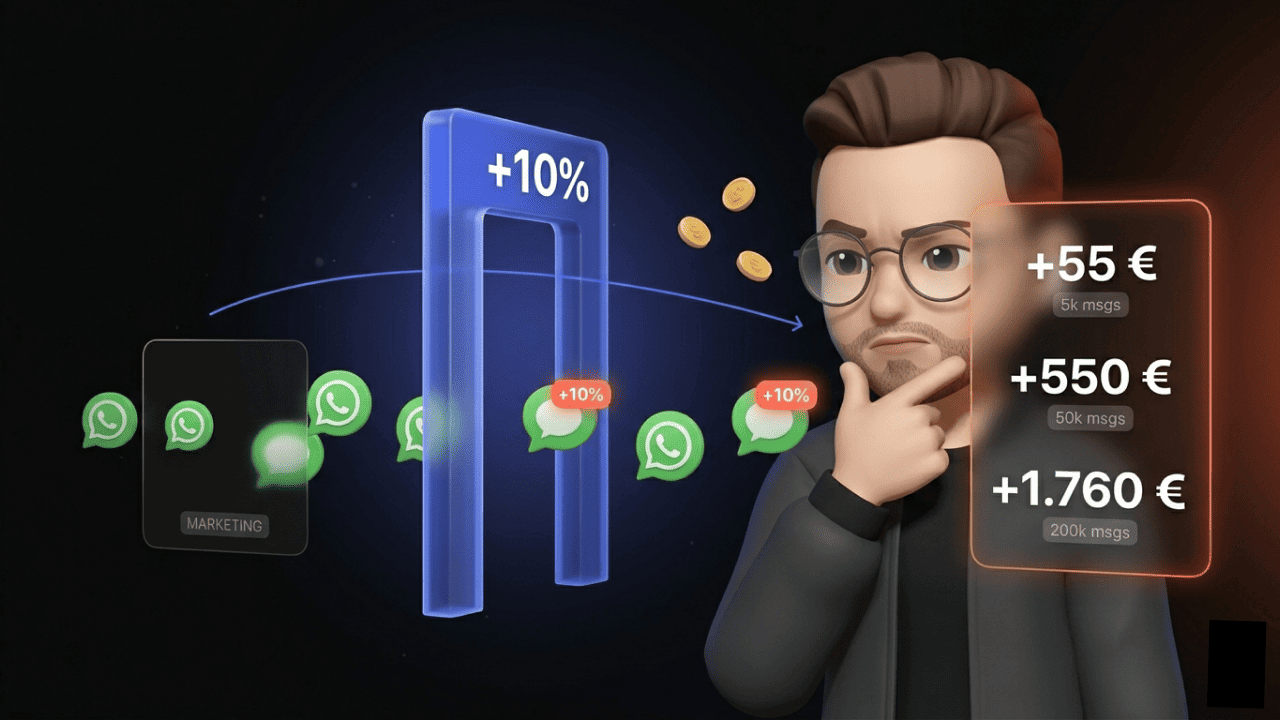
What the table doesn't say out loud: 10 % on every business-initiated Meta message. At 50,000 sends per month, that's €550 on top. At 200,000 sends, €1,760.
Plus: The Chatflow Builder — the feature for newsletters and bot automations — is only included from Premium (€129/month). In Starter and Basic, it's an add-on at €59/month.
The plans are honest. Real TCO only emerges from plan + add-ons + service fee + seat slots. We're breaking that down for three realistic shop scenarios — plus an honest comparison with Chatarmin.
ChatWerk Pricing at a Glance
ChatWerk sells five plans — four with fixed prices, one on request. With an annual contract, you save 13 to 19 % depending on the plan compared to monthly billing. All prices excl. VAT and one-time setup fee.
| Plan | Monthly cancellable | Annual contract | Seats | WhatsApp accounts | Messengers |
|---|---|---|---|---|---|
| Starter | €85/month | €69/month | 3 | 1 | WhatsApp only |
| Basic | €102/month | €85/month | 10 | 1 | all (WA, FB, IG, Telegram) |
| Premium ★ | €149/month | €129/month | 30 | 3 | all |
| Supreme | €299/month | €249/month | 50 | 5 | all |
| Enterprise | custom | custom | custom | custom | all |
The official pricing page lives at chatwerk.de/preise (German site, with English toggle).
Three things this table doesn't show — but they decide your TCO:
- The Chatflow Builder for WhatsApp newsletters and bot automations costs extra in Starter and Basic (€59/month). From Premium upwards, it's included.
- Seat counts are capped. Beyond the included number, you pay €5/user/month. A 15-person team on Basic means +€25/month.
- Every business-initiated WhatsApp conversation triggers Meta fees plus a 10 % service fee. More on that in the next section.
The 10 % Markup on Meta — What That Means in Euros
This is the point that often only surfaces after the demo call. ChatWerk doesn't pass Meta fees through 1:1 — it adds 10 % service fee per message on top. Stated openly on the pricing page.
For anyone unfamiliar with Meta's fee structure: Since July 2025, Meta no longer bills per 24-hour conversation but per delivered template message. Four categories, four prices. Marketing is the most expensive, service replies inside the 24-hour window are entirely free.
Concretely in Germany: A marketing message currently costs around €0.11 (Meta list price). With ChatWerk's 10 % markup: €0.121. Sounds like small change. At volume, it becomes a number you want on your radar.
| Marketing messages sent/month | Meta list price (1:1) | ChatWerk (with 10 % fee) | Markup |
|---|---|---|---|
| 5,000 | €550 | €605 | +€55/month |
| 20,000 | €2,200 | €2,420 | +€220/month |
| 50,000 | €5,500 | €6,050 | +€550/month |
| 100,000 | €11,000 | €12,100 | +€1,100/month |
The effect: The more you send, the more you pay on top. The ChatWerk Premium licence at €129 is suddenly smaller than the service fee alone in the 50,000 scenario.
For contrast: Chatarmin passes Meta conversation costs through 1:1, no markup. Which model is "better" depends on volume, platform pricing, and service depth. What matters: You should know which model you're signing up for before you commit.
Counterpoint: At small send volumes (under 3,000 marketing messages/month), the 10 % effect barely shows. Anyone using ChatWerk primarily as a multi-channel inbox for service inquiries — not for marketing broadcasts — rarely sees the markup on the bill, since incoming conversations within the 24-hour window stay free.
Add-Ons That Many Miss in the First Quote
ChatWerk has an unusually clear add-on catalogue. What's missing from Starter and Basic can be added — but it costs. Here are the key items:
| Add-on | Price | Important for |
|---|---|---|
| Chatflow Builder (newsletters + bot automations) | €59/month | Marketing, included from Premium |
| AI FAQ Bot (Beta) | €49/month | Service automation |
| AI Bot answer upgrade | €19 per 1,000 tokens | Scaling AI replies |
| Location Finder (postcode-based) | €170/month | Multi-location chains |
| Additional WhatsApp number | €45/month | Multi-brand / multi-country |
| Additional seat | €5/month/user | Team growth |
| Additional contacts (over included limit) | €10 per 100 contacts | Scaling |
What stands out in this list: ChatWerk charges €59/month extra for the Chatflow Builder in Starter and Basic. That's the function you need to even set up WhatsApp newsletters. Anyone starting on Starter (€69) and wanting to run newsletters lands at €128/month. For €1 more, you get Premium — with the builder included, three WhatsApp accounts, and 30 seats.
My take: Anyone serious about WhatsApp marketing should start at ChatWerk Premium or higher. Starter and Basic are essentially service-inbox plans — the marketing power sits inside the Chatflow Builder, and that's deliberately gated behind Premium.
ChatWerk vs. Chatarmin: What's Each Tool Built For?
Both tools are DACH-based providers with GDPR hosting. Both bundle WhatsApp conversations. But the focus is different — and that's what matters in the sales call.
| Criterion | ChatWerk | Chatarmin |
|---|---|---|
| Headquarters / hosting | Nuremberg / Frankfurt-DE | Vienna / EU hosting |
| Core focus | Multi-channel inbox for SMBs & branch networks | WhatsApp-first for e-commerce |
| Typical clientele | Edeka, TUI, Bosch, John Reed (chains, service) | Smilodox, YFM, VITAFORM (D2C / Shopify) |
| Newsletter / broadcast | Add-on (€59/mo) on Starter/Basic, included from Premium | Core function in all plans |
| Meta fees | + 10 % service fee per message | 1:1 pass-through, no markup |
| Klaviyo integration | no (HubSpot/Zapier yes) | native, bidirectional sync |
| Shopify integration | possible via Zapier | native one-click connection |
| Personal onboarding | 30-min video call included | Structured e-commerce onboarding |
| Pricing model | 5 public plans (€69–€299 + Enterprise) | Sales-led, individual per volume |
| API access | free in all plans | included |
| AI phone assistant | no | yes, integrated in omnichannel inbox |
What this means in practice:
ChatWerk is built for SMBs and branch networks that want to bundle several messenger channels in one inbox and replace their boss's private WhatsApp account. Edeka branches, furniture retailers, fitness studios, plumbing contractors — the typical ChatWerk customer wants to professionalise WhatsApp, not primarily drive revenue through it.
Chatarmin is built for e-commerce brands that use WhatsApp as a revenue channel — with Klaviyo sync, Shopify trigger flows, abandoned-cart recovery, and newsletters with 80–95 % open rates. The case study numbers reflect this: Smilodox €481,000 revenue from one Black Friday campaign, YFM €225,000 in 30 days, VITAFORM 40.7× ROI on WhatsApp flows.
Counterpoint: Anyone with a pure service use case — a branch network with location queries, a trades business with appointment logistics, a B2B with mixed inboxes — and marketing as a secondary concern fits ChatWerk well. Premium at €129/month is fair for that use case. Only when marketing volume scales does the TCO tip via the 10 % markup.
Three TCO Scenarios for E-Commerce Shops
Here's the maths the sales call usually doesn't open up. Assumptions for all scenarios: marketing conversations at €0.11 Meta list price, monthly cancellable contract (worst-case TCO; the annual contract saves 13–19 %), 80 % of contacts messaged per month.
Scenario 1: Coffee Roastery from Munich, 10,000 Newsletter Opt-Ins
Single-brand D2C shop, three-person team, service-focused with occasional drop campaigns for new beans. No Klaviyo, no multi-brand. Classic ChatWerk ICP.
| Item | Cost/month |
|---|---|
| Premium plan (monthly cancellable) | €149 |
| Seat allowances: 30 included → no surcharge | €0 |
| 8,000 marketing messages × €0.11 | €880 |
| ChatWerk service fee (10 %) | €88 |
| TCO | €1,117/month |
In this setup, the licence is still the largest single line item. The service fee stays under €100/month — manageable. Anyone running just three drops per year hardly sees it on the bill. ChatWerk fits here without much friction.
Scenario 2: Supplements Brand on Shopify with Klaviyo Stack, 50,000 Contacts
Mid-market D2C, eight-person marketing team, newsletter-driven growth plan, abandoned cart and post-purchase flows as standard. Klaviyo is the customer data platform.
| Item | Cost/month |
|---|---|
| Premium plan (monthly cancellable) | €149 |
| 10 additional seats (€5 each) | €50 |
| 40,000 marketing messages × €0.11 | €4,400 |
| ChatWerk service fee (10 %) | €440 |
| TCO | €5,039/month |
Here the ratio tips: The service fee alone (€440) is nearly three times the licence (€149). With annual prepayment, you save €4,400 per year on the service fee — only if you cut send volume. There's nothing left to negotiate on the plan side.
The second bottleneck for this brand: Klaviyo sync. ChatWerk has no native Klaviyo integration — workarounds run via Zapier or the Unified Messaging API, both operationally heavy and without bidirectional customer profiles. For a brand whose entire segmentation logic lives in Klaviyo, that's a show-stopper, not a "we can add that later".
Scenario 3: Multi-Brand Fashion Retailer with Three Shopify Stores, 200,000 Active Contacts
Three brands under one company, separate Shopify instances, shared service team. Each brand needs its own WhatsApp number for proper sender attribution in chat.
| Item | Cost/month |
|---|---|
| Supreme plan (monthly cancellable) | €299 |
| 30 additional seats (€5 each) | €150 |
| 160,000 marketing messages × €0.11 | €17,600 |
| ChatWerk service fee (10 %) | €1,760 |
| TCO | €19,809/month |
At 200k active contacts, the licence is mathematically irrelevant. The 10 % markup (€1,760/month) equals roughly six times the platform licence. This is the point where the negotiation moves to the service fee mechanism — not the plan price.
Anyone not running these numbers ends up paying 8–11 % over plan, just from the markup model. See also our breakdown of WhatsApp Newsletter Costs.
When ChatWerk Fits — And When It Doesn't
ChatWerk fits well if you:
- run an SMB or chain operation with a multi-channel service use case (Edeka, Bosch, John Reed are typical ChatWerk customers — none of them pure e-commerce brands)
- need WhatsApp, Facebook Messenger, Instagram, and Telegram in one inbox, with HubSpot or Zapier as your CRM backbone
- exclusively want DACH-based hosting — servers in Frankfurt, German provider, clear accountability
- start with small to mid send volume (< 5,000 marketing messages/month), so the 10 % fee disappears in the noise
- need the postcode-based location finder for a branch network (Location Finder add-on)
ChatWerk fits less well if you:
- run a Shopify store and need native Klaviyo and Shopify integration — both are missing in ChatWerk
- run performance flows like abandoned-cart, post-purchase, or win-back as a core workload (standard at Chatarmin, requires Builder + Zapier glue at ChatWerk)
- send over 20,000 marketing messages/month, and the 10 % markup turns into a three-digit monthly cost line
- need case studies with hard revenue numbers per WhatsApp campaign as decision basis (ChatWerk's site features service cases more than marketing revenue figures)
- need an AI phone assistant as part of an omnichannel strategy — not in ChatWerk's stack
In other words: It's not about "better or worse", it's about use-case fit. ChatWerk is a multi-channel inbox generalist for SMBs. Chatarmin is an e-commerce performance platform with WhatsApp at the centre.
Counterpoint: Some brands run both in parallel — ChatWerk for traditional service inbox, Chatarmin for WhatsApp marketing and performance flows. More licence cost, yes. But it makes sense when both use cases are independently large and you don't want to force everything onto one platform. At under 20k contacts, the dual setup rarely pays off.
GDPR, Contracts, and the Fine Print
ChatWerk is a German provider, founded and hosted in Germany — servers in Frankfurt-DE. In the DACH market 2026, that's not a nice-to-have but a requirement for any shop wanting GDPR-compliant WhatsApp marketing with a Data Processing Agreement, EU hosting, and a clearly identifiable controller. Inbox Solutions GmbH is the legal entity.
Contract terms you should know:
- Monthly contract: 30-day cancellation notice
- Annual contract: 3-month cancellation notice, with up to 20 % savings
- One-time setup fee (amount not public, ask in the sales call)
- Personal onboarding (30-min video call) is included in all plans
- Premium staff training (90 minutes) is an add-on for Starter–Premium, included in Supreme
External reading on Meta conversation mechanics: WhatsApp Business Pricing overview from Meta — the official source for conversation fees per market. Anyone wanting to understand the service fee mechanism should know the original pricing.
Conclusion
ChatWerk does something rare in the DACH BSP market: It shows its plan prices. Five tiers, clear tables, an honest pricing structure. The twist isn't in the licence — it's in the 10 % markup on every Meta message and the add-on items that gate marketing power in Starter and Basic.
For SMBs with a service focus and small send volume, Premium at €129/month is a fair package. For e-commerce brands with a marketing focus, Klaviyo in the stack, and five-figure send volumes, the maths tips — the service fee turns the manageable licence into four-figure additional costs per month.
If you're thinking of WhatsApp as a revenue channel for your shop, not just as a service channel: book a slot with us. We'll walk through your contact base, send volume, and TCO on the call — Meta list price pure, no markup, honest numbers.
👉 Book a demo with the Chatarmin team
FAQ: Frequently Asked Questions on ChatWerk Pricing
What does ChatWerk cost per month?
Yes, ChatWerk has public prices. Starter from €69/month (annual contract), Basic from €85, Premium from €129, Supreme from €249, Enterprise on request.
Are Meta fees included in the ChatWerk licence?
No. Meta conversation fees are charged on top of the licence, plus a 10 % ChatWerk service fee on every business-initiated message.
Does ChatWerk charge a setup fee?
Yes. ChatWerk charges a one-time setup fee in addition to the plan price, with the amount not publicly stated and negotiated individually in the sales call.
Is ChatWerk GDPR-compliant?
Yes. ChatWerk is a German provider (Inbox Solutions GmbH, Nuremberg) with servers in Frankfurt-DE, with DPA and EU hosting as standard.
Which ChatWerk plan suits e-commerce marketing?
Yes, for serious marketing you need Premium from €129/month — the Chatflow Builder for newsletters and bot automations is included there. In Starter and Basic, it costs €59/month extra.
Does ChatWerk offer a Klaviyo integration?
No. ChatWerk integrates HubSpot natively and supports Zapier — a native Klaviyo integration is missing, which is a show-stopper for e-commerce stacks built on Klaviyo.
How high is the ChatWerk markup on Meta fees?
Yes, ChatWerk adds a 10 % service fee on Meta fees per business-initiated message. At 50,000 marketing sends/month, that's roughly €550 on top.
What contract terms does ChatWerk offer?
Yes, ChatWerk offers a monthly contract (30-day notice) and an annual contract (3-month notice with up to 20 % savings). Both run without multi-year commitment.
Which messengers does ChatWerk support?
Yes, ChatWerk integrates WhatsApp, Facebook Messenger, Instagram, Telegram, and its own Webchat. Starter only activates WhatsApp; from Basic upwards, all channels are available.
Does ChatWerk offer a free trial?
Yes. ChatWerk offers a 14-day trial without credit card, registration runs directly via the pricing page.
What's the difference between ChatWerk and Chatarmin?
Yes, the difference is concrete: ChatWerk is a multi-channel inbox for SMBs and branch networks. Chatarmin is WhatsApp-first for e-commerce with native Klaviyo and Shopify integration.
Is WhatsApp marketing worth it for shops under 10,000 contacts?
Yes. With clean opt-ins and 80–95 % open rates, even small conversion lifts pay off — provided your stack supports segmentation and trigger flows.