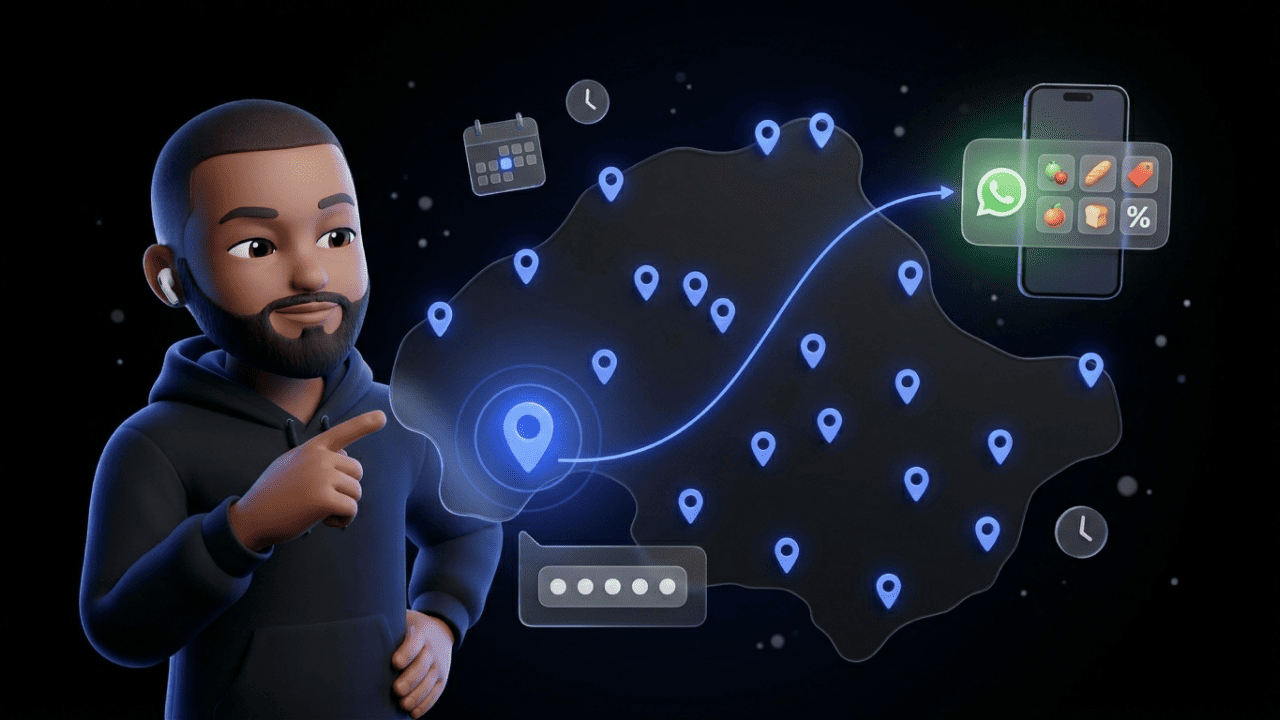

REWE killed the printed flyer in 2023. Instead, every Sunday morning, a WhatsApp message lands on millions of phones — with the deals for the upcoming week, tailored to the REWE store around the corner. Not generic for all of Germany. Local.
Sounds like a feel-good sustainability story. It partly is — 73,000 tonnes of paper saved per year isn't nothing. But the more interesting part is what's running under the hood. Because what REWE built isn't "let's also do WhatsApp now." It's a tight setup with a handful of design choices that matter for any e-commerce shop that takes its WhatsApp channel seriously.
Let's look at it together.
REWE and WhatsApp — why does this matter?
For anyone outside the DACH region: REWE is one of Germany's largest grocery retailers, sitting right next to Edeka at the top of the full-assortment market. Around 3,700 stores, over 160,000 employees, double-digit billion-euro revenues. Not a D2C shop — bricks-and-mortar retail with a strong app and a large online shop on the side.
The relevant chunk of history: In 2022, REWE announced it would stop printing weekly flyers. Completely. Nationwide. From July 1, 2023 onward, the entire promotional communication was going to run through the REWE app, the website — and WhatsApp.
Why that mattered: For decades, the weekly flyer was the top-of-funnel channel in German grocery retail. No flyer in the mailbox on Wednesday, no weekend visit to the store. Dropping that channel and replacing it with digital touchpoints isn't a "let's test something" move. It's a strategic shift with measurable consequences:
- 73,000 tonnes less paper per year
- 70,000 tonnes less CO₂
- 1.1 million tonnes less water
- 380 million kWh less energy
Plus: direct channel, better measurability, no more distribution waste. Aldi and Kaufland have walked similar paths — Lidl is still holding on to print. So the DACH grocery market is openly fighting over who wins the digital flyer game.
For you as a shop owner, the actually interesting question is: What can a company that was still tossing paper into mailboxes until 2023 teach you about WhatsApp? More than you'd think — if you look closely at how the setup is built.
How the REWE WhatsApp setup works
The user-facing flow is intentionally simple:
- Go to rewe.de/whatsapp, start the WhatsApp service
- Send your postcode or location
- Pick your home store from the list
- Send "START" — done
From there, every Sunday morning the digital flyer arrives as a WhatsApp message. Want to opt out? Send "STOP". That's it.
Three things in this mechanic look obvious at first glance — but the real value is in the detail:
It's hyperlocal. You don't get "REWE deals," you get the deals for your store. With 3,700 stores and regional promotion variations, that's a meaningful difference. A user in Cologne gets different offers than one in Hamburg.
The frequency is tight. One message per week. Sunday morning. That's the whole sending plan. No "let's push this real quick," no flash-sale interruption, no add-on broadcasts.
The opt-out is frictionless. Just "STOP". No login, no support hotline, no "we'll process your request within 5 business days." That's how the GDPR wants it — and how users want it.
Sounds boring, I know. But I see shop WhatsApp setups regularly where at least one of these three things is off. That's exactly where the lesson starts.
The geo-segmentation — and why it matters for your shop
The one detail in the REWE setup that genuinely impressed me: the postcode-based geo-segmentation.
At opt-in, the system asks for exactly one data point — the postcode. From that, the nearest store is derived. Every Sunday, the recipient list is segmented per store, and each subscriber gets their store's flyer.
That's not much. Single-data-point segmentation. But it turns a mass message into a relevant individual message. And relevance is where WhatsApp either works or doesn't.
Now, you can say: "Cool for REWE, but I don't have 3,700 stores." Fair. You don't need to. Geo-segmentation scales down just fine:
- Weather triggers: sunscreen pushes to Southern Germany when it hits 28°C. Ice-cream-maker reminders to Northern Germany when the first warm day rolls in.
- Shipping zones: Express-delivery cutoffs for DACH only. Black Friday shipping deadlines communicated regionally.
- Language: German messages to DE/AT/CH, English to UK — individually, not as a mass send with "(international friends, scroll down for English)."
- Pricing and promos: VAT-correct prices, country-specific coupon logic.
The bigger lever, though: geo is just one segmentation axis. REWE segments on one data point. You as a shop have click behavior, purchase history, cart status, order count, favorite categories — all flowing in through your shop integration. Combined right, you're going to beat REWE on relevance comfortably.
How that works in practice is in our WhatsApp Marketing Guide and the broader WhatsApp Strategy overview.
Why one message per week isn't a coincidence
Something that puzzled me at first: Why does a company the size of REWE only send one WhatsApp per week?
Short answer: because more wouldn't work.
Slightly longer answer: With a mass newsletter that has no deep personalization, every additional message is a risk. Three generic offers per week on WhatsApp, and the user is gone within two weeks. One relevant flyer per week, and they stay — turning "Sunday = REWE flyer" into a routine they keep alive themselves.
What REWE solves with that:
- List fatigue stays low because the user has a clear, predictable briefing
- The WhatsApp Business API punishes lists with high block rates — frequency discipline protects account quality
- The user develops an expectation they maintain on their own
For your shop, that doesn't necessarily mean "also only once a week." It means: the right frequency depends on how segmented your sends are.
- Generic broadcast to your whole list: max once a week, often less
- Event-based broadcasts to specifically opted-in segments (drops, restocks): as often as events happen
- Automations (cart abandonment, post-purchase): trigger-based, not frequency-based
Put differently: If you don't have segments yet, REWE's once-a-week logic is your benchmark. If you do have segments, you can send more often within those segments — because every message is relevant to that segment specifically. That's the lesson Snocks understood early — we wrote about that in the Snocks WhatsApp strategy post.
Opt-in: how REWE fills the list
REWE has a massive advantage on the opt-in side: brand recognition. When you've spent decades distributing millions of paper flyers, you can plaster "Get your flyer on WhatsApp now" all over the last printed editions. A D2C brand doesn't have that multi-channel machine.
Still — there are a few things any shop can copy:
REWE runs a dedicated landing page (rewe.de/whatsapp) that does one thing: explain what happens and offer a click-to-WhatsApp button. No mega funnel, no "first name, last name, email, gender." One postcode field later and you're in.
The detail I actually like: the promise is concrete.
"Get the latest flyer automatically every Sunday and never miss a deal again."
What happens, when it happens, what I get out of it. Three things, zero buzzwords. That clear expectation-setting is probably the main reason their opt-out rate stays manageable. You know what you're signing up for.
For your shop, that translates to:
- Tell people concretely what's in the newsletter. Frequency, content, value — in one sentence.
- Keep the opt-in process short. One data point (postcode, birthday) is fine. More than that isn't.
- Use the funnel touchpoints you already have: checkout, order confirmation, post-purchase email, package insert, QR code on the box, social bio.
If you want more inspiration on opt-in generation: we analyzed 320+ DACH shops and collected the best-performing methods in the WhatsApp Leadgen Playbook.
What REWE deliberately doesn't do — and where you can do more
Reality check: REWE is probably using around 30 % of what the WhatsApp Business API offers technically. That's enough for REWE's use case. For your shop, it's usually not.
What REWE leaves on the table, intentionally or not:
Behavior-triggered flows. REWE doesn't send "You clicked on wine offers three times last week — here are two new ones this Sunday." Technically possible. Doesn't happen.
Cart abandonment. The classic e-commerce use case. Doesn't apply directly in bricks-and-mortar retail — but on your shop with full checkout tracking, it absolutely does. And it's one of the most profitable WhatsApp use cases there is.
Post-purchase communication. After your Saturday REWE run, there's no WhatsApp coming in with "Here are recipes for the sausage you bought." On your shop, this could be a cross-sell, a care guide, a review request, a replenishment reminder.
Conversational commerce. The REWE channel is essentially one-way: flyer in, done. On your shop, WhatsApp can handle product advice, size finders, pre-sale dialogues. That's where WhatsApp shifts from newsletter tool to sales tool.
Incrementality measurement. REWE measures clicks and (to the degree possible) store visits. Clean holdout groups with contribution-margin views are hard in bricks-and-mortar. On your shop, with UTMs, coupon codes, and server-side events, it's very doable — and that's what makes WhatsApp internally defensible.
If you want the side-by-side:
| Aspect | REWE setup | D2C setup (Shopify-style brand, à la Snocks) |
|---|---|---|
| Segmentation | Geo via postcode | Geo + RFM + behavior + loyalty |
| Frequency | 1× per week, fixed | Event-based, dynamic per segment |
| Main format | Weekly flyer | Drops, restocks, flash sales, pre-sales |
| Automations | Almost none | Cart abandonment, post-purchase, reactivation |
| Conversational | No | Yes (advice, sizing, service) |
| Measurement | Clicks + store visits | Contribution margin, holdouts, CLV |
Both setups are right in their context. REWE has to serve millions of recipients at low friction — personalization by purchase history would be operationally near-impossible. You as a D2C shop have the other lever: fewer recipients, but a lot more data per recipient.
What I take away from the REWE setup
If I had to compress this whole post into three things, it would be these:
First, the concrete promise. REWE doesn't write "exclusive benefits on WhatsApp." They write "your store's flyer, every Sunday." One sentence, everything in. Pull off even half of that clarity and you'll out-opt-in 80 % of the shops I see.
Second, segment from day one. Even if it's just one data point (postcode, language, first-time buyer yes/no). A segmented list of 5,000 contacts beats an unsegmented list of 20,000 — almost every time.
Third, frequency discipline as the default. As long as you're not segmenting heavily, one to two messages per week is the benchmark. Once segments are in place, you can push more — within the segments, not across the whole list.
The biggest difference between REWE and a D2C brand at the end isn't the tool. It's the logic: REWE replaces a print channel with WhatsApp. You build a profit channel with WhatsApp. Two different games — and in your game, you can play with way more weapons.
The tech setup behind it, briefly
What REWE is technically running is very likely not a public WhatsApp Channel (Meta's one-to-many broadcast feature without individual recipient targeting), but the WhatsApp Business API with individual sending. Anything else would make the postcode-based segmentation across hundreds of store options technically impossible.
What you need to build something even remotely comparable:
- WhatsApp Business API instead of the WhatsApp Business App
- Approved message templates for proactive sends
- CRM or shop integration for segmentation
- Tracking layer with UTMs, coupons, server-side events
- GDPR-compliant opt-in/opt-out management
- Template governance: approval, versioning, quality control
That's exactly what Chatarmin covers for e-commerce brands — with native Shopify, WooCommerce, and JTL integrations for direct data sync. If you want to go deeper on the technical side, there's the WhatsApp Business API Guide. For the running cost side, the WhatsApp Business Costs breakdown.
Bottom line
REWE decided to digitize a mass channel in one step — and built a pretty clean setup around it. Geo-segmentation, frequency discipline, clear promise, easy opt-out. None of that is rocket science. But the way they fit together is what makes it work.
For you as a shop owner, REWE is the baseline, not the goal. You have the data REWE doesn't. Use it. And don't think of WhatsApp as an email replacement — think of it as its own channel with its own logic: more direct, faster, conversational.
If you want to see what this would look like for your setup — grab 30 minutes with our team. We'll walk through what you currently have and show you where the real lever sits. More brand breakdowns are in the Snocks post or in the Chatarmin case studies.
Frequently asked questions about the REWE WhatsApp strategy
How does the REWE WhatsApp newsletter work?
Users subscribe via rewe.de/whatsapp, send their postcode or location, and pick their home store. Every Sunday morning, they receive the digital flyer for their store with the offers for the upcoming week. Unsubscribe by sending "STOP".
Why did REWE drop the printed flyers?
Since July 2023, REWE no longer distributes printed flyers. According to REWE, the switch saves around 73,000 tonnes of paper, 70,000 tonnes of CO₂, 1.1 million tonnes of water, and 380 million kWh of energy per year. Promotional communication now runs via WhatsApp, the REWE app, and the website.
Is the REWE WhatsApp newsletter free for users?
Yes. Subscribers don't pay anything. REWE covers the sending costs through its WhatsApp Business API setup.
Which parts of the REWE setup can a small shop actually copy?
Three things mostly: a concrete, clearly phrased opt-in promise, at least one segmentation axis from the start (e.g., geo or language), and disciplined sending frequency as long as the list isn't segmented heavily.
Do I need the WhatsApp Business API for a setup like this?
In most cases, yes. The WhatsApp Business App is fine for very small volumes and manual sending. For segmented newsletters, automations, templates, and CRM integration, the WhatsApp Business API is essentially a requirement. Details in the WhatsApp Business API Guide.
What's the difference between REWE's WhatsApp newsletter and a WhatsApp Channel?
A WhatsApp Channel (Meta's public broadcast feature) is one-to-many, anonymous, and the sender doesn't know who's on the list. REWE almost certainly uses the WhatsApp Business API with individual sending instead — that's the only way the postcode-based segmentation across hundreds of stores works.
Which other DACH grocery retailers offer flyers via WhatsApp?
Aldi and Kaufland have followed similar paths and offer flyer subscriptions via WhatsApp. Lidl is still betting on print. Among full-assortment retailers, REWE has done the most extensive WhatsApp rollout to date.
How do I avoid list fatigue on a WhatsApp newsletter?
Three levers help: frequency discipline (less is more, as long as relevance is high), segmentation (not every message goes to everyone), and sunset logic (inactive recipients get cycled out of promotional flows rather than blasted further).