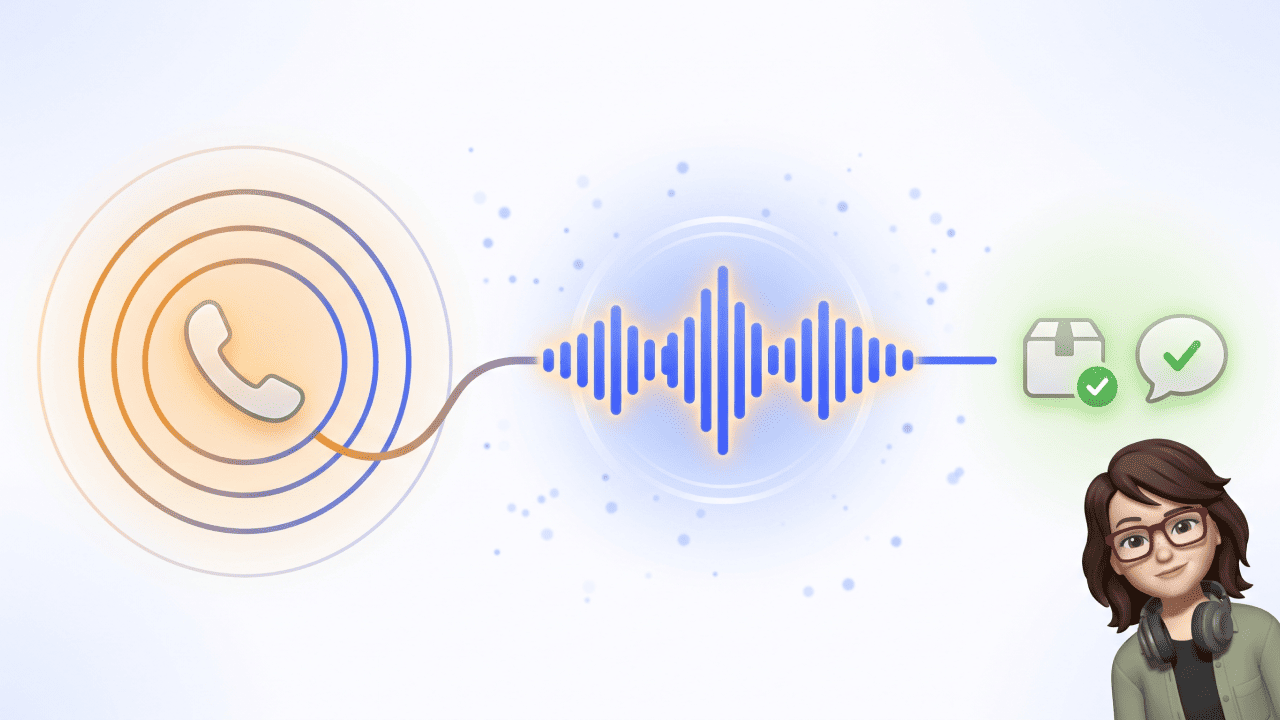

70% of all online shopping carts get abandoned. That benchmark has barely moved in years. What has moved is what you can do about it.
If you still rely on email alone to recover abandoned carts, you leave money on the table. Industry-standard email recovery sits between 5 and 12% conversion rate, with a mean around 8%. Optimized WhatsApp recovery setups land between 18 and 23%. These figures come from aggregated data across over 450 e-commerce brands using Chatarmin, plus 96 documented sales and customer calls on cart recovery.
This article covers how WhatsApp recovery works technically, what recovery rates are realistic, when the effort pays off, and when it does not. With real cases, an honest ROI calculation, and an FAQ section answering the most common questions from those sales calls.
WhatsApp recovery vs. email recovery at a glance
Before we dive into the mechanics, here are the key differences side by side.
| Metric | Email recovery | WhatsApp recovery |
|---|---|---|
| Open rate | 18 to 45% | 72 to 85% |
| Conversion rate | 5 to 12% | 18 to 23% |
| Delivery location | Inbox, promo tab, spam | Lock screen |
| Read time after send | Hours to days | Minutes |
| Reply option | No | Yes, in the same chat |
| Setup effort | Variable | 10 to 30 minutes |
| Cost per message | Volume license | Around 11 cents (Germany) |
Why email recovery has been stuck at 5 to 12% for years
Email recovery is mature. Three structural problems hold it back.
First, the inbox reality. Recovery emails land in the promotions tab or the spam folder. Open rates for recovery emails sit between 18 and 45% based on standard industry benchmarks. Click rates between 5 and 21%. End-of-funnel conversion lands at 5 to 12%, with a mean around 8%.
Second, timing. A recovery email usually reaches the customer an hour or more after the abandonment. The buying moment is long gone. The customer is in a meeting, at dinner, or already shopping at a competitor.
Third, the format. Email is one-way communication. The customer has a question about the product. They cannot ask it. So they do not buy.
WhatsApp addresses all three at once. That brings us to the next section.
What makes WhatsApp recovery technically different
A WhatsApp recovery message lands on the lock screen. Open rates among Chatarmin customers average between 72 and 85%. That is 2 to 4 times email.
Three mechanics make the difference.
The 24-hour service window. Once a customer messages you on WhatsApp, you have 24 hours to send any reply. No template approval. No additional cost. For proactive messages outside that window, you need a pre-approved template. A marketing message currently costs around 11 cents in Germany, with pricing varying by destination country.
The direct deep link to the prefilled checkout. Unlike email, WhatsApp lets you send a deep link straight back to the cart with products preserved. The customer taps once, sees their items, hits "Buy". Friction approaches zero.
The direct reply option. The customer replies when they have a question. Same chat. Same brand. From this you get higher conversion rates and additional data on abandonment reasons that you would never capture otherwise.
Realistic recovery rates from over 450 e-commerce brands
Concrete figures from the past twelve months, aggregated from 96 cart-recovery-related sales and customer calls at Chatarmin.
| Setup type | Recovery rate | Requirements |
|---|---|---|
| Standard flow without optimization | 8 to 15% | Native shop integration, single reminder message |
| Optimized flow | 18 to 23% | Cart-level tracking, 2- to 3-step sequence, good timing, sufficient opt-ins |
| Top cases at high AOV | 25%+ | Specific high-ticket niches, established brand affinity |
Two examples with concrete, publicly documented numbers.
MeubelBaas, a Dutch brand for custom-made furniture, generated over 75,000 euros in revenue through WhatsApp flows in two months. Setup took ten minutes. The cart recovery flow contributed a substantial share, combined with a welcome flow and personalized product recommendations. Full case at chatarmin.com/customers/meubelbaas.
SNOCKS, a German underwear D2C brand, achieved a 2.5x higher open rate via WhatsApp compared to email. Revenue per message sent is 6x the email equivalent. From project start to first live campaign took 21 days. More on this in WhatsApp Marketing Examples 2026.
The prerequisite where most shops fail: opt-ins
Here is the truth most articles on this topic skip. A 20% recovery rate means nothing if you only have 50 opt-ins.
The math is simple. If you have 1,000 cart abandonments per month but only 5% of your buyers have given consent for WhatsApp marketing, you can send 50 recovery messages. At 20% recovery, that is 10 won-back orders. That does not justify the setup.
The math flips once you reach opt-in rates of 15 to 30% of your shop traffic. That becomes realistic through three mechanics.
Welcome flow with a lead magnet. A pop-up in your shop offering a coupon in exchange for the WhatsApp opt-in. This is the biggest lever for most shops.
Checkout opt-in. Right inside the order process, you ask for consent for shipping updates and WhatsApp marketing. Conversion rates here often sit between 30 and 60% because the customer is entering their phone number anyway.
Offline touchpoints for brands with physical retail. A QR code at the register routing directly into the WhatsApp chat. Takko uses this across roughly 1,100 stores in Germany.
Only once this opt-in machine runs does the recovery flow have a data foundation. If you want to run cart recovery, you have to solve lead generation first.
The WhatsApp recovery flow step by step
Here is what a recovery flow looks like that works in practice for e-commerce brands with AOV above 50 euros.
Trigger. The customer adds products to the cart and leaves the page without completing the purchase. The prerequisite is cart-level tracking, not just checkout tracking. If you only track abandoned checkouts, you miss a large share of cart abandonments because many customers never enter the checkout.
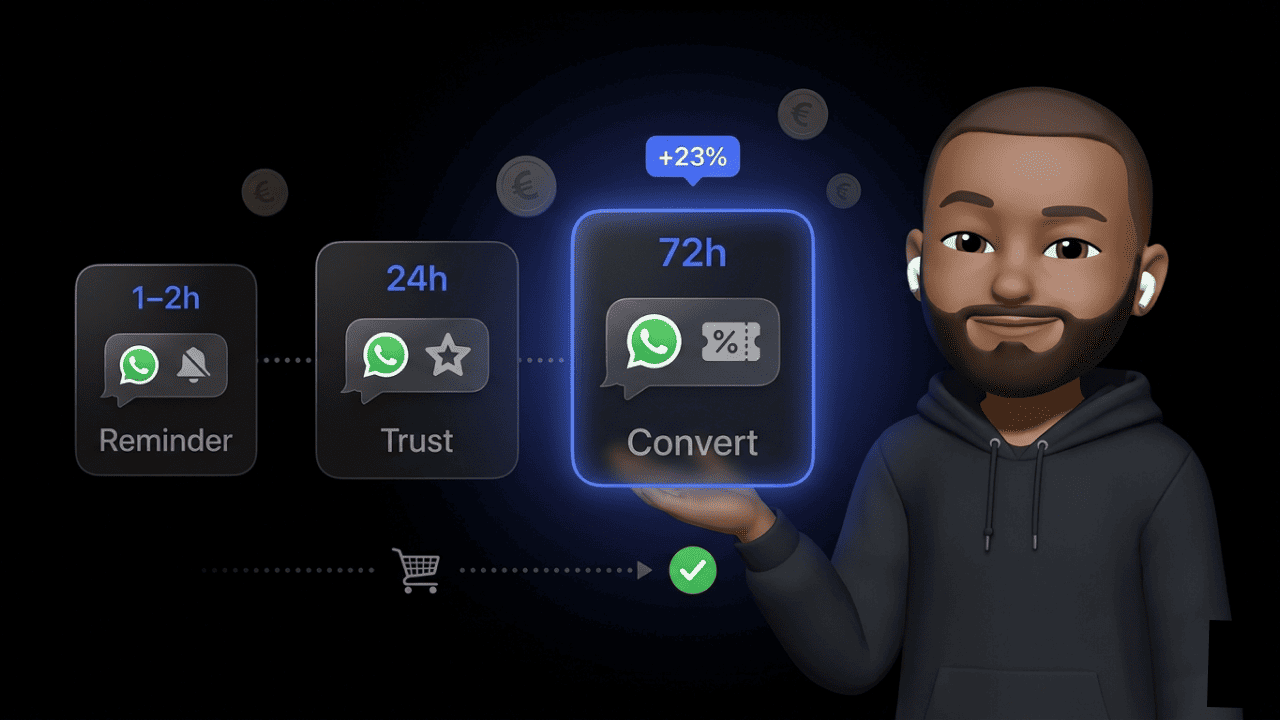
Message 1, after 1 to 2 hours. Friendly reminder with product image, customer name, and direct link to the prefilled cart. Sample wording:
"Hi Sarah, you just left the Yoga Mat Set in your cart with us. Want me to reserve it for you? Here is the direct link back: [Link]"
No discount in this first message. If you fire a discount immediately, you train your customer base to expect discounts. If the customer would have bought anyway, you give away margin for nothing.
Message 2, after 24 hours. Trust building. Product reviews, FAQ, common objections. When someone abandons, they usually have a specific concern. Delivery time, return policy, material quality. This message addresses it proactively.
"Still on the fence? Over 4,200 customers have bought this Set from us. 4.8 of 5 stars on average. Free shipping above 50 euros, 30-day returns."
Message 3, after 72 hours, optional. Conversion push with scarcity or a small incentive. Discount is allowed here, but targeted. 5 to 10% maximum. Or free shipping. Or a stock-low notice.
"Last call: Your Yoga Mat Set is down to the last 4 in stock. Use COMEBACK10 for 10% off, code valid for 24 hours."
More than three messages in a recovery sequence hurt more than they help. Performance breaks down sharply after message four. A sales call quote captured this well: "If a customer hasn't bought after three WhatsApps, they're not going to buy. More pressure just drives opt-outs."
Integrations for Shopify, Klaviyo, Mailchimp, and ERP systems
For the trigger to fire at all, your shop or your CRM has to talk to the WhatsApp tool. Here are the most common configurations.
Shopify, native. Chatarmin integrates directly with Shopify. Cart updates, checkouts, and orders pass over in real time. The recovery flow starts automatically. Setup typically takes 10 to 30 minutes.
Shopify plus Klaviyo. The most common combination in European D2C. Klaviyo manages segments and profiles, Chatarmin sends the WhatsApp messages. Both tools sync bidirectionally. Advantage: you orchestrate email and WhatsApp recovery in a single customer journey. Email as the wide net, WhatsApp as the high-conversion layer for opt-in customers.
Klaviyo launched its own WhatsApp module in October 2025. For requirements like double opt-in compliance, German-speaking customer success, and integration with helpdesk systems like Gorgias, many brands still run the combined stack: Klaviyo for email, Chatarmin for WhatsApp. More on the trade-offs in Chatarmin vs. Klaviyo WhatsApp.
WooCommerce plus Omnisend. Works similarly to Klaviyo. Fewer standard templates, more flexibility on custom triggers.
Brevo. Brevo offers its own WhatsApp module, but the recovery flow is primarily designed around email. Brands already on Brevo who want to lift recovery performance often run Chatarmin in parallel and use it as the WhatsApp layer only.
Mailchimp. Mailchimp itself has no native WhatsApp integration. Chatarmin built a dedicated bridge that uses Mailchimp events such as sent, opened, clicked, and unsubscribed as triggers for WhatsApp flows. If you want to keep Mailchimp as your email CRM and add WhatsApp without a tool change, the integration runs without middleware. Details at chatarmin.com/en/whatsapp-integration/mailchimp.
ERP systems like JTL, Xentral, Billbee. This is where it gets more complex. Cart data usually sits in the shop, order data in the ERP. Chatarmin syncs to both sides. For mid-market shops with multi-stage order processes, this is often the decisive setup point.
When WhatsApp recovery does not work
The point most articles skip. Four situations where WhatsApp recovery does not return the investment.
First: AOV below 25 euros. If your average order value sits at 18 euros, the 11-cent marketing message combined with a low margin eats your recovery yield. From a sales call, verbatim: "If your average basket size is below 25 euros, you need to think differently." For low-AOV shops, pure email sequences or SMS reminders make more sense.
Second: too few opt-ins. If you do not have at least 200 monthly WhatsApp opt-ins, recovery rate is irrelevant. You lack the send base. Build the welcome flow and the opt-in machine first. Recovery comes after.
Third: wrong tracking. Many shops only track abandoned checkouts, not abandoned carts. They lose a large share of recovery opportunities because customers often drop out before reaching the checkout. If you take recovery seriously, you have to capture cart-level events cleanly.
Fourth: over-messaging. If you stack three recovery sequences per week on top of newsletter and post-purchase flow, you burn your list. Opt-out rates rise, open rates fall, and the entire list turns unprofitable. The rule of thumb: maximum one to two marketing touches per week per customer.
If any of these four apply to you, WhatsApp recovery is the wrong project right now. Build the prerequisites first, then build the flow.
ROI calculation: what does WhatsApp recovery actually deliver
The abstract recovery rate helps you little if you cannot translate it to your shop. A sample calculation for a shop with 250,000 euros monthly revenue and 60 euros AOV.
| Item | Value |
|---|---|
| Monthly revenue | €250,000 |
| AOV | €60 |
| Successful orders per month | 4,167 |
| Cart abandonment rate | 70% |
| Total carts | 13,890 |
| Of which abandoned | 9,723 |
| Opt-in rate among cart abandoners | 25% |
| Recovery target customers per month | 2,430 |
| Recovery rate | 18% |
| Recovered orders | 437 |
| Additional revenue per month | €26,220 |
| Meta cost (2,430 × 11 cents) | €267 |
| Return on WhatsApp Spend (ROWS) | 15x to 60x |
For a shop of this size, that produces around 26,220 euros in additional revenue per month at roughly 267 euros in Meta fees plus the software license. Even on a generous all-in cost calculation, the Return on WhatsApp Spend (ROWS) lands between 15x and 60x. For optimized recovery flows we have also seen outliers above 100x at Chatarmin.
More on the benchmarks and on calculating ROWS and RPR (Revenue Per Recipient) in WhatsApp Marketing KPIs 2026.
GDPR and consent: what you need to know
Three points you cannot work around legally.
First: active consent, ideally double opt-in. The customer has to actively agree that you may contact them via WhatsApp. Single opt-in means a specific checkbox or an unambiguous registration form. Double opt-in adds a confirmation action by the customer, such as a reply confirmation via WhatsApp after the initial sign-up. For the European market, double opt-in is the most legally sound best practice and significantly reduces the risk of warning letters.
Second: documentation. You have to be able to prove when and where the customer consented. Chatarmin and comparable tools document this automatically.
Third: simple opt-out. Every marketing message needs a clear way to unsubscribe. "STOP" as a reply is sufficient. Important: opt-out processing must happen within 24 hours.
If those three points are in place, WhatsApp recovery stands on solid GDPR-compliant ground in the EU and UK. Deeper into compliance in GDPR-compliant WhatsApp Marketing.
A note for US-based brands: WhatsApp marketing messages to US phone numbers are not currently supported by Meta. WhatsApp marketing in the US is on the roadmap, but for now this article applies primarily to brands targeting customers in Europe, the UK, Latin America, APAC, and the Middle East.
FAQ: common questions on WhatsApp cart recovery
How can I recover abandoned carts via WhatsApp?
With three building blocks. An integration between your shop and a WhatsApp tool that detects cart abandonments automatically. An opt-in base of customers who have consented to WhatsApp marketing. And a recovery flow with two to three messages in the first 72 hours after abandonment. Setup time is 10 to 30 minutes for standard configurations on Shopify.
What recovery rate is realistic for WhatsApp cart recovery?
Standard setups land between 8 and 15%. Optimized setups with good timing, sufficient opt-ins, and a personalized sequence reach 18 to 23%. Top cases at Chatarmin sit above 25%, but only in specific niches with high AOV.
Is WhatsApp cart recovery worth it for small shops?
Yes, above an AOV of 25 euros and 200 monthly opt-ins. Below that, the per-message Meta fees are too high relative to recovered revenue. Small shops are often better off building the opt-in machine first and starting recovery later.
What does WhatsApp cart recovery cost?
Marketing messages currently cost around 11 cents per message in Germany via the Meta WhatsApp Business API. Pricing varies by destination country. Service messages within the 24-hour window are free. On top of that comes the software license for the WhatsApp tool. For a typical mid-market shop, the return sits between 15x and 60x of the budget invested.
Which tools connect Shopify with WhatsApp for cart recovery?
Chatarmin integrates natively with Shopify and triggers cart recovery flows automatically. Other providers in the European market are Charles and Superchat. Klaviyo has offered its own WhatsApp module since October 2025, but many European brands still combine Klaviyo as the email layer with Chatarmin as the WhatsApp layer. The choice depends on existing tools, send volume, and the language coverage of the customer success team.
Is WhatsApp cart recovery GDPR-compliant?
Yes, provided you implement active consent (ideally double opt-in), clean consent documentation, and a simple opt-out mechanism. A purchase alone does not constitute consent for marketing communication. You need separate, specific consent for WhatsApp marketing.
Is WhatsApp marketing available for US customers?
No, not currently. Meta does not support WhatsApp marketing messages to US phone numbers. The article applies to brands targeting customers in Europe, the UK, Latin America, APAC, and the Middle East.
When should the first recovery message go out?
The optimum is 1 to 2 hours after cart abandonment. Earlier feels intrusive, later loses the buying moment. For verticals with longer decision cycles such as furniture or premium fashion, 4 to 6 hours can perform better.
How many recovery messages should a sequence contain?
At most three in the first 72 hours. More leads to opt-out spikes without meaningful recovery gains. A proven sequence is reminder after 1 to 2 hours, trust building after 24 hours, conversion push after 72 hours.
Does WhatsApp recovery outperform email recovery?
Yes, for most cases at optimized setups. WhatsApp recovery reaches 18 to 23% conversion, email recovery 5 to 12%. WhatsApp complements email rather than replacing it. Email reaches a broader audience, WhatsApp converts the opt-in subgroup at a higher rate. The best performance comes from shops orchestrating both channels in parallel.
Conclusion: when WhatsApp recovery pays off
Three prerequisites need to align: AOV above 25 euros, at least 200 WhatsApp opt-ins per month, a shop on Shopify, WooCommerce, or a comparable standard platform. If those fit, WhatsApp cart recovery is currently one of the highest-ROI levers in e-commerce marketing. 18 to 23% recovery rate against 5 to 12% via email. Setup in 10 to 30 minutes. First results within the first week.
If any of those three prerequisites is missing, recovery is the wrong project right now. Build the prerequisites first. Welcome flow for opt-ins. Cart-level tracking instead of checkout tracking. A clean lead magnet on the shop.
Over 450 e-commerce brands run WhatsApp recovery with Chatarmin today. MeubelBaas generated over 75,000 euros in two months. SNOCKS achieved a 2.5x higher open rate and 6x higher revenue per message. Both saw results within 30 days of setup.
If you want to know what this looks like for your shop concretely, calculate your recovery potential in 15 minutes with our team. 15 minutes. Free. You leave with a concrete revenue estimate.