
More than half. That's how many of the clearly categorizable support tickets in e-commerce come down to a single question: "Where is my order?" In an analysis of 131 merchants using armincx — Chatarmin's AI support — WISMO accounts for 54.6% of classified tickets. Across all channels. On the phone, it's no different.
On top of that: return questions, size charts, and "Is it back in stock?" Always the same topics. Over and over.
And your team? Stuck in the loop. Telling a customer for the 40th time that day that the parcel arrives tomorrow. That's not support. That's an endless loop with a headset.
This is exactly where a voicebot in customer service comes in. No toy, no gimmick. A phone assistant that answers the same recurring questions automatically — and hands the tricky ones to your people.
The question isn't whether it works technically. The question is: does it pay off for your shop? That's what this decision framework is for. Honest, with yes and no.
What a voicebot in customer service actually does
A voicebot is an AI phone assistant that takes calls, understands what the customer wants, and answers. By voice. In real time. Without a keypad menu from 2009.
The difference from a classic IVR ("Press 1 for …") is fundamental. An IVR doesn't ask what you want — the voicebot understands it. The customer simply says: "I want to know where my order is." Done.
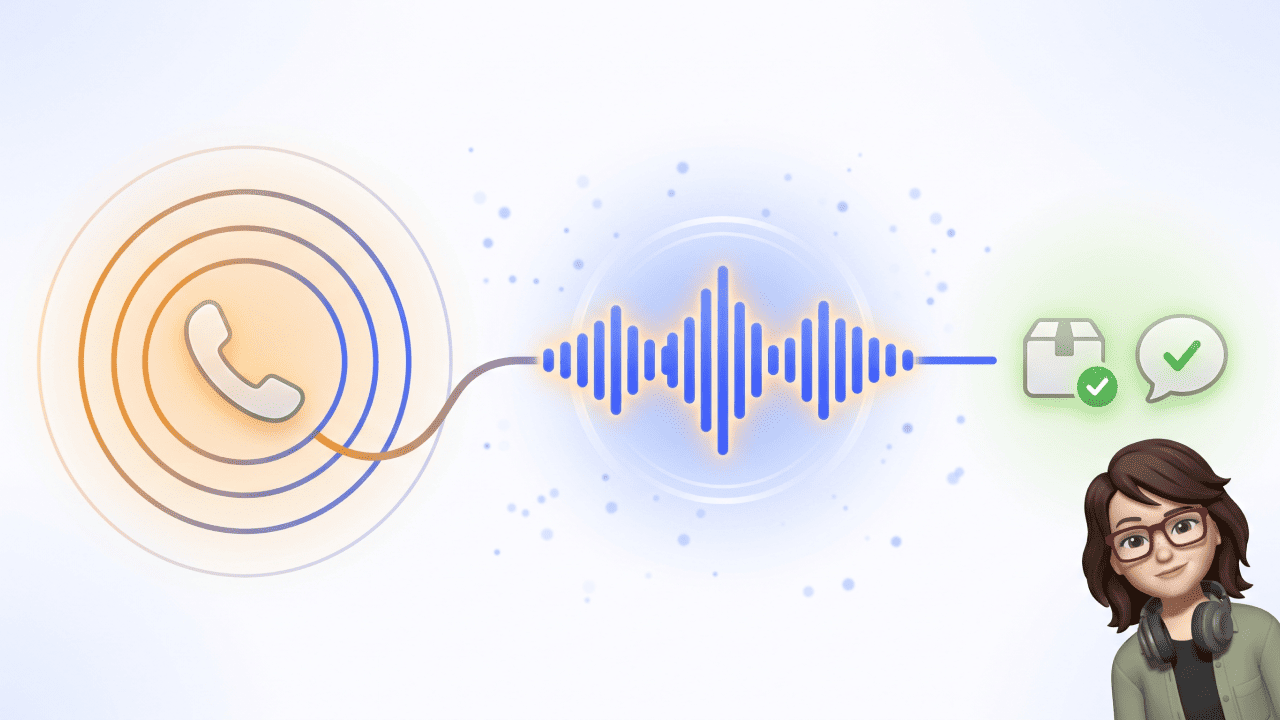
Here's what that means in practice: the bot accesses your shop system, pulls the order status, and reads the tracking info back to the customer. In under 30 seconds. No human needed.
Three building blocks make this work:
- Speech recognition (ASR): turns spoken words into text.
- Language understanding (NLU): detects the intent behind the sentence.
- Backend connection: pulls real data from your shop, OMS, or tracking tool.
Without the third piece, a voicebot is just a voice that talks back. With it, it becomes a workhorse.
The top use cases for e-commerce support
Not every task is a fit for automation. These are — and really well.
1. WISMO — "Where is my order?"
The classic. The evergreen. In many shops the single most common reason to call. The bot asks for an order or phone number, matches it in the system, and reads out the status. WISMO eats up the biggest chunk of your support volume — and that's exactly what the bot takes off your plate.
In short: this is the use case with the highest leverage. If you automate only one thing, make it this.
2. Triggering returns
"I want to send the trousers back." The bot identifies the order, checks the return window, generates the label, and sends it by email or SMS. Completely without an agent.
3. Phone product advice — the light version
"Do you still have those shoes in a size 42?" Availability, sizes, delivery times. Factual questions the bot answers from the product catalog.
The catch: real advice ("Which wine goes with my menu?") doesn't belong here. A bot can't do that — and shouldn't pretend to.
4. Taking calls outside business hours
Your team clocked out at 6 p.m. The customer calls at 9 p.m. A voicebot picks up, instead of the call going unanswered.
The result? Round-the-clock availability, without a night shift.
The decision framework: who it's for, who it isn't
Now the honest part. A voicebot isn't a must for every shop. Check yourself against these four axes.
Axis 1: Call volume
Rule of thumb: below ~500 relevant calls a month, setup rarely pays off. The effort for setup and training outweighs the time saved.
From ~1,000 calls a month it gets interesting. From 3,000+ it's almost negligent not to do it.
Axis 2: Repetition
Are more than half of your calls the same five questions? Perfect. A high degree of standardization means a high automation rate.
Nothing but individual edge cases? Then the bot won't help much.
Axis 3: Shop system connection
A voicebot without data access is useless. If your shop runs on Shopify, Shopware, or a common system and is kept clean — great. If your order data sits in three Excel sheets and one intern's head — clean up first.
Axis 4: Margins and order value
With high volume and low order value (fashion, cosmetics, FMCG), automation pays off fast. With few, high-priced advisory sales, the human wins.
| Criterion | Voicebot pays off (YES) | Voicebot doesn't pay off (NO) |
|---|---|---|
| Calls/month | ✓ > 1,000 | ✗ < 500 |
| WISMO share | ✓ high (40%+) | ⚠ low, many edge cases |
| Recurring questions | ✓ dominate | ✗ everything individual |
| Shop system integration | ✓ present & maintained | ✗ missing / chaotic |
| Order value | ✓ low, high-volume | ⚠ high-priced advisory |
| 24/7 availability needed | ✓ yes | ⚠ not relevant |
| Sensitive topics (complaints, claims) | ⚠ only as pre-qualification | ✗ as the main channel |
| Language variety | ✓ bot covers several languages | — |
In short: high volumes, lots of WISMO, a clean shop system? Then yes. A niche hotline with 80 calls a month and nothing but special cases? Skip it. A good employee is cheaper and better there.
Voicebot in the call center: relieve, don't replace
A common misconception: a voicebot in the call center means all agents get fired. Wrong.
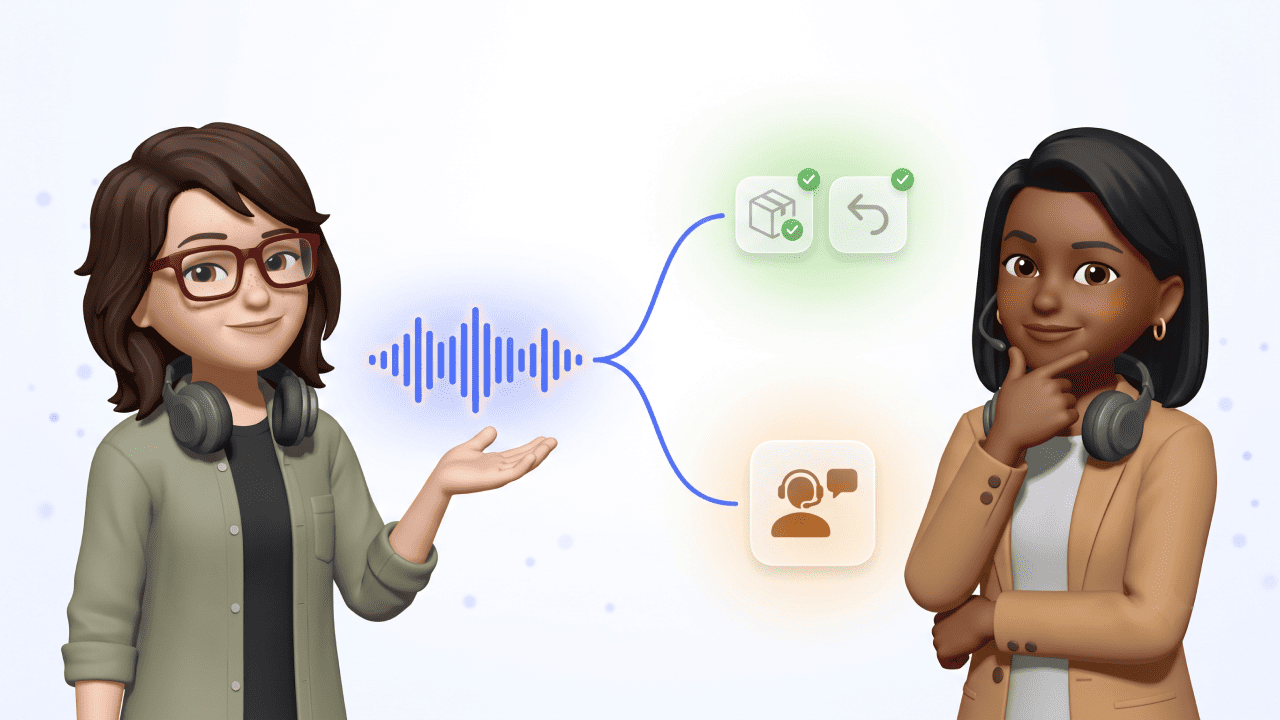
The model that works is called triage. The bot catches the standard cases — WISMO, returns, availability. Anything complex, emotional, or sensitive, it escalates cleanly to a human. With context, so the customer doesn't have to explain everything again.
Here's what that means in practice: your team spends its time on the cases where it's actually needed. Complaints, special requests, real advice. Instead of reading out a tracking number for the 40th time.
How much a voicebot actually takes off your plate depends on the setup — and on how standardized your calls are. A number for context: in the same analysis, total automation — AI plus stored workflows — sits at around one third of all tickets, again across all channels. On the phone, your use-case mix decides how much of that lands. The bot hands off the rest.
The difference between voice and text isn't trivial. Voice is faster for the caller and great for clear, standard requests. Text wins when the customer needs to read something or upload proof.
What it costs — and what it saves
Most providers bill per minute or per call. The range is wide, depending on feature scope and integration depth.
The simple ROI logic: call volume × automation rate × minutes saved per call.
Worked example: 2,000 calls a month, around one third automated, 4 minutes of handling time saved per call. That's roughly 2,700 minutes saved — more than 40 hours a month. More than a quarter of a full-time role, free again for the cases that matter.
The catch: these numbers only hold with a clean setup. A poorly trained bot that resolves only one call in five burns money and annoys customers. Training isn't a side job.
Provider comparison: who can do what
The market is crowded. But not every provider fits e-commerce. Many are built for medical practices, law firms, or local service businesses — and shine there.
| Provider | Strength | Weakness for e-commerce |
|---|---|---|
| fonio | ✓ Local service businesses, medical practices, appointment booking | ✗ Barely any shop system integration |
| VITAS | ✓ General telephony, SMBs | ⚠ Little e-commerce focus |
| aaron.ai | ✓ Healthcare | ✗ Not built for shops |
| armincx (Chatarmin) | ✓ E-commerce DACH, deep shop system connection, WISMO/returns | ⚠ No focus on local service businesses |
Honestly: if you run a dental practice, fonio is probably the better choice. If you run an online shop with high WISMO volume, we play to our strength — the connection to your shop system and the understanding of e-commerce processes.
Common pitfalls
A voicebot rarely fails on the technology. It fails on three things:
- Poor training. If the bot only understands half the questions, customers hate it. Then you're better off with none.
- No clean escalation. A bot that doesn't know when a human needs to step in is dangerous. Especially with complaints.
- Missing data connection. Without shop system access, it can't answer WISMO — and that's the whole point.
And honestly: customers accept self-service — as long as it works. They hate it the moment it sends them into loops. The difference isn't the technology, it's the setup.
FAQ — Voicebot in customer service
Does a voicebot replace my support team?
No. It takes over the recurring standard cases and passes complex or sensitive requests to humans. Your team focuses on what really matters.
From what call volume does a voicebot pay off?
Rule of thumb: from about 1,000 relevant calls a month. Below 500, the setup effort usually outweighs the benefit.
Can a voicebot access my order data?
Yes. Through the connection to your shop system, it pulls order status, tracking, and return data in real time. Without that connection, it can't answer WISMO questions.
What's the difference between a voicebot and an IVR?
An IVR works with keypad menus ("Press 1"). A voicebot understands natural language and responds directly to the request. That saves the customer time and hassle.
Does a voicebot understand dialects?
Usually, depending on the speech recognition. Strong dialects or background noise can lower the recognition rate. A good setup escalates to a human when unsure.
Which use cases are the best fit?
WISMO, triggering returns, availability checks, and taking calls outside business hours. Real advice and emotional complaints belong with humans.
How long does setup take?
It depends on the shop system connection and the number of use cases. Standard WISMO setups are quick; complex integrations need more training.
Is a voicebot suitable for high-priced advisory sales?
No. With few, advice-heavy sales, the human wins. The voicebot shines in high-volume business with standardized requests.
What happens with a complaint?
The bot should recognize it and immediately route it to a human — ideally with context, so the customer doesn't have to repeat everything. Complaints don't belong in full automation.
Can a voicebot handle multiple languages?
Yes. Multiple languages can be covered without extra staff. The prerequisite is clean training per language.
Conclusion: Weigh it honestly, then act
A voicebot in customer service is no cure-all. But for online shops with high call volume and a fat WISMO share, it's one of the best levers there is. Your team gains time, your customer gets an answer at nine at night, and you save real money.
If you run a niche hotline without volume — skip it. A human is better there.
Want to know whether it pays off for your shop? Book a demo of armincx Voice. We'll show you on a real example how much volume your setup could automate. No bullshit promises.