
85% open rate. No spam folder. No promotions tab. WhatsApp messages land directly on your customers' lock screen — and get read. Yet most businesses still rely exclusively on email and cold calling for sales.
That's wasted potential. Over two billion people use WhatsApp every day. Not as a marketing channel — as their personal communication tool. That's exactly what makes WhatsApp Sales so powerful: You reach prospects where they already are. No filters. No detours.
In this guide, you'll learn:
- which of the three WhatsApp Business options fits your company
- how to use WhatsApp for sales — B2B and B2C
- real-world examples from businesses already running profitable WhatsApp Sales
- which mistakes to avoid before sending your first campaign

The Three WhatsApp Business Options — and Which One You Actually Need
Before you get started, one fundamental decision: Which WhatsApp are you going to use? There are three options — and the differences are bigger than most people think.
| Feature | Business App | Business Premium | Business Platform (API) |
|---|---|---|---|
| Monthly costs | Free | Free | Software license + Meta fees |
| GDPR compliant | ❌ | ❌ | ✅ |
| Automated flows | ❌ | ❌ | ✅ |
| Support agents & ticketing | ❌ | ❌ | ✅ |
| Dashboards & analytics | ❌ | ❌ | ✅ |
| API integrations (Shopify, Klaviyo, JTL) | ❌ | ❌ | ✅ |
| Desktop users | 4 | 10 | Unlimited |
| Broadcast to 1,000+ recipients | ❌ | ❌ | ✅ |
| Hyper-personalization | ❌ | ❌ | ✅ |
| A/B testing | ❌ | ❌ | ✅ |
| Revenue attribution | ❌ | ❌ | ✅ |
WhatsApp Business App
Free. Built for solopreneurs and small teams with up to four devices. You can set up a business profile, save quick replies, and create a basic product catalog. For getting started, that's enough.
The problem: No automations. No CRM sync. No GDPR-compliant setup. And once you want to message more than 256 contacts, you're done — worst case, your account gets banned for sending mass messages without the official API.
WhatsApp Business App at a glance:
- Employee accounts: 1
- Linked devices: 5
- Assign chats to employees: No
- Approved WhatsApp newsletters: No
- GDPR compliant: No
- Broadcast recipients: max. 256
If your business is a small team with only a few hundred contacts, the WhatsApp Business App could be your entry point. Install it on an office phone, use WhatsApp Desktop — and test whether the channel works for you. But be aware: this is not a scalable setup. It's a proof of concept.
WhatsApp Business Premium
Also free, but with up to eleven linked devices and the ability to assign chats to employees. Sounds better — but it doesn't solve any of the fundamental issues: no flows, no segmentation, no integrations, no GDPR-compliant setup.
WhatsApp Business Premium at a glance:
- Employee accounts: 1
- Linked devices: 11
- Assign chats to employees: Yes
- Approved WhatsApp newsletters: No
- GDPR compliant: No
If you have between five and ten employees and the Business App feels too limiting, Premium is a stepping stone. Nothing more.
WhatsApp Business Platform (API) — The Professional Solution
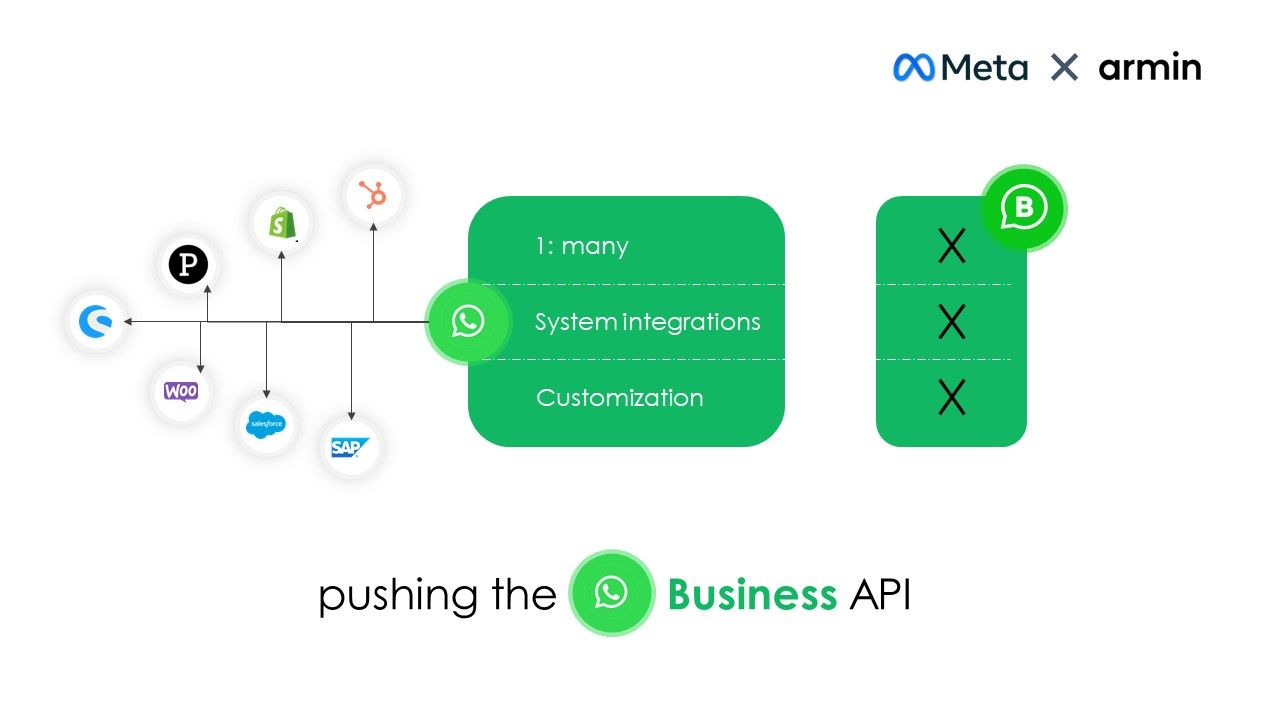
This is where it gets interesting. The official WhatsApp Business API is the foundation that Chatarmin is built on. Cloud-based, no physical phone needed, unlimited users, GDPR compliant, ISO 27001 certified, servers in Frankfurt.
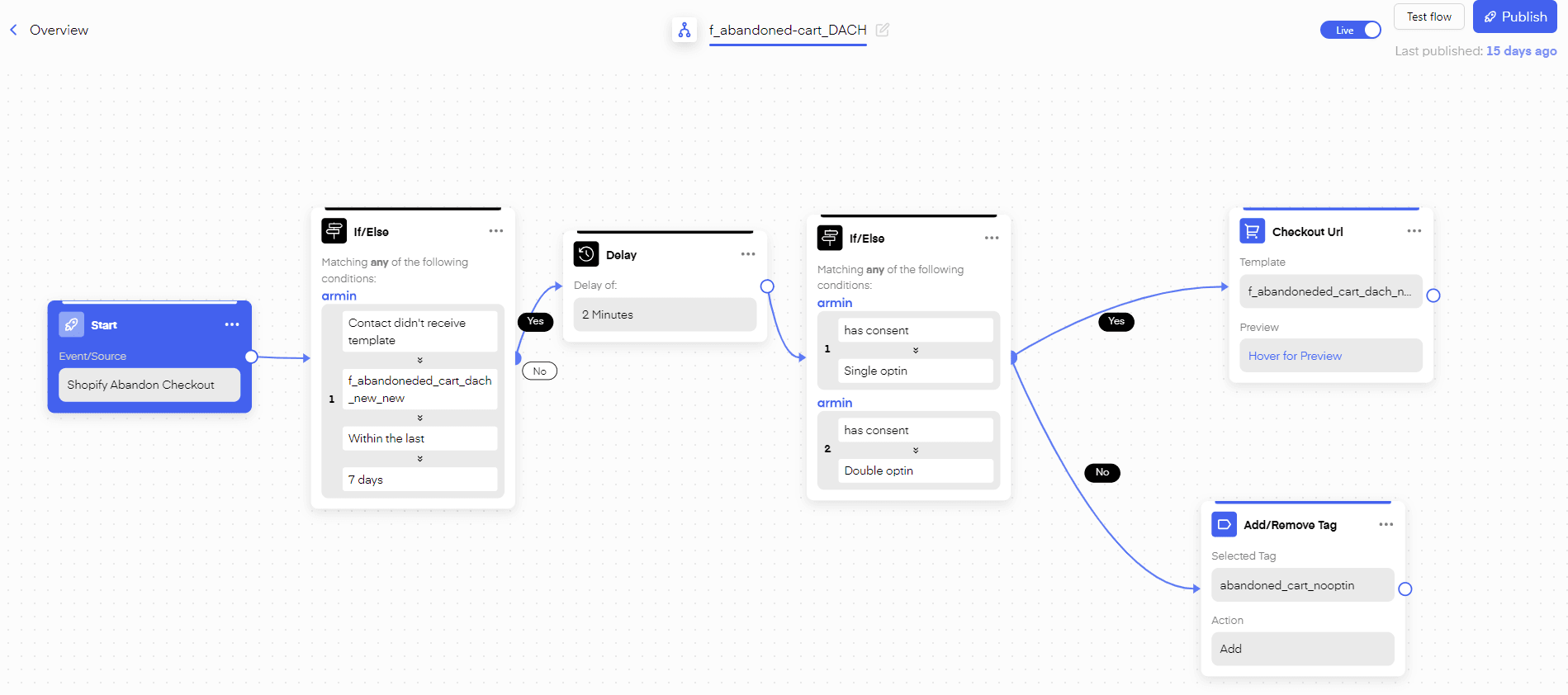
In practice, that means: You can send campaigns to thousands of recipients, set up automated flows — abandoned cart, restock reminders, post-purchase — use segmentation based on purchase behavior, and sync everything directly with Shopify, Klaviyo, or your CRM.
My honest take: If you have one to three employees and are just getting started — start with the Business App. Get some experience. But once your contact list grows beyond 500 or you have a sales/marketing team, you need the API solution. Anything else is patchwork. And you risk GDPR violations that no professional business can afford.
WhatsApp Sales for B2C: Where the Channel Has the Biggest Impact
B2C is the sweet spot for WhatsApp Sales. Your customers already use WhatsApp every day — for friends, family, groups. When you show up as a brand there, you're not "just another newsletter." You're part of their daily routine.
For B2C, you need three things: passive lead generation, automated flows, and personalized campaigns. And that's exactly what the WhatsApp Business Platform is built for.
Passive Lead Generation Through Chatstarts
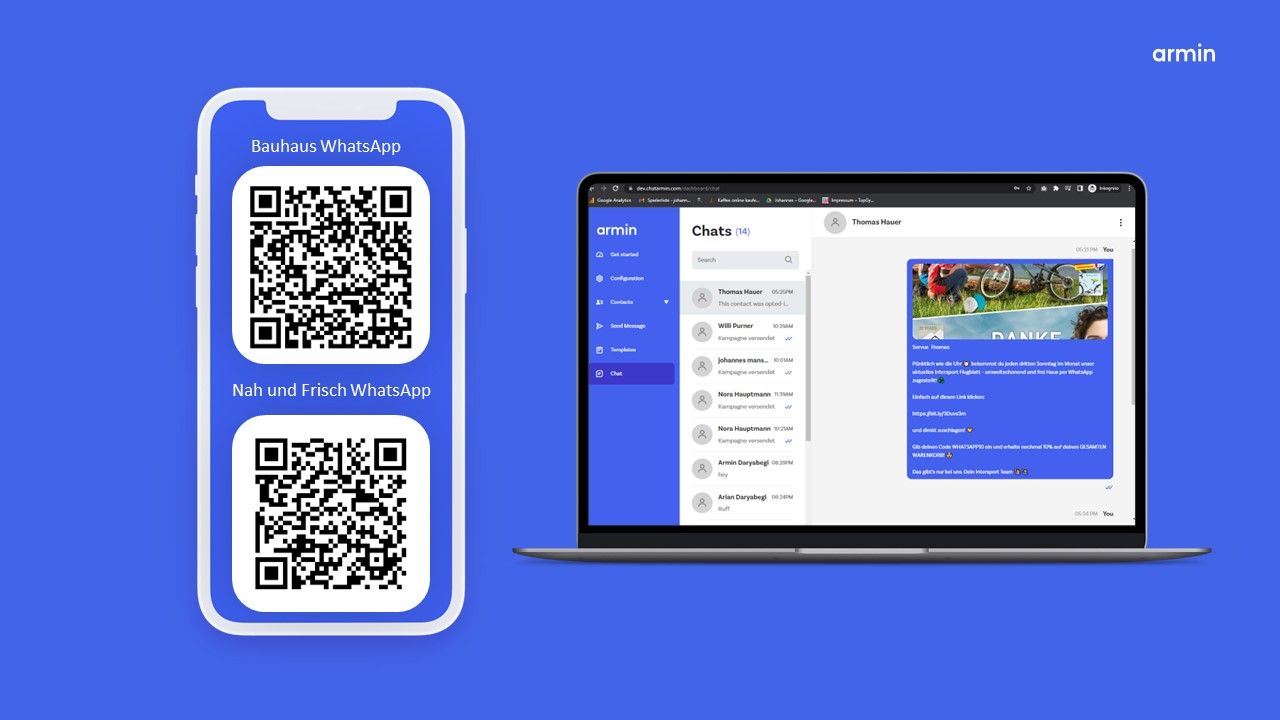
With Chatarmin, you create individual chatstart links for different traffic sources: WhatsApp Ads, influencer partnerships, mobile pop-ups on your website, QR codes in packages, or the thank-you-page widget after checkout.
Each chatstart link can trigger its own journey. Meaning: A lead coming from an Instagram ad gets a different welcome than someone scanning a QR code from a package. Auto-tagging makes sure you know where every contact came from — right from the first message.
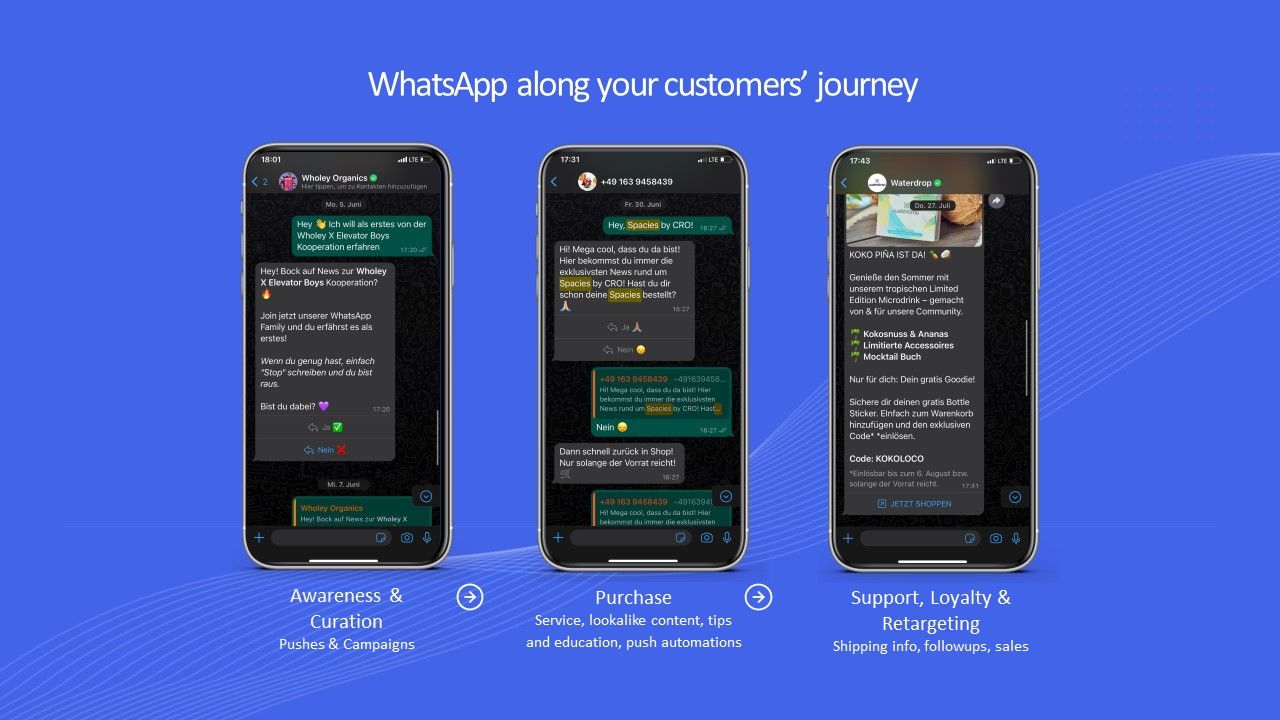
Automated Flows Along the Customer Journey
The real leverage in B2C WhatsApp Sales comes from automated flows. The most important ones:
- Abandoned cart: The most profitable flow in eCommerce. Someone adds products to their cart but doesn't buy. Via email, you might reach them — if the message doesn't end up in spam. Via WhatsApp? 80–95% open rate. In real time. With product image, direct link to the cart, and a personalized discount code.
- Welcome flow: Greet new opt-ins, build customer profiles, collect email addresses, and sync directly to your CRM.
- Restock reminders: Automatically remind customers after 30 or 60 days — perfect for consumable products.
- Back-in-stock: Notify waitlisted customers via WhatsApp as soon as a product is available again.
- Post-purchase: Tracking updates, cross-sell offers, review requests after purchase.
- Winback: Re-engage customers who haven't ordered in six months with a personalized offer.
Campaigns That Convert
Beyond automated flows, targeted WhatsApp campaigns are the second major revenue driver. Product launches, flash sales, seasonal promotions, VIP offers — all delivered straight to your customers' lock screens.
The numbers speak for themselves: Your email newsletter has an 18% open rate. Your WhatsApp newsletter? 85%. Click-through rates are 3–10x higher. That's the difference between "campaign running" and "campaign converting."
But here's the catch: Frequency matters. More than one to four campaigns per month is too many. The opt-out rate among Chatarmin customers is below 0.3% — because the content is relevant and the frequency is appropriate. Blast your contacts too often, and you'll lose them.
WhatsApp Sales for B2B: Faster to Close
WhatsApp is often underestimated in B2B. But think about it: Your point of contact checks their email maybe twice a day. WhatsApp? Every few minutes.
What Sales and Marketing Each Need
Serving B2B clients via WhatsApp typically splits operations between sales and marketing. Both departments have different interests — but the same goal:
Sales wants to:
- Communicate one-to-one with their personal clients
- Write custom offers and send them as PDFs directly via WhatsApp
- Document touchpoints and create reminders
- Make calls and track contact points
Marketing wants to:
- Create campaigns at scale — product updates, industry news, seasonal offers
- Send segmented and personalized messages
- Run the WhatsApp marketing channel professionally
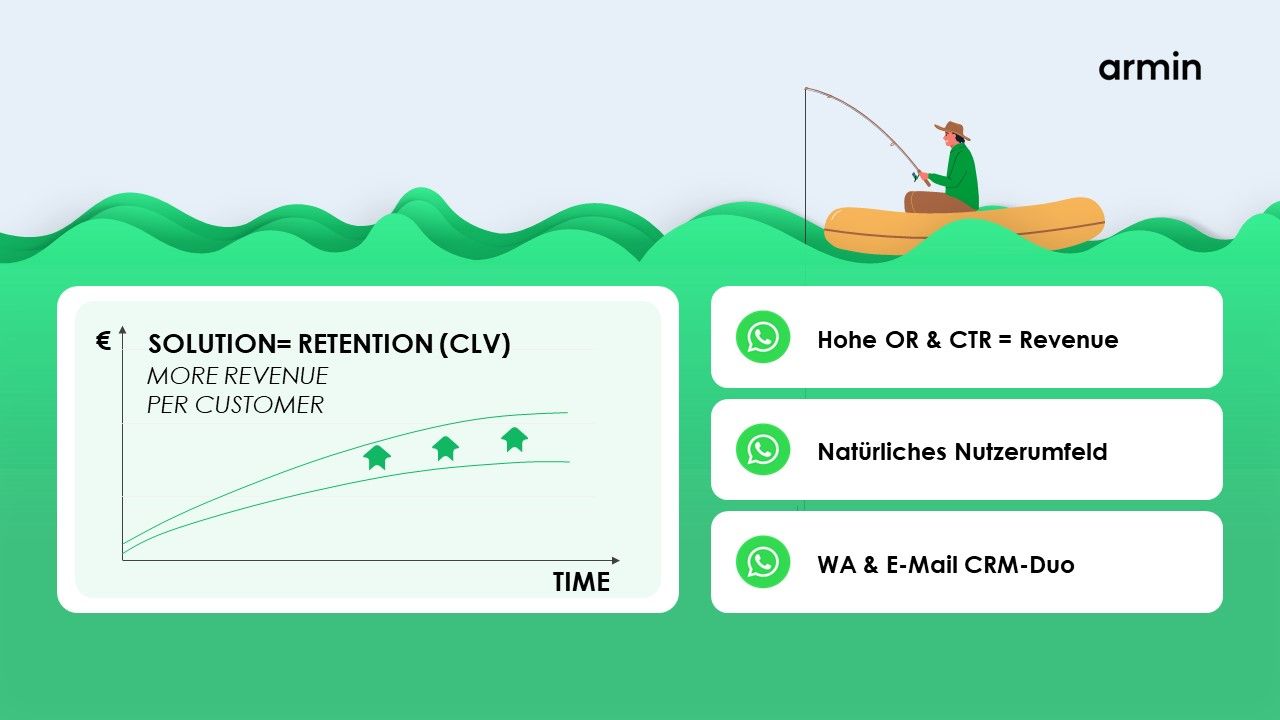
The shared goal: Increase Customer Lifetime Value. Whether individually or at scale — it all comes down to more revenue per customer.
Why B2B WhatsApp Sales Only Works With the API Solution
Once you're serving both B2B and B2C clients, you need a system that handles both: personal chats and scaled campaigns. With the WhatsApp Business App, you lose track. Who messaged whom? Which rep owns which account? Which campaign drove which revenue?
With Chatarmin, you manage this through an agent system: Each sales rep only sees their own chats, marketing has full data transparency, and all touchpoints are documented. Add CRM integration — whether HubSpot, Pipedrive, or Salesforce — so WhatsApp contacts, conversations, and revenue automatically land where your team needs them.
The trade-off you should know about: WhatsApp doesn't replace your CRM. It complements it. The strength is in the combination: personal communication via WhatsApp, structured documentation in your CRM. If you think you can run B2B sales on WhatsApp alone, you'll lose track fast.
B2B Case Study: Kammerberger — Personal Sales Meets Scaled Marketing
Austrian family business Kammerberger sells crops and raw materials — offline and online, to thousands of B2B clients. The challenge: market at scale while selling personally.
The solution with Chatarmin:
Personal sales: Kammerberger sells through custom offers directly in WhatsApp chats. GDPR compliant, documented, with personalized offers as PDF — sent to the right contact person.
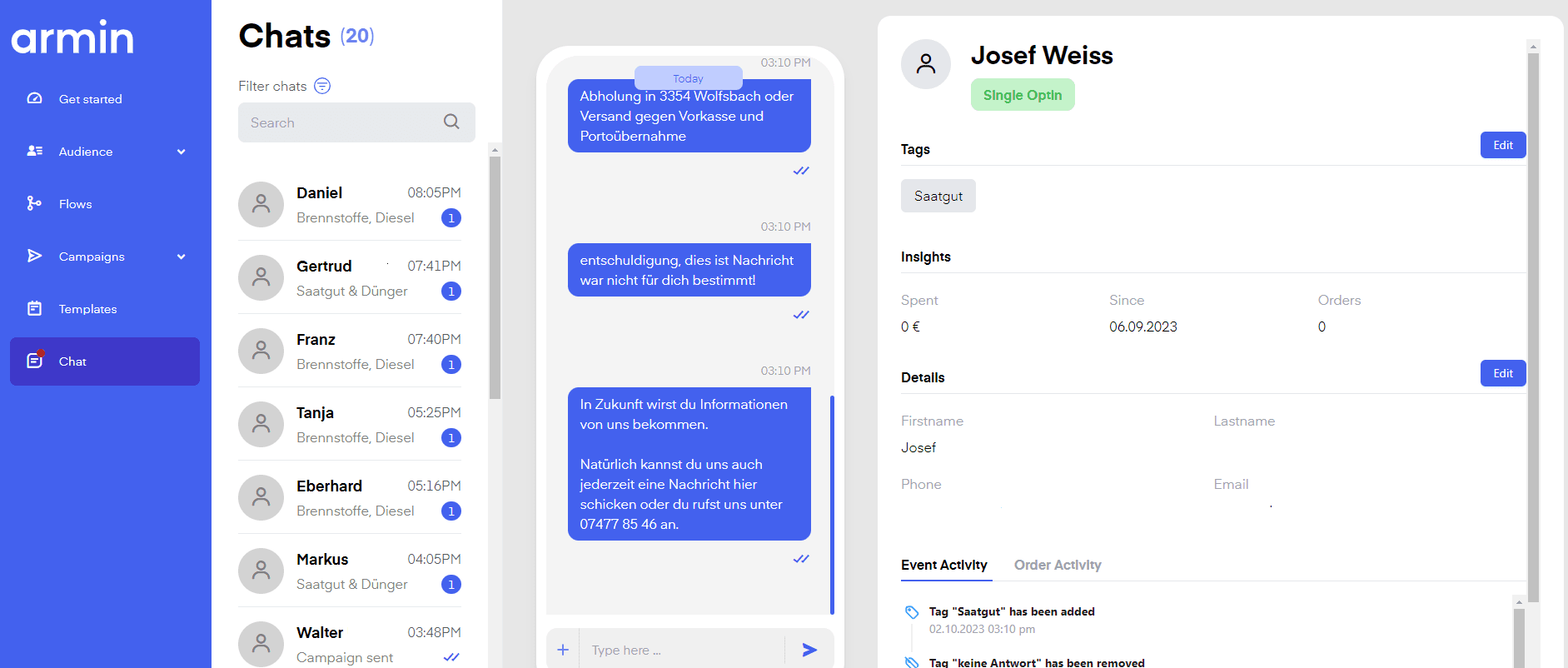
Automated welcome flow: New B2B leads are greeted, enriched, and segmented — automatically. The sales team instantly knows who they're dealing with.
Scaled campaigns: B2B marketing campaigns with 90%+ open rates. For comparison: The average email open rate in B2B sits at 20–30%.
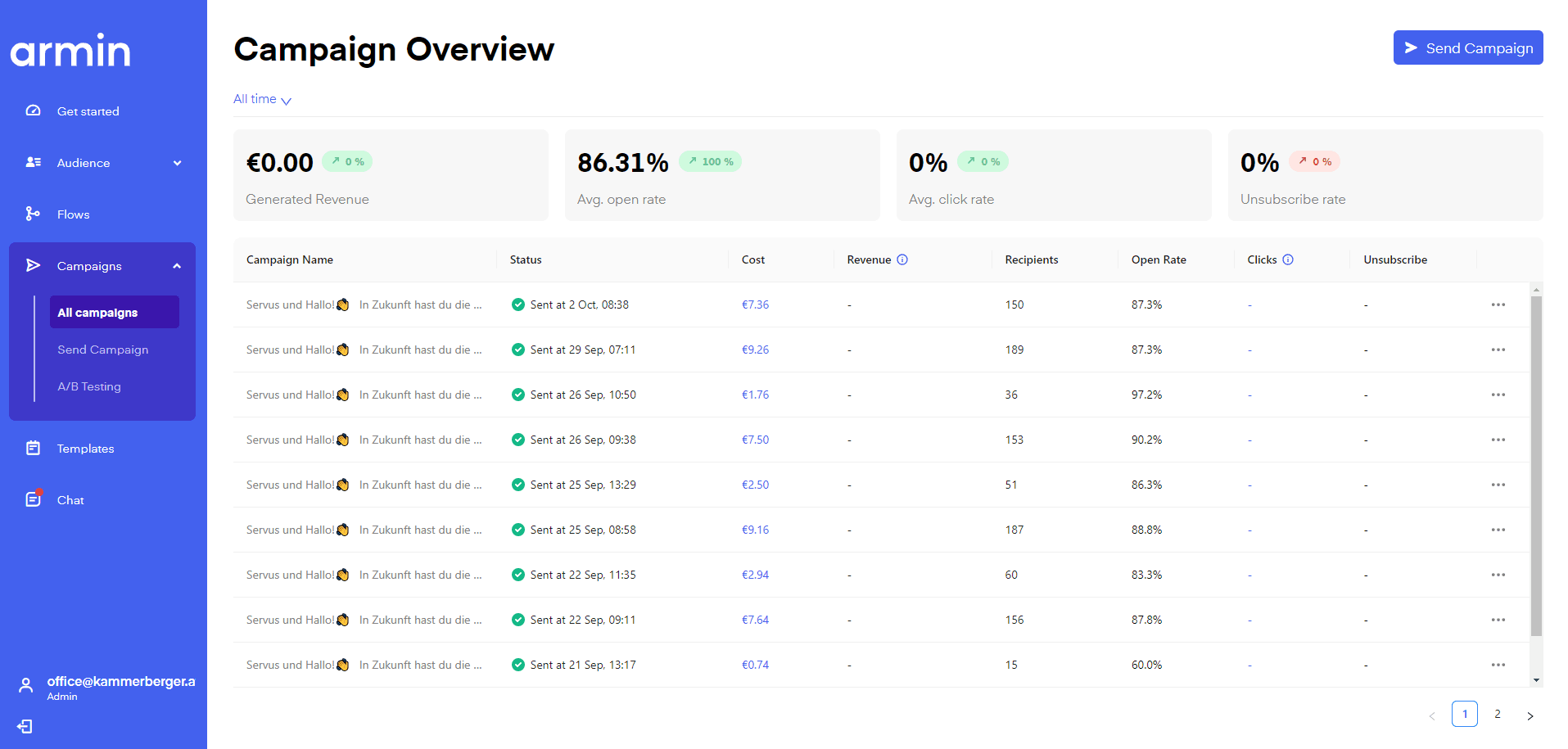
Note: Open rates from non-verified (blue-ticked) accounts are not fully tracked by Meta.
The result: Kammerberger uses Chatarmin for their entire WhatsApp sales mix — individual B2B chats and scaled marketing campaigns in one system.
B2C Case Study: waterdrop® — Increasing CLTV Through WhatsApp
waterdrop® is an Austrian nine-figure D2C brand built on Shopify. The company uses Chatarmin to systematically increase Customer Lifetime Value.
Abandoned cart flow: Triggered by a Shopify webhook, waterdrop® reaches cart abandoners via WhatsApp — with a personalized product image, direct cart link, and time-limited offer.
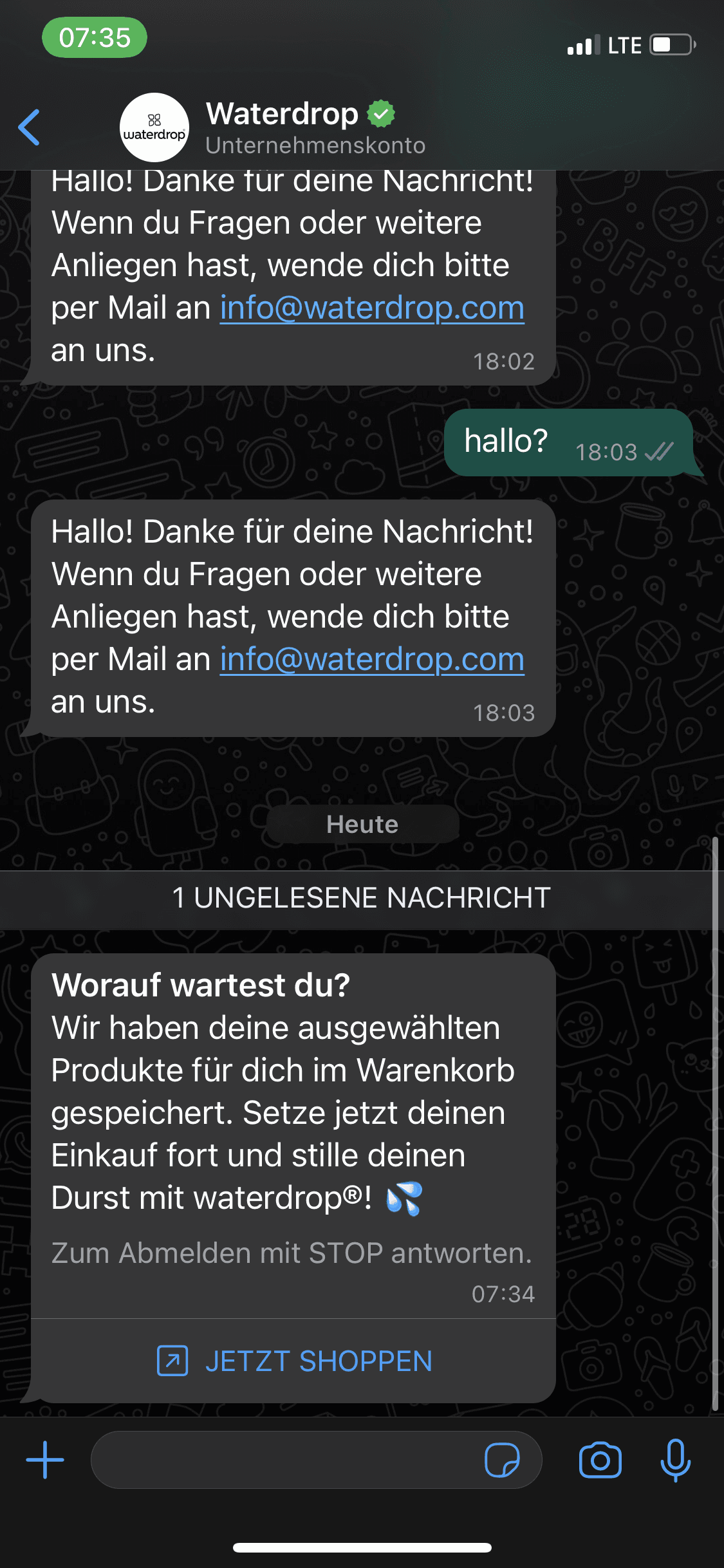
Campaign performance: waterdrop® achieves 90%+ open rates, 30%+ click-through rates, and a revenue per recipient (RPR) above €3.50 with Chatarmin campaigns.
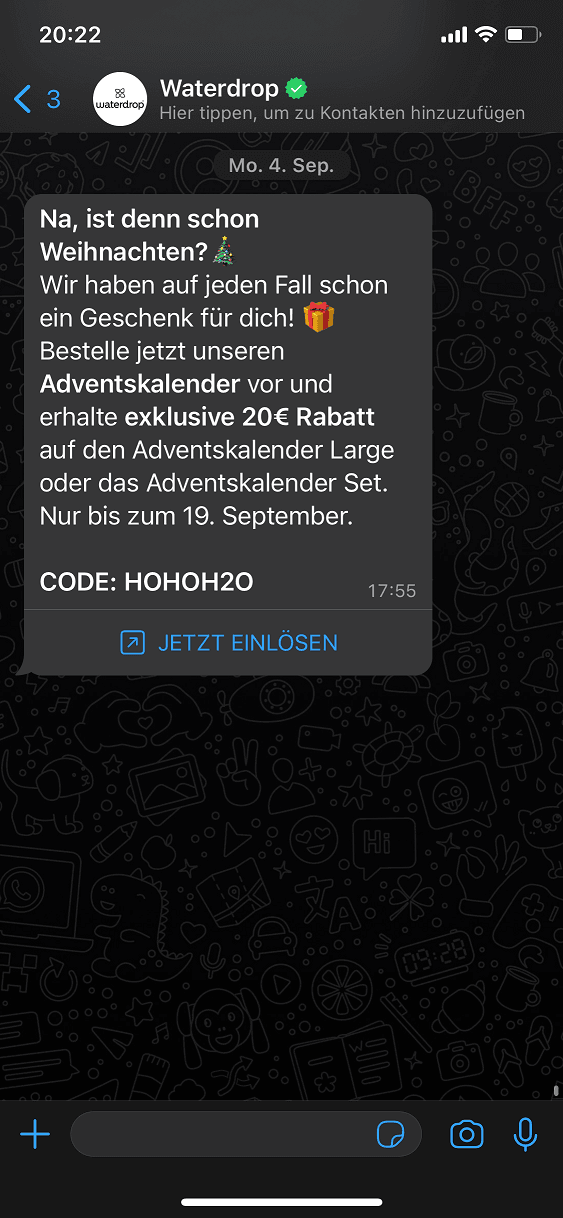
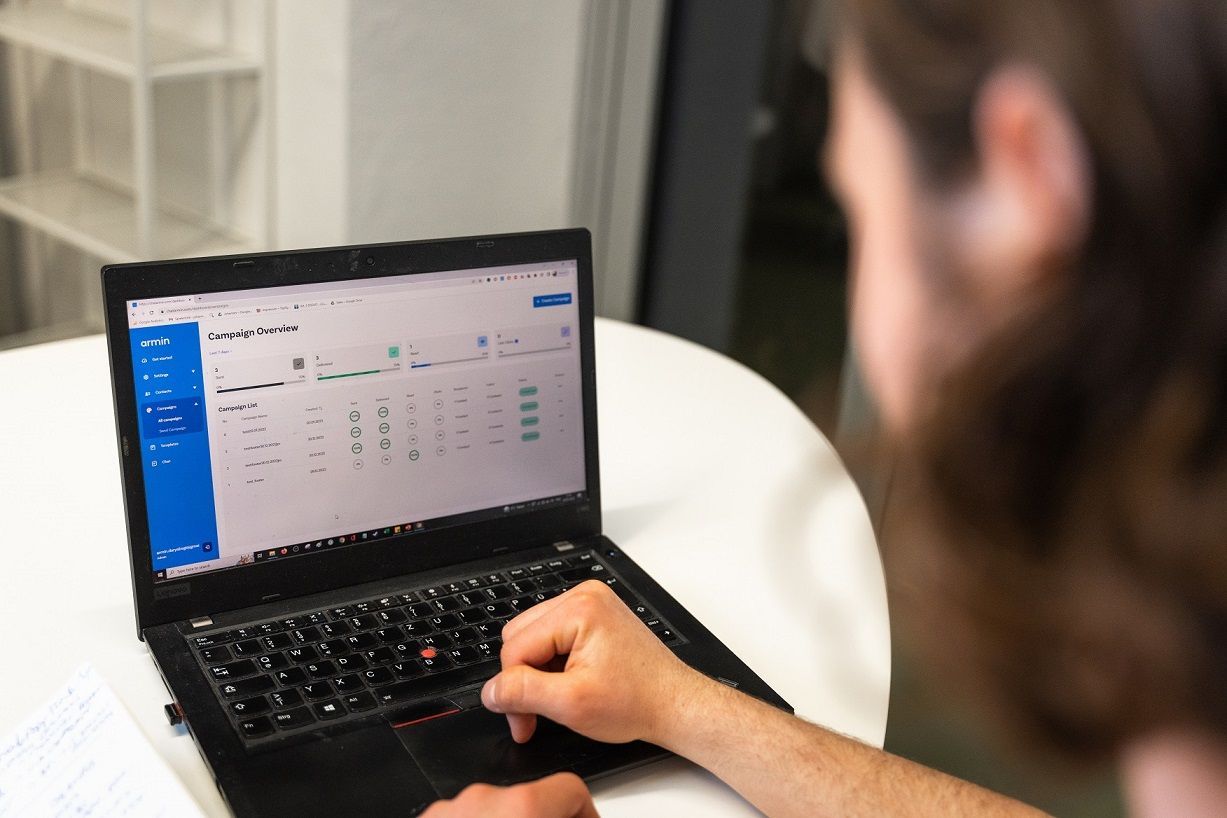
This works because Chatarmin was originally built for eCommerce businesses running on Shopify and Klaviyo. Bidirectional Klaviyo sync, native Shopify integration, dedicated WhatsApp dashboard with revenue attribution — all in one platform.
Learn more about the Klaviyo WhatsApp integration and why it's the biggest lever for D2C brands.
Do's & Don'ts: WhatsApp Sales B2C vs. B2B
| Action | B2C | B2B |
|---|---|---|
| Cold-message audience without opt-in | ❌ | ❌ |
| Use double opt-in | ✅ | ✅ |
| Activate existing customer base | ✅ | ✅ |
| Deploy automated flows | ✅ | ✅ |
| Support agents & ticketing | ✅ | ✅ |
| Use dashboards & analytics | ✅ | ✅ |
| Decentralized field sales reps | ❌ | ✅ |
| Centralized marketing campaigns | ✅ | ✅ |
| Custom offers & personal service | ❌ | ✅ |
The most important rule — B2B or B2C, doesn't matter: Never message someone who hasn't opted in. No double opt-in, no WhatsApp contact. Period. Meta will ban accounts that violate this rule. And your reputation with recipients is gone.
Frequency: One to four campaigns per month. No more. WhatsApp is a personal channel. If you show up like a newsletter spammer, you'll lose subscribers — and their trust.
WhatsApp Sales & GDPR: What You Need to Know
A topic that comes up in almost every sales call: "Is this GDPR compliant?"
Short answer: The WhatsApp Business App and WhatsApp Business Premium are not GDPR compliant. They store contact data on US servers without the necessary safeguards.
The WhatsApp Business Platform — the API solution that Chatarmin is built on — is GDPR compliant. Servers in Frankfurt, ISO 27001 certified, built-in double opt-in mechanism, official Meta/WhatsApp Business API.
Bottom line: If you're selling professionally via WhatsApp, especially in the DACH region or EU, you need a third-party provider like Chatarmin. Anything else is a business risk — particularly in institutional or government sales.
Want the details? Simply text us "GDPR" through the chat button in the bottom right corner, or use this chatstart link — you'll receive our free 7-page GDPR statement comparing the WhatsApp Business App and the WhatsApp Business Platform.
Conclusion: How to Build Your WhatsApp Sales Machine
WhatsApp Sales works. B2B and B2C. But only if you do it right.
Three steps to get started:
- Choose the right WhatsApp Business solution. Small teams start with the Business App. Once you hit 500+ contacts or have a sales team, you need the API solution.
- Define your use cases. B2C: abandoned cart, product launches, restock reminders. B2B: lead qualification, custom offers, personalized campaigns.
- Build your opt-in base. No contacts, no WhatsApp Sales. Pop-ups, QR codes, checkout opt-in, thank-you-page widget — the more touchpoints, the faster your list grows.
WhatsApp doesn't replace email or your CRM. It's a complementary channel with reach and engagement rates that no other tool offers. But it requires the right setup, the right frequency, and respect for the channel.
Book your free WhatsApp sparring session now — we'll show you in 30 minutes what WhatsApp Sales looks like for your business.
FAQ: Common Questions About WhatsApp Sales
How much does WhatsApp for sales cost?
Two cost components: the software license (at Chatarmin, a monthly fixed fee depending on your plan) and Meta fees per message sent. A marketing message in Germany costs around €0.11, in Austria and Switzerland around €0.05. Chatarmin passes Meta costs through 1:1 — no markup. For comparison: Klaviyo charges €0.22 per WhatsApp message.
Can I just message my existing phone numbers via WhatsApp?
No. You need a separate double opt-in for WhatsApp. Messaging existing numbers without opt-in will get your account banned by Meta. You collect opt-ins through website pop-ups, QR codes, checkout checkboxes, or your thank-you-page widget.
Does WhatsApp cannibalize my email channel?
No — and this is the most common objection we hear in sales calls. WhatsApp reaches a different audience: younger, more mobile, higher engagement. Through bidirectional sync with Klaviyo or other email tools, there's no double messaging. On the contrary: You can retarget email non-openers specifically via WhatsApp.
How quickly can I go live with WhatsApp Sales?
With Chatarmin, the setup typically takes a few weeks to go live. You get a dedicated, native-speaking customer success manager who actively builds flows, templates, and strategies with you. No "here's the tool, good luck" — it's done-for-you onboarding.
Will my customers be annoyed?
The opt-out rate among Chatarmin customers is below 0.3%. The key: relevant content and appropriate frequency — one to four campaigns per month, max. Customers appreciate the direct channel when the content is right. WhatsApp isn't a spam tool. It's a premium channel.
Do I need a physical phone for WhatsApp Sales?
Not with the API solution. Chatarmin is cloud-based — no SIM card, no office phone. You work through a web interface with a campaign builder, flow editor, segmentation, and analytics. Unlimited users, from anywhere.
What makes Chatarmin different from other WhatsApp providers?
Transparent pricing with no Meta markup. Deep, bidirectional eCommerce integrations — Shopify, Klaviyo, JTL, Xentral. Personal DACH-based support instead of anonymous ticket systems. Bootstrapped and agile instead of VC-driven and rigid. And: true eCommerce specialization instead of generalist solutions for every use case.