
The Purelei advent calendar sold out within weeks. A hero product priced well above the brand's average order value, where buyers don't even know in detail what's inside before they buy. Tough sell. According to WhatsApp marketing agency chatmarks, the brand's own WhatsApp channel was a key driver behind that result.
Purelei, headquartered in Mannheim, Germany, generated around €54 million in annual revenue in 2023 (per Business Insider), employs roughly 180 people and is still completely bootstrapped almost ten years in. In the OMR ecosystem, a figure of around €60 million was mentioned in 2023. Three co-founders, one brand, no VC money. And an owned channel that bundles multiple use cases on a single list: welcome discount, exclusive drops, pre-sales and shipping updates. This post breaks down how the publicly visible Purelei WhatsApp setup actually looks, what works, and what D2C brands can take from the stack.
Who is Purelei and why does WhatsApp matter for the brand?
Purelei is a Mannheim-based jewelry and lifestyle label with Hawaiian inspiration. Founded in 2016 by Alisa Jahnke together with co-founders Frederik Jahnke and Etienne Espenner. Headquarters in Mannheim, in-house logistics from day one with around 180 people on the team today. Marketplace presence across Amazon, Otto, Zalando and About You among others. Plus the brand's own shop. The stated goal: break the €100M revenue mark. All of this bootstrapped, no VC funding.
Three reasons why WhatsApp is a logical channel for a brand like Purelei:
- Repeat purchase logic in jewelry. Earrings, rings and necklaces are bought in sets, mixed and extended. This is not a one-and-done purchase. It is a collection that grows over months and years. WhatsApp is the natural channel for drops, restocks and new designs.
- Seasonal hero products. The jewelry advent calendar has been a core revenue driver for years. Hero drops like this benefit massively from a direct, mobile channel with high attention.
- Multichannel complexity. Purelei sells across multiple marketplaces plus the brand's own shop. In that reality, owned channels like WhatsApp are valuable because they operate independently of algorithms and marketplace fees.
If you look at the wider Purelei marketing strategy, the picture is clear: WhatsApp is a deliberately placed pillar in the owned-channel stack that grows in parallel with the marketplace business.
Why WhatsApp fits a jewelry D2C brand better than email alone
Email is still the most important CRM channel in e-commerce. But open rates have been collapsing for years. The industry average for email newsletters sits between 15% and 25% and keeps trending down. WhatsApp newsletters reach 80% to 95% open rates depending on setup. That is a 4x to 6x gap.
For jewelry brands, the lever is doubled:
- Visual impact. Jewelry sells through images. WhatsApp lets you push images, videos and carousels directly into the chat. The picture lands on the customer's lock screen and gets seen before she decides whether to open.
- High AOV relative to messaging cost. Jewelry AOVs typically sit in the mid-double-digit range in euros. A WhatsApp marketing message in Germany costs roughly 11 cents. At that AOV level, the unit economics per touchpoint look noticeably better than they do for many FMCG brands.
That is the real difference to email. WhatsApp feels like a private message. That measurably changes reading and click behavior. For the broader picture and benchmarks across over 450 setups, see our WhatsApp Marketing Guide.
The Purelei WhatsApp Newsletter: 15% welcome discount as the reach engine
The core of the Purelei opt-in strategy is the welcome discount. From the official help center:
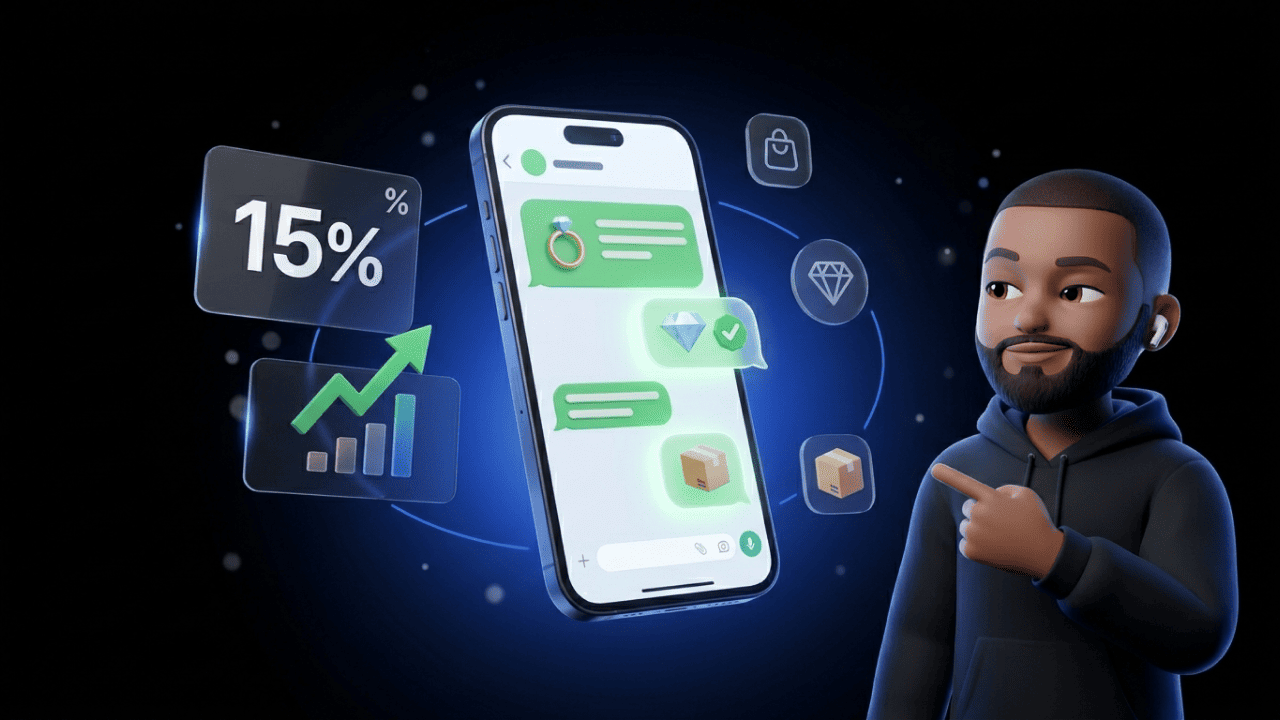
"15% welcome discount on your first order. Exclusive deals and giveaways for our WhatsApp Community only. Shipping updates straight to your phone."
Three promises, three functions, three target groups:
| Promise | Target group | Function |
|---|---|---|
| 15% welcome discount | New customers | Conversion trigger for the first order |
| Exclusive deals and giveaways | Existing customers | Retention, engagement, community feel |
| Shipping updates | Buyers in transit | Utility use case that keeps the list warm |
In short: one opt-in delivers three use cases. That is the actual lever. You do not need three separate lists for three purposes. You need one list with three clear expectations set at the moment of opt-in.
A 15% welcome discount is not a free lever from a margin standpoint. Anyone copying this needs to do the math: lifetime value of WhatsApp buyers minus the welcome discount needs to stay profitable. For Purelei, the math likely works because jewelry buyers tend to repeat and extend their range. For a brand with one-and-done purchase mechanics, the same lever can wreck your margin. Run the numbers first.
Opt-in strategy: where Purelei systematically collects phone numbers
Purelei does not hide the opt-in in one corner. It shows up at multiple touchpoints:
- Dedicated WhatsApp landing page at purelei.com/pages/whatsapp. This page ranks itself for "purelei whatsapp" in position 2 on Google.
- Newsletter page with cross-promo. Anyone signing up for the email newsletter sees the prompt for the Purelei WhatsApp Newsletter.
- Help center. Every support touchpoint uses the chance to mention the WhatsApp channel.
- QR code for desktop. Sitting at the laptop? Scan the code with your phone and you're in. Low friction despite multi-device reality.
More mechanics that Purelei and similar brands typically add or expand on top:
- Checkout opt-in ("Shipping updates via WhatsApp?") as a soft service hook
- Thank-you-page widget after a successful order
- QR code as a package insert in every shipment
- Click-to-WhatsApp buttons in Meta and TikTok ads
A similar multi-channel opt-in logic is used by Snocks. We broke that setup down in detail in the post on the Snocks WhatsApp Strategy. For more entry-point mechanics, the WhatsApp Leadgen Playbook covers an analysis of over 320 DACH shops.
The advent calendar case: pre-sale, A/B tests, and a sold-out drop
The Purelei jewelry advent calendar has been one of the brand's central hero products for years. High preparation cost, high financial commitment, clear expectations on launch.
The challenge: the price sits well above the normal AOV. Buyers don't know in detail what's inside when they purchase. Classic trust problem.
The solution ran in part over WhatsApp, with the agency chatmarks. Simplified mechanic:
- Pre-sale access for repeat customers only. Anyone in the WhatsApp community got exclusive access before the public launch. A reward for loyalty, and at the same time validation for hesitant first-time buyers.
- A/B tests throughout the campaign. Two findings are publicly documented: an additional question in the newsletter measurably increases interaction. Videos in reminders deliver a clear conversion-rate uplift over static images.
- Multi-stage reminder logic. People who already responded drop out of the reminder flow. People who didn't get another stage, often with a different format or angle.
Result, per chatmarks: the advent calendar sold out within weeks.
What we take from it: a hero product with high AOV and low natural trust benefits disproportionately from pre-sales over an exclusive channel. WhatsApp fits that purpose because the message feels personal and gets read immediately.
Shipping updates via WhatsApp: when service becomes a conversion lever
The probably most underrated piece of the Purelei WhatsApp strategy is shipping updates. From the help center: "Shipping updates straight to your phone. Always up to date."
Why this matters:
- Service messages (utility) are cheaper than marketing messages. You pay only a fraction per send.
- Every service touchpoint keeps the number active. A list with active touchpoints scores better with Meta and delivers higher delivery rates.
- Service conversations open organic cross-sell windows. A customer receiving "Your package was delivered today" is in the right mindset for a follow-up recommendation, a matching set, or a related product.
According to Klaviyo, Purelei also uses WhatsApp to enrich customer data. Anyone interacting via WhatsApp leaves data points that flow back into the Klaviyo profile. WhatsApp does not become a competing channel to email. It becomes a data source for the entire CRM setup.
That is exactly the transition from WhatsApp as "yet another channel" to WhatsApp as CRM infrastructure. For the integrations typically needed to pull this off, see the Chatarmin Integrations overview.
Multichannel reality: WhatsApp next to multiple marketplaces
One thing that often gets overlooked in analysis pieces: Purelei sells in parallel on Amazon, Otto, Zalando, About You and other marketplaces. Plus the brand's own shop. Plus retail touchpoints.
What does that mean for the WhatsApp strategy?
- WhatsApp is the only channel that fully belongs to Purelei. Marketplaces throttle reach, change algorithms, charge commissions. WhatsApp delivers direct access to the customer without an intermediary.
- WhatsApp builds the customer relationship that Amazon does not allow. On Amazon, Purelei has no direct contact with the buyer. On WhatsApp it does, the moment she actively opts in.
- Owned-channel margin beats marketplace margin. Every order via purelei.com instead of Amazon saves the marketplace fee (typically 8% to 15% depending on category). WhatsApp is a tool to pull buyers from marketplaces to the brand's own shop over time.
If you sell across multiple marketplaces, WhatsApp deserves to be seen less as "another marketing activity" and more as a strategic lever to reduce marketplace dependency.
What the publicly visible setup does not show
One important caveat: what Purelei runs internally on WhatsApp is not publicly communicated. From what is visible (help center, landing page, chatmarks case), clear mechanics can be deduced. Plenty more likely runs in the background.
For you as a D2C brand, that means: treat Purelei as an inspiration source for the WHAT. Plan the HOW deliberately yourself. Three levers where most D2C brands typically still have room to grow, independent of the Purelei setup specifically:
- Abandoned-cart flows. The most lucrative WhatsApp flow in e-commerce. Industry benchmark: 5% to 15% additional recovery conversions with a clean setup.
- Restock alerts per product variant. For a jewelry or fashion range with many variants, this is a direct revenue lever. Customer wants ring X in size 54 back, clicks "remind me," gets an automated message the moment the variant is back in stock.
- Dynamic RFM segmentation. Recency, frequency, monetary value as the steering logic. Reduces list fatigue because every person gets the right message frequency for their segment.
These are the spots where tools like Chatarmin take the heavy lifting off the table. Over 450 brands currently run on Chatarmin, including Zelesta, CATRICE, Firebox and Quarantini. None of these flows build themselves. They are set up together with the customer success team.
Tech setup: WhatsApp Business API, templates, and shop integration
Anyone wanting to replicate Purelei runs into four components:
- WhatsApp Business API. The regular WhatsApp Business app only works for very small volumes. For newsletters, flows, templates, team inbox and tracking, you need the official API, typically through a Business Solution Provider like 360dialog.
- Approved templates. Every proactive message outside the 24-hour window must be approved as a template by Meta. Template governance decides over delivery rate.
- Tracking setup. UTM parameters, coupon codes, server events. Without tracking, you don't know which campaign delivered which revenue. You can't tell apart "WhatsApp closed the sale" from "the customer would have bought anyway."
- Integration with the shop system. Shopify, JTL, Xentral, WooCommerce. Without deep integration, personalization is not possible. Dynamic segments need shop data in real time.
For the GDPR building blocks that are mandatory in the DACH region, see the breakdown in Is WhatsApp GDPR compliant?. For more detail on the newsletter mechanics themselves, see the WhatsApp Newsletter Guide.
What we take from the Purelei setup
| Lesson | Practical implementation |
|---|---|
| One opt-in for multiple use cases | Communicate welcome discount, exclusive deals and shipping updates in one signup |
| Welcome discount only with margin math | Measure LTV of WhatsApp buyers before pulling the discount lever |
| Pre-sales for hero products | Advent calendar, limited editions, collabs go to the WhatsApp community first |
| Run A/B tests systematically | Questions vs. statements in newsletters, video vs. image in reminders, short vs. long in headlines |
| Service as a conversion lever | Offer shipping updates via WhatsApp, integrate cross-sell triggers after delivery |
| Build multichannel logic deliberately | Use WhatsApp as the bridge from marketplace buyer to direct shop customer |
Conclusion: Purelei shows WhatsApp works in jewelry D2C too
The Purelei WhatsApp strategy is no wizardry. 15% welcome discount, exclusive deals, shipping updates, pre-sales for hero drops, A/B tests across the campaign. Every single component is replicable. What Purelei gets right is consistency: the channel is treated seriously and integrated into the owned-channel stack.
Three things worth remembering:
- WhatsApp gets stronger with every touchpoint. Service plus marketing plus community on one list.
- Hero products benefit disproportionately. Pre-sales, drops and restocks are the most natural WhatsApp logic.
- Tech setup decides scalability. Without API, templates, tracking and shop integration, WhatsApp stays a manual playground.
If you want to build a comparable setup for your own brand, take a look at how Chatarmin runs it in practice. Over 450 brands are live, onboarding and strategy come from a German-speaking customer success team that understands DACH e-commerce. Book a demo. 30 seconds.
Frequently asked questions about the Purelei WhatsApp strategy
What does Purelei do differently on WhatsApp compared to other jewelry brands?
Purelei uses WhatsApp not just as a marketing channel but as a combined service and CRM channel. One signup gives the customer access to a welcome discount, exclusive deals and shipping updates. One opt-in delivers multi-use value, which keeps engagement and list quality healthy over the long run.
How do I sign up for the Purelei WhatsApp newsletter?
Through Purelei's dedicated WhatsApp landing page. On mobile via direct tap, on desktop via QR-code scan and a prescribed confirmation message. After the double opt-in, you receive 15% off your first order.
What discount do you get for signing up for the Purelei WhatsApp newsletter?
As of the research for this article: 15% welcome discount on the first order. The code is sent in the WhatsApp chat right after signup. In addition, the WhatsApp community gets access to exclusive deals and giveaways that don't run on other channels.
Which tools does Purelei use for WhatsApp marketing?
Publicly documented is the collaboration with the agency chatmarks, including on the advent calendar campaign. The WhatsApp platform provider charles is also mentioned in industry sources in connection with Purelei. The exact current tool stack is not publicly communicated by Purelei.
How much revenue does Purelei generate?
Business Insider reported approximately €54 million in annual revenue at the end of 2023. In the OMR ecosystem, around €60 million was discussed in 2023. The company does not consistently publish current annual revenue figures. What is clear: Purelei is still fully bootstrapped almost ten years in, employs around 180 people and is aiming for the €100 million mark.
Do I need the WhatsApp Business API for a similar strategy?
Yes, the moment you want to scale. The WhatsApp Business app works for the smallest volumes but cannot handle templates, API integration, real segmentation or professional tracking. For a setup like Purelei's, there is no way around the WhatsApp Business API combined with a specialized platform like Chatarmin.
Can I copy the Purelei WhatsApp strategy 1:1 for my brand?
No. The mechanics transfer, the parameters do not. A 15% welcome discount works differently at a jewelry AOV than at a €30 supplement AOV. Before copying the discount lever, run the numbers on your lifetime value and margin. The lessons (pre-sales, A/B tests, service integration, multi-touchpoint opt-in) are nearly universally applicable.