
WhatsApp marketing examples that actually drive revenue in 2026: 98% open rate, 6x higher revenue per message than email, 82% uplift in in-store purchases. These aren't fantasy numbers. These are results from real campaigns by SNOCKS, Takko Fashion, and Deutsche Bahn.
Studies show that 70% of consumers are more likely to buy from a brand they can contact directly via messenger. And 80% of WhatsApp messages are read within the first 5 minutes. No other channel delivers this combination of reach, speed, and conversion.
Yet most companies leave that potential on the table. They either don't start at all – or they treat WhatsApp like a second email channel. Broadcasts to everyone, once a week, zero segmentation. In 2026, that just burns budget.
This article walks you through six WhatsApp marketing examples from real businesses with concrete numbers, mechanics, and lessons learned.
Why WhatsApp Is a Performance Channel in 2026 – Not a Toy
WhatsApp is no longer an experiment. And it's certainly not a cute side project for trendy D2C brands. In 2026, WhatsApp is a full-fledged performance channel for sales, service, and marketing – all inside one app. That's called conversational commerce, and it's rewriting the rules.
Here's what changed: In mid-2025, Meta overhauled its pricing logic. Messages are now charged by category – marketing, utility, service. If you blast untargeted broadcasts to your entire list, you burn budget. If you segment and automate, you maximize revenue per message.
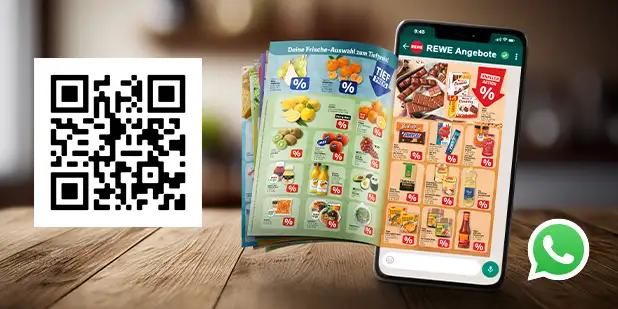
Source: REWE WhatsApp – sending digital flyers via WhatsApp goes against every best practice
The REWE example above shows how not to do it: pushing a digital flyer every Sunday via WhatsApp has nothing to do with WhatsApp marketing. That's spam with a push notification. Without a clear strategy, you burn money and trust. The following examples show what actually works.
Click-to-WhatsApp Ads: The Most Important Feeder for Your List
You can't cold-message customers on WhatsApp – GDPR won't allow it. And that's exactly where Click-to-WhatsApp Ads (CTWA) come in.
The principle: You run an ad on Facebook or Instagram. The user clicks – and lands directly in a WhatsApp chat instead of a landing page. From there, a flow takes over: answer questions, redeem a coupon, book an appointment. No form, no page load, no abandonment.
The impact is measurable: CTWA campaigns frequently deliver a higher ROI than classic landing page ads because the drop-off rate inside the chat is significantly lower. The user is already in WhatsApp – an app they use every day. No media break, no cookie banner, no password field.
For list building, CTWA is the most important channel in 2026. Organic reach is getting harder, and QR codes on packaging or in-store are a solid supplementary channel – but not a scaling strategy. If you want to build your WhatsApp list fast and GDPR-compliant, you can't get around WhatsApp advertising via CTWA.
The 6 Best WhatsApp Marketing Examples in 2026
Now let's get specific. Here are six WhatsApp marketing examples that show how different businesses use the channel – and why it works.
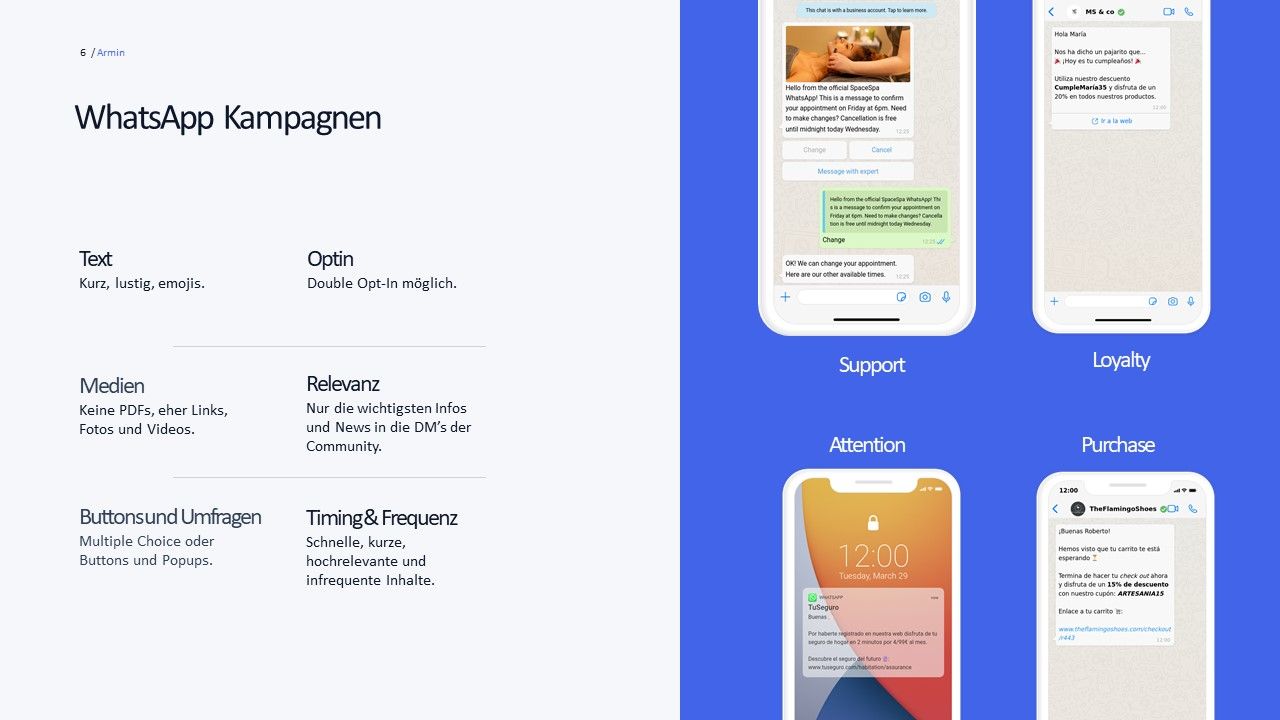
Source: Chatarmin
SNOCKS: Retention and Reactivation in E-Commerce
Problem: SNOCKS' email open rates were dropping. Existing customers barely reacted to newsletters anymore.
Solution: SNOCKS used exit-intent popups to convert website visitors into WhatsApp subscribers. Automated flows for cart abandonment and personalized product recommendations brought inactive buyers back. The kicker: from project start to the first live campaign took just 21 days. WhatsApp marketing isn't a mammoth project – if you know what you're doing.
Result: 2.5x higher open rate than email. 6x higher revenue per message sent.
Lesson: WhatsApp beats email for customer retention. But only if you keep frequency low and relevance high. SNOCKS doesn't spam – SNOCKS segments. It's one of the most frequently cited practical examples in the DACH region for good reason.
You'll find more real-world examples with concrete revenue metrics in our WhatsApp marketing case studies.
Takko Fashion: From the Store Straight Into the WhatsApp Chat
Starting point: Takko wanted to digitally capture in-store customers – without complicated registration processes.
Solution: Customers scan a barcode at the checkout or in the store and sign up for WhatsApp in seconds. The barcode is linked directly to the CRM – meaning Takko instantly knows which customer signed up when and at which location. As a reward, they get a coupon straight to their phone.
Result: The subscriber list grew massively. During active campaigns, in-store revenue increased by 82%. In a comparable retail campaign, the ROAS (Return on Ad Spend) hit 36.8x – meaning for every euro invested, nearly 37 euros came back.
Lesson: Offline-to-online works better via WhatsApp than through any email signup. The barrier is lower, the channel more familiar. If you want to roll this out at scale, our guide on WhatsApp bulk marketing has the playbook.
Deutsche Bahn: Recruiting via WhatsApp
Strategy: Deutsche Bahn ran ads on XING (a professional network popular in the DACH region) that led directly into a WhatsApp chat with recruiters. Goal: attract engineers to career events.
Mechanics: Interested candidates applied via WhatsApp message for events like "Backstage DB" – no forms, no upload fields, no résumé required. The process: see the ad, click the link, share your name and interest in the chat. Done. The barrier was under 60 seconds.
Result: Hundreds of qualified applications from engineers in a very short time.
Lesson: WhatsApp doesn't just work in e-commerce. In recruiting, the channel reduces the application barrier to a minimum. Especially with talent shortages, that's a decisive advantage. This example proves the channel fits B2B contexts as well – provided you have a clear WhatsApp strategy.
Hellmann's and Maggi: Value Over Generic Advertising
Campaigns: "WhatsCook" (Hellmann's) and "Chef in Your Kitchen" (Maggi).
Mechanics: With Hellmann's, users sent a photo of their fridge leftovers via WhatsApp and received a matching recipe back – including ingredient list and cooking time. Maggi offered an interactive cooking class directly in the chat: step by step, with images and timer reminders.
Result: The average interaction time with Hellmann's was 65 minutes per user. 65 minutes of attention for a mayonnaise brand – try achieving that with a banner ad.
Lesson: Utility creates stronger bonds than advertising. When your WhatsApp message solves a real problem for the user, you're not perceived as spam. You're perceived as a helpful everyday companion. Both campaigns prove: deliver value and you earn the right to stay.
Absolut Vodka: Gamification and Viral Hype
Campaign: "Doorman at the Party." A fictional bouncer named Sven had to be convinced via WhatsApp to hand over tickets to an exclusive party. Users sent voice messages, memes, love letters – anything to win Sven over.
Result: Viral engagement, massive user-generated content, huge reach – without any traditional ad spend.
Lesson: Gamification and exclusivity create buzz. This example shows how to use the private nature of the channel as an advantage – not work against it.
Netflix: Churn Prevention via Chat
Campaign: "I Am In." Netflix sent personalized recommendations and trailers directly via WhatsApp to users who had disabled the app's push notifications.
Effect: Inactive users came back. The channel reached exactly those who were no longer reachable through app notifications or email.
Lesson: WhatsApp reaches users who already ignore every other channel. For churn prevention and reactivation, it's a lever that very few deploy – but one that delivers measurable results.
WhatsApp Flows in Detail: Why Media Breaks Cost You Revenue
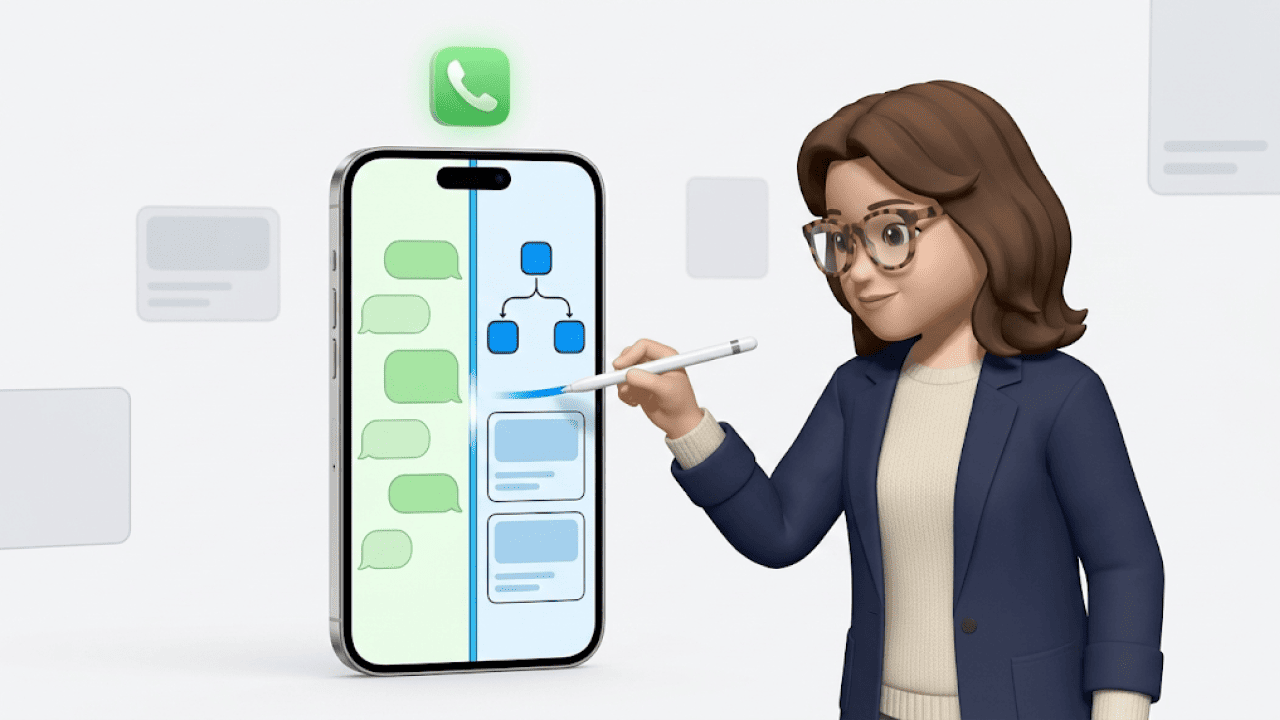
The best campaigns in 2026 share one thing: they keep the user in the chat. No redirect to a landing page, no switch to the browser, no form with 15 fields.
WhatsApp Flows make that possible. Three concrete use cases:
Appointment booking: The customer selects date and time directly in the chat. No Calendly link, no page switch.
Lead capture: Instead of a contact form on the website, the prospect answers 3–4 questions in WhatsApp. The data automatically flows into the CRM. Especially relevant for financial services, insurance, and agencies.
Product configuration: Color, size, features – all via buttons and dropdown menus in the chat. The user configures without switching apps.
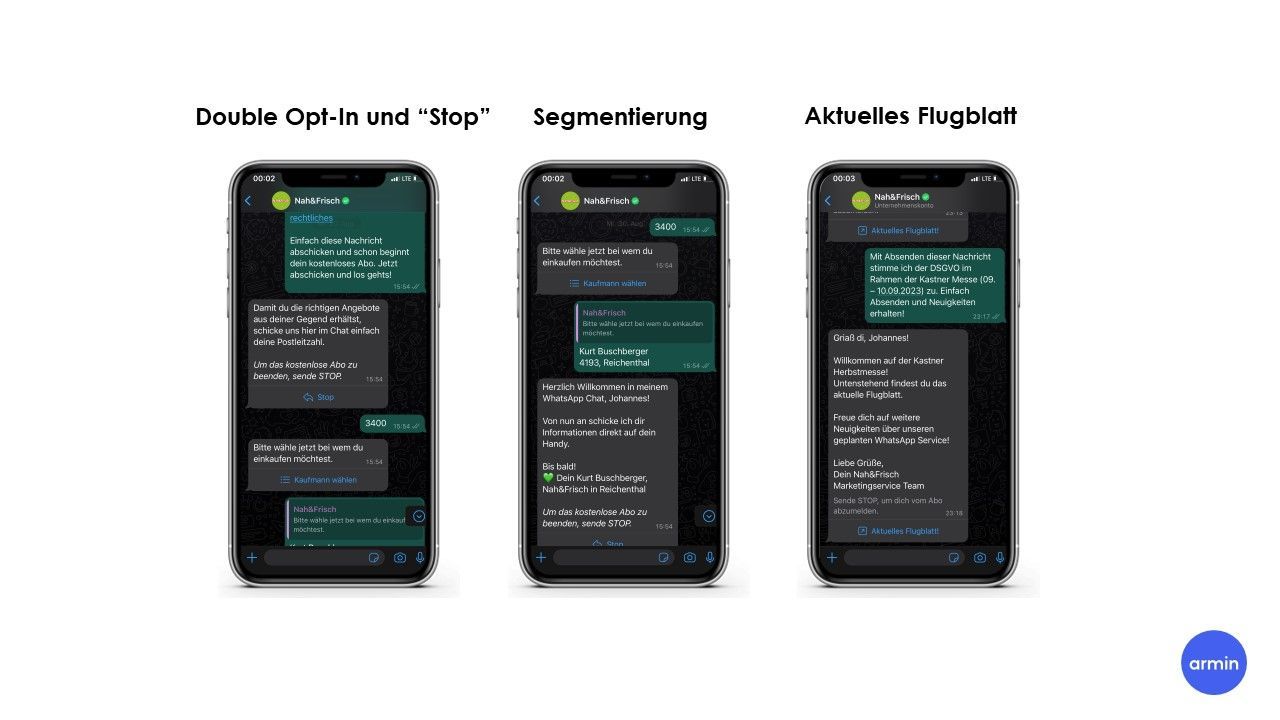
Source: Nah&Frisch WhatsApp, Chatarmin customer
B2B Lead Qualification: Flows Instead of Contact Forms
WhatsApp Flows aren't just for e-commerce. In B2B, they solve a problem every sales team knows: unqualified leads that eat up time.
Instead of a long contact form on the website, a CTWA ad routes directly into a WhatsApp flow. There, the prospect answers three to four questions: budget range, timeline, industry, team size. Based on the answers, the flow automatically decides whether the lead gets forwarded to sales or enters a nurturing sequence.
The advantage: the sales team only calls pre-qualified contacts. The conversion rate from first call to close goes up because no time is wasted on leads without budget or need. We've detailed how to use WhatsApp specifically for lead generation in a dedicated article.
GDPR and Best Practices: What You Need to Know
No WhatsApp marketing without a clean opt-in. Period. That's not a recommendation – it's the law.
1. Double opt-in is mandatory. You need explicit consent from your contacts before sending marketing messages. GDPR-compliant methods include website popups, QR codes on packages or receipts, or Click-to-WhatsApp Ads. No "we met at a trade show, so I'll message you now."
2. Only use the WhatsApp Business API. Not the personal app, not the free Business app. Only the API (Platform) enables marketing with an audit trail, automation, and deletion mechanisms. We've explained separately how to integrate WhatsApp into your existing CRM system.
3. Frequency: less is more. WhatsApp is a private channel. If you bombard your list with daily messages, you'll lose subscribers faster than you gain them. Rule of thumb: 1–4 times per month, highly relevant and segmented. Every recipient must be able to unsubscribe at any time via button or keyword ("Stop").
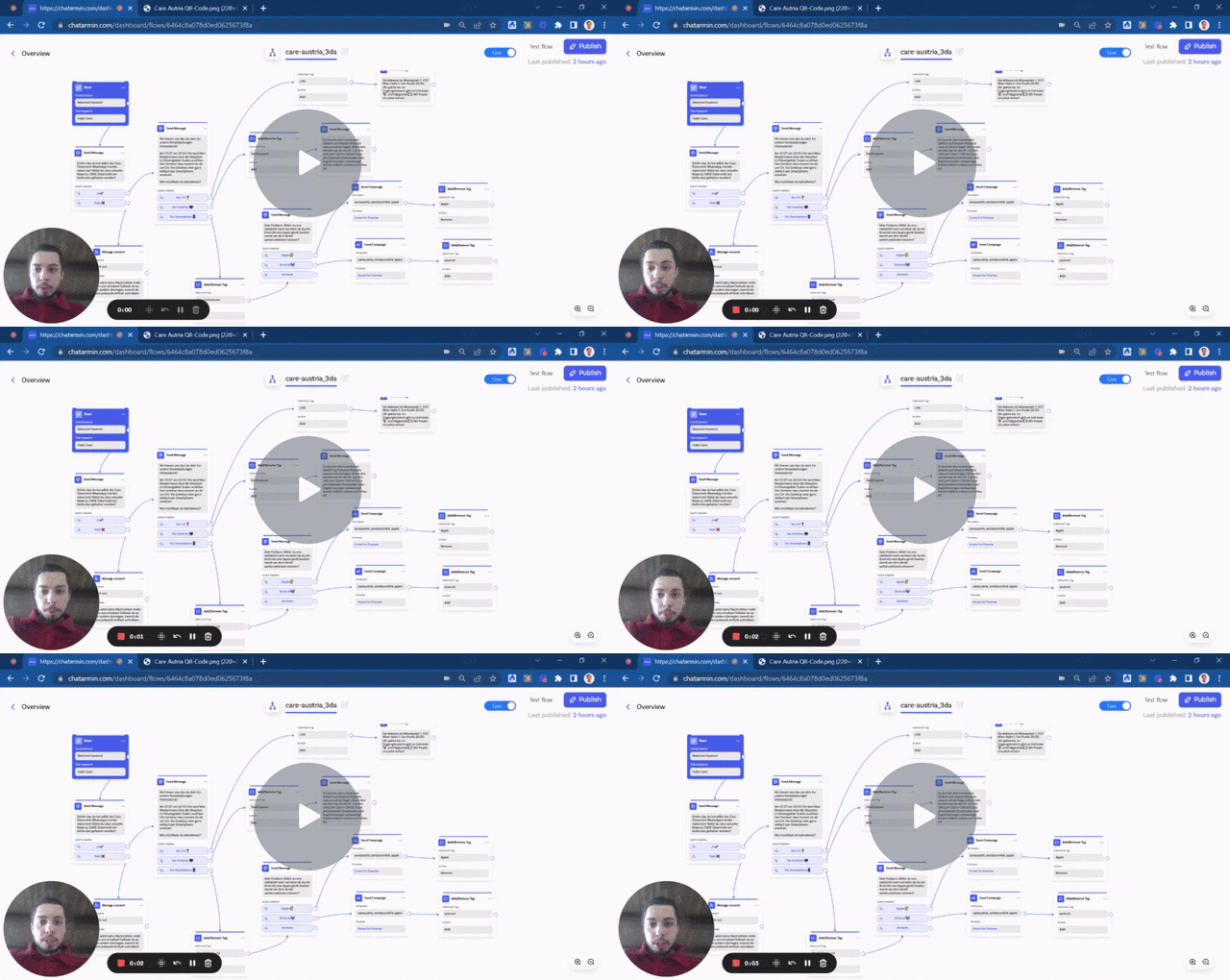
Source: Support flow by Chatarmin
Conclusion: WhatsApp Marketing Examples Prove – the Channel Delivers
The real-world examples in this article share one thing: they work because they take the channel seriously. No spray-and-pray, no mass messaging. Instead, segmented, relevant communication on the most personal digital channel there is.
SNOCKS shows how retention works. Takko proves that offline-to-online isn't wishful thinking – with a ROAS of nearly 37x. Deutsche Bahn delivers proof that WhatsApp produces results beyond e-commerce. And Hellmann's? They demonstrate that 65 minutes of attention isn't a fluke – it's the result of genuine value.
In 2026, WhatsApp is no longer optional for retention, reactivation, and direct customer engagement. Those who start now still have a head start – those who wait will pay more for the same attention later.
Want to know what this looks like for your business? Book your demo with Chatarmin and we'll show you which strategy fits your use case.
Frequently Asked Questions About WhatsApp Marketing Examples
What are good WhatsApp marketing examples?
Successful examples include SNOCKS (cart abandonment flows with 6x higher revenue per message), Takko Fashion (in-store coupons via barcode, 82% uplift), and Deutsche Bahn (recruiting via chat with hundreds of applications).
Is WhatsApp marketing better than email marketing?
WhatsApp achieves open rates of 98% and click rates up to 60%, while emails stagnate around 20%. WhatsApp doesn't replace email but complements it as a stronger retention channel.
How much does WhatsApp marketing cost in 2026?
Meta charges per conversation by category (marketing, utility, service). Exact costs depend on volume and target country – segmentation significantly increases ROI per message.
How do I collect WhatsApp numbers in a GDPR-compliant way?
Use double opt-in via website popups, QR codes on packages, barcode scanners in-store, or Click-to-WhatsApp Ads.
What are WhatsApp Flows?
Interactive in-app forms that let users book appointments, configure products, or qualify as leads – without leaving the chat.
Is WhatsApp marketing suitable for B2B?
Yes, especially for recruiting, lead qualification via flows, and after-sales support. Deutsche Bahn generated hundreds of engineering applications through the channel.
How often should I send WhatsApp campaigns?
1–4 times per month to segmented audiences. Every campaign needs a concrete reason. Unfiltered broadcasts lead to blocks.
Do I need the WhatsApp Business API?
Yes. For marketing to more than 256 recipients, GDPR compliance, and automations like flows or cart abandonment campaigns, the API (via providers like Chatarmin) is required.
What is the biggest advantage of WhatsApp for businesses?
Speed: 80% of messages are read within 5 minutes. No other channel matches this combination of reach and response time.
Can I automate WhatsApp messages?
Yes. Via the WhatsApp Business API, flows – welcome messages, cart abandonment reminders, appointment confirmations – can be fully automated and connected to your CRM.