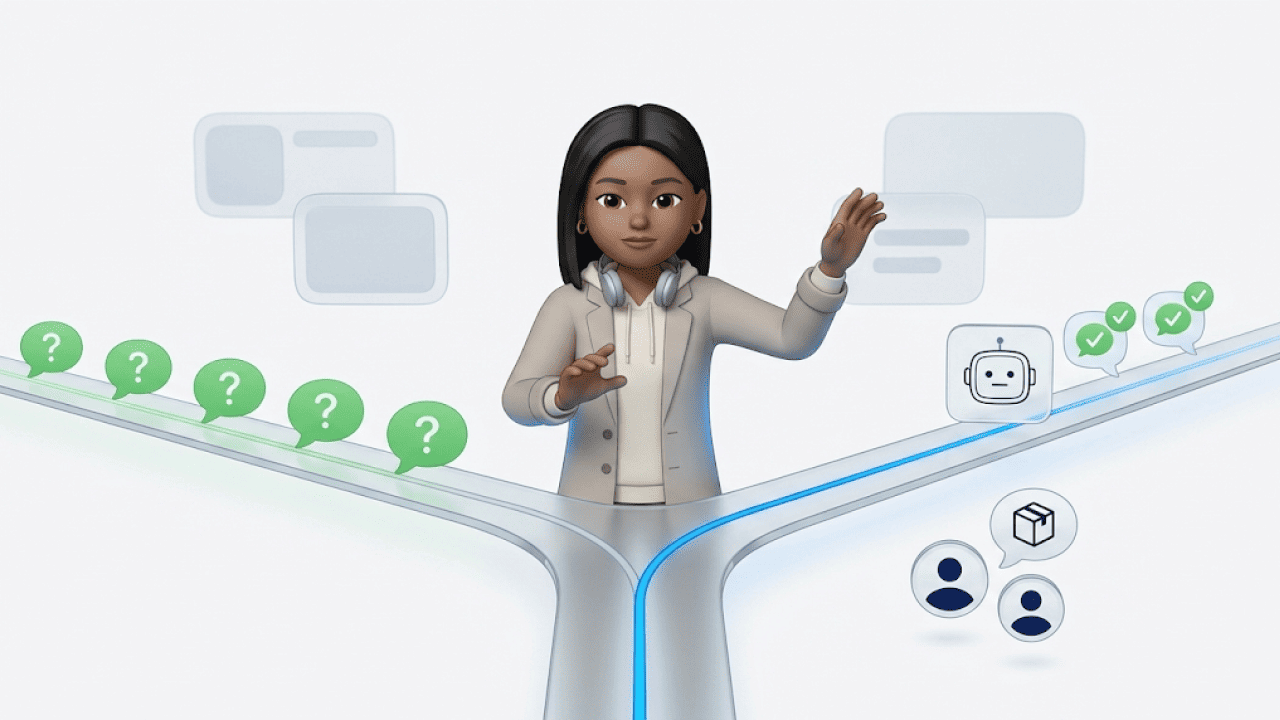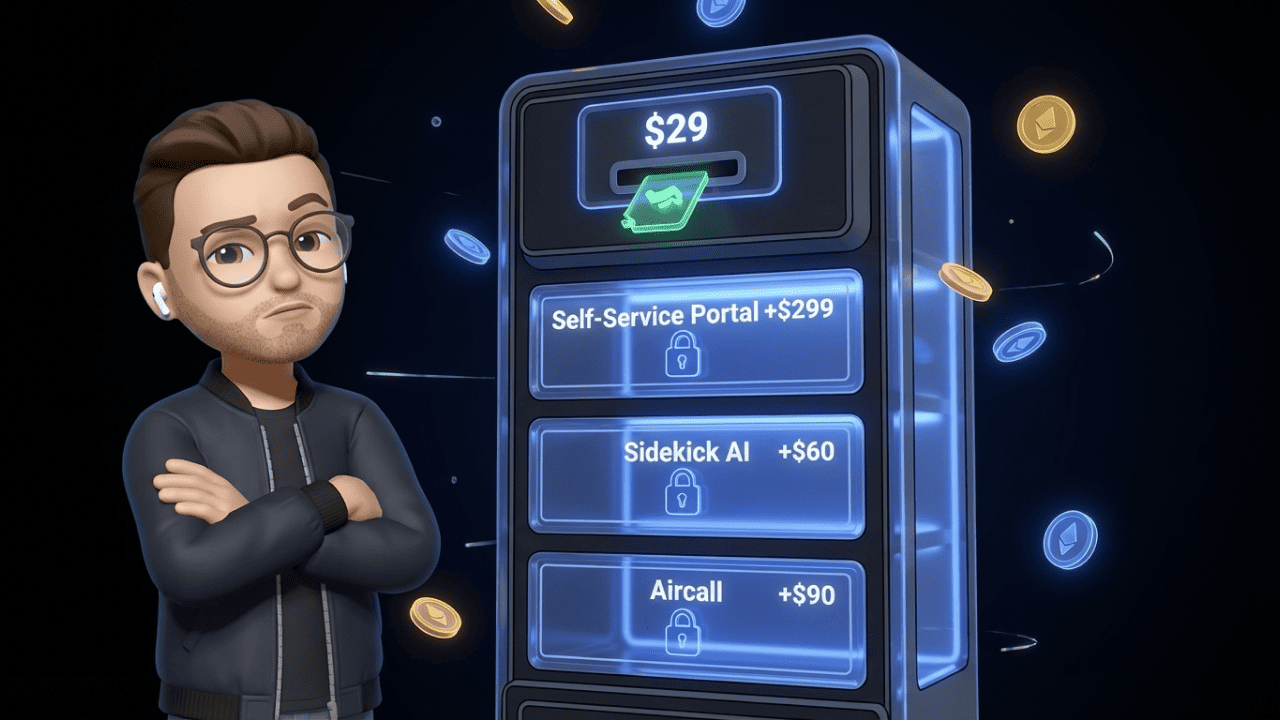

$500 a month. That is the new baseline when you look at Richpanel pricing today. The helpdesk that once started at $29 per seat now sells an AI agent that Richpanel positions like an extra hire on your team. For a Shopify shop in the DACH region (Germany, Austria, Switzerland), that changes the question: what does an AI agent at $500 actually cost, and what gets added on top in seats and credits? That is what we break down here. Descriptive, sourced, from the perspective of an e-commerce operator.
What Richpanel costs today
Richpanel's pricing page (as of June 2026) leads with a clear promise: your next hire is an AI. The pricing follows suit.
- AI agent: from $500/month (approx. €460). Billed by volume at around $0.25 per conversation (approx. €0.23). So $500 covers roughly 2,000 conversations a month. Richpanel says one agent replaces the work of several human reps. As your volume grows, the price scales up through credits.
- Human helpdesk seats: $100/seat/month (approx. €92) for the team that works the inbox.
- Enterprise: custom volume pricing for multi-brand operations and regulated industries.
On top of that sits a credits system: seats are for humans, credits are your AI capacity. As your volume rises, you buy credit packs (1,000 to 25,000 conversations), and larger packs get cheaper per conversation. When the credits run out, conversations route back to your human agents.
Richpanel's own sample bill: one AI agent at $500 plus three seats at $100 comes to $800/month (approx. €735). On top, Richpanel adds a guarantee: 50% of conversations resolved autonomously within 30 days, or a full refund. That is a marketing promise rather than a neutral fact. It does show where the product has moved, though.
From the $29 seat to the AI agent: what changed
If you follow older Richpanel comparisons or third-party portals, you often see very different numbers. That is because Richpanel is mid-transition, with several pricing states live at once.
On portals like G2 (last updated there in October 2024) you still find the old seat tiers: Starter $29, Regular $49, Pro $99 per agent. Richpanel's own pricing calculator shows yet another helpdesk model, with Pro at $59/agent (approx. €54) and Pro Max at $89/agent (approx. €82). The earlier add-on bundle that used to inflate the bill still appears there too. In other words, anyone walking into a demo with the $29 expectation meets an offer that is built differently.
My take: do not rely on a single number from a comparison portal for Richpanel. What counts is the offer you get in the demo. Ask for the current AI-agent model in writing, and check whether you are billed per conversation or per seat.
The self-service portal and the add-ons
The self-service portal was long the real reason D2C shops looked at Richpanel. Customers resolve returns, cancellations and order status on their own. On Richpanel's calculator the portal is still listed as an add-on, tiered by order volume from $99/month (approx. €91) at 5,000 orders and climbing into the five-figure order range.
In the new AI-agent model, many former extras move into the agent itself: email, chat, social, SMS, WhatsApp and voice run through the same agent instead of being bought separately. The Sidekick AI assistant, once a $20-per-user add-on, is now free on the calculator. A separate Social Media Moderator at $59/month (approx. €54) is still in the catalog.
If you take self-service seriously, the same logic applies as with any helpdesk: budget the time to set up the flows. Which return gets approved automatically, which needs a manual check, which reply a customer gets for a late delivery. You build that logic once, properly. Shops that approach it in a structured way can automate returns and refunds end to end and take the standard cases off the team's plate.
Cost example: what a DACH shop really pays
Take a Shopify shop with around 2,000 conversations a month and a small team. Based on Richpanel's own sample bill, the monthly invoice looks like this:
| Line item | Cost/month (USD) | Cost/month (EUR) |
|---|---|---|
| 1× AI agent (~2,000 conversations) | $500 | approx. €460 |
| 3× helpdesk seat (at $100) | $300 | approx. €276 |
| Total (base setup) | $800/month | approx. €735/month |
Above roughly 2,000 conversations, you add credit packs or a second AI agent. At very high volume you negotiate enterprise terms. The old $29 logic no longer holds for a real setup. Realistically you land in the low-to-mid three-figure dollar range, depending on how many human seats you add and how high your conversation volume runs.
You can combine the AI inquiries through AI agents that handle tickets on their own with a base of human seats. That mix of automation and human escalation is the core of the new model.
What users report
On the software portals, Richpanel sits in solid territory. On G2 the average is 4.7 out of 5 (around 94 reviews), and Capterra is similar (roughly 4.6 to 4.7). Reviewers praise the automation, a tidy interface, quick onboarding and the Shopify integration. Several reviews highlight a fast switch from an older tool and responsive support.
The picture is not uniform everywhere. On Trustpilot the average comes out noticeably lower, around 2.8 out of 5 according to third-party sources. The recurring theme there is pricing and billing, while the product itself usually reviews well. For a pricing comparison that is exactly the point: get billing, credits and cancellation terms in writing before you sign.
Richpanel from a DACH perspective: GDPR, hosting, language
On data protection, Richpanel has stepped up. The company lists SOC 2 Type II, a GDPR audit, an "EU-ready" setup and a Data Processing Addendum that covers GDPR, Standard Contractual Clauses and the UK IDTA. There is a public sub-processor list, and Richpanel states that it does not use customer data for model training.
It remains a US company, though. For a DACH shop that means: check the actual hosting region for your customer data, the availability of German-language support, and above all the depth of the integration into your stack. Plenty of US tools handle Shopify well but are thinner on JTL, Xentral, Shopware or Billbee. If your order and returns logic lives there, integration depth decides whether the AI only writes text or actually executes actions in your system.
This is where armincx comes in, Chatarmin's AI customer-service suite for DACH e-commerce. We bundle all channels in one omnichannel inbox, run German-speaking onboarding, and build deep integrations into the systems that set the tone in DACH commerce. If you sell across borders, you also need AI that replies cleanly and on-brand in every language.
Seat logic, volume logic, and the invisible costs
Helpdesk tools bill in three ways. Per seat, meaning per agent. Per volume, meaning per ticket or conversation. Or per outcome, meaning per resolved inquiry. Richpanel's new model blends them: humans cost per seat, the AI costs per conversation through credits.
For your planning, the decisive question is how your costs behave as you grow. Pure seat billing keeps the price stable no matter how many tickets arrive. Volume billing rises with every peak. Richpanel's conversation price means your bill goes up in peak season because more inquiries come in. So plan Q4 and Black Friday deliberately instead of being lulled by the base price. A solid peak-season setup belongs in every calculation.
The most expensive line item appears on no invoice: your time. Setting up the self-service flows and training the AI takes a while. Every rule you build ties you closer to the system, because you would have to rebuild it on a switch. That is normal for any helpdesk, and it belongs in your decision before you sign an annual contract.
Who Richpanel fits, and who it doesn't
Richpanel fits if you:
- run a Shopify or D2C shop with decent volume. Richpanel itself names roughly three agents or about 2,000 conversations a month as the threshold where the AI agent pays off.
- want to automate standard inquiries like returns and "where is my order?" and accept an AI-agent model for it.
- are comfortable with a tool run in English and billing in dollars.
Richpanel fits less well if you:
- have a small team with low volume. Below that threshold, Richpanel itself calls the math marginal.
- need a German-language interface and German-language support for your team.
- need deep connections to JTL, Xentral, Shopware or Billbee rather than just Shopify.
- want plannable costs in euros, without conversation credits and exchange-rate risk.
If you need telephony: in the new model, voice runs through the AI agent, per Richpanel. On our side that part is handled by an AI phone assistant that is available around the clock.
Conclusion: the $29 days are over
The honest answer to "what does Richpanel cost?" reads differently in 2026 than it did a year ago. Instead of $29 seats, Richpanel sells an AI agent from $500/month, plus human seats at $100 each and credits by volume. The model is reasonable as long as you know the threshold where it pays off. For a shop with real ticket volume, it can work out.
For a DACH shop the key questions stay the same: where your data sits, whether your team works in German, and how deep the tool hooks into your shop system. If you want clear answers to those and you are after an AI that resolves tickets on its own and executes real actions in Shopify, JTL or Xentral, take a look at armincx. What a modern ticketing system with AI automation looks like in a DACH context is best shown on your own case.
See armincx on your own setup. 15 minutes, free, with clear numbers for your shop: book a demo.
Frequently asked questions about Richpanel pricing
What does Richpanel cost in 2026?
Richpanel currently charges for an AI agent from $500/month (approx. €460) plus human helpdesk seats at $100/month each (approx. €92). AI capacity runs through credits, billed at around $0.25 per conversation.
How much is the AI agent at Richpanel?
The AI agent starts at $500/month (approx. €460) and is billed at around $0.25 per conversation. $500 covers about 2,000 conversations, and the price scales up through credits at higher volume.
How much is a helpdesk seat at Richpanel?
A human seat costs $100/month (approx. €92). Richpanel's own sample bill, one AI agent plus three seats, comes to $800/month (approx. €735).
What about the old $29 plans?
Partly current. The tiers with Starter $29, Regular $49 and Pro $99 still appear on third-party portals, while Richpanel's own pricing page now leads with the AI-agent model. Have the current offer confirmed in your demo.
Does Richpanel offer a money-back guarantee?
Yes. Richpanel promises 50% of conversations resolved autonomously within 30 days, or a full refund. That is a marketing commitment and should be checked in the contract.
Does Richpanel include WhatsApp?
Yes. In the new AI-agent model, email, chat, social, SMS, WhatsApp and voice run through the same agent, per Richpanel. Meta's WhatsApp fees apply separately by volume.
Is Richpanel GDPR-compliant?
Richpanel lists SOC 2 Type II, a GDPR audit and a DPA including Standard Contractual Clauses. It remains a US provider, so check the hosting region and the data processing terms for your specific case.
Does Richpanel have native phone support?
It depends. In the current model, voice is listed as a channel of the AI agent. Earlier versions relied on external providers like Aircall, so confirm the current state in your demo.
Is Richpanel worth it for small shops?
Often not. Richpanel itself names roughly three agents or about 2,000 conversations a month as the threshold where the AI agent pays off. Below that, the model is marginal.
Can I migrate from Gorgias or Zendesk to Richpanel?
Yes. Richpanel offers a one-click migration for tickets, macros, tags and users, and advertises 30 to 50 migrations a month from those platforms.
Does Richpanel work with Shopify, Magento and WooCommerce?
Yes. Beyond Shopify, Richpanel lists further integrations. The connection to DACH systems like JTL, Xentral or Billbee is worth checking concretely before you buy.
Does Richpanel lock me into an annual contract?
It depends. Richpanel's calculator shows subscriptions on annual contracts, while credits can be billed monthly or annually. Clarify term and cancellation before signing.
Is there a free trial at Richpanel?
Yes. Richpanel offers a trial and puts the 50% resolution guarantee forward as a risk reversal. It does not prominently advertise a permanent free plan right now.