
Google Messages has counted over 1 billion monthly active RCS users since late 2023 — and today, more than 14 billion RCS messages flow through it every day. Apple has supported RCS since iOS 18. And in DACH, all three major carriers — Telekom, Vodafone, O2 — have been live in production since early 2026. Sounds like the moment every marketer panic-writes "RCS strategy" into the roadmap.
It isn't.
I'm currently advising brands like Pergolux on exactly this question: SMS, RCS, or WhatsApp? And the honest answer is almost always: it depends on which market you sell in and what you want to send. For a handful of use cases, RCS Business Messaging is the right call. For most DACH D2C brands, it's burning money.
This article is the decision framework I walk through on calls with CMOs. No hype story, no "RCS kills WhatsApp". Just: when yes, when no, and why.
What RCS Business Messaging actually is (briefly)
RCS = Rich Communication Services. The successor to SMS, technically operated through carriers and Google. For businesses this means RBM (RCS Business Messaging) — verified senders, branding, images, carousels, buttons, read receipts. In short: SMS, but finally with a logo and CTA buttons.
We've covered the basics of RCS Chat separately.
The point that matters for marketers: RCS runs on the phone number. No opt-in through an app, no QR code, no separate platform. The user gets the message in their default messenger (Google Messages on Android, and since iOS 18 also on iPhone).
Sounds strong at first. Here is the catch: reach ≠ engagement ≠ conversion. More on that in a second.
RCS vs. WhatsApp: the comparison table that's actually honest
| Criterion | RCS Business Messaging | WhatsApp Business Platform |
|---|---|---|
| Reach in DACH | ✅ Broad — all 3 carriers live (2026), ~80% of devices compatible | ✅ High smartphone penetration |
| iPhone support | ⚠️ P2P live since iOS 18, business features (RBM) still rolling out | ✅ Full for years |
| Opt-in hurdle | ✅ Phone number is enough | ❌ User has to actively chat / scan a code |
| Conversion behaviour | ⚠️ Behaves like SMS (transactional) | ✅ Behaves like chat (conversational) |
| Pricing | ⚠️ Carrier-based, negotiable, opaque | ✅ Clear per conversation |
| Template approval | ✅ Faster | ⚠️ Meta review required |
| 2FA / OTP | ✅ Strong | ⚠️ Possible, but more expensive |
| Marketing adoption DACH | ⚠️ Carriers live, but D2C tooling and practice still thin | ✅ Standard |
| Customer support | ⚠️ Limited | ✅ Fully conversational |
| Ecosystem (CRM, tools, agencies) | ❌ Thin | ✅ Mature |
We break down RCS vs. WhatsApp head-to-head in a separate article.
The key row sits in the middle of the table: conversion behaviour. RCS is available now — in 2026, that's no longer the problem. The problem is how the user behaves inside it. More on that in a moment.
The decision framework: who RCS works for
I sort use cases into three buckets. RCS clearly wins in exactly one of them.
1. Airlines, hotels, mobility — RCS wins
You're sending boarding passes, gate changes, booking confirmations, delay alerts. These are transactional notifications with high urgency and low need for replies.
Which means: the user doesn't want to start a chat. They want to see the QR code for the boarding pass, click once, done. RCS delivers exactly that — verified sender (no phishing suspicion), branding, clickable buttons, reach via phone number without an app install.
WhatsApp could do this too — but the opt-in hurdle kills reach. With a flight passenger who booked six months ago, you don't want to hope they saved your WhatsApp number.
2. KYC, 2FA, authentication — RCS wins
OTP codes, identity checks, banking notifications. What matters here: deliverability, verified sender, anti-phishing.
RBM comes with the green checkmark (verified brand logo) and the carrier trust layer. The result? Higher interaction rates than plain SMS (the verified sender lowers phishing scepticism), significantly less phishing risk, no app required.
Banks and fintechs in the US, UK and France are moving in this direction. In DACH? Still hesitant, but this is the use case with the clearest ROI.
3. SMS-first markets (US, France, UK) — RCS wins
In the US, you send marketing over SMS. That's the norm. If you're a brand there with SMS lists, RCS is the logical upgrade path: same opt-in, same phone number, suddenly images and buttons. Conversion lift is immediately noticeable.
Same in France. Orange and SFR are actively pushing RBM and the market is prepared.
The short version: if your SMS programme performs, RCS is your next step. If you've never done SMS marketing, RCS isn't your entry point.
Who RCS Business Messaging does NOT work for
Now the uncomfortable side. Three scenarios where I actively advise against RCS marketing.
1. DACH D2C and e-commerce — stick with WhatsApp
You sell fashion, beauty, home, supplements in Germany, Austria, Switzerland? WhatsApp is the standard. Full stop.
The numbers from our pipeline:
- Smilodox generated €481,000 in revenue via WhatsApp over a single Black Friday weekend.
- YFM generated €225,000 in revenue in 30 days via WhatsApp.
- VITAFORM runs a 40.7x ROI on WhatsApp campaigns.
These aren't RCS numbers. These are WhatsApp numbers. Why? Because DACH users chat in WhatsApp, not Google Messages. Because they send brands replies, ask follow-up questions, tap quick replies. RCS behaves like SMS — one-way push. WhatsApp is conversational.
Which means: in an abandoned-cart recovery, you want the customer to write back "Which size fits me?" In RCS, she won't. In WhatsApp, she will.
And that's the part availability doesn't solve: RCS is technically live across DACH in 2026 — but user behaviour doesn't migrate away from WhatsApp because of it. Behaviour beats technology.
2. Marketing campaigns with a conversational hook
Quizzes, advisory flows, personal shopping, product finders. Anything that needs dialogue. RCS can do it technically — but the user mindset is wrong. Nobody expects chat in Google Messages.
3. Customer support / service
If you're scaling service conversations, you need reply volume. WhatsApp delivers that. RCS stays an outbound channel in most cases.
We cover the structural limits in our overview of RCS Chat downsides.
What RCS Business Messaging costs (roughly)
Pricing for RBM is carrier- and country-dependent. Which means: no global list price like WhatsApp. You negotiate per carrier, per country — and list prices are only the starting point.
Rough ballparks (carrier-dependent, confirm before you launch your campaign):
- Basic message (text-based): low single-digit cents, depending on carrier
- Conversational / rich message: noticeably higher, since media and buttons are billed
- Authentication / OTP: often cheaper than plain SMS
- Marketing: generally more expensive than WhatsApp marketing conversations
We compare it to WhatsApp pricing in detail in our RCS Chat costs breakdown.
Here is the catch: you negotiate prices per carrier, per country. That's administratively heavy. WhatsApp has a clear list price per conversation, done.
iPhone and RCS: where do we actually stand?
Apple introduced RCS with iOS 18 (autumn 2024). Through the iOS 18 updates in 2025, Telekom, Vodafone and O2 were added — meaning RCS between iPhone and Android now works by default in DACH. Bubbles stay green, but HD media, read receipts and typing indicators are there.
The catch for marketing: that's the person-to-person layer (P2P). The full RBM feature set — verified branded senders, carousels, quick replies on iPhone — is still rolling out unevenly. On Android, RBM is further along; on iOS, it's catching up through 2026.
Which means: the reach is there. The business infrastructure on iPhone isn't everywhere yet. Anyone building a DACH marketing strategy on "verified RCS campaigns to every iPhone user" is planning for later this year — not for today.
We track the exact status in our RCS on iPhone article.
The honest decision matrix
| Your use case | Recommendation |
|---|---|
| Airline / travel notifications | RCS |
| 2FA / KYC / OTP | RCS |
| SMS marketing upgrade (US/FR/UK) | RCS |
| Transactional shipping / delivery updates | RCS or WhatsApp (test) |
| DACH e-commerce marketing | |
| Abandoned cart / win-back DACH | |
| Conversational commerce | |
| Customer support / chat | |
| Newsletter / broadcast DACH |
Bottom line: RCS for transactional and SMS markets. WhatsApp for DACH marketing and dialogue.
What marketers should actually do in 2026
- Market audit: Where do your customers sit? US/FR-heavy → RCS pilot. DACH-heavy → double down on WhatsApp.
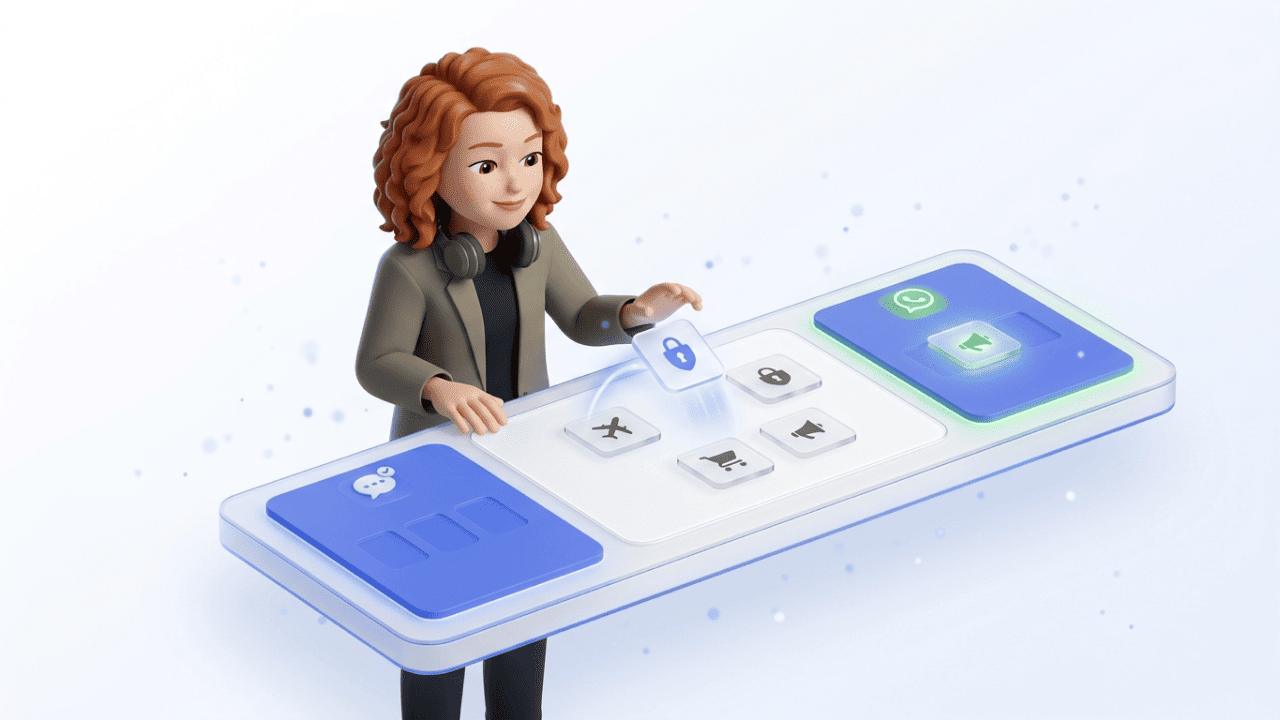
- Use-case split: Separate transactional from marketing. Transactional can be RCS, marketing stays WhatsApp.
- Don't build both without a hypothesis. Multichannel without strategy is multi-cost without multi-revenue.
- Prioritise the WhatsApp programme if DACH is your main market. The ROI numbers above speak for themselves.
For more context on the global rollout status, the GSMA's RCS initiative is a good reference.
FAQ
Is RCS Business Messaging available in Germany?
Yes. Telekom, Vodafone and O2 have supported RBM in production since early 2026. Reach and feature set vary by carrier and device, however — on iPhone, the full business features are still rolling out.
Is RCS worth it for my e-commerce shop in DACH?
No. For DACH D2C brands, WhatsApp is the more productive choice — higher conversion, conversational behaviour, mature ecosystem.
Can I run RCS and WhatsApp in parallel?
Yes. But it only makes sense if you have a clear use-case split: RCS for transactional / OTP, WhatsApp for marketing and service.
Do I need an opt-in for RCS Business Messaging?
Yes. Even if the phone number is already on file, you need a documented marketing opt-in under GDPR. Transactional messages follow different rules.
Is RCS more secure than SMS?
Yes. Verified sender, brand logo and the carrier trust layer make phishing significantly harder.
Does RCS work on iPhone?
Yes, since iOS 18 — and in DACH since the 2025 iOS 18 updates, across Telekom, Vodafone and O2. The full RBM feature set on iOS is still rolling out, however.
Will RCS replace WhatsApp in DACH?
No. Not in the next 3–5 years. Behaviour beats technology — and DACH users chat in WhatsApp.
Can I run RCS campaigns from a tool platform?
Yes, technically. The ecosystem of mature tools is significantly thinner than for WhatsApp, however. For DACH marketing, that's a clear negative.
Are RCS messages more expensive than SMS?
Yes, mostly. Rich messages sit clearly above SMS prices, but in return you get images, buttons and branding.
What are the biggest downsides of RCS for businesses?
Carrier-dependent feature depth, opaque pricing, thin tool ecosystem, low conversational behaviour.
Bottom line: decide by use case, not by hype
RCS Business Messaging is a strong technology for clearly defined use cases: travel, auth, transactional, SMS markets. And yes — in 2026, RCS is live across DACH, on all three carriers and on iPhone. For DACH D2C marketing it's still the wrong channel. Not because RCS is bad, but because user behaviour and ecosystem belong to WhatsApp.
If you're currently deciding where to put your messaging budget in 2026: let's talk for 30 minutes. We'll go through your use case, look at your markets and tell you honestly whether you need RCS, WhatsApp or both — and which lever brings the biggest ROI.
👉 Book a demo with Chatarmin.