
15 cents per minute. Or 0.08 euros. Or 0.30 euros. Or a flat 499 euros a month. Ask three vendors what an AI phone assistant costs — you'll get five answers. And not one of them tells you whether the thing actually pays off for your shop.
That's exactly the problem. Most price lists explain the what, but never the when. When does automation pay off? At 200 calls a month? At 2,000? And which costs does the tech really eat up — hidden setup fees included?
This article does both. First, the real pricing models on the market. Then an honest ROI calculation for online shops. With numbers you can apply to your own store.
How AI Phone Assistants Are Billed — the Four Models
There's no such thing as the price. There are four basic billing logics. And they decide whether your bill at the end of the month is predictable or catches you off guard.
1. Per minute. You pay for every minute of conversation, often between 0.08 and 0.30 euros. Sounds fair. Here's the catch: long calls get expensive, and complex requests are exactly the ones that drag on. A 6-minute call quickly costs you 1.80 euros.
2. Per call. A flat rate for every answered conversation, often 0.50 to 1.50 euros. Upside: more predictable. Downside: you also pay for the caller who hangs up after 10 seconds.
3. Credit or volume packages. You buy a quota — say 1,000 conversations a month — at a package price. Which means: bulk discount, but you pay upfront for the risk.
4. Fixed monthly licence. A flat fee, often 200 to 1,000 euros a month, sometimes plus a usage-based component. Good for high volumes, bad if your phone rarely rings.
The result? Per-minute is cheap at low volume. Flat fees only pay off once the phone runs hot. More on the individual vendor models is in our overview of AI phone assistant providers.
The Hidden Costs Nobody Writes on the Quote
The per-minute price is just the tip. Underneath lurk line items that blow your budget if you don't look closely.
- Setup & onboarding: A one-time setup, ranging from 0 to several thousand euros depending on the vendor. Some charge implementation fees for connecting to your shop system.
- Integrations: You want the assistant to pull order status from Shopify or Shopware? That often costs extra — either as a setup fee or as a pricier tariff tier.
- Telephony fees: The phone number and the actual phone line aren't always included. SIP trunk or number rental come on top.
- Language model costs: With some vendors you pay for the AI tokens separately. With others they're baked in. Ask explicitly.
- Support & maintenance: Premium support, SLAs, a dedicated contact — all happily sold as an upsell.
In concrete terms: never compare just the per-minute price. Calculate the total cost over twelve months. A vendor at 0.10 euros per minute but with a 2,000-euro setup can be more expensive than the 0.18-euro competitor with no setup fee.
Market Overview: What Costs What?
An honest overview of the common pricing models. No specific vendor tariffs — those change monthly and are often negotiable. But the ranges help you place things.
| Model | Typical range | Setup | Good for | Watch out |
|---|---|---|---|---|
| Per minute | 0.08–0.30 €/min | often low | irregular volume | ⚠️ long calls get expensive |
| Per call | 0.50–1.50 €/call | medium | predictable volume | ⚠️ pays for drop-offs too |
| Credit packages | depends on bundle | medium | medium volume | ⚠️ upfront pay, may expire |
| Fixed licence | 200–1,000 €/month | ✔ predictable | high volume | ✘ expensive at low call count |
| Licence + usage | base + variable | medium | growing shops | ⚠️ double costs possible |
| "Free" tier | 0 € | ✔ none | testing / private | ✘ limits, no e-commerce |
| Enterprise custom | individual | high | high volume | ⚠️ lock-in risk |
| Open-source setup | hosting + dev | high | tech teams | ✘ maintenance effort |
The table shows: "cheap" depends entirely on volume. Which is exactly why the calculation that really matters comes next.
Are There Free AI Phone Assistants?
The short version: Yes, but not for your shop. There are free tiers and trial periods. They're meant for testing — limited to a few minutes, with no serious integrations, no order-data connection.
For an online shop with real call traffic, "free" is a dead end. Without a connection to your shop system, the assistant can't answer WISMO requests — and "where is my order?" is exactly what's clogging your line. Without that automation, you save nothing.
In other words: free for testing — yes. Free in the live operation of a shop — forget it.
The ROI Calculation: At What Volume Does It Pay Off?
Now it gets concrete. Forget the price lists for a moment. The only question that matters: what does a call cost you today — and what do you save when the AI takes it over?
The formula is simple:
Savings = calls per month × automation rate × cost per manual call − AI costs − fixed costs
Three levers. Let's go through them.
Calls per month. Check your telephony stats. Many DACH shops sit, by experience, between 300 and 3,000 calls a month.
Automation rate. How many of those calls are standard questions? WISMO, return status, opening hours, availability. In typical e-commerce hotlines that's often 50 to 70 percent. A good voicebot in customer service handles exactly these.
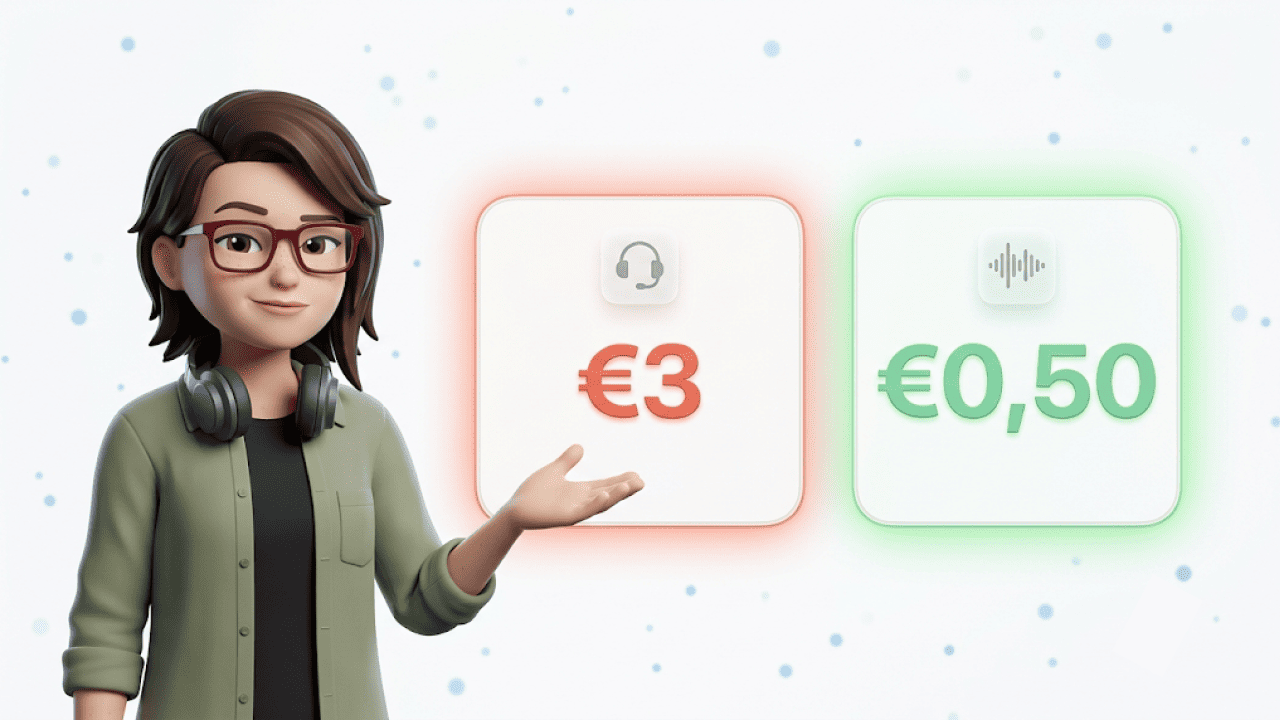
Cost per manual call. A support agent costs you — including non-wage labour costs — roughly 30 to 40 euros an hour. An average call lasts 4 to 6 minutes. That makes 2.50 to 4 euros per conversation. Plus wait times, breaks, sick days.
Worked Example: Mid-Sized Shop
Let's take 1,000 calls a month. 60 percent automatable. That's 600 calls the AI handles.
- Manual cost of these 600 calls: 600 × 3 € = 1,800 €/month
- AI costs (assume 0.15 €/min × 3 min): 600 × 0.45 € = 270 €/month
- Plus fixed costs/setup amortised: ~150 €/month
- Savings: around 1,380 €/month
The result? At this volume, the thing clearly pays off. The rule of thumb: from roughly 500 automatable calls a month, an AI phone assistant becomes profitable for most shops.
And at Low Volume?
You've got 150 calls a month, around 90 of them automatable? Then your gross savings land at maybe 200 euros a month. Here's the catch: at low volume, the base fee of a flat-rate vendor eats exactly those savings. Better to go for a per-minute model, or stick with people for now. When automation does not pay off is something we also cover in the guide to AI phone assistants.
What Drives the Price Up — and What Doesn't
Not every expensive tariff is worth its money. These factors justify a higher price:
- Real shop-system integration. Pull order status live, write address changes, trigger returns. That's the difference between an answering machine and an assistant.
- German-language quality. Speech recognition that understands dialects and technical terms. Poor recognition costs you customers.
- Clean escalation to humans. When the AI is stuck, it has to hand off cleanly — not ask in circles.
What does not justify the price: buzzword features you'll never use. Ask yourself with every upsell: does this lower my call costs, or does it just sound good?
What Automation Delivers in DACH E-Commerce
The ROI logic isn't a theoretical construct. In automated customer contact via Chatarmin there are hard numbers — from WhatsApp marketing, but they show what direct, automated customer dialogue delivers:
- Smilodox generated 481,000 euros in Black Friday revenue via WhatsApp.
- VITAFORM achieved a 40.7x ROI.
The point: automated communication pays off when the volume is right and the connection is solid. The exact same logic applies to the phone channel.
Fonio, VITAS, Aaron AI — and Who Each One Suits
A quick placement: providers like fonio or VITAS are strong with service businesses, practices, and classic call-centre scenarios — appointment booking, structured enquiries. For an online shop, they often lack the deep shop-system connection. Aaron AI goes even further into the niche: as part of Doctolib, it serves the healthcare sector exclusively — so for an online shop, it's simply not an option. If you come from the medical-practice world and are looking for an e-commerce-capable solution, it's worth a look at a fonio alternative.
For DACH online shops with real WISMO volume and Shopify/Shopware integration, something else counts: that the assistant understands order data and writes into your processes. How that differs from a pure AI answering machine is the deciding point. The broader vendor comparison is in our provider overview.
FAQ — AI Phone Assistant Costs
What does an AI phone assistant cost per month?
It depends on the model and volume. Per-minute models start at a few euros a month at low traffic, fixed licences often sit between 200 and 1,000 euros. Your call numbers are what matter, not the list price.
Is there a free AI phone assistant?
Yes. But only as a test tier. For the live operation of an online shop, free versions are too limited — usually with no shop-system connection and a minute cap.
At what call volume does automation pay off?
As a rule of thumb, from roughly 500 automatable calls a month. Below that, the base fee often eats the savings; above it, it becomes clearly profitable for most shops.
How is a voicebot billed?
Usually via four models: per minute, per call, via credit packages, or as a fixed monthly licence. Per-minute is cheap at low volume, flat fees pay off at high volume.
What hidden costs are there?
Setup fees, integration costs, telephony/number fees, separate language-model costs, and premium support. Always calculate the total cost over twelve months, not just the per-minute price.
Is a more expensive provider automatically better?
No. A higher price is only justified by real shop-system integration, good German speech recognition, and clean escalation. Buzzword features you'll never use are money thrown away.
Does an AI phone assistant pay off for small shops?
Rarely. Below 150 calls a month, the savings are small. Better to go for a per-minute model with no fixed costs, or stick with human support for now.
What do I save per automated call?
A manual support call costs, including non-wage labour costs, roughly 2.50 to 4 euros. The AI handles the same standard call for often under 0.50 euros. The difference is your saving per conversation.
Can the AI handle all calls?
No. Realistically it's 50 to 70 percent — the standard questions like WISMO, return status, or availability. Complex or sensitive cases still belong with a human.
Are the prices negotiable?
Yes. There's room especially at higher volume and with annual contracts. Ask for bulk discounts and have the setup fee itemised.
Conclusion: Calculate by Volume, Not Per-Minute Price
The cost question for an AI phone assistant isn't a price-list question. It's a volume question. Below 500 automatable calls a month: do the maths carefully, often people are enough. Above that: the AI usually pays off fast — provided the integration is solid and you're not paying for features you'll never use.
My honest advice: pull your call stats, run the formula above, and compare the total cost over twelve months — not the per-minute price.
Want to see what an AI phone assistant looks like for your shop specifically — with real shop-system integration? Then take a look at the AI phone assistant for online shops or book a demo directly. We'll work through your case together.
Note: market prices vary widely and change constantly. Check current tariffs directly with the provider.