
Otto is Germany's largest online retailer after Amazon. €4.4 billion in revenue, €7 billion in GMV, and 12.2 million active customers in fiscal year 2024/25 (Otto Group annual report). And the company has been on WhatsApp since late 2018 — as one of the first major online retailers in the DACH region.
If you look at Otto's WhatsApp strategy today, you find a clear pattern: WhatsApp is consistently run as a customer service channel. No newsletter, no drop alerts, no abandoned cart flows. Service in, service out.
For many DACH e-commerce people, that's surprising. Otto is the pioneer, so the setup should be state of the art, right?
Not quite. Otto's service-first approach makes sense in the enterprise context — and that's exactly where the learning is for smaller brands. This article shows how Otto uses WhatsApp, why the choice is strategically sound, and which levers a modern D2C setup adds on top.
Otto on WhatsApp: the facts
Otto launched its WhatsApp customer service in late 2018. The technical integration runs through novomind, a German WhatsApp Business Solution Provider. The setup is GDPR-compliant and uses the official WhatsApp Business API.
Access is simple: save the Otto service number (01806 30 30 30) on your smartphone, or click the WhatsApp button in the service area on Otto's mobile site. A chat opens directly.
What customers can do via Otto WhatsApp:
- Ask questions about their order
- Track shipping and delivery status
- Get product and service advice
- Send voice messages and videos
What's not possible:
- Place orders
- Subscribe to a newsletter
- Receive marketing messages
- Get personalized product recommendations
Otto's logic behind this is clearly communicated: WhatsApp is an additional service channel alongside phone and email. Customers should be reachable where they communicate — and many of them communicate via messenger. Marketing reach at Otto runs through other channels: email, app notifications, paid ads, and marketplace mechanics.
This isn't an oversight. It's a setup choice. And it deserves a fair read before we talk alternatives.
What Otto's service setup gets right
Three things stand out today.
Early API experience. In 2018, the WhatsApp Business API had just opened up to large enterprises. Otto was one of the first players in German e-commerce to make the move — alongside Sixt, Vodafone, and KLM. If you start collecting API experience early, seven years later you have a much more mature understanding of templates, routing, escalation logic, and data governance. That's not a trivial asset.
Clean API setup via a BSP, not a hack. Otto never worked through the WhatsApp Business app. They went straight to a Business Solution Provider. That means: templates get officially approved, routing into service teams works, data protection documentation is in place, CRM mapping is maintained. Exactly what most mid-market brands only get right after their first painful bottlenecks.
Service use cases that solve real customer problems. "Where's my package?" is one of the most frequent service inquiries in e-commerce. Otto handles exactly that via WhatsApp — fast answer, low friction, mobile. An Otto spokesperson described the logic this way: customers prefer to contact companies through the channel they already use day-to-day. People who live in messengers want support via messenger. That's an honest reading of customer behavior.
And that's the most important lesson from the Otto setup: WhatsApp service works. When the setup is clean, when the templates are right, when the teams are trained. Every e-commerce brand should understand this foundation before thinking about anything else.
What Otto's setup structurally doesn't cover
Now the second part — stated fairly: Otto's setup is optimized for service, not for marketing performance. That's not a weakness, it's a decision with clear trade-offs. The setup structurally leaves a few gaps:
- No WhatsApp newsletter. Otto doesn't build an opt-in list for marketing campaigns. Drops, sales, and seasonal promotions run on email and through the app.
- No abandoned cart flows. If you abandon checkout at Otto, you get — at best — an email. No real-time WhatsApp reminder.
- No post-purchase marketing sequences. Service communication runs after purchase (tracking), but no cross-sell or repurchase flows.
- No segmented reactivation. Inactive customers aren't approached via WhatsApp.
- No drop or restock alerts. Hot products don't get pushed to interested lists.
To be clear: this doesn't make Otto's strategy "wrong." Enterprise marketing follows different logics — brand stewardship, compliance reach, risk management with multi-million recipient lists, internal accountability between service and CRM teams. A misfired broadcast to several million customers is a PR risk for an enterprise that a smaller brand simply doesn't carry.
Still, the Otto setup clearly shows where a pure service approach leaves marketing levers on the table. Levers that, in a D2C reality, deliver very different conversion numbers.
Why Otto's choice makes sense at enterprise scale
Before we add the marketing layer: Otto's service-first approach has good reasons that every brand should understand.
Organizational reality. WhatsApp at Otto sits in the service department. Service teams think in CSAT, AHT (average handle time), and response time — not in revenue per recipient. A different setup would need a different team with a different mandate. That kind of restructuring doesn't happen on a whim inside an enterprise.
Scaling risk. Otto has 12.2 million active customers. Even small opt-in rates would create recipient lists in the seven- or eight-digit range. One sloppy campaign and you risk Meta template bans, brand reputation damage, and PR blowback at the same time. The bar for "let's just start with WhatsApp marketing" is objectively higher at an enterprise.
Existing marketing infrastructure. Otto has its own app with push notifications, a massive email database, a loyalty program, and a marketplace model with 6,200 partners. The marginal value of an additional marketing channel is lower than at a D2C brand that hasn't yet capitalized on all its owned channels.
Brand stewardship. Otto positions itself as a serious, trusted retailer. Aggressive WhatsApp marketing with flash sales and push messages doesn't fit every brand promise. Otto consciously picks a more restrained tone here.
Put differently: what's rational in the enterprise context isn't automatically optimal in the D2C context. And vice versa. Both can coexist.
What smaller e-commerce brands can take from this
Here's where it gets interesting. If you run a D2C brand or a mid-market shop, your reality is structurally different from Otto's:
- You don't have 12 million customers, you have maybe 50,000 — small enough to learn fast.
- You don't have a massive app ecosystem replacing your marketing reach.
- You often have marketing and service in the same team, sometimes the same person.
- A template error hurts, but it's not a PR catastrophe.
That opens up levers that simply don't scale for Otto — but work directly for you:
Active opt-in generation. Otto collects WhatsApp contacts passively through service inquiries. You can build opt-ins actively — through website pop-ups, checkout checkbox, package insert QR codes, thank-you-page widget, click-to-WhatsApp ads. Brands with a clean setup hit opt-in rates that wouldn't be conceivable in an enterprise setup.
Automated marketing flows. Welcome flow, abandoned cart, post-purchase, reactivation, win-back — these five always-on flows are the backbone of modern D2C WhatsApp setups. According to our customer data, they deliver 60-70% of WhatsApp revenue before you ever send a single broadcast.
Segmented broadcasts instead of enterprise mass sends. You can talk to your VIP segment (top 10% by revenue) differently than to your first-time buyers. With 50,000 customers, that's operationally doable — with 12 million it gets hard.
Service and marketing in one inbox. This is probably the most underrated lever. At Otto, service and marketing are organizationally separate. In your setup, they can run on the same platform — the service rep sees that a customer just received a drop alert and can react accordingly. Data flows both ways.
That's the operational strength of smaller brands: service quality at enterprise level, plus marketing levers the enterprise structurally doesn't touch.
Otto setup vs. modern D2C setup: a direct comparison
To make the difference concrete, here's a sober comparison. Both setups are valid in their respective contexts — the question is which one fits your reality.
| Area | Otto setup (service-first) | Modern D2C setup |
|---|---|---|
| Primary function | Customer service | Service + marketing combined |
| WhatsApp newsletter | Not used | Active, segmented |
| Abandoned cart flow | Not used | Real-time reminder |
| Post-purchase flows | Service only (tracking) | Service + cross-sell + reviews |
| Opt-in generation | Passive, via service | Active, multiple touchpoints |
| CRM integration | Service-focused | Shop, Klaviyo, CRM bidirectional |
| Attribution & tracking | Service KPIs (CSAT, AHT) | UTM, coupons, holdouts, contribution-margin logic |
| Goal | Response time + service quality | Incremental revenue + service |
| Who owns it | Service team | CRM team with service interface |
This isn't about one being "better" than the other. It's about every brand consciously deciding which levers to use — and which to skip.
How to build the service layer — the Otto pattern
If you're setting up WhatsApp for the first time, it's worth taking the Otto setup as inspiration for the service portion. That's the solid base; without it, marketing doesn't make sense.
Step 1: WhatsApp Business API instead of the app. The WhatsApp Business app is fine for very small volumes. As soon as you have more than a few hundred active chats or you need a team working from a shared inbox, you need the API through a Business Solution Provider. Start with a clean WhatsApp Business API setup.
Step 2: define and get service templates approved. The most important templates: order number request, tracking response, return instructions, escalation to human agent. Templates need Meta approval — plan a few days lead time.
Step 3: service team inbox and routing. Clear ownership, defined response times, clean routing by request type. Otto does this exemplarily — take it as your benchmark.
Step 4: automate order tracking. Typical flow: customer asks "where's my package?", the system requests order number plus email, then delivers the status straight from the shop or ERP system. This is one of the most thankful automation use cases out there — and it takes serious load off your service team.
That's the service layer. Once it stands, you have the Otto base. Now comes the part Otto doesn't build.
How to add the marketing layer
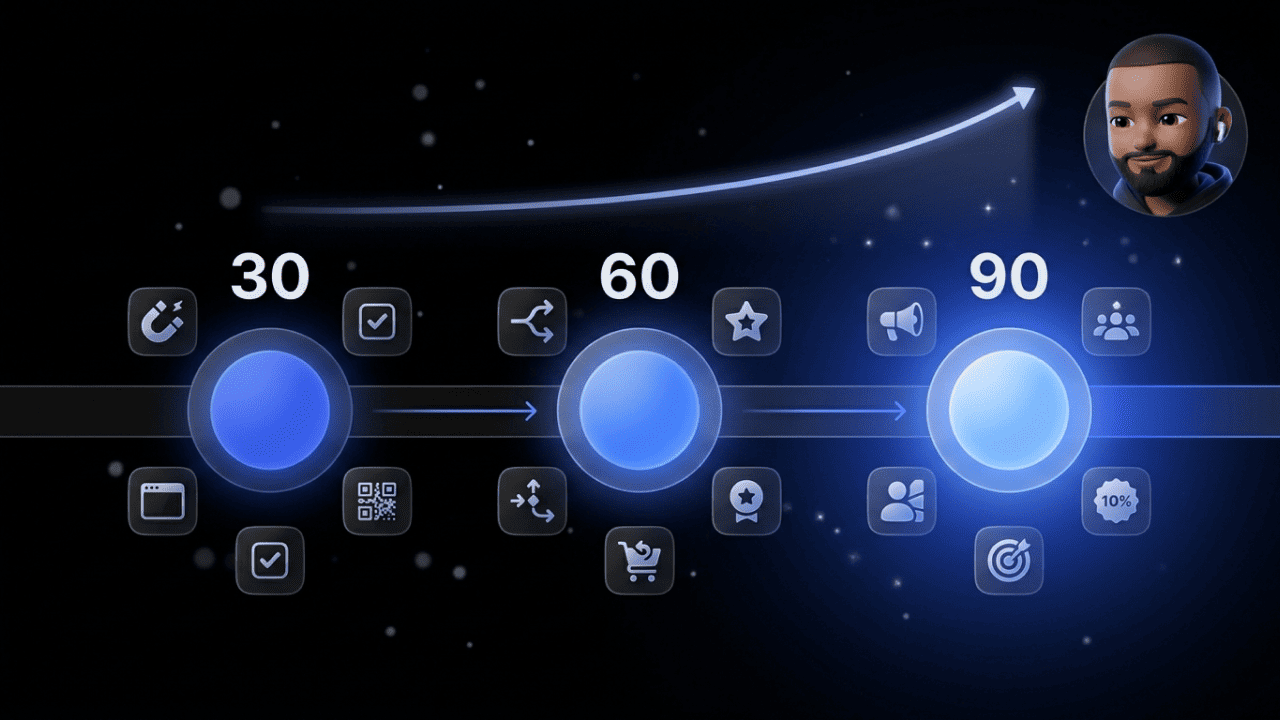
This is where the actual lever sits for smaller brands. The build typically follows a 30-60-90-day plan that has proven itself with many Chatarmin customers.
Days 1-30: activate the opt-in engine
No opt-ins, no marketing. You need multiple touchpoints where customers consciously consent:
- Website pop-up with a clear value prop (e.g. "10% off your next order when you join our WhatsApp newsletter")
- Checkout checkbox for WhatsApp shipping updates (often the single biggest opt-in source)
- Thank-you-page widget right after the purchase — buying intent is at a peak here
- QR code on package inserts for existing customers
- Click-to-WhatsApp ads via Meta Ads Manager
Expected outcome: a growing, cleanly GDPR-compliant opt-in list that you can activate in the next phases. How to keep this legally clean is detailed in our WhatsApp GDPR guide.
Days 30-60: roll out the first always-on flows
Three flows usually deliver the bulk of revenue — before you send a single broadcast:
- Welcome flow for new opt-ins (welcome, brand story, first offer)
- Abandoned cart flow with two-stage escalation (reminder, then optional incentive)
- Post-purchase flow with tracking update, review request, and matching cross-sell
All of this runs in the background. You build it once, properly, and it delivers consistently.
Days 60-90: broadcasts with segmentation
Now you move to active communication:
- VIP segment (top 10% by revenue): early access, exclusive drops
- First-time buyer segment: educational content, bundle recommendations
- Inactive segment (no purchase in 90+ days): reactivation mechanics
- Frequency caps: max. 2 broadcasts per week per segment to prevent fatigue
Important from here on: set up a holdout group of 10%. This group gets no WhatsApp messages and serves as a control to measure true incrementality. Otherwise you get pretty ROAS numbers but never know if those purchases would've happened anyway.
Realistic timeline: a clean mid-market setup stands in 3 months. You'll often see the first measurable results within 6 weeks, once the first flows are live.
GDPR and compliance: what Otto solves cleanly — and what you need too
Otto's WhatsApp setup is GDPR-compliant. That's not a given, and if you're setting up WhatsApp you need the same building blocks:
- Consent (opt-in) with a clear notice: what gets sent, how often, for what purpose?
- Opt-in documentation for verifiable compliance.
- Opt-out via stop-wording (e.g. "STOP") — easy to use and cleanly implemented in the system.
- Template governance: who creates templates, who approves them, which triggers are allowed?
- Data minimization: in service flows, only ask what you actually need (e.g. order number + email for tracking, no more).
- Verified business account (green checkmark) as a trust signal.
A platform that doesn't bring all of this out of the box will cost you lawyer hours and audit pain later. Take Otto's setup as a real benchmark here.
Common stumbles when translating Otto's pattern to your own setup
Three patterns we see repeatedly when brands start with WhatsApp:
Stumble 1: giving WhatsApp only to the service team. This is the most common setup choice — and it has logic in the enterprise context (see Otto). In the D2C context, it cuts you off from 60-70% of the potential. Better: set up WhatsApp as a shared channel between CRM and service, with clear ownership.
Stumble 2: no active opt-in management. If you wait for service inquiries as your only opt-in source (like Otto), you grow very slowly. Active opt-in funnels aren't a nice-to-have, they're the engine.
Stumble 3: WhatsApp without shop integration. A platform that doesn't know what a customer has bought, how much they spend, and when they were last active can only broadcast generically. The real strength shows up when shop data (Shopify, WooCommerce, Klaviyo) flows automatically into the WhatsApp platform.
Conclusion: what Otto shows — and what you should add on top
Otto shows two things. First: WhatsApp service on the API works, is GDPR-compliant when set up properly, and delivers real customer value. That's the foundation you should hold to.
Second: a pure service setup structurally leaves marketing levers on the table — levers that, in a D2C reality, can drive revenue directly. Newsletter, automated flows, segmented broadcasts.
For a brand with enterprise complexity (12 million customers, multiple marketing channels, brand stewardship requirements), Otto's choice can be right. For a D2C brand with 50,000 customers that needs to show growth every quarter, it's usually not optimal — because the structural hurdles that apply to Otto don't exist at that scale.
The honest recommendation: learn from Otto's service setup. It's clean, established early, proven in practice. Then add the marketing layer your brand size and setup allow — opt-ins, flows, broadcasts, attribution. None of this is something Otto does "wrong." It's just a different optimization path that a smaller, more agile brand can run.
At Chatarmin, we build exactly this combined setup for D2C and mid-market brands in DACH: WhatsApp Business API, service inbox, marketing flows, segmentation, and tracking — integrated with Shopify, WooCommerce, JTL, Klaviyo, and Pipedrive. A brand like Snocks turned WhatsApp into a measurable revenue channel this way. If you want to see what your setup could look like, book a short demo — we'll walk you through it together.
Frequently asked questions about Otto's WhatsApp strategy
Does Otto have a WhatsApp newsletter?
No. Otto uses WhatsApp exclusively for customer service — that is, order questions, tracking requests, and product advice. There is no official Otto WhatsApp newsletter and no marketing broadcasts. If you want Otto news, you stay on email and the app.
How do I contact Otto customer service via WhatsApp?
Save the Otto service number (01806 30 30 30) on your smartphone and send a WhatsApp message to that number. Alternatively, find the WhatsApp button in the service area on Otto's mobile site, which opens a chat directly. Placing orders via WhatsApp isn't possible — service inquiries only.
Why doesn't Otto run WhatsApp marketing?
Otto has organizationally placed WhatsApp in its service department and runs marketing communication through other channels (email, app push, paid ads). In an enterprise context with 12 million active customers, this makes sense — the compliance and scaling risks of segmented broadcasts to multi-million lists are much higher than for a smaller brand. For a D2C or mid-market brand, the hurdles are lower and the marketing levers more directly effective.
Which tool does Otto use for WhatsApp?
Otto works with novomind, a German WhatsApp Business Solution Provider. The setup runs through the official WhatsApp Business API and is GDPR-compliant. novomind is built for enterprise service. For D2C and mid-market brands that also want to run WhatsApp for marketing and automation, specialized platforms like Chatarmin tend to fit better — because they bring deeper Shopify and CRM integrations to the table.
What can a smaller e-commerce brand do on WhatsApp that Otto doesn't?
Three things: first, actively collect opt-ins for marketing (Otto collects passively through service). Second, roll out automated marketing flows — welcome, abandoned cart, post-purchase, reactivation. Third, run segmented broadcasts to customer groups. All of this is harder to execute in an enterprise context — for a more agile brand with a clear CRM mandate, it's doable in 90 days.
Is WhatsApp worth it for smaller shops in DACH e-commerce too?
Yes, often more so than for enterprises. Smaller D2C shops can set up WhatsApp faster and without organizational overhead. Rule of thumb from our practice: starting at around 5,000 orders per year, a WhatsApp setup with abandoned cart and post-purchase flows usually pays for itself within 3-6 months.
How do I measure whether my WhatsApp channel is actually working?
Three KPI layers: engagement (open rate, click rate, reply rate, unsubscribes), revenue (revenue per recipient, conversion rate per campaign, contribution margin) and incrementality (holdout tests with a 10% control group). Only when all three layers run cleanly is the channel internally defensible. Last-click attribution alone is not enough — it only shows the tip of the iceberg.