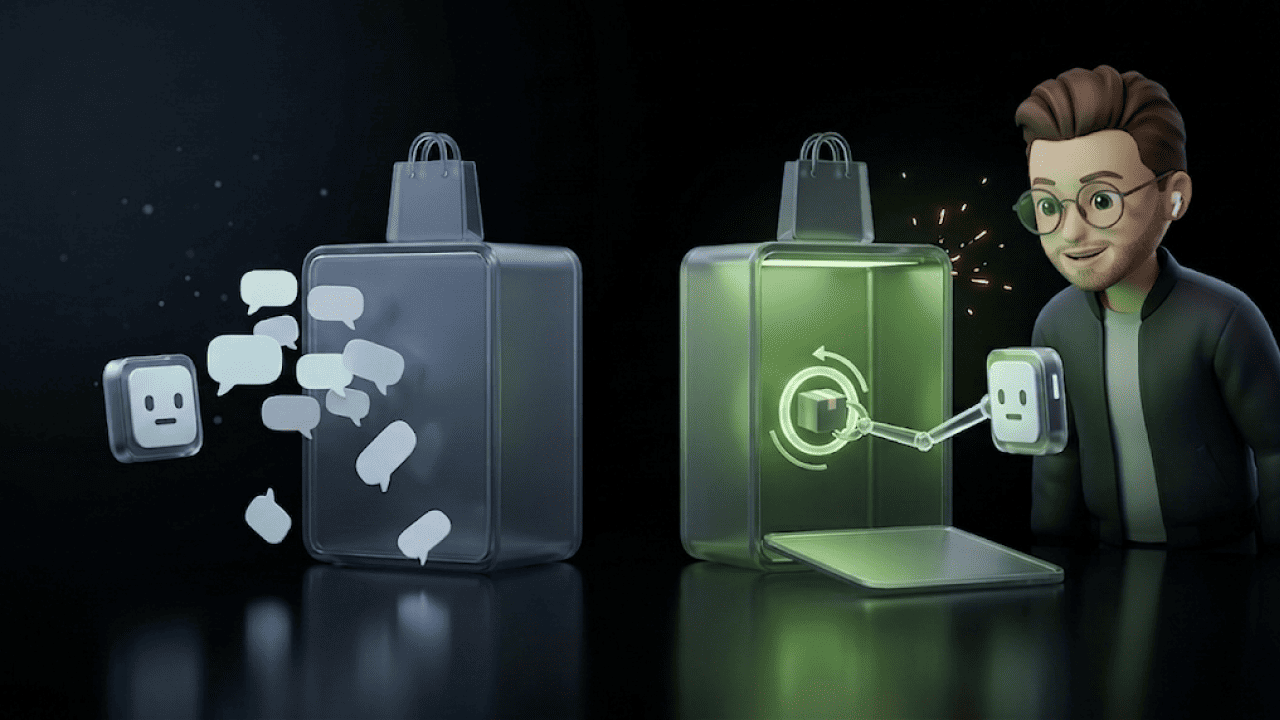

Outsourcing customer service means an external provider answers your customers' enquiries on your behalf, either completely or for specific channels and hours. For online shops it pays off mainly for calls that need a lot of back-and-forth, out-of-hours cover, foreign languages and sharp seasonal peaks. For standard questions such as "Where is my parcel?" we recommend automation, because every one of these enquiries costs paid working time at a provider.
In this article we calculate all three routes: doing it yourself, outsourcing and automating. You also get data from 140 shops, a decision matrix and a list of tasks that are better kept in your own team.
Why are so many shops thinking about outsourcing right now?
Almost 4 in 10 respondents outsource their customer service fully or partly. In a Capterra survey from 2024, 38% of respondents with budget responsibility said they outsource completely (17%) or partly (21%). The trade portal callcenterprofi reports on it with a focus on just under 200 respondents from Germany. Of the teams that still do everything in-house, 69% are planning or considering the move.
The pressure comes mainly from staff costs. One hour of work cost employers in Germany an average of €45.00 in 2025, according to the Federal Statistical Office (Destatis). Since 1 January 2027, the statutory minimum wage has also stood at €14.60 per hour (Fifth Minimum Wage Adjustment Ordinance).
A typical scenario shows why outsourcing looks tempting at that point. Monday after Black Friday, three people in support, more than 900 open tickets. Many ask about their parcel, others about returns, invoices and delivery addresses. Hiring new people takes weeks, and by January you need far fewer of them again.
Whether outsourcing is also the cheaper option only becomes clear in the calculation further down. Before that, it is worth looking at the third route, automation. Our overview of AI in customer service sums up what software handles in support today and where it falls short.
What does customer service outsourcing mean in practice?
When you outsource support, an external provider handles communication with your customers, using your knowledge and under your name. This ranges from a simple phone hotline to support across every channel. If you want to outsource customer service, you will usually choose one of five models in e-commerce:
| Model | What the provider takes on | Typical use in a shop |
|---|---|---|
| Full outsourcing | All channels and all enquiries | Shops without their own support team |
| Channel outsourcing | Usually the phone hotline | Shops whose team works in writing |
| Overflow | Everything above an agreed daily volume | Black Friday, Christmas, sales |
| Out-of-hours | Evenings, weekends, public holidays | Shops with customers in several time zones |
| Languages | Enquiries in languages outside your team | Expansion into France, Italy, the Netherlands |
The model determines how much knowledge you hand over. An overflow hotline needs a good briefing and a knowledge base. Full outsourcing needs access to your shop system, shipping data and goodwill rules.
The more access the provider needs, the longer the start-up takes. Plan time for training, a test phase and aligning reply templates from the outset, especially if you are aiming for next season.
Customer service outsourcing: what does it cost?
Costs depend mainly on the pricing model, and each model becomes expensive with a different type of enquiry. You will find these billing methods in most quotes:
| Pricing model | Billing | Gets expensive when … |
|---|---|---|
| Per minute | Call or handling minutes | calls run long, for example with complaints |
| Per ticket | Every enquiry handled | lots of short standard questions come in |
| Per hour | Booked agent hours | your volume fluctuates and hours sit idle |
| Per agent per month | Fixed seats in the team | you hardly need the seats outside peak season |
| Set-up | One-off fee for training and set-up | you switch after a few months |
For German-language support from Germany, the minimum wage of €14.60 sets the floor. Employer on-costs and the provider's margin come on top. Your quote determines the rest.
When you outsource customer service, things that rarely appear in the quote also cost money:
- Onboarding every time staff change on the provider's side
- Maintaining the knowledge base whenever products, carriers or returns rules change
- Follow-up questions from the external team to your people, for example on goodwill cases
- Quality control through spot checks, so tone and answers fit your brand
Get at least three quotes based on the same briefing. Only then can you compare per-minute, per-ticket and hourly prices properly.
What is cheaper: doing it yourself, outsourcing or automating?
The cheaper route is the one that leaves fewer hours of ticket work, whoever does it. The automation rates for this calculation come from the Chatarmin benchmark on automated support tickets, based on data from 140 shops and 2.6 million tickets.
The worked example uses clear assumptions. A D2C shop receives 6,000 tickets a month, and each ticket takes 6 minutes on average. That adds up to 600 hours of pure handling time. As the hourly rate we use Destatis' €45.00, the average across all sectors. For your own calculation, plug in your own hourly rate or your provider's.
Automation reduces the number of hours before you even decide between in-house and outsourcing. This is how the calculation changes depending on the rate:
| Scenario | Automated tickets | Remaining hours per month | Cost at €45 per hour |
|---|---|---|---|
| Everything manual | 0% | 600 | €27,000 |
| Typical shop (median) | 16.3% | 502 | €22,599 |
| Average per shop | 25.2% | 449 | €20,196 |
| Top quarter of shops (average) | 61.2% | 233 | €10,476 |
In this example, around 270 hours a month separate the typical shop from the top quarter. According to the study, the rate depends heavily on set-up, sector and ticket mix. Our own assessment: the biggest difference comes from the connection to shop and shipping data and clean master data.
The calculation has three limits. Per ticket it comes to €4.50 of pure handling time, while full-cost calculations including management, idle time and tools come out considerably higher. Automated tickets are often the shortest, so you usually save less time than the share of tickets suggests. And according to the benchmark, AI on its own resolves only 4.7% of all tickets completely without humans, while most of the automation comes from workflows.
When is outsourcing the right choice?
Outsourcing pays off where you lack people for conversations, hours or languages. For rule-based enquiries, automation is usually the better route. Our guide to support automation shows which enquiries are suitable. The clearest cases for outsourcing:
- Phone hotline: A provider supplies agents, cover and enough lines for peak times. In the same Capterra survey from 2024, only 12% of callers in Germany reached a person within one minute, compared with an international average of 23%.
- Foreign languages: When you expand into France or Italy, you get native-speaking agents without hiring them yourself.
- Out-of-hours: You cover evenings, weekends and public holidays without building shift rotas for your own team.
- Peaks with a lot to clarify: If December brings mainly individual cases, extra people help more than extra rules.
For standard calls, there is now a second option. An AI phone assistant such as the one from armincx by Chatarmin answers calls and hands complex cases over to your team.
Long conversations with a lot of back-and-forth remain a job for people. A furniture shop with freight delivery is a good example: customers call to agree delivery dates, check measurements or discuss delivery to an upper floor.
With standard questions, you pay the provider to look things up. A beauty shop with 200 emails a day, many of them about shipping status and returns, pays an external team to search for tracking numbers. Software does this work faster and around the clock.
When should you automate first and outsource second?
Automate everything that follows fixed rules and needs data from your shop and shipping first. At a provider, these enquiries cost working time on every ticket:
| Enquiry | Data needed | Effort for external agents |
|---|---|---|
| Where is my order? | Order and tracking data | Look up tracking manually |
| Return or exchange | Returns rules and order data | Create label, check rules |
| Cancellation and refund | Write access to the shop system | Query to the internal team |
| Invoice or receipt | Invoice data from shop or ERP | Find and attach the document |
| Change of address | Shipping status and write access | Check whether it is still possible |
The prerequisite is access to your systems. Before any decision, check which systems can be connected: shop system, ERP, carrier and returns tool. The more of them are connected, the more enquiries the software closes without follow-up questions.
armincx is built for exactly these enquiries. The software brings email, WhatsApp, Instagram, Facebook and live chat together in one inbox and connects to Shopify, Shopware, JTL, Xentral and Billbee. The AI agent works with real order data and carries out actions such as cancellations or address changes via workflows.
Workflows do most of the work. One example is order status enquiries, which the agent answers directly with the tracking data.
There are clear differences between marketplaces. Amazon is connected with order data and AI actions. OTTO and Kaufland run as an email channel without AI actions.
Decision matrix: in-house, outsourcing, automation or hybrid?
For most shops, a combination is the right route. The matrix shows which route fits which task and which shop situation:
| Criterion | In-house | Outsourcing | Automation | Hybrid |
|---|---|---|---|---|
| Fits | Products that need explaining, premium customers | Calls with a lot of back-and-forth, languages, out-of-hours | Order status, returns, cancellations, invoices | Lots of standard questions plus seasonal peaks |
| Cost logic | Fixed salaries | Per minute, ticket, hour or seat | Software plus set-up | Software plus a smaller team or overflow contract |
| Black Friday | Overtime and temporary staff | Extra agents by agreement | More volume with the same team | Software absorbs standard questions, people handle the rest |
| Control over tone | Entirely yours | Via briefing and spot checks | Via rules, approvals and AI drafts | High, as long as escalations stay internal |
| Data protection | Data stays in-house | DPA with the provider | DPA with the software vendor | Both DPAs |
| Start | Recruiting and onboarding | Selection, contract and training | Connecting systems and workflows | Staggered, automation first |
Our recommendation for most D2C shops is hybrid. Hybrid here means software for standard questions, your own team for goodwill and escalations, and a provider for phone and peaks when needed.
In the example shop, just over 2,300 tickets are left for people. If the shop reaches the top-quarter rate, automation takes on around 3,670 of the 6,000 tickets a month. A small internal team and, if needed, an external hotline share the rest.
Start with your own figures. armincx for customer service answers standard questions with live data from your shop. If you want to know how many of your tickets can be automated with a shop connection, book a demo of armincx. Together we will look at your ticket categories and your shop system.
What should you neither outsource nor automate?
Anything that needs decision-making authority, customer history or legal care belongs in your own team. These cases include:
- Complaints with escalation risk: Anyone threatening a lawyer or a public review needs someone with authority to decide.
- Goodwill above a fixed threshold: Set an amount, for example refunds over €100, above which your team decides.
- VIP and loyal customers: For premium brands, the first reply should come from a person who knows the customer history.
- Legal questions: Withdrawals in borderline cases, warranty claims and data access requests under Art. 15 GDPR.
- Health-related questions: For supplements or cosmetics, a wrong answer costs more than any minute saved.
Complaints about faulty products are suitable at most for pre-qualification. Software or a provider collects the order number and photos, and your team makes the decision. That keeps product feedback in-house, and quality problems go straight to the people who can fix them.
What should you look out for in an outsourcing contract?
A good contract covers quality, data and the exit. These six points belong in it:
- A data processing agreement under Art. 28 GDPR, because the provider processes customer data on your behalf.
- Service levels for first response time and availability, broken down by channel.
- Quality metrics such as CSAT and resolution rate, with monthly reporting.
- System access: The external agents work in your inbox, so tickets and history stay with you.
- Notice periods and minimum terms that fit your seasonal planning.
- Handover on exit: The knowledge base, templates and conversation notes belong to you.
Before you sign, run the numbers against automation once. Set staff costs, ticket volume and licence against each other, then compare the result with the quotes you have collected.
FAQ: Customer service outsourcing
What does outsourcing mean?
Outsourcing means a company permanently hands a task to an external provider. In customer service, an external team then answers enquiries on behalf of your brand.
What is the difference between insourcing and outsourcing?
With insourcing your own team does the task, with outsourcing an external partner does. Mixed models are common in e-commerce, for example an in-house team with an external phone hotline.
What are the disadvantages of outsourcing?
You give up control over tone, quality and customer knowledge and pay working time for every standard enquiry. On top come the effort for briefings, follow-up questions and quality control.
What are some examples of outsourcing?
In e-commerce, the most common examples are phone hotlines, weekend support, overflow teams for Black Friday and foreign-language support. Logistics and accounting are also typical areas that shops outsource.
How much does customer service outsourcing cost?
It depends on the pricing model: per minute, per ticket, per hour or per agent per month, often plus a set-up fee. Always compare quotes based on your real ticket volume.
Is it worth outsourcing customer service?
It depends. Often yes for calls with a lot of back-and-forth, languages and out-of-hours cover, while for standard questions such as order status or returns we recommend automation.
Can AI replace an external provider?
It depends. Yes for rule-based enquiries with a shop connection, but for goodwill, complaints and long conversations that need coordination you still need people, in-house or external.
Conclusion: automate first, then outsource selectively
Outsourcing customer service is the right answer when you lack people for conversations, languages or out-of-hours cover. For standard questions, on the other hand, you pay the provider for hours that software can take over. In the worked example with 6,000 tickets and 6 minutes per ticket, around 270 hours a month separate the typical shop from the top quarter.
That is why hybrid is the best route for most shops. Automate order status, returns and cancellations, keep escalations and goodwill in your own team and outsource phone, out-of-hours or peaks selectively. As a next step, enter your own ticket numbers into the chatbot ROI calculator and see which mix works out for your shop.