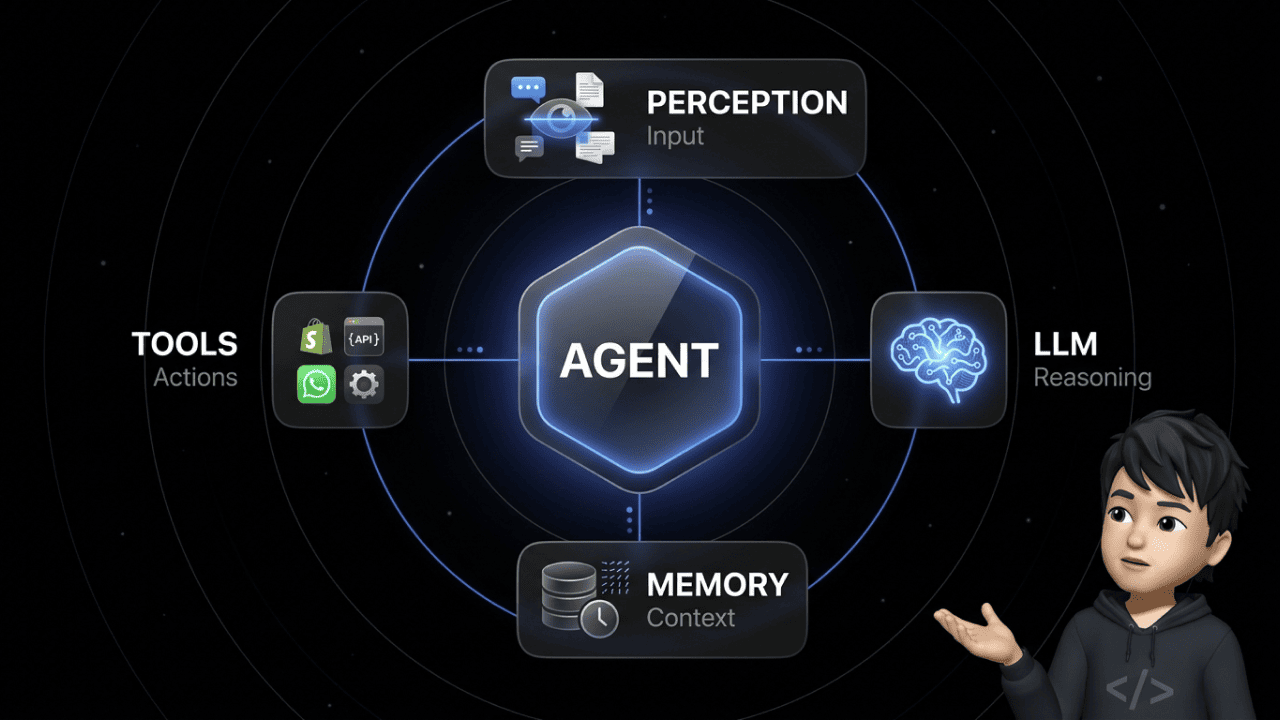

Claude can write five subject lines for your Black Friday newsletter in ten seconds. What it cannot tell you is how many contacts sit in your VIP segment or how much revenue your last campaign generated. This is exactly the gap an MCP server closes. It connects AI assistants such as Claude or ChatGPT to the tools that hold your data, from your Shopify store to your WhatsApp marketing.
What is an MCP server? The short definition
An MCP server is an interface that lets an AI assistant access the data and functions of a piece of software. MCP stands for Model Context Protocol, an open standard that defines how AI tools and software communicate with each other.
The official MCP documentation compares the protocol to a USB-C port for AI applications. Just as USB-C connects devices through one universal plug, MCP connects AI tools to other software through one universal standard. A vendor builds its server once, and every compatible AI tool can use it.
| MCP at a glance | |
|---|---|
| Full name | Model Context Protocol |
| What it is | An open standard that lets AI assistants access external software |
| Developed by | Anthropic, released in November 2024 |
| Governed by | The Agentic AI Foundation under the Linux Foundation (since December 2025) |
| Supported by | Claude, ChatGPT, Gemini, Microsoft Copilot, Cursor, VS Code |
| Official servers in e-commerce | Shopify, Shopware, Klaviyo, Chatarmin (as of October 2026) |
In practice: you ask Claude "How did Tuesday's WhatsApp campaign perform?" and Claude pulls the figures straight from your tool. Claude then works with your real data instead of assumptions.
Where does MCP come from and why is it suddenly everywhere?
Anthropic, the company behind Claude, released the Model Context Protocol in November 2024. Since then, the major AI providers have adopted the standard:
- March 2025: OpenAI officially adopts MCP for its products.
- December 2025: Anthropic donates MCP to the Agentic AI Foundation under the Linux Foundation. The foundation was co-founded by Anthropic, Block and OpenAI, with support from Google, Microsoft, AWS, Cloudflare and Bloomberg.
- At the time of the donation, MCP counted more than 10,000 active public servers and over 97 million monthly SDK downloads, according to Anthropic.
What this means for you: MCP is the standard that OpenAI, Google, Microsoft and Anthropic have jointly backed. If one of your tools offers an MCP server, it works with whichever AI assistant your team already uses.
How does an MCP server work?
Every MCP connection involves three roles:
| Role | What it is | Example |
|---|---|---|
| Host | The AI application you work in | Claude, ChatGPT, Cursor |
| Client | The connection inside the host to exactly one server | The Chatarmin connector in Claude |
| Server | The vendor's program that provides data and functions | Klaviyo's MCP server |
An MCP server provides three types of building blocks. Tools are actions such as "tag a contact". Resources are data to read, for example campaign statistics. Prompts are templates for recurring tasks.
This is how a request works:
- You type into Claude: "Show me the three highest-revenue flows of the last 30 days."
- Claude recognises that it needs data from your WhatsApp tool and calls the relevant tool on the MCP server.
- The server checks your permissions, fetches the data and returns it.
- Claude analyses the data and answers you in plain language.
For you as a user, setup usually takes just a few minutes. With hosted servers, you add a connector URL in your AI tool and sign in with your normal login.
MCP vs. API: what is the difference?
An API connects software through fixed, programmed workflows, while an MCP server makes the same functions available to AI assistants via chat. For e-commerce teams, that is the decisive difference: an API needs a developer, a hosted MCP server usually needs nothing more than a login.
| Criterion | API | MCP server |
|---|---|---|
| Built for | Developers connecting systems permanently | AI assistants that choose the right function themselves |
| Setup | Write and maintain code | Paste a connector URL and sign in |
| Control | Fixed, programmed workflows | Your request in natural language |
| Typical use | Shop integration, data sync, automations | Analysis, drafts, ad hoc questions |
| Reusability | Every integration is built individually | One server for all MCP-compatible AI tools |
Our take: MCP complements your existing integrations. An MCP server usually sits on top of a tool's existing API. Your Shopify sync and your Klaviyo integration keep running as before. MCP comes into play as soon as someone on the team has a question about the data.
Which e-commerce tools have an MCP server?
Many shop systems and marketing tools widely used in the DACH region already offer official MCP servers. The vendor maintains an official server itself and adapts it to API changes.
| Tool | Official MCP server | What it does |
|---|---|---|
| Shopify | Several servers via UCP, including the Storefront Catalog MCP for every shop, plus a Dev MCP for developers | Search products, build carts, fetch order status |
| Shopware | Built in since version 6.7.11.0, enabled via feature flag, experimental until version 6.8 | Access to your shop's Admin API and Store API |
| Klaviyo | Hosted MCP server | Use your Klaviyo data directly in Claude, ChatGPT or Cursor |
| Chatarmin | Chatarmin MCP, for all Chatarmin customers | Contacts, campaigns, flows, templates and analytics for WhatsApp marketing |
As of October 2026. Features and status are changing constantly.
It gets interesting when you combine several servers. One example: Claude uses your Shopify store's Storefront Catalog MCP to find the products in your autumn collection. Claude then turns them into a WhatsApp template with product links in Chatarmin. What used to mean copying and pasting between three tabs now happens in a single chat.
In day-to-day marketing, MCP saves the most time on four tasks:
- Ad hoc reports that would otherwise mean copying figures from several dashboards
- Drafts for campaigns, templates and flows based on your real data
- Channel comparisons, for example email open rates from Klaviyo next to WhatsApp metrics
- Troubleshooting when a metric suddenly drops
How secure is an MCP server?
An MCP server acts with exactly the permissions you grant it when connecting. How secure it is therefore depends on the server and on your settings. Keep these points in mind:
- Prefer official servers: For community projects on GitHub, check beforehand who is behind them and how actively they are maintained.
- Sign in via OAuth: You log in with your own account. As a rule, the server only sees what your account is allowed to see.
- Confirmation before write actions: Campaign sends or price changes should only happen after your approval.
- Watch out for prompt injection: Manipulated content, for example in a customer message, can try to slip instructions to the AI. A confirmation step before critical actions catches this.
Our clear recommendation: start read-only. For the first few weeks, let the AI only read and analyse. Anyone who grants write access for campaign sends on day one saves ten minutes and risks a message to the wrong list.
Several of these points are built into the Chatarmin MCP: you sign in via OAuth, campaigns are only created after your explicit confirmation, and a dry run shows you the recipients beforehand. Access is also limited to your own organisation.
MCP and GDPR: what e-commerce teams in the DACH region should clarify
MCP defines how data flows. Whether that is GDPR-compliant depends on your AI provider, your contract and your queries. The data an MCP server returns is processed by the provider of your AI tool. If you ask Claude for contact details, those contact details end up with Anthropic.
Clarify these four points with your data protection officer before your team uses MCP with customer data:
- Business account instead of personal account: Only use company accounts of your AI tool for customer data.
- Data processing agreement: Check whether your AI provider offers a DPA for your plan, and sign it.
- Data minimisation: Ask for metrics, not people. "How many VIP customers placed an order?" does not need a single phone number.
- Third-country transfers: Clarify where your AI provider processes data and on what legal basis.
On the tool side, the same rules apply as without MCP. Chatarmin, for example, is ISO 27001-certified and hosts on servers in Frankfurt. As soon as data is passed to an AI tool via MCP, that provider's terms apply as well.
Where does MCP still reach its limits?
MCP saves a lot of clicking, but the decisions remain yours. These are the limits you should know about:
- AI assistants sometimes misinterpret data. Double-check any figures a budget decision relies on in the dashboard.
- Many servers are new. Shopware lists its server as experimental until version 6.8, and the Chatarmin MCP is also being expanded continuously. Features may still change.
- Recurring reports are faster in a dashboard. For the analysis that looks the same every week, a saved dashboard is worth it. MCP plays to its strengths with ad hoc questions.
- Many smaller tools do not have an MCP server yet. Your stack is therefore likely to be only partly connected.
- Precise prompts deliver better results. Time period, metric and desired format belong in every request.
Conclusion: is MCP worth it for e-commerce teams?
Yes, as soon as your team regularly has questions about data from several tools. MCP is open, supported by the major AI providers and has arrived in widely used shop systems such as Shopify and Shopware. The biggest lever is ad hoc analysis and drafting. You approve write actions deliberately and clarify data protection questions before using MCP with customer data for the first time.
If you run WhatsApp marketing, the best way is to try it out directly. Our prompt collection for the Chatarmin MCP gives you 15 prompts to copy, from campaign reports to a ready-made welcome flow. Not using Chatarmin yet? Book a demo and see how more than 500 brands are building WhatsApp into a revenue channel.
Frequently asked questions about MCP servers
What does MCP stand for?
MCP stands for Model Context Protocol. It is an open standard that lets AI assistants access the data and functions of other software.
Is an MCP server only for developers?
No. With hosted MCP servers, you add a connector URL in Claude or ChatGPT and sign in, without writing any code.
What is the difference between MCP and an API?
An API connects software through fixed, programmed workflows. An MCP server makes these functions available to AI assistants that decide for themselves what they need for your request.
Does MCP work with ChatGPT?
Yes. OpenAI officially adopted MCP in March 2025, and ChatGPT can add MCP servers as connectors.
Which e-commerce tools have an MCP server?
Official MCP servers are available from Shopify, Shopware, Klaviyo and Chatarmin, among others. Shopware has built its server directly into the shop system since version 6.7.11.0.
Is an MCP server free?
It depends. The protocol itself is open and free. Whether a tool's server costs extra is up to the vendor.
Is MCP GDPR-compliant?
It depends. What matters is your AI provider, a data processing agreement and which data you query via MCP.
Is MCP secure?
It depends. Look for official servers, sign-in via OAuth and a confirmation step before every write action.